This is the full developer documentation for interVal
# interVal
> interVal documentation, solutions, and insights — structured and AI-agent-friendly, with clean Markdown and llms.txt endpoints.
## Browse the documentation
[Section titled “Browse the documentation”](#browse-the-documentation)
[Solutions ](/solutions/wealth-management-firms/)interVal for Wealth, Accounting, Banking, and Personal Tax.
[Insights ](/insights/insights/)interVal's full library of articles on advisory, valuation, and growth.
[Company ](/company/company/)About, careers, press, media, and ways to get in touch.
[Testimonials ](/testimonials/customer-testimonials/)Customer quotes and stories from advisors and business owners.
[Policies ](/policies/)Privacy, terms, and other legal pages.
[Homepage ](/pages/home/)interVal's homepage overview.
## For AI agents
[Section titled “For AI agents”](#for-ai-agents)
llms.txt
A compact index of every page with summaries and links — start here.
[Open /llms.txt](/llms.txt)
llms-full.txt
The entire documentation corpus concatenated into a single file.
[Open /llms-full.txt](/llms-full.txt)
***
About this site
This is a structured, AI-agent-friendly version of interVal’s public content, refreshed regularly so it stays current. Every page links back to its source on [inter-val.ai](https://www.inter-val.ai/) and records when it was last updated.
# Company
> Join our diverse and driven team at interVal, where we believe in being energy givers and making a difference. Discover open opportunities and a culture rooted in empathy. Apply now!
### Our Story.
[Section titled “Our Story.”](#our-story)
From our inception, our founding team has always believed that business owners deserve better from their advisory partners. Better advice, better communication, and better access to the information they depend on to make decisions. We also believe that change can only come when there is a great deal at stake.
interVal is focused on automating discovery and visualizing benchmarked insights that, at their core, are undeniably important to both business owners and the advisors who serve them. We believe that by connecting both parties through an underserved and incredibly important point of analysis, we can create a more equal playing field where mutual success can be achieved.
# Contact & Demo Requests
> interVal's contact and demo-request forms for wealth, accounting, and banking audiences, consolidated onto one page.
interVal publishes several near-identical contact and demo-request form pages, one per audience. The booking forms themselves are interactive embeds, so only their intro copy is shown here — grouped by audience, with every original URL listed.
## General
[Section titled “General”](#general)
Fill out the form below to get in touch with us, and someone will get back to you within 24 hours. If it’s easier to chat by phone, you can call us at **(519) 601-0888** or email directly to **.**
Form pages: [`/book-demo`](https://www.inter-val.ai/book-demo), [`/contact-us`](https://www.inter-val.ai/contact-us)
## Wealth
[Section titled “Wealth”](#wealth)
**We’ll reach out**
If you would like to schedule some time with us, get a platform tour, and learn how other wealth management firms are leveraging our technology, fill out the form below and we’ll be in contact.
If you would like to schedule some time with us, get a platform tour, and learn how other firms are leveraging our technology, fill out the form below.
Form pages: [`/book-demo-wealth`](https://www.inter-val.ai/book-demo-wealth), [`/contact-wealth`](https://www.inter-val.ai/contact-wealth), [`/contact-wealth-0`](https://www.inter-val.ai/contact-wealth-0)
## Accounting
[Section titled “Accounting”](#accounting)
**We’ll reach out.**
If you would like to schedule some time with us, get a platform tour, and learn how other accounting firmsare leveraging our technology, fill out the form below and we’ll be in contact.
**Book A Demo.**
We love talking about how we help accounting and advisory-focused firms, but we get even more excited when we have a chance to show-off our platform in action. If you would like to schedule some time with us, get a platform tour, and learn how other firms are leveraging our technology, fill out the form below.
Form pages: [`/book-demo-accounting`](https://www.inter-val.ai/book-demo-accounting), [`/contact-accounting`](https://www.inter-val.ai/contact-accounting), [`/contact-accounting-0`](https://www.inter-val.ai/contact-accounting-0)
## Banking & financial institutions
[Section titled “Banking & financial institutions”](#banking--financial-institutions)
**We’ll reach out.**
If you would like to schedule some time with us, get a platform tour, and learn how other institutions are leveraging our technology, fill out the form below and we’ll be in contact.
We love talking about how we help financial institutions, but we get even more excited when we have a chance to show-off our platform in action. If you would like to schedule some time with us, get a platform tour, and learn how other institutions are leveraging our technology, fill out the form below.
Form pages: [`/book-demo-fi`](https://www.inter-val.ai/book-demo-fi), [`/contact-financial-institutions`](https://www.inter-val.ai/contact-financial-institutions), [`/request-a-demo-fi`](https://www.inter-val.ai/request-a-demo-fi)
# Media
> interVal media coverage, interviews, and press resources.

#### Trevor Greenway
[Section titled “Trevor Greenway”](#trevor-greenway)
##### CEO & Co-Founder
[Section titled “CEO & Co-Founder”](#ceo--co-founder)
With 11 years of experience in the M\&A space, Trevor accidentally started interVal in 2018 to solve an internal data problem, which quickly became a broader solution. He leads Sales and Business Development, focusing on enhancing the User Experience and driving growth.

#### Colin Szemenyei
[Section titled “Colin Szemenyei”](#colin-szemenyei)
##### CFO & Co-Founder
[Section titled “CFO & Co-Founder”](#cfo--co-founder)
With over 15 years of experience in finance and financial analysis, Colin founded an M\&A firm that grew nationally, driven by its focus on valuation analysis. This analysis laid the foundation for interVal’s comprehensive algorithm. He leads finance, operational functions and oversees the ongoing development of the interVal algorithm.

#### Matt Beecher
[Section titled “Matt Beecher”](#matt-beecher)
##### Chief Revenue Officer
[Section titled “Chief Revenue Officer”](#chief-revenue-officer)
With over 25 years of success as a startup founder, business builder, and investor, Matt has driven growth across strategy, technology, sales, marketing, finance, and operations. He led Neocova through a successful turnaround and product relaunch and previously drove Vault’s exponential growth as CEO. Matt also co-founded Redstar Ventures and SCS Financial.

#### Karen Chalmers
[Section titled “Karen Chalmers”](#karen-chalmers)
##### VP Marketing & Partnerships
[Section titled “VP Marketing & Partnerships”](#vp-marketing--partnerships)
With over 25 years in marketing and communications, Karen is a seasoned leader focused on start-ups and technology. She has led marketing and growth teams at a start-up accelerator, supported hundreds of emerging companies, and held senior marketing roles at global organizations, bringing deep expertise and strategic insight to interVal.
***
**Source pages:** [`/media`](https://www.inter-val.ai/media), [`/media-coverage`](https://www.inter-val.ai/media-coverage)
# Press Kit
> interVal's Press Kit
## Executives, Thought Leaders & Public Speakers.
[Section titled “Executives, Thought Leaders & Public Speakers.”](#executives-thought-leaders--public-speakers)
###### Trevor Greenway
[Section titled “Trevor Greenway”](#trevor-greenway)
CEO & Co-Founder
###### Colin Szemenyei
[Section titled “Colin Szemenyei”](#colin-szemenyei)
CFO & Co-Founder
###### Matt Beecher
[Section titled “Matt Beecher”](#matt-beecher)
Chief Revenue Officer
\[
**Matt Beecher** is the Chief Revenue Officer at interVal, a leader in automated discovery for accounting firms, financial institutions, and wealth advisors. With over 25 years of success as a startup founder, business builder, and investor, Matt has driven growth across strategy, technology, sales, marketing, finance, and operations. He led Neocova through a successful turnaround and product relaunch and previously drove Vault’s exponential growth as CEO. Matt also co-founded Redstar Ventures and SCS Financial, which grew to over $30B AUM before its acquisition. A native Bostonian and avid Red Sox fan, he resides in Austin, TX.
]\()
###### Karen Chalmers
[Section titled “Karen Chalmers”](#karen-chalmers)
Vice President Marketing & Partnerships
\[
**Karen Chalmers** is the Vice President of Marketing & Partnerships at interVal, a leader in automated discovery for accounting firms, financial institutions, and wealth advisors. With over 25 years of experience in marketing and communications, Karen is an industry leader with a passion for start-ups and innovation. Before joining interVal, she led marketing and venture growth teams at a Regional Innovation Centre, helping hundreds of start-ups succeed. Her diverse background, from film post-production to marketing leadership roles at global organizations, makes her an invaluable asset at interVal. Karen is a musician, actor, and enjoys backcountry camping with her husband and two kids.
]\()
###### Dave Bunce
[Section titled “Dave Bunce”](#dave-bunce)
Vice President Strategic Accounts
# 3 Insights About Business Owner Clients That Matter
> Discover 3 key insights wealth advisors need to better serve business-owner clients, strengthen plans, and uncover new opportunities.
When your client is a business owner, their company is more than just a line item in their financial plan—it’s often their largest asset, their primary source of income, and the key driver of their long-term wealth. To truly serve business-owner clients, wealth advisors need to go deeper than standard investment portfolios or tax strategies.
Here are the three most important things wealth advisors should know about a business-owner client, because it shapes stronger plans, deepens relationships, and creates opportunities for additional AUM.
**1. The Current Value of The Business**
Why it matters:80-90% of business owners have their financial wealth locked up in their companies ([CNBC](https://www.cnbc.com/2022/12/29/the-biggest-mistakes-owners-make-when-selling-their-business.html#:~:text=For%20many%20entrepreneurs%2C%20the%20sale,avoid%20when%20selling%20a%20business)). Without knowing the current value of the business, it’s nearly impossible to build an accurate financial plan. A client may think their retirement is secure based on assumptions about what they’ll eventually sell the business for, but until that number is grounded in real data, the plan is built on shaky ground.
Impact on financial planning:
* Ensures retirement and succession planning are based on realistic numbers.
* Helps identify protection needs (like insurance) to cover risks tied to that value.
* Provides clarity for estate and tax planning.
How it creates opportunities for wealth advisors:Once you know the business value, you can introduce relevant products and services: succession planning strategies, tax-efficient investment vehicles, key-person insurance, or buy-sell agreements. It gives you a natural entry point to deliver more value—and broaden your offering.
**2. The Owner’s Personal and Business Goals**
Why it matters:Every business owner has unique priorities. Some want to maximize growth and reinvest profits, while others prioritize lifestyle and stability. Some dream of selling in five years, others want to pass the business to the next generation. Unless you understand both the personal and business goals, your advice risks missing the mark.
**I**mpact on financial planning:
* Aligns the financial plan with real timelines and personal aspirations.
* Helps identify when to shift strategies—from aggressive growth to wealth preservation.
* Ensures liquidity planning matches up with exit or transition goals.
How it creates opportunities for wealth advisors:\
When you know their goals, you can proactively introduce services they didn’t even know they needed: succession planning for family transfers, investment strategies for business sale proceeds, or structures to protect and grow wealth post-exit. This positions you as the go-to advisor—not just a financial product provider.
\*\*\
3\. The Business’ Financial Health\*\*
Why it matters:\
A company’s performance directly impacts a business owner’s cash flow, liquidity, and ability to meet personal financial commitments. Understanding the areas of risk and opportunity within the business allows for deeper insights into the financial stability of the business owner - and, ultimately, better, more proactive advice.
Impact on financial planning:
* Provides insight into how sustainable your client’s income is.
* Identifies risks if revenues are volatile or margins are tight.
* Highlights opportunities for better debt management, tax efficiency, or reinvestment.
How it opens opportunities for you:\
Understanding the financial health of the business allows you to tailor solutions or provide timely referrals to other experts to explore things like lending and credit facilities, risk management tools, group benefits, or even investment strategies for surplus cash. By engaging with both the personal and business side, you expand your role and uncover opportunities that other advisors overlook.
*Author: Rebecca Cook*
# 3 Reasons for Accounting Firms to Invest in Automation
> Automation can help your Accounting firm streamline processes, create capacity, and unlock growth. Learn how you can leverage automation and grow.
With increasing complexities in financial data and ever-changing compliance requirements, the demand for efficiency in accounting processes has never been higher. According to [Deloitte’s](https://www2.deloitte.com/us/en/insights/focus/technology-and-the-future-of-work/intelligent-automation-2022-survey-results.html) survey, firms believe they can reduce their costs by 31% and increase their revenue by 24% through automation solutions.
In response to these challenges and opportunities, many accounting firms are turning to automation as a strategic investment — and for good reason.
## 1. Streamlines Processes
[Section titled “1. Streamlines Processes”](#1-streamlines-processes)
Clear the clutter and focus on priorities that matter — by having accounting tools and platforms convert data into meaningful insights, you can spend more time creating strategies for your SMB client’s growth. This will directly impact their bottom line and will positively affect mutual growth.
Automation platforms like [interVal](/insights/interval-for-accounting-firms/) can continuously monitor changes in your SMB’s financial position compared to their industry’s benchmarks. This proactive approach increases the number of opportunities presented to your business owners, and the chance to capitalize on them as soon as they surface.
Accuracy of reporting is also enhanced through automation and AI, making it easier for your accountants to generate detailed and error-free financial insights.
## 2. Creates Capacity
[Section titled “2. Creates Capacity”](#2-creates-capacity)
One of the main advantages of automation for accountants is the significant boost in efficiency it provides. Manual tasks such as data entry and reconciliation can be time-consuming and may be prone to human error. Automation tools can help your CAS practice handle these tasks at a faster pace and with a higher degree of precision. This saved time can instead be spent on new business development initiatives as well as more time spent advising your existing client base, positively affecting the growth of your firm.
With [dwindling CPA numbers](https://www.forbes.com/sites/forbestechcouncil/2022/02/08/why-cpas-are-getting-rarer-and-technology-is-not-the-enemy/?sh=430dc8561b35) in the market, empowering your accountants with automation can free up valuable time and help them focus on more strategic aspects of their work, such as financial analysis, planning, and advising clients. An investment in automation can effectively multiply your human capital.
## 3. Helps Your Firm Scale
[Section titled “3. Helps Your Firm Scale”](#3-helps-your-firm-scale)
As your accounting firm grows, so does the volume of financial data and its analysis. Manual discovery of increasing data sets can be overwhelming especially with fewer CPAs entering the market. Automation provides a scalable solution, allowing accounting firms to handle larger volumes of work without worrying about a proportional increase in staffing.
Investing in automation can lead to significant cost savings while simultaneously boosting revenue. While there may be an initial time investment in implementing automation systems, the reduction in costs and the avoidance of costly errors can result in substantial financial benefits for your firm. You can take advantage of streamlined processes and greater capacity to take on more clients and expand your services.
Investing in automation is a strategic move for accounting firms looking to scale in the market today. Enhanced efficiency, streamlined processes, and capacity creation are just a few of the compelling reasons to arm your firm with AI and automation. Stay ahead of the curve and [request a demo](https://www.inter-val.ai/get-automated-book-demo) from us to learn how your CAS practice can leverage automation and scale.
# 3 Reasons You Need to Automate Your Accounting Processes
> Accounting Automation is becoming commonplace and for good reasons. Read our blog and explore how you can benefit from it as well.
The accounting industry has been facing a unique challenge for some time now — fewer students have been entering the accounting profession, while the demand for Client Advisory Services has never been higher.
The most reliable solution has been automation. Replacing time-consuming manual tasks, such as digging through financial statements, has become a necessity if firms want to grow their CAS practice. The good news is that McKinsey found that [42%](https://www.mckinsey.com/capabilities/strategy-and-corporate-finance/our-insights/bots-algorithms-and-the-future-of-the-finance-function?cid=soc-web) of financial activities are automatable, and accounting automation can help you create capacity and advise more clients with the same resources.
## 1. Multiply Human Capital — Do More With Less
[Section titled “1. Multiply Human Capital — Do More With Less”](#1-multiply-human-capital--do-more-with-less)
Accounting Tech has been evolving at an unprecedented rate. Repetitive and time-consuming financial calculations that traditionally consumed most of your day are now completed by cloud software, AI, and other digital tools. This evolution has enabled CPAs to minimize manual errors, enhance data accuracy, and free up valuable hours for more strategic advisory tasks.
While traditional accounting processes, such as data entry, transaction categorization, and reconciliation can now be streamlined through automation, finding the best available tool for your practice has become paramount. This is especially important because the entire reason to use an accounting automation platform is to make your life easier, and not for you to end up spending hours learning about the tool and be engulfed by its complexity.
An ideal accounting automation platform simplifies complex financial operations and instantly provides actionable insights into an SMB’s financial health. The advisor’s role is to use these insights to help clients capitalize on the best available opportunities and grow.
## 2. Increase Client Lifetime Value
[Section titled “2. Increase Client Lifetime Value”](#2-increase-client-lifetime-value)
Real-time processing capabilities of automation tools can empower your accounting firm with timely insights. This can help in [strategic decision-making](/insights/strategic-decision-making-made-easy-for-advisors/), enabling your practice to respond swiftly to market changes and focus on client experience. With a consistent focus on business health, cost minimization, and growth optimization, you ensure that your clients work with you as long-term partners.
For example, [interVal](/overview/get-started/) automates discovery, and arms advisors with up-to-date visualized insights so that SMB growth can be monitored on a single platform. This not only enhances the overall ability to capitalize on industry-specific opportunities for SMBs, but also contributes to a more sustainable and competitive business model for the accounting firm.
## 3. Stay Ahead of the Curve
[Section titled “3. Stay Ahead of the Curve”](#3-stay-ahead-of-the-curve)
Accounting automation, although prevalent, is still not implemented by some firms. Despite its numerous benefits, adapting to automation feels like a challenge for many. Unfamiliarity with new tech isn’t a new phenomenon — we switched to computers and mobile phones from pen and paper, and this is no different. With how quickly tech and AI are evolving, it’s just a matter of time before automation becomes a routine part of accounting and advisory.
Another challenge lies in the perceived complexity of transitioning a firm from manual to [automated processes](/insights/interval-for-accounting-firms/). Most automation services are user-friendly with a minimal learning curve. The sooner you move to automation, the sooner you can free up your time to better advise more clients.
## The Future of Accounting Automation
[Section titled “The Future of Accounting Automation”](#the-future-of-accounting-automation)
Advanced artificial intelligence and machine learning algorithms are expected to play an increasingly vital role in advisory. Predictive analytics, intelligent decision support systems, and other forms of automation will become more sophisticated, offering personalized insights and efficiency gains for SMBs.\
By leveraging tech and automation, you unlock unparalleled efficiency, accuracy, and strategic insights for your clients and build an ecosystem for mutual growth.
# 3 Tips to Prepare for The Great Generational Wealth Transfer
> ‘The Great Wealth Transfer’ is upon us. Here’s how wealth management firms can capitalize on growth opportunities and stay ahead of the curve.
An estimated [84 trillion dollars](https://www.cerulli.com/press-releases/cerulli-anticipates-84-trillion-in-wealth-transfers-through-2045) in wealth will be transferred to estates in the next three decades. With the ‘Great Wealth Transfer’ upon us, wealth management firms have to equip themselves optimally to help their clients with the transfer of funds and businesses, and the growth processes of both.
By embracing tech, fostering intergenerational relationships, and helping your clients understand their financials, you can stay ahead of the curve.
## 1. Embrace Tech and Scale
[Section titled “1. Embrace Tech and Scale”](#1-embrace-tech-and-scale)
Technology is pivotal in how wealth management firms operate and interact with clients. To effectively navigate the generational wealth transfer, it’s essential to evaluate your tech stack and streamline processes for efficiency, and effectiveness. This includes investing in robust digital platforms that save you time, and empower SMB owners to grow their businesses.
Millennials and Gen Z, who are set to inherit a significant portion of the wealth, are [tech-savvy](https://www.cnbc.com/select/why-millennials-gen-z-use-mobile-banking-apps/) and prefer the convenience and accessibility of cloud-based platforms. [interVal](/insights/interval-for-wealth-management-firms/) is an ideal solution for this audience. By connecting their financials to the platform, your SMB clients can uncover hidden growth opportunities.
Leveraging tech-based solutions that are data-driven and personalized can enhance your wealth firm’s efficiency, allowing you to scale your services, and reach a broader audience without increasing the size of your team.
## 2. Focus on Intergenerational Relationships
[Section titled “2. Focus on Intergenerational Relationships”](#2-focus-on-intergenerational-relationships)
To effectively serve multiple generations within a family, you may want to foster intergenerational relationships built on trust, transparency, and empathy.
Create pathways to attract and retain clients across different age groups and facilitate meaningful conversations about wealth planning and investments. By understanding the unique needs and preferences of each generation, you can develop comprehensive wealth transfer [strategies that align](/insights/level-up-stakeholder-communication/) with their values and objectives.
You may also want to consider offering educational workshops and webinars specifically tailored to younger beneficiaries who may be inheriting wealth for the first time. Empowering them with financial prowess and decision-making skills can help ensure a smooth transition and promote a sense of ownership and responsibility over their inherited assets.
## 3. Foster Financial Literacy
[Section titled “3. Foster Financial Literacy”](#3-foster-financial-literacy)
As a proactive wealth management firm, prioritizing financial literacy training can be a game-changer in preparing both current and future clients in the realm of their wealth. From basic financial concepts to advanced lending, investment, and tax strategies, you can empower SMB clients with the tools and resources they need to navigate complex financial landscapes.
Streamlining financial literacy components into your processes can help your SMB clients make informed decisions. Through [Key Metrics](/insights/getting-the-most-out-of-key-metrics/), interVal helps SMB owners make sense of opportunities presented to them. Informed business owners make decisions confidently and regularly, ensuring consistent growth for all stakeholders.
By equipping clients with the knowledge to manage their businesses effectively, you strengthen your relationship as a trusted partner. As your clients become more [empowered and engaged](/insights/3-ways-to-boost-smb-engagement-for-financial-institutions/) in their financial affairs, they become better positioned to preserve and grow their wealth over the long term, ensuring a smooth and successful transition for generations to come.
By being proactive, and taking advantage of technology and AI, you can position your firm for success in this ever-evolving landscape. [Book a demo](/overview/get-started/) with us and learn how you can empower your clients to grow their wealth for generations.
# 3 Ways Accounting Firms Can 'Create' More Time
> Time is one of the most important currencies for accounting firms. With the right tools and future outlook, more time can be created.
With the [demand for CPAs](https://www.cpacanada.ca/news/accounting/the-profession/2021-01-25-cpas-in-demand) as high as ever and the number of CPAs entering the profession dwindling, growing your accounting firm may seem like a challenge. Capacity creation is one of the best solutions. The concept of ‘creating’ more time is not new in the accounting world, but the ways of doing so have changed drastically.
With strategic approaches and a focus on using the right tech, accountants can unlock more hours in their workday. Here are three effective ways to achieve just that:
## 1. Rely on Cloud-Based Collaboration Platforms
[Section titled “1. Rely on Cloud-Based Collaboration Platforms”](#1-rely-on-cloud-based-collaboration-platforms)
Collaboration is key in the accounting industry, especially when your team members and SMB clients are spread across different locations. With many businesses operating remotely, their demands on their accounting firm have grown. [Cloud-based collaboration](https://www.cpapracticeadvisor.com/2023/08/07/embracing-cloud-technology-to-meet-growing-accounting-demands/92953/) platforms offer a centralized hub where stakeholders can access and update information in real-time. This is especially important if your team is working in different time zones.
Working on cloud-based platforms can help minimize redundant communication through emails or phone calls, and save precious hours that can be better spent on client-focused activities. Cloud platforms also enhance data security and accessibility, ensuring that your team can work securely and efficiently.
## 2. Empower Your Team with Automation
[Section titled “2. Empower Your Team with Automation”](#2-empower-your-team-with-automation)
Technology is a game-changer if you aim to create capacity quickly and effectively. Investment in automation can save you not just time, but also increase your firm’s revenue simultaneously. To gain the most from automation, invest in tech that gives you actionable insights that you can use to help your SMB clients grow.
[interVal](/insights/how-ai-and-automation-are-changing-the-accounting-industry/) helps with exactly that. Sync your SMB client’s financial data (Caseware, Quickbooks, Xero, or Sage) and gain access to automated growth insights and actionable industry benchmark data feedback. Not only does it automate discovery, but it also ensures that opportunities are not missed, no matter the number of clients on your dashboard.
By leveraging automation, you can redirect efforts towards more strategic, value-added activities such as advisory services, and client relationship building.
## 3. Implement Agile Project Management
[Section titled “3. Implement Agile Project Management”](#3-implement-agile-project-management)
If your accounting projects involve multiple tasks and collaborators, implementing [project management processes](https://www.teamwork.com/blog/accounting-project-management/) can positively impact time optimization. By breaking down projects into smaller, manageable tasks with specific timelines, your team can track, measure, and repeat successful practices.
Agile allows for regular reassessment and adjustment of priorities, ensuring that your team is always working on the most critical and time-sensitive aspects of a project. Combine this practice with automation, and you have a great recipe for saving time and multiplying your human capital.
Creating more time revolves around optimizing workflows and processes. By shifting to cloud-based platforms, embracing tech, and implementing agile project management, your team can unlock valuable hours in their day. If you want to enhance efficiency and deliver higher-quality client advisory services, [book a demo](/overview/get-started/) with us, and let us help you lead the way.
# 3 Ways to Boost SMB Engagement for Financial Institutions
> By helping your SMB clients understand their financial health, you enable them to make better-informed decisions — resulting in mutual growth.
From personalized customer service to digital innovations, there are many avenues for financial institutions to elevate their engagement with SMB clients. In a [study](https://www.mckinsey.com/industries/financial-services/our-insights/banking-matters/five-ways-for-banks-to-better-serve-small-business-clients) conducted by McKinsey, estimates show that $150 billion in annual revenue for US banks is generated by SMBs – or approximately 17% of the industry’s revenue. Which is why there is no doubt that SMBs are vastly important to financial institutions.
In this blog post, we will explore 3 strategic ways your financial institution can help SMBs grow — so you can grow with them.
## 1. Tailored Financial Solutions for SMBs
[Section titled “1. Tailored Financial Solutions for SMBs”](#1-tailored-financial-solutions-for-smbs)
Understanding the distinctive financial needs of SMBs is crucial for any financial institution looking to enhance engagement. One-size-fits-all approaches aren’t sufficient in a market where diversity and differentiation have become commonplace. Financial institutions need to offer [tailored solutions](/insights/tailored-financial-advice/) that address the specific challenges faced by SMB clients.
For example, having AI and automation tools in place that direct financial advisors to assist businesses based on their financial data and trends. If the tool or platform shows that an SMB client has excess working capital, you may want to reach out and offer investment options. Not only will the client feel supported, but they may also become a source of referrals, directly impacting your overall growth.
## 2. Personalized Customer Service and Relationship Management
[Section titled “2. Personalized Customer Service and Relationship Management”](#2-personalized-customer-service-and-relationship-management)
While automation and AI have become integral parts of system processes, financial advisors remain irreplaceable, especially for SMBs. Offering personalized customer service can significantly impact engagement levels and create a high level of trust between the two stakeholders where they jointly understand the SMB’s unique challenges and opportunities.
Understanding seasonal fluctuations, growth phases, or challenges specific to each SMB enables financial institutions to provide timely and targeted support. In order for business owners to feel supported and empowered, financial institutions can also provide insights to these clients so they can understand opportunities and make informed decisions. [interVal](/overview/get-started/) makes this process easy and simple for both parties.
## 3. Digital Innovation and Access to Actionable Insights
[Section titled “3. Digital Innovation and Access to Actionable Insights”](#3-digital-innovation-and-access-to-actionable-insights)
As technology continues to evolve and become part of competitive landscapes, SMBs are increasingly turning to digital solutions for their financial health. Financial institutions must stay ahead of the curve by embracing digital innovation and providing effective services.
Integration with accounting software commonly used by SMBs, such as QuickBooks, Xero, or Sage streamlines financial processes. There are more tools available that can help SMBs realize their true potential.
For example, by syncing their financial data with [interVal](https://www.inter-val.ai/insights/interval-for-financial-institutions) in just a few minutes, SMBs get instant access to visualized insights into their business. These actionable insights such as investment opportunities due to excess working capital, or loan opportunities due to serviceable debt capacity, can help SMBs make better financial decisions — and help advisors pursue new sales opportunities.
By understanding the unique needs of SMB clients and proactively addressing them you create long-term relationships, contributing to the mutual growth and success of both parties.
# 3 Ways to Make it Easier for SMBs to Share Financial Data with You
> As long as your SMB clients see value in your services, they’ll keep sharing their financial data with you. Read on and learn more
Transparency is vital to SMB growth. Yet, when it comes to sharing financial data, many small and medium-sized businesses (SMBs) may feel hesitant or overwhelmed. As a stakeholder, whether you’re an advisor, a lender, or a consultant, gaining access to accurate financial information is crucial for making informed decisions.
However, it’s equally important to recognize the challenges faced by SMBs in sharing such data. You can bridge this gap and facilitate a smoother exchange of financial information by making the process easier for SMB clients, providing value, and establishing long-term relationships.
## Simplify the Process
[Section titled “Simplify the Process”](#simplify-the-process)
SMBs, particularly those with limited resources, may find the process of compiling and sharing financial data daunting. To address this challenge, it’s important to simplify the process as much as possible. Besides the basics, such as offering templates or standardized forms that SMBs can easily fill out, you can help SMB clients connect their financial data to automated cloud-based platforms.
Implementing cloud-based data-sharing platforms can significantly reduce the manual effort involved in gathering and transmitting financial information. By minimizing friction in the sharing process, you not only make it easier for SMBs but also improve the accuracy and timeliness of the data you receive. Using technology to streamline the sharing process can be one of the most effective ways to gain ongoing insight into SMB health.
## Educate and Build Trust
[Section titled “Educate and Build Trust”](#educate-and-build-trust)
Many SMBs may be reluctant to share financial data due to concerns about confidentiality or not enough trust in an advisory service to grow their business. Take proactive steps to educate SMBs about the importance of sharing financial information and the benefits it can bring to their business relationships — preferably through data visualization and quantitative forecasts. Emphasize confidentiality protocols and reassure them of your commitment to safeguarding their data, ensuring your technology partners are SOC 2 compliant can ease everyone’s fears.
Consider offering resources such as webinars or informational materials that demystifies financial reporting and helps SMBs understand what information is relevant for different stakeholders. Transparency and assistance in [educating your SMB clients](/insights/educate-your-team-to-be-trusted-business-advisors/) can help create an environment where SMBs feel more comfortable sharing their financial data.
## Provide Value in Return
[Section titled “Provide Value in Return”](#provide-value-in-return)
For SMBs clients, sharing financial data shouldn’t feel like a one-sided transaction. To incentivize participation, it’s crucial to demonstrate the value they stand to gain from sharing their information. Highlight how access to accurate financial data can enable better decision-making, and fuel growth. Offer [insights](/insights/dig-deeper-with-key-metrics-expansion/) or feedback based on the data provided, demonstrating that you’re not just passively receiving information but actively engaging with it to support their success.
Consider providing access to benchmarking data or industry trends that can help SMBs gain valuable insights into their performance relative to their peers by partnering with a technology partner like interVal. By offering tangible benefits in return for sharing financial data, you can motivate SMBs to prioritize transparency and collaboration.
# 5 Tips on Building Your CAS Practice
> Building a successful CAS practice requires consistent commitment, focus on the right activities, and using the right tools. Read on and learn more.
Client Advisory Services (CAS) isn’t a new concept but has evolved tremendously over the last few years. From traditional accounting tasks such as bookkeeping, budgeting, and forecasting, to complex financial guidance, CPAs and Accounting Firms perform a plethora of accounting services for clients. What has changed, especially in recent times, is how we can automate advisory processes using tech, AI, and machine learning. CPA Practice Advisor covered this topic well in their recent [roundtable discussion](https://www.cpapracticeadvisor.com/2024/01/19/the-present-future-of-cas-for-accounting-firms/100399/).
As trusted advisors, accountants can heavily influence the trajectory of their clients’ businesses. SMBs have realized this impact and are more keen than ever to hire a firm with a strong CAS practice they feel is a good fit for their business. In this blog, we’ll explore 5 tips to help you build and grow your CAS practice.
## 1. Understand Your Clients’ Unique Industry
[Section titled “1. Understand Your Clients’ Unique Industry”](#1-understand-your-clients-unique-industry)
The foundation of a successful CAS practice lies in a deep understanding of your clients’ businesses. To grow your business, taking on clients from various industries makes sense. However, for newer CAS firms, it is better to focus on a few specific industries your team is familiar with. Competing in fewer industries and performing better than the competition can give you an edge and help you capture a greater market share quickly.
The same can apply to larger CAS firms as well. If you see a drop in client retention and positive customer feedback, it may be a good idea to assess how your team is performing regarding different industries. You can always grow your team and expertise later to focus on SMBs in other industries.
Specializing in fewer industries also gives you an edge when it comes to offering unique or tailored services. We’ll talk more about this in the next tip.
## 2. Diversify Your Service Offerings
[Section titled “2. Diversify Your Service Offerings”](#2-diversify-your-service-offerings)
CAS is a broad spectrum of services, ranging from cash flow management to fractional/part-time CFO services. While it can serve you better to focus on fewer industries as mentioned above, you may feel growth is dependent on taking on more clients. However, growth can be achieved with your current pool of clients as well — diversifying your offerings within your specialized industries can be a great way to scale.
By proactively suggesting services beyond traditional accounting, such as technology implementation, [industry benchmarking](/insights/getting-the-most-out-of-key-metrics/), and strategic planning, you can help your SMB clients grow - so that you can grow with them. In some cases, you may be able to help your clients using industry knowledge that goes beyond accounting advisory. The more comprehensive your service portfolio, the more indispensable you become to your clients.
## 3. Invest in Technology and Training
[Section titled “3. Invest in Technology and Training”](#3-invest-in-technology-and-training)
Embrace technological advancements that constantly reshape the accounting landscape. Accounting software such as [QuickBooks](https://quickbooks.intuit.com/), [Xero](https://www.xero.com/), and [Sage](https://www.sage.com/) keep up with accounting trends in the cloud universe. But there are always new and upcoming tools that can help you get the most out of your SMB’s financial data.
For example, [interVal](/overview/get-started/) ingests your SMB clients’ financial data and provides visualized benchmarked trends along with actionable insights. Having access to instantly-available automated discovery helps you save time and creates more growth opportunities for you and your clients.
Investing in continuous training for yourself and your team helps you stay updated on the latest industry trends, tools, and best practices. Most training sessions are available as online resources such as videos, webpages, downloadable guides, etc. This ensures you provide the best available solutions that add substantial value to your clients.
## 4. Build Long-Term Relationships
[Section titled “4. Build Long-Term Relationships”](#4-build-long-term-relationships)
CAS is an ongoing partnership, and fostering long-term relationships with your clients is paramount. The primary focus should be on consistently delivering high-quality advisory services. But regular check-ins with clients on a personal level can help you understand their stance on their business or industry, and potentially help you increase your reach and network.
How often you touch base, and how you catch up with clients varies from one to another. But, there is one constant — building trust and rapport over time ensures loyalty and positions you as a valuable asset to their business.
## 5. Market Your CAS Expertise
[Section titled “5. Market Your CAS Expertise”](#5-market-your-cas-expertise)
Let the world know about your CAS offerings — shout it from the rooftops on your social media pages and website. To remain competitive, you need to highlight case studies, success stories, and the value you’ve added to your clients’ businesses.
Position yourself as a thought leader in CAS through quantitative and measured victories. If you’re new to the CAS world, you can outsource your marketing efforts initially so you can focus on advisory.
## Build a Successful CAS Practice Through Effective Communication
[Section titled “Build a Successful CAS Practice Through Effective Communication”](#build-a-successful-cas-practice-through-effective-communication)
Building a successful CAS practice requires a combination of the right tools, effective communication, and a commitment to your client’s success. We’ve established that CAS is not just about crunching numbers and coming up with the best solutions. Effective communication plays an integral role in advisory.
Develop strong communication skills to explain complex financial concepts in a way that resonates with your clients. [Visualization tools](https://www.inter-val.ai/get-automated-book-demo-ap) have made it simpler for CPAs to explain their thought processes and suggestions. By helping your SMBs understand the implications of your findings and recommendations on their business, you also develop trust — a vital component of a successful CAS practice.
# 98% of Business Owners Don’t Know Their Worth
> Most business owners don’t know their company’s value, impacting major decisions. Discover how interVal provides real-time valuation insights to transform decision-making.
**And That Should Outrage You**
Imagine if 98% of homeowners didn’t know what their home was worth.\
Or if 98% of retirees didn’t know what was in their savings.
We’d call that a crisis.\
And yet, it’s happening every day with business owners.
\*\*98% of business owners don’t know the value of their business.\*\*And most are making major financial, personal, and strategic decisions without that fundamental piece of insight.
This isn’t just a blind spot—it’s a broken system.
### **The Biggest Asset, and the Least Understood**
[Section titled “The Biggest Asset, and the Least Understood”](#the-biggest-asset-and-the-least-understood)
For most small and mid-sized business owners, their company represents their single largest asset. It’s their retirement plan, their legacy, their life’s work.
And still, most don’t know what it’s worth.
They’re building without a blueprint.\
Planning without a clear picture.\
Getting advice—without the context that valuation provides.
### **It’s Not Just About Exit**
[Section titled “It’s Not Just About Exit”](#its-not-just-about-exit)
Valuation has long been treated as a one-time event—something to be done just before a sale, or during a transition.
That thinking is outdated.
Business value is not just a “sell now” number. It’s a real-time signal of financial health. It can (and should) inform every major decision a business owner makes:
* When and how much to invest
* Whether to grow or scale back
* How to prepare for succession
* Whether they’re actually building equity—or just staying afloat
### **The Tools Are Here. The Time Is Now.**
[Section titled “The Tools Are Here. The Time Is Now.”](#the-tools-are-here-the-time-is-now)
There’s no excuse anymore.
At interVal, we’ve built a platform that provides ongoing, automated insights—pulling directly from financial systems to surface key metrics, including business value. No expensive consultants. No waiting months for a static report.
Just real-time visibility into business health.
For owners, it means clarity.\
For advisors, it means stronger conversations.\
For everyone involved, it means better outcomes.
### **Let’s Stop Normalizing the 98%**
[Section titled “Let’s Stop Normalizing the 98%”](#lets-stop-normalizing-the-98)
It’s no longer acceptable to advise business owners without giving them access to the insights they need to make informed decisions.
Valuation shouldn’t be rare.\
It should be routine.
Let’s flip the stat. Let’s make 98% the *informed* ones.
**Because you care about your clients, start by helping them understand their worth —** *interVal can help.*
*Author: Karen Chalmers*
# A Darwinian Moment for Wealth Management
> Trillions are about to change hands. Stop waiting for the liquidity event. See the signals, start earlier, and win.
*Trillions are about to change hands. If you aren’t helping your client value and exit their business, the advisor who does will capture the proceeds, not you.*
For decades, the wealth management industry has treated business owners like a “someday” problem. They are the whales of the financial world—high-net-worth on paper, but cash-poor and time-starved in reality. Most advisors look at a founder’s balance sheet, see 90% of the net worth locked in an illiquid operating entity, and decide to wait until the “liquidity event” to make their move.
**That waiting game is officially a losing strategy.**
#### **The Organic Growth Myth**
[Section titled “The Organic Growth Myth”](#the-organic-growth-myth)
Wealth managers are under more pressure than ever to grow organically. But let’s be honest: the “traditional” high-net-worth segment is over-served and exhausted. You aren’t going to win market share by pitching a slightly better Sharpe ratio or a more sophisticated tax-loss harvesting algorithm to a family that already has three advisors.
If you want real growth, you have to go where the complexity is. You have to go to the business owner.
#### **Why Advisors Are Scared (And Why They’re Right)**
[Section titled “Why Advisors Are Scared (And Why They’re Right)”](#why-advisors-are-scared-and-why-theyre-right)
Business owners are a difficult segment. They don’t care about your quarterly market outlook; they care about their supply chain, their EBITDA, and their “key man” risk.
Advisors have historically stayed away because:
* **The Assets are Illiquid:** You can’t charge an AUM fee on a manufacturing plant.
* **The Language is Different:** “Alpha” and “Beta” mean nothing to someone worried about “Working Capital Hooks.”
* **The Fear of the Unknown:** If you don’t understand how to value a private company, you risk looking incompetent in front of your best prospect.
**But here is the provocative truth:** If you are only managing the 10% of their wealth that is liquid, you aren’t their lead advisor. You’re a vendor. And vendors are easily replaced during a transition.
#### **Build a Fence They Can’t Scale**
[Section titled “Build a Fence They Can’t Scale”](#build-a-fence-they-cant-scale)
The “Great Wealth Transfer” isn’t just about passing stocks to Gen Z; it’s about the massive migration of private business equity into liquid capital. When that transition happens, the business owner doesn’t just need a portfolio manager—they need a sherpa.
To capture the proceeds, you have to **build a fence** around the client long before the check is signed. How? By becoming the architect of the exit.
1. **Value Early and Often:** You cannot manage what you do not measure. By providing regular valuation insights, you move from “the person who manages my IRA” to “the partner who understands my life’s work.”
2. **Focus on “The Gap”:** Most owners have a “Wealth Gap”—the difference between what their business is worth today and what they actually need to fund their post-exit life. If you are the one identifying that gap, you are the only one qualified to help them close it.
3. **De-Risk the Asset:** Helping an owner institutionalize their business to make it “sellable” is the highest form of financial planning. It’s not about the exit; it’s about the *readiness*.
#### **The Bottom Line**
[Section titled “The Bottom Line”](#the-bottom-line)
The trillions of dollars currently locked in private enterprises are the last great frontier of organic growth in this industry.
The advisor who waits for the “For Sale” sign to go up has already lost. The proceeds will flow to the person who was in the trenches five years prior, helping the owner understand the value of their blood, sweat, and tears.
**Stop waiting for the liquidity event. Create it, or someone else will.**
*Author: Trevor Greenway*
# A New Way of Interacting
> As financial professionals, we watched as 2020 quickly carved an entirely new business environment, creating an incredible new set of challenges and opportunities in our industry. Early into the new year, it appears as though these changes aren’t going anywhere anytime soon.
As teams work remotely, business owners increasingly rely on strategic advisors with access to up-to-date, data-driven insights to help them make informed business decisions quickly. Business owners no longer have the luxury of waiting for the data they need to be compiled, organized, or interpreted. They need reliable and timely information to plan for a very quickly-moving future, or to react to the seemingly constant shifts in the market.
As strategic advisors, our clients must be able to rely on us to get them the information they need, right when they need it, and it’s critical that they are able to interact with us when they want and in the format that they prefer.
Traditional client interactions that used to take place on the golf course, tennis court or across a fancy dinner table are, for the time being, on lockdown. Virtual meetings, audits, and advisory services are here to stay, and we need to operate with speed and agility to ensure that clients receive the support they need, from a reliable digital system that works every time.
A lot of time has passed since March 2020 when teams first went remote. The tolerance for connectivity issues or joining a call audio-only to hide the fact that you just hopped off the treadmill into a meeting has waned. Now, our clients expect a new type of interaction. They expect these meetings to be timely, with no technical glitches, and expect you to be prepared and armed with the right data to provide valuable strategic advice.
To accomplish this, you need tech. You need a conferencing system that works every single time. You need cloud-based access to innovative accounting tools and your client’s financial data. Once you have the right tech in place, you are poised to harness the incredible opportunities that this unexpected shift has had on our industry.
These opportunities include the ability for business owners and you, their advisor, to interact on a much more human level, and from a much more informed starting point. When business discussions are fuelled by the type of data-driven insights and metrics available through use of innovative financial technologies, the client/advisor relationship strengthens, as both parties become able to collaborate and build strategic plans based on the same data, relying on an accurate and up-to-date single source of truth.
Keep an eye out for our next post in the series that will examine the concept of our new role as strategic advisors, and the difference between providing your clients with service-based support and value-based support, with tech making it possible.
# A Practical Guide to Understanding Business Valuation
> Unlock the power of business valuation with this practical guide—no jargon, just clear insights to build long-term value and unlock future potential.
Let’s face it—when most people hear the word “valuation,” their minds either jump to dollar signs or they tune out completely, assuming it’s some complicated, out-of-reach concept meant for mergers, acquisitions, or high-level accounting. But the truth? Valuation is so much more than just a number on paper. It’s a roadmap. A tool. And, when used properly, it’s a game-changer for both advisors and business owners.
This blog series isn’t about giving you a crash course in financial jargon (because, let’s be honest, nobody wants that). Instead, it’s about breaking down the core factors that contribute to—or limit—a business’s value in plain, practical terms. Things like cash flow, risk, market trends, and even the decisions we make on a daily basis. Because once you understand how these pieces fit together, you can start managing them proactively. And that’s where the magic happens.
Whether you’re a wealth advisor trying to help your clients see the bigger picture, or a business owner looking to build sustainable, long-term value, this series is for you. We’ll dive into what really drives valuation, uncover the common pitfalls that can drag it down, and—most importantly—offer actionable insights to help you build something that lasts.
Valuation isn’t just about understanding what your business is worth today—it’s about unlocking its potential for tomorrow.
[Tangible Asset Backing in Valuation](/insights/tangible-asset-backing-in-valuation/)\
[Understanding Non-Operating Assets in Business Valuation](/insights/understanding-non-operating-assets/)\
[Demystifying Goodwill in Business Valuation](/insights/demystifying-goodwill/)
# A Smarter Way to See Your Clients: The New Client Portfolio
> Discover interVal’s redesigned Client Portfolio: top performers, full insights in one view, and data you can sort, filter, and export.
“Thor” here, Head of Product at interVal, with an exciting but simple new update! On our team, we’re constantly iterating on parts of our platform that help us achieve our goal of delivering tools that save time, surface opportunities, and give you the clarity needed to have stronger conversations with your clients. We’ve talked about it for quite some time, and we’re excited to finally bring our **Client Portfolio** feature in alignment with our focus on opportunities and expanded metrics.
It’s been a few years since we rolled out the Client Portfolio page, back when we only ran 6 metrics. Since then, we’ve added another table focusing on opportunity amounts, but it was still tricky to navigate and view everything at once. The updated version now brings all of your businesses into a single, smarter view - with a leaderboard of your top performers front-and-center to make sure you have an easy next action.
As part of these updates, we’ve brought our full list of 26 metrics and ratios, opportunity amounts, valuation results, and profile completion activities into one table. This makes it simple to assess where a client is today compared to others and where there may be room to grow.
With any table housing a great deal of data points, it’s only useful if it can be sorted, filtered, and customized. That’s why we’ve added quick filters, sorting, and a fully-configureable filterset to the table, so you can adjust the table to see what you’re most interested in.
All of this said, we know that data is often most useful when it can be factored into other datasets. That’s
why I’m excited to share that we’ve made the table and filtered datasets available in a downloadable CSV file - which can be used to import into your spreadsheet of choice, or prepare custom reports without extra effort.
The redesigned Client Portfolio was built with one goal in mind: to make it easier for you to deliver proactive advice to business owner clients. By combining clarity with control, we’re helping advisors spend less time gathering data and more time turning that data into meaningful conversations.
interVal clients can access the Client Portfolio page on the left navigation bar in the platform, and please let us know what you think!
*Author: Trevor “Thor” Horman*
# A Year of Evolving Needs
> Discover how advisors can empower SMB owners with insights-driven strategies to navigate challenges, drive growth, and plan for a successful year ahead.
In 2024, the SMB landscape continued to evolve rapidly. Business owners faced an array of challenges, from navigating economic uncertainty to staying ahead of technological advancements and shifting market demands. These changes have underscored the critical role that wealth managers and accountants play in helping SMB owners not only survive but thrive in an ever-changing environment.
For many business owners, their company represents their most significant asset—a source of pride, a vehicle for financial stability, and the key to their legacy. Yet, too often, SMB owners lack the tools and insights to fully understand their business’s value and potential. That’s where professionals like you come in, equipped with interVal’s tools to turn data into actionable insights without having to spend more time (you don’t have) to do it.
Insights-Driven Conversations: The Key to Impact\
In a year defined by uncertainty, one thing remains constant: the importance of personalized, data-driven advice. interVal has been proud to partner with wealth managers and accountants to deliver business health and valuation insights that fuel meaningful conversations with SMB clients. These insights help owners:
* Make informed decisions about growth strategies.
* Understand the impact of operational choices on long-term value.
* Prepare for eventual transitions, whether through succession planning, mergers, or acquisitions.
By putting value and business health at the center of conversations, you’ve helped your clients see the bigger picture and take proactive steps toward achieving their goals. In doing so, you’ve not only deepened client relationships but also positioned yourself as a trusted and proactive advisor in their journey
Looking Ahead: What’s Next for 2025\
As we turn toward 2025, the horizon is bright with opportunity. SMB owners will continue to rely on wealth managers and accountants for guidance through:
* Tax planning and compliance: With tax regulations evolving, ensuring SMB owners are well-prepared remains a top priority.
* Strategic Initiatives: Helping businesses make investments, refine business models, and build future value at a faster pace
* Succession and exit planning: Supporting owners in building a roadmap for their next chapter—whether that’s retirement, a sale, or generational transfer.
interVal is committed to staying at the forefront of innovation to support you in this mission. Our tools will continue to evolve, delivering the insights you need to provide unparalleled service to your clients - all in less time.
Gratitude for a Year of Partnership\
As the year ends, we want to express our heartfelt gratitude for the trust you’ve placed in us. Together, we’ve made significant strides in empowering SMB owners with the clarity and confidence to make better decisions. Your dedication inspires us to do more.
Here’s to closing 2024 with pride in all we’ve accomplished and opening 2025 with excitement for what’s to come. Thank you for being a part of our journey. Let’s continue to shape the future, one insight at a time.
Happy New Year from all of us at interVal!
*Author: Trevor Greenway*
# Advising Business Owners: Why SMBs are an Industry Goldmine
> Unlock the goldmine of advising SMB owners—help them turn business value into wealth and retirement, while growing your advisory firm’s future revenue.
As seen in [WealthTender](https://wealthtender.com/advisors/practice-management/advising-business-owners-why-smbs-are-an-industry-goldmine/)\

Helping business owners turn their business value into retirement realization is more than just a feel-good goal. Business owners are often high earners whose wealth exists within their biggest asset: their business.
It’s easy to be focused on wealth that exists right now. The clients with the money are the ones willing to pay more, right? That math seems to make sense, until you consider the [“HENRY”s (High Earners, Not Rich Yet).](https://wealthtender.com/insights/financial-planning/henrys-high-earners-not-rich-yet/)
Business owners are perfect HENRYs, and an often overlooked opportunity for wealth advisors who are only focused on current revenue. Building out long-term potential with your clients allows you to take your high-growth “B” clients and nurture them into your next “A” client — before they look for a different wealth advisor at the precipice of their impending wealth liquidity.
To small and medium business owners, their business is more than just an income stream, it is their retirement plan, their life’s work, their best ideas, and their safety net. Wealth managers play a role in the health and success of business owners due to their positioning to help guide them towards growth, scaleability, and ultimately, an [exit plan](https://wealthtender.com/insights/exit-planning/). Whether through M\&A, succession, or other wealth transfer plans, wealth managers and business owner clients both win when working together. With the [Great Wealth Transfer](https://wealthtender.com/insights/do-rich-people-plan-to-transfer-wealth-to-their-heirs/) upon us, now is the time to build these lasting relationships.
That’s the why, but here’s the how:
1\. Talk about the future\
The more you know, the more you can grow. Focus on what’s ahead, including goal and expectation setting. When clients experience forward-thinking advisory, they understand that their growth is a mutual goal. Tying yourself to their future of success is key to client retention.
2\. Bring new data and insights\
Provide strong storylines and data-backed suggestions that [help business owners](https://wealthtender.com/insights/investing/what-value-can-a-financial-advisor-bring-to-your-small-business/) understand the “why” behind different advisory decisions. Showcasing trustworthy data to paint the picture of how and why their wealth should be managed in a certain way will help with friction and enhance the chances of genuine success.
3\. Gather feedback\
Sometimes asking for feedback can feel awkward, but it is imperative for growth. Whether you choose to do this in 1:1 conversations or something less “personal” like surveys, feedback is valuable. Iterate your strategy as you learn.
4\. Stay innovative\
Tech and AI are everywhere in this industry, and it can be hard to know where to start. Review your tech stack often, and stay ahead of the curve by onboarding technology that helps with time constraints, data insights, process automation, etc. Without an innovative attitude, you’re bound to outgrow the trajectory of the industry.
The bottom line\
Becoming the quarterback advisor to business owners puts you in their corner for eventual M\&A, succession, or other wealth transfer plans. Regardless of each SMB’s long-term goals, [helping them grow their business effectively](/solutions/wealth-management-firms/) will also grow your wallet share as an advisor, because when their largest asset becomes liquid, you get to help them invest it.
\_\
Author: Matt Beecher\_
# Advisors Are Losing Millions in Insurance Revenue Because of This One Blind Spot
> Advisors miss key insurance revenue by skipping business valuation. Learn how integrating it can unlock trust, coverage accuracy, and new opportunities.
*Hint: It’s not products or pricing—it’s understanding the business.*
Ask any advisor if they offer insurance solutions, and the answer is usually a confident *yes*. But when it comes to business-owner clients—the ones with the most complex and high-impact insurance needs—many advisors are unintentionally leaving money on the table.
Why?
Because they’re missing a crucial piece of the puzzle: an up-to-date understanding of what the business is actually worth.
### The Hidden Risk in Guesswork
[Section titled “The Hidden Risk in Guesswork”](#the-hidden-risk-in-guesswork)
Without a current valuation, insurance planning becomes reactive at best—and inaccurate at worst.\
Buy-sell agreements, key person coverage, succession strategies, personal insurance tied to business performance—all of these rely on a clear picture of the business’s value. When that number is outdated or unknown, the result is often misaligned coverage, unmet client needs, and a growing risk exposure no one is tracking.
This doesn’t just impact your client. It impacts your business too.
Insurance planning driven by guesswork leads to missed opportunities for meaningful coverage, long-term client retention, and—ultimately—revenue.
### Valuation is the Key
[Section titled “Valuation is the Key”](#valuation-is-the-key)
Here’s the good news: this blind spot is easy to fix.\
With today’s modern tools, business valuation no longer requires a formal engagement, a lengthy process, or a hefty fee. Platforms like interVal give advisors the power to access real-time, dynamic valuation insights—automatically, and as often as needed.
That means you can:
* Make valuation part of every client review
* Identify risk gaps before they become pain points
* Tie insurance conversations directly to the health and trajectory of the business
When you do this, you’re not just offering products. You’re showing up as a partner who understands the full picture—and that’s where trust begins.
### The Opportunity is Massive
[Section titled “The Opportunity is Massive”](#the-opportunity-is-massive)
Every business owner you work with is a potential insurance client. But only if you understand their business.
Valuation opens the door to smarter, more aligned insurance planning. It allows you to:
* Recommend appropriate life insurance to fund buy-sell agreements
* Adjust coverage based on actual business growth and risk exposure
* Protect key personnel with accurate, strategic solutions
* Build comprehensive succession and continuity plans based on real numbers
Most importantly, it helps your clients make decisions they’ve been putting off—because they finally feel understood.
### Bottom Line
[Section titled “Bottom Line”](#bottom-line)
When you lead with valuation, you’re not just improving insurance outcomes. You’re deepening relationships, unlocking new revenue, and positioning yourself as the kind of advisor business owners want in their corner.
At [interVal](/pages/home/), we believe insight builds confidence—and confident advisors drive better conversations, better outcomes, and better businesses.
# AI in Wealth Management: Hype vs. What Actually Matters
> AI won't replace wealth advisors—it'll free them. Discover what's actually driving real results for advisors today, and what the hype gets wrong.
If you’re a wealth advisor right now, you’ve probably heard it all. The industry headlines are relentless: AI is going to replace advisors, automate entire practices, and fundamentally change the landscape of wealth management overnight. It is painted as either a magic wand that solves every problem or a looming threat to your livelihood.
But if we cut through the noise, that’s not what’s actually happening on the ground.
The reality is that advisors aren’t suffering from a lack of technology; they’re overwhelmed by it. Most firms have a tech stack that feels more like a tech pile. What they’re missing isn’t more software. It is clarity. The real friction in this role has never been the technical side of building portfolios or choosing products. The real friction is the invisible labor: the hours spent preparing for meetings, the manual effort of pulling together scattered data from disparate systems, and the mental fatigue of trying to figure out where to actually focus the conversation.
That’s where AI is starting to make a real, tangible impact.
The advisors seeing actual value from AI today aren’t using it to outsource their thinking. They are using it to elevate how they show up for their clients. It’s about speed to insight. Instead of spending three hours digging through tax returns, balance sheets, and outdated CRM notes, AI allows an advisor to walk into a meeting with a clear, data-driven direction.
When you remove the manual lift, you create space for better conversations. This is the fundamental shift we are witnessing. Better conversations are the engine of wealth management; they drive trust, improve retention, and ultimately fuel growth. If you are stuck in the weeds of data entry or manual report generation, you are effectively a high-priced administrator. AI restores your role back to what it was meant to be: a strategist.
Despite the hype, there’s still a massive amount of noise in the market regarding automated advice. Let’s be clear: AI isn’t replacing client relationships. It isn’t replacing the nuanced judgment required when a client is navigating a complex business transition or a family crisis.
Clients still want and frankly, demand human interaction. However, they want that interaction to be backed by guidance that is more relevant, timely, and personalized than ever before. They don’t want a generic market update; they want to know how the current economic climate affects their specific business valuation or their exit strategy.
Judgment, context, and trust remain firmly with the advisor. AI just helps you get to the truth of the client’s situation faster.
At [interVal](/pages/home/), we see this evolution every day. We believe the future of wealth management isn’t about AI doing the advisor’s job; it’s about AI making the advisor’s job more impactful.
By simplifying the work behind the scenes pulling together complex financial data, surfacing key insights, and packaging them into professional, client-ready outputs, we allow advisors to spend less time in spreadsheets and more time in front of people.
We help advisors raise the bar and become the true differentiator in their clients’ lives. Business owners, in particular, expect and deserve an advisor who isn’t just reacting to the past, but is proactively identifying the risks and opportunities of the future.
The hype says AI will replace you. The reality? AI will finally give you the time to be the advisor your clients hired you to be. That is what actually matters.
# Are We Prepared for the Exodus?
> The Great Wealth Transfer is colliding with an advisor retirement wave. What happens when demand explodes and expertise disappears?
We’ve all heard the buzz about the “Great Wealth Transfer” and the massive wave of business owners approaching retirement. But what if I told you that the financial services industry itself is facing a parallel, equally seismic demographic shift that could leave millions of these retiring entrepreneurs underserved? This isn’t just a trend; it’s a ticking time bomb, and it demands our immediate attention.
#### **The Stark Reality: A Shrinking Advisor Pool Meets a Growing Need**
[Section titled “The Stark Reality: A Shrinking Advisor Pool Meets a Growing Need”](#the-stark-reality-a-shrinking-advisor-pool-meets-a-growing-need)
##### Consider these sobering statistics:
[Section titled “Consider these sobering statistics:”](#consider-these-sobering-statistics)
* **The Aging Advisor:** A staggering **[30% of financial advisors are over the age of 55](https://www.cerulli.com/press-releases/the-financial-advisor-industry-has-a-headcount-problem)**, with a significant portion eyeing retirement in the next 5-10 years.
* **The Retirement Cliff:** This means we’re staring down a potential **exodus of tens of thousands of experienced advisors** precisely when the demand for their expertise is skyrocketing.
* **The Entrepreneurial Boom:** Simultaneously, the number of businesses, particularly small and medium-sized enterprises (SMEs), continues to grow. These business owners often have complex financial needs that extend beyond personal wealth management, encompassing succession planning, business valuation, and more.
This creates an unprecedented vacuum: a historic number of business owners needing sophisticated financial guidance, met by a rapidly shrinking pool of seasoned advisors. The math simply doesn’t add up. We’re not just facing a shortage; we’re on the precipice of a crisis of capacity and capability.
##### Why the Traditional Model is Failing Us (and Our Clients)
[Section titled “Why the Traditional Model is Failing Us (and Our Clients)”](#why-the-traditional-model-is-failing-us-and-our-clients)
For too long, the industry has relied on a slow, often unstructured approach to bringing new talent into the fold. The traditional apprenticeship model, while valuable, simply cannot keep pace with the scale of the demographic challenge we face. New advisors need more than just mentorship; they need a robust ecosystem that accelerates their development and empowers them to serve complex client needs from day one.
##### The Solution Isn’t a Secret: Educate, Empower, Elevate.
[Section titled “The Solution Isn’t a Secret: Educate, Empower, Elevate.”](#the-solution-isnt-a-secret-educate-empower-elevate)
If we are to avoid a catastrophic gap in financial advice, we must radically rethink how we cultivate the next generation of financial leaders. The solution hinges on a powerful trifecta:
1. Revolutionary Education: We need more than just product knowledge. Future advisors require comprehensive training in holistic financial planning, business owner complexities, and succession strategy. We must move beyond “selling” and focus on the deep-level advisory skills that business owners demand.
2. Unwavering Support Structures: The “lone wolf” advisor model is dying. To bridge the vacuum, firms must provide robust back-office support and collaborative ecosystems. This allows advisors to spend less time on administration and more time on high-value client strategy.
3. Cutting-Edge Technology: This isn’t about replacing advisors with robots; it’s about super-charging the human element. We need technology that automates the mundane, provides deep data insights into business valuations, and streamlines the planning process. Technology is the only way to achieve the *scale* necessary to serve the incoming wave of clients.
#####
A Wake-Up Call for the Advisor Exodus
The demographics don’t lie. We are entering a period where there has never been more wealth in motion and a decreasing number of experienced hands to guide it.
If we don’t invest heavily in the education, support, and technology for the next generation of advisors *now*, the “retirement wave” won’t just be a transfer of wealth—it will be a crisis of confidence for millions of business owners who built this economy.
The vacuum is coming. Will we fill it with innovation, or will we let it pull the industry apart?
Author: Trevor Greenway
# B2B SaaS Pricing is Dying—And We Should Have Seen it Coming
> Traditional B2B SaaS pricing is failing. Discover why outcome-driven models are the future—and how they better serve accountants, banks, and advisors.
For years, B2B SaaS companies have measured and rewarded the wrong things, and eventually, that approach started shaping product decisions in ways that hurt both businesses and their customers. Now, we’re witnessing a shift—one that was inevitable. Traditional pricing models are dying, and it’s for the better.
### **The Flawed Numerator-Denominator Approach**
[Section titled “The Flawed Numerator-Denominator Approach”](#the-flawed-numerator-denominator-approach)
Think of B2B SaaS pricing as a fraction. The numerator represents seats and usage, while the denominator represents actual business outcomes. The problem? We’ve always priced based on the numerator, but success is determined by the denominator.
If a SaaS solution is truly impactful, why would we penalize customers for using it more? The moment pricing is tied to seats or usage, friction is introduced—customers start limiting adoption to control costs, which is counterproductive to driving outcomes. A better approach is to align pricing with value delivered. When the denominator (business outcomes) is prioritized, increased usage is encouraged, not restricted.
For accountants, wealth managers, and banks purchasing software, this shift is critical. These professionals need tools that help drive real client outcomes, whether that’s enhancing financial planning, improving business valuations, or streamlining compliance processes. If pricing is based on seats rather than impact, firms are forced to make cost-based adoption decisions rather than prioritizing the best solutions for their clients.
### **Misaligned Incentives and Product Decisions**
[Section titled “Misaligned Incentives and Product Decisions”](#misaligned-incentives-and-product-decisions)
The second major flaw in traditional SaaS pricing is that seat-based models became the primary metric for success, driving product decisions that emphasized engagement over outcomes. Companies chased DAUs (daily active users) and MAUs (monthly active users) as leading indicators of success—but were they really?
Maybe. But only if every product decision was made with business outcomes in mind, rather than simply increasing engagement for engagement’s sake. Too often, teams optimized for stickiness and retention metrics at the expense of solving real business problems. AI is now shifting the landscape—changing how we price, how we build teams, and how we measure success.
For financial professionals investing in technology, this misalignment has been a long-standing frustration. Software solutions should be designed to help advisors deliver deeper insights, not just increase logins. Banks, for example, need tools that strengthen relationships with business clients, not ones that charge per advisor login and make it costly to scale expertise across teams.
### **A New Era: Outcome-Driven Pricing**
[Section titled “A New Era: Outcome-Driven Pricing”](#a-new-era-outcome-driven-pricing)
The denominator should have always been the focus. That’s not to say usage has no value, but prioritizing business outcomes ensures a model that benefits both the SaaS provider and the customer. When interests are aligned, customers are not just willing but happy to pay because they see tangible value.
Great solutions don’t create winners and losers—they create mutual benefit. That’s the future of B2B SaaS pricing. The companies that embrace this shift will thrive, while those clinging to outdated models will struggle to justify their value.
For accountants, wealth managers, and banks, this transformation means moving toward software that is priced on the value it brings to their business and clients. No longer should firms have to choose between financial constraints and adopting tools that drive real impact. Instead, they should demand pricing models that reflect success—because when their clients win, they win too.
The world is evolving, and so should the way we price software. The question is: are we ready to change with it?
*Author: Trevor Greenway*
# Be the Advisor Everyone Talks About
> Show prospects your value before they become clients. Learn how advisors use interVal to lead with insight, build trust, and grow their practice.
In today’s competitive wealth landscape, advisors aren’t just competing on performance, they’re competing on *perception*. The advisors who win new business aren’t just managing portfolios; they’re leading conversations, building trust, and proving that they understand what matters most to business owners.
That’s where thought leadership meets proactive advisory, and where interVal can become your most powerful marketing ally.
### **1. Build Credibility by Owning the Conversation**
[Section titled “1. Build Credibility by Owning the Conversation”](#1-build-credibility-by-owning-the-conversation)
Business owners crave advisors who “get it.” They don’t want a sales pitch. They want insights that make them think differently about their company’s value and their personal wealth. By consistently sharing thought leadership content, blog posts, webinars, podcasts, even quick LinkedIn takes. You position yourself as the advisor who *understands* the intersection of business and personal finance. And remember, as our VP of Marketing and Partnership, Karen Chalmers, shares in a recent [CMO Convo podcast episode](https://www.cmoalliance.com/why-authenticity-builds-trust-in-b2b-video/), “You don’t need permission to be a thought leader, just a point of view and the courage to share it.”
interVal gives you the data and the narrative to back that up, illustrating trends, opportunities, and risks in a way that connects directly to wealth planning. For example, an advisor who regularly shares insights like “Three ways business owners can turn excess working capital into long-term wealth” (powered by interVal scenarios) shows not just knowledge, but *relevance*.
When you can demonstrate how operational decisions affect enterprise value, you elevate yourself from “advisor” to *strategic partner.*
### **2. Turn Thought Leadership Into Action**
[Section titled “2. Turn Thought Leadership Into Action”](#2-turn-thought-leadership-into-action)
Content without context can feel hollow. The real magic happens when you turn awareness into action, and interVal makes that transition seamless.
Imagine this: You share an article or speak on a podcast about why business owners should treat valuation as an ongoing health metric, not a one-time event. A prospective client reaches out, intrigued. Instead of jumping straight into a pitch, you offer to demonstrate what that looks like, by running their data through interVal.
Within minutes, you’re showing tangible insights into where their business stands today and what it could be worth tomorrow. That’s not marketing fluff, that’s *evidence*.
interVal becomes your bridge between thought leadership and client engagement: it gives you something *real* to show. You’re not telling prospects that you can help them build wealth, you’re showing them exactly how.
### **3. Scale Trust Through Consistency**
[Section titled “3. Scale Trust Through Consistency”](#3-scale-trust-through-consistency)
Thought leadership is a long game, but the advisors who win it are the ones who stay visible, valuable, and consistent. By integrating interVal into your ongoing marketing, you can create a rhythm of proactive insights, regularly sharing learnings that tie back to business health, valuation trends, and strategic decision-making.
And when clients or prospects see that you have a structured, data-driven process to support your advice, their confidence in you grows.
Thought leadership isn’t just about being seen. It’s about being *trusted.*
With interVal, you can anchor your marketing and client conversations in something tangible, real data that tells a wealth story. It’s a simple but powerful formula – lead with insight, prove your value early, and let interVal do the heavy lifting behind the scenes.
That’s how you turn your marketing into momentum, and your expertise into growth.
# Be the Ally Business Owners Trust
> Business owners want advisors who understand their wealth. Learn how the right tools turn insight into trust, clarity, and lasting partnerships.
Business owners aren’t looking for another advisor. They are looking for an ally, someone who gets the business, the pressure, and the dreams behind it. They want more than portfolio management. They want clarity, insight, and guidance that speaks to the engine of their wealth, their company.
Most advisors miss this. They focus on personal assets while the business, the largest driver of the owner’s wealth, remains in the shadows. That is not just a missed opportunity, it is a trust gap. Business owners sense it immediately. When your insight stops short of their business, they start to wonder if you really understand them at all.
And that’s where most advisors lose them.
###### The Trust Gap
[Section titled “The Trust Gap”](#the-trust-gap)
Most financial conversations stop short of where business owners actually live. They focus on personal assets such as investment accounts, real estate, and retirement savings while the single biggest piece of their financial story, their business, stays in the dark.
That is not just a missed opportunity for advisors. It is a trust gap.
Because the moment a business owner realizes you do not fully understand what drives their net worth, the relationship changes. You become the person who manages their portfolio, not their future.
###### It’s Not About Reinventing. It’s About Revealing.
[Section titled “It’s Not About Reinventing. It’s About Revealing.”](#its-not-about-reinventing-its-about-revealing)
Here’s the paradox: advisors do not need to reinvent their entire practice to close that gap. They just need better visibility, and tools that bring the business into the conversation.
That is what [interVal](/pages/home/) does.
interVal connects directly to the business’s financial data and translates it into clear, current, actionable insight. It helps advisors and owners see how decisions in the business ripple through the owner’s wealth and vice versa.
The business owner does not have to explain what’s going on. You can show them with accuracy, context, and confidence.
###### Advice That Feels Like Partnership
[Section titled “Advice That Feels Like Partnership”](#advice-that-feels-like-partnership)
When you can bring a business owner a dashboard that speaks their language, performance, value, trends, opportunity, you shift the dynamic completely.
You are no longer offering financial planning in theory. You are co-piloting a strategy grounded in reality.
You can talk growth, risk, reinvestment, or exit timing with context that matters. You can build financial plans that adapt as the business evolves. And in doing so, you prove what every business owner hopes is true: that their advisor is not just watching the numbers, they are paying attention to the whole picture.
###### The Future of Trust
[Section titled “The Future of Trust”](#the-future-of-trust)
Business owners do not expect perfection. They expect partnership.
You do not need to overhaul your approach to earn that. You just need the right tools to bridge the gap between their business and their wealth, to turn data into dialogue and advice into action.
Because when a business owner feels seen, they listen.\
When they feel understood, they trust.
And when they trust, they stay.
# Being a SMB Owner Isn’t Easy
> Discover the importance of a cohesive advisory network for SMB owners to achieve clarity, confidence, and long-term success.
Not only do they feel the weight of the world on their shoulders– being responsible for the wellbeing of their employees, delighting their customers, and the overall success of the company– but they’re expected to simultaneously keep so many balls in the air without fumbling, with limited time and energy to make it all happen. This is even *more* difficult when the company isn’t yet big enough to have a strong leadership or management team in place to help take some of these out of the owner’s hands.
Out of necessity, small and medium sized business owners are elbows deep in the day-to-day—because that’s what it takes to build something successful.
But when you’re in the weeds, how do you find the time to step back and look at the bigger picture?
The bigger picture *matters*. That’s where long-term strategy lives. It’s where opportunities to grow, de-risk, and prepare for the future exist. But getting there requires more than just time to be “big enough” to hire help; it needs alignment between the business owner and their core advisors to make sure that everyone is pulling in the same direction.
This is where your advisory network should come in: accountants, wealth advisors, lawyers, bankers, consultants—each one with a piece of the puzzle, each one invested in helping you build and protect your business.
A business owner needs a strong advisory network; professionals who are experts in their respective fields and who can bring the right advice and strategy to support the business owner’s personal and professional goals. Looking at you, accountants, wealth advisors, banking advisors, consultants…
Sounds straightforward, right?
But here’s the problem: more often than not, **those advisors aren’t aligned**. They’re reactive, siloed, and disconnected from each other. Everyone means well, but when communication is inconsistent—or worse, non-existent—the business owner ends up being the messenger.
It’s like a game of broken telephone, and your path to success is what’s being jumbled up along the way.
Not only does this create inefficiencies—it creates **missed opportunities**.
* Opportunities to leverage the wealth you’ve built – knowing when and where you can take advantage of positive momentum
* Opportunities to plan ahead instead of just catching up, or constantly reacting to things that could have been de-risked in the first place
* Opportunities to make confident, informed decisions about your future.
Imagine instead a network of advisors who are on the same page—proactively surfacing insights, collaborating behind the scenes, and focused on helping you reach your goals. Advisors who are up to speed on your business performance and health, and who can provide advice from their field when the time is right. Advisors who aren’t just reacting to problems, but who are identifying blind spots before they even get to that point.
That’s the kind of advisory experience business owners need—and deserve.
Build a circle of advisors who communicate, collaborate, and act with intention. The ones who care enough to look at the bigger picture, and both your personal and professional goals. The ones who know that your time is valuable—and that your success depends on more than just showing up when there’s a fire to put out.
When the right people are aligned around your goals, you gain something incredibly powerful: **clarity**. And with clarity, comes confidence in the decisions you’re making—not just for today, but for the future you’re building.
*Author: Rebecca Cook*
# Best Practices for a Strong Start
> Set your firm up for success with interVal. Learn best practices to unlock insights, drive client conversations, and grow long-term value from day one.
Getting started with interVal the right way sets the foundation for long-term success. Our partners who see the strongest results are the ones who dive in early, adding all of their business clients, connecting data, and using interVal’s insights to drive more meaningful conversations. Those conversations don’t just strengthen your clients’ businesses and help grow their wealth, they also reduce client turnover and create new revenue opportunities for your firm.
Whether you’re just beginning or looking to refine your workflow, here are a few best practices that make all the difference.
### **1. Get Client Data into the Platform**
[Section titled “1. Get Client Data into the Platform”](#1-get-client-data-into-the-platform)
interVal is at its most powerful when it has complete, accurate data to work with. The sooner your client information is in the platform, the sooner you’ll start seeing actionable insights that help drive meaningful conversations and uncover opportunities across your portfolio.
Start by adding **all** of your business owner clients, not just the ones you think may have clear opportunities. It’s easy to assume there’s nothing to uncover with a long-time or stable client, but without looking under the hood of the business, how would you know? Advisors rarely have time to manually dig through all of their clients’ financial information, let alone address the additional questions needed to truly understand a business’s value and health. That is exactly where interVal does the heavy lifting, surfacing insights you might otherwise miss.
The bottom line: getting data into interVal is what unlocks its full potential. The more complete and accurate the information, the more clarity and opportunity you’ll uncover for both your firm and your clients.
### **2. Engage Your Team**
[Section titled “2. Engage Your Team”](#2-engage-your-team)
The implementation process of interVal is most effective when the whole team understands the *why*. Even if utilization starts with a small group of advisors using interVal to start proactive client conversations, success grows when everyone sees how the platform supports their work.
Hosting an internal session with interVal’s Success Team and sharing key learnings as you go helps build collective understanding and adoption so that all clients receive the maximum value and support, and our dedicated Support team is always available to assist each of our partners along the way.
### **3. Use Insights to Drive Action**
[Section titled “3. Use Insights to Drive Action”](#3-use-insights-to-drive-action)
Once your client data is in and accurate, that’s where the real value begins. interVal’s insights make it easier for Advisors to see where each client stands today and where they could go next. Use this information to guide discussions about wealth planning, tax strategy, succession, cash flow management, or other areas most relevant to the client. Each conversation becomes more targeted and impactful because it’s grounded in real data.
The best part about using interVal? Upload updated client data year over year so you can keep track of business growth, surface new insights and opportunities, and consistently help clients make informed strategic choices that keep them on track to their goals.
### **Building Momentum from Day One**
[Section titled “Building Momentum from Day One”](#building-momentum-from-day-one)
Success with interVal comes from momentum. The more you put in, the more you get out, and our team is here to support you along the way.
Whether you’re just starting or refining your existing process, these steps will help you unlock the full potential of interVal and bring even more value to your clients and your firm.
### **Not an interVal Partner?**
[Section titled “Not an interVal Partner?”](#not-an-interval-partner)
If you’re not yet an interVal partner but want to see how the platform can support your firm in driving more meaningful client conversations, uncovering opportunities, and gaining clarity across your portfolio, we’d love to show you. Reach out to request a demo or explore how interVal can support your firm’s long-term goals!
# Beyond Disruption
> AI is commoditizing your knowledge. Stop showing up after the decision. Start shaping it. See the signals, engage early, and grow your firm.
*Why AI Changes Everything for Wealth Management.*
“You can’t close the door when the walls cave in.” — Grateful Dead
I’ve been thinking about that line a lot lately.
Because that’s exactly what I’m watching happen across wealth management right now. Firms are trying to close doors, tighten processes, add incremental tech, and tweak their models, while the entire structure around them is shifting.
I’ve spent 30 years on both sides of this industry. As a wealth manager, I helped build an RIA from scratch to $30B in AUM, sitting across the table from ultra-high-net-worth families, Fortune 500 executives, and institutional investors. As a wealthtech startup guy during Web 1.0, I was part of the movement that promised “digitization” and on-demand access would change everything. I’ve watched this industry absorb every “transformation” wave, CRM, cloud, digital onboarding, robo-advisors, and direct indexing.
None of them fundamentally changed what an advisor does.
AI will.
And I don’t think our industry is ready for the conversation we need to have about it.
Let me take you through the arc of how we got here, because it matters.
The Industrial Revolution mechanized physical labor. For thousands of years, human muscles and animal power were the engine of the economy. Then steam, steel, and electricity changed everything. It took roughly 80 years for that revolution to fully reshape how businesses operated. Entire industries were born. Others disappeared. But here’s the thing, it replaced our bodies, not our minds. The value of human thinking actually went UP.
The internet digitized information and distribution. What used to require a library, a phone call, or a plane ticket suddenly lived on a screen. Commerce went global overnight. Communication became instant. It took about 20 years for the internet to fully reshape business. But again, it replaced access, not expertise. You could find information faster, but you still needed someone smart to interpret it, contextualize it, and make decisions with it.
That’s where we’ve been living for the last two decades. The entire wealth management value proposition has been built on this premise: “Yes, information is everywhere, but YOU need US to make sense of it for you.”
Now AI, specifically agentic AI, is automating the one thing that was always exclusively human.
Judgment. Decision-making. The ability to synthesize complex, ambiguous information and recommend a course of action.
Sit with that for a minute.
Each revolution compressed the timeline of the one before it. 80 years. Then 20. Now we’re looking months before AI capability is table stakes. The adoption curve isn’t just faster, it’s exponential because, unlike factories or fiber-optic cables, AI improves itself.
And each revolution disrupted a deeper layer of human value.
Physical labor → commoditized.\
Information access → commoditized.\
Knowledge and judgment → being commoditized right now.
This is the part that should terrify and excite the wealth management industry in equal measure.
Because if you really follow this thread to its conclusion, you have to ask a very uncomfortable question:
If AI can analyze a portfolio better than a human, stress-test scenarios faster, optimize tax strategies more comprehensively, identify risk factors more consistently, and do all of this 24/7 without cognitive bias or a bad night’s sleep…
What exactly is the advisor’s value?
I’ve been wrestling with this question honestly, not defensively. And I think the answer reshapes everything about how this industry operates.
Here’s what happens when knowledge gets disrupted:
First, the consumer becomes the expert. This has already started. A motivated client with ChatGPT, a brokerage account, and a weekend can now generate portfolio analysis that would have taken a team of analysts a week five years ago. They can model retirement scenarios. They can evaluate estate planning strategies. They can compare insurance products. They can even get genuinely good tax-optimization recommendations.
This isn’t theoretical. It’s happening right now. And it’s going to accelerate dramatically.
Second, the knowledge premium collapses. For decades, advisors justified their fees by knowing more than their clients. By having access to better tools, better research, and better models. When every consumer have access to the same AI-powered analytical horsepower? That justification evaporates.
Third, and this is where it gets interesting, what’s LEFT becomes the real value.
Behavioral coaching. Emotional regulation during market panic. Helping a family navigate the intersection of money, values, identity, and legacy. Being the person who calls you when your spouse dies and helps you not make catastrophic financial decisions while grieving. Holding you accountable when your ego wants to chase a bad investment. Having the hard conversation about spending, about realistic expectations, about what money can and can’t solve.
In other words, the advisor of the future looks less like an analyst and more like a financial therapist.
Now here’s where business models get disrupted.
The current AUM model, charging a percentage of assets for investment management and financial planning, was designed for a world where knowledge and access were scarce. Where the advisor’s edge was informational. Where “I can do things you can’t do yourself” was a credible promise.
In an AI-native world, that promise gets harder to defend every single quarter.
So what replaces it?
I think we’ll see a massive unbundling and rebundling of financial advice:
The analytical layer, portfolio construction, tax optimization, risk modeling, and scenario planning get automated and commoditized. Consumers access this directly. The cost approaches zero.
The coaching layer, behavioral guidance, accountability, and emotional support through financial transitions, become the premium service. This is deeply human work that AI can augment but not replace. And ironically, it’s the work most advisors already do but don’t explicitly charge for.
The integration layer, connecting the analytical and the emotional, helps clients actually implement and stick with strategies while navigating family dynamics and generational wealth transfer, becoming the differentiator for firms that thrive.
The firms that win won’t be the ones with the best AI. Everyone will have great AI. The firms that win will be the ones that figure out how to combine AI-powered intelligence with a deeply human connection.
I see this playing out every day in my current role leading revenue at @interVal, where we serve wealth management firms, banks, and accounting firms. The firms that are leaning into AI aren’t just getting efficiency gains; they’re fundamentally rethinking what they offer and why clients pay them.
The ones that scare me? The ones still saying “our clients value the relationship” without asking themselves what that relationship is actually built on. If it’s built on knowledge, you’re in trouble. If it’s built on trust, empathy, and the ability to help people make hard decisions during emotional moments, you might be more valuable than ever.
But you have to be honest about which one it is.
The walls are caving in. You can’t close the door on this one.
The only question is whether you’ll be the one who builds something new or the one still looking for a door to close.
So here’s my question for everyone in wealth management, advisors, executives, product leaders, technologists:
If AI commoditizes knowledge, what are you actually selling?
And whatever your answer is, are you building your firm around it, or are you still building around the thing that’s about to be free?
*Author: Matt Beeher*
# Beyond the Sale
> Valuation isn’t just for exits. Learn how ongoing insights help wealth advisors drive smarter decisions, deeper relationships, and long-term growth.
**The Role of Valuation Throughout an SMB’s Journey**
When you hear the word *valuation*, what comes to mind?
For many wealth advisors, it’s often tied to big, event-driven moments—selling of a business, estate planning, M\&A. These are undeniably important times to know a company’s value, but here’s the thing: valuation isn’t just a moment in time, it’s a metric that evolves alongside the business itself.
Every business owner should have a clear understanding of their company’s value *right now*, not just when they’re preparing for a major transition. Why? Because valuation isn’t just about the destination; it’s about the journey. It informs smarter decisions, fuels long-term planning, and ultimately drives sustainable growth.
For wealth advisors, this shift in mindset presents a huge opportunity.
**The Strategic Advantage of Continuous Valuation**
Business owners who track valuation regularly are equipped to make smarter decisions. Whether it’s securing financing, optimizing cash flow, reinvesting in growth, or planning for succession, understanding business value helps them keep their fingers on the pulse at all times.
For wealth advisors, integrating valuation tracking into client conversations opens the door to deeper engagement and additional service offerings. It shifts the advisor’s role from being reactive, only stepping in at a sale or liquidity event, to becoming a strategic partner in an SMB’s journey.
Additionally, it creates opportunities to refer clients to key centers of influence such as accountants, bankers, and legal professionals. By facilitating these connections, advisors further solidify their role as a trusted resource, strengthening relationships and expanding their professional network.
**Leveraging Technology for Real-Time Insights**
One of the biggest challenges wealth advisors face is time, balancing multiple client relationships while delivering personalized advice. With limited hours in the day, scaling these efforts across a broad client base can feel impossible.
Platforms like interVal empower advisors with real-time business valuation insights while tracking and analyzing key financial metrics—streamlining the entire process. Rather than relying on outdated valuations or waiting for a major event, advisors can use technology to deliver ongoing, actionable guidance without adding to their workload.
By integrating business valuation into regular advisory discussions, advisors can:
* Help clients set and track financial goals with a clear, data-driven approach.
* Provide timely recommendations based on the latest valuation insights.
* Strengthen their role as a trusted partner in their clients’ long-term success.
**Staying Ahead of the Curve**
Valuation is more than just a number, it’s a strategic tool that business owners and their advisors can leverage to drive smarter decisions, increase financial stability, and unlock new opportunities. By shifting the conversation from one-time valuation events to ongoing tracking, advisors can deepen client relationships and position themselves as essential partners in long-term success.
In an increasingly competitive market, those who embrace continuous valuation insights won’t just keep up—they’ll stay ahead of the curve.
*Author: Candice Besselaar*
# Bridging the Gap Between Business and Personal Wealth
> Unlock the full potential of your business with interVal's real-time valuations and insights, bridging the gap between business value and personal wealth for lasting success.
*How real-time valuations and business health insights create valuable interactions that drive long-term success.*
There’s a well-worn phrase in the advisory world: *“My business is my retirement plan.”*
The problem? Most business owners don’t actually know what their business is worth, let alone how its performance today affects their personal wealth tomorrow.
That’s where [interVal](/pages/home/) comes in.
This isn’t just a valuation platform. It’s a catalyst for smarter conversations, better decisions, and meaningful action. In fact, that’s the heart of the name: **interVal** stands for **valuable interactions** between advisors and clients.
### **More Than a Number**
[Section titled “More Than a Number”](#more-than-a-number)
Traditional valuations are expensive, slow, and outdated by the time they’re delivered.
interVal flips the model. It delivers real-time, automated, dynamic valuations that open the door to richer planning and more strategic thinking.
But the magic isn’t just in the number. It’s in what that number reveals. Think business health, growth potential, and how value connects directly to the client’s financial future.
### **Business Health Drives Personal Wealth**
[Section titled “Business Health Drives Personal Wealth”](#business-health-drives-personal-wealth)
When business owners see the key drivers behind their valuation (revenue trends, profitability, and risk), they gain clarity.
And when they focus on improving those drivers, they aren’t just making the business stronger. They’re building a more secure personal financial future, too.
Advisors who use interVal can help clients:
* Understand the real-time value of their business
* Track performance against long-term goals
* Identify which metrics matter most
* Make smarter decisions about succession, reinvestment, and exit planning
Valuation becomes a planning tool, not just a report. Business health becomes a shared objective.
### **The Power of Valuable Interactions**
[Section titled “The Power of Valuable Interactions”](#the-power-of-valuable-interactions)
At its core, interVal is designed to spark conversations that matter.
A fresh valuation leads to a discussion about growth strategy. A dip in business health might trigger a conversation around risk management. A steady upward trend? That’s a great opening for legacy and estate planning.
These are the kinds of valuable interactions that build trust and drive results.
### **For the Advisor: Less Guesswork, More Impact**
[Section titled “For the Advisor: Less Guesswork, More Impact”](#for-the-advisor-less-guesswork-more-impact)
Advisors using interVal aren’t waiting for financials to appear. They are leading the conversation with current data, actionable insights, and a clear connection between business value and personal goals.
interVal makes it easy to:
* Bring valuation into the center of wealth planning
* Spot red flags and new opportunities
* Show progress over time
* Become the strategic partner every business owner needs
interVal helps advisors bridge the gap between business value and personal wealth in a way that is practical, ongoing, and relationship-driven.
By focusing on real-time valuation and business health, it unlocks the full potential of the business owner’s largest asset. And by creating valuable interactions along the way, it turns routine check-ins into transformative moments.
Your clients already see their business as their path to financial freedom. With interVal, you can help them get there with more clarity, confidence, and control.
*Author: Matt Beecher*
# Building a Fence Around your Business Owner Clients
> Discover how integrated technology enhances efficiency, client experience, and data-driven decisions for wealth management and accounting firms.
The next decade is poised for a remarkable shift as [trillions of dollars in liquidity from the sale of small and medium-sized businesses (SMBs) are projected](https://www.cerulli.com/press-releases/cerulli-anticipates-84-trillion-in-wealth-transfers-through-2045) to flood the market. For wealth advisors, this presents both an opportunity and a challenge. If proactive steps aren’t taken now, many advisors could find themselves competing for their own customers when these businesses finally achieve liquidity. But how do advisors justify building a fence around their clients’ future wealth when that will take time and investment — neither of which they have?
**The Dilemma of Immediate Needs vs. Future Potential:**
Wealth advisors tend to focus on liquid assets, often because their clients’ businesses aren’t bearing the fruits of investment in a traditional sense. Each client interaction must deliver immediate value, which is increasingly challenging when you’re not aware of the potential future liquidity locked away in a client’s business. It raises an uncomfortable question: how can you justify building protective measures today when the growth isn’t yet visible?
I get mocked regularly for my use of analogies. Somehow, this one made it past my marketing team. Imagine a patch of land that looks barren on the surface. For over 20 years, your clients have diligently planted seeds, nurturing their businesses with the hope that roots will take hold and yield a bountiful harvest. However, while those plants are growing, your immediate focus on liquid assets can lead you to overlook these long-term investments.
**The Importance of Proactive Fence Building:**
So, why should you build a fence around these invisible assets? The truth is, you can’t afford not to. If you wait until those seedlings break the surface and start yielding wealth, you will be positioning yourself in a competitive scramble for your clients’ business. It’s a classic case of being “too late to the party,” but in this case, you thought you were the only one invited. Those fruitful opportunities won’t remain unnoticed, and competition will eagerly move in and crash your one person party.
Your clients’ businesses will attract attention as they become liquid, so it’s crucial to build a protective boundary now. By doing so, you safeguard not only your relationship with your clients but also the wealth they have built over years of hard work. The bigger the potential outcome, the larger the fence you need to build.
**Harnessing Technology to Build and Maintain Your Fence:**
The question then arises: how do you build this protective fence when time is finite, capacity is limited, and the focus remains heavily on existing liquid customers? The solution lies in embracing technology.
By leveraging advanced tools, you can gain visibility into your clients’ business operations. Understanding the growth trajectory of their investments allows you to anticipate when the plants will break through. Moreover, technology can provide notifications on key milestones, enabling you to offer timely assistance in not just strengthening, but also protecting the burgeoning assets your clients have painstakingly nurtured.
This approach does more than protect your clients; it fortifies your relationship with them. When you’re attuned to their growth and proactive in offering support, you’re positioning yourself as a trusted advisor and protector, ensuring that you’re the first point of contact when liquidity emerges. It prevents competitors from swooping in and convincing your clients to shift their loyalty.
Building a fence today may seem like a stretch when visible growth feels far off. However, recognizing the potential under the surface and investing the time and resources into maintaining these relationships is vital. By doing so, you establish yourself as the go-to advisor for your clients, ensuring that when the fruits of their labor finally appear, they’ll look to you for guidance and support.
In the ever-changing landscape of wealth management, those who anticipate and prepare will be the ones who capitalize on the coming tide of liquidity. Take the initiative now to protect your clients’ futures, and you will not only ensure your own success but also reinforce the trust and loyalty that your clients have placed in you over the years.
*Author: Trevor Greenway*
# Building Your All Star Team
> If you’re an entrepreneur, you’ve probably either said or thought something along the lines of: “I have trouble turning my brain off.”
If you’re an entrepreneur, you’ve probably either said or thought something along the lines of: “I have trouble turning my brain off.”
Even when you aren’t physically at work, you’re likely being pulled into work discussions or decisions after hours (or before hours!) or thinking about plans or decisions that are upcoming. Entrepreneurship certainly isn’t easy —and it can take its toll on your sleep, your relationships, and your health.
While a certain degree of “healthy paranoia” can be good for entrepreneurs—as it challenges you to always think two steps ahead—it can very often become all consuming. The heavy weight of feeling like the *only* person responsible for the success or failure of the business, or the pressure of every single decision that gets made can very quickly be alienating. The line between “healthy paranoia” and “analysis paralysis” is laser thin.
[73% of small and medium sized business owners](https://www.ceotodaymagazine.com/2017/12/73-of-sme-owners-admit-to-feeling-lonely/) say that they are lonely running their business. Typically, entrepreneurs are builders—and take immense pride in what they’re building. Their “free time” is spent tinkering, even if it’s just in thought. As a result, they train their brains to constantly analyze threats and opportunities. There is no such thing as “turning your brain off”—and often these thoughts and fears and ideas are internalized, or at least not shared outwardly until they’re fully baked ideas.
As an entrepreneur, you’re probably great at what you do, and believe wholeheartedly in what you’re building. But at the end of the day, you can’t build it all on your own, or be everything to everyone. Entrepreneurs, no matter what stage of business ownership they’re at, need to surround themselves with great people who can share the load when it’s too much, lift them up when they need it, and share expertise and experiences.
In the early days, maybe this is a friend or former colleague, or even a mentor who has worked with entrepreneurs in the past and understands the pain points and the very loneliness you’re looking to curb. Later down the road, you will begin to build an advisory network of like-minded people who really understand your business and your goals, and who are invested in helping you achieve them. Business ownership can be a lonely journey—but sharing the load and seeking out support from day one is important to building a solid foundation.
While you may never completely achieve the “turning my brain off” status—because let’s be honest, your business will always be your baby—surrounding yourself with a team of all stars who are genuinely committed to helping you achieve success will help your business thrive—and will allow you to be a healthier and stronger entrepreneur in the long run.
# Business Decisions Build Wealth
> Turn every client’s business decision into a wealth-building moment. interVal bridges strategy and finance with real-time business insight.
Every business owner makes hundreds of decisions a year — some small, some transformative. But for their advisors, those decisions often live in the dark and can all have ripple effects on a client’s long-term wealth. Yet too often, those impacts don’t surface until it’s too late to adapt.
That gap between business activity and financial insight is where opportunities — and confidence — are lost.
At interVal, we believe every business decision has the potential to become a wealth-building moment. But that’s only possible when business and personal financial plans are connected.
#### The Missing Link Between Strategy and Finance
[Section titled “The Missing Link Between Strategy and Finance”](#the-missing-link-between-strategy-and-finance)
For wealth and financial advisors, understanding a business owner’s personal goals without visibility into their company’s performance is like trying to complete a puzzle with missing pieces. You can see the picture, but not the details that make it whole.
Most advisors look backward at what’s already happened rather than forward to what could happen next. That limits their ability to guide clients through strategic, wealth-creating choices in the moment — when those decisions matter most.
That’s where interVal comes in.
#### Visibility That Drives Real Impact
[Section titled “Visibility That Drives Real Impact”](#visibility-that-drives-real-impact)
interVal connects directly to a business’s financial data, delivering valuation updates and business health metrics that advisors can trust. Instead of just relying on annual statements – or worse, taking the owner’s word for it, you get a living snapshot of the company’s financial strength, performance trends, and value trajectory.
With visibility, every strategic decision, whether it’s expanding operations, investing in equipment, or preparing for an eventual exit, can be tied directly to its impact on the client’s overall wealth picture.
You’re no longer reacting to the past. You’re guiding in real time.
#### Confidence for Clients, Clarity for Advisors
[Section titled “Confidence for Clients, Clarity for Advisors”](#confidence-for-clients-clarity-for-advisors)
When business owners see how today’s choices influence tomorrow’s wealth, they gain confidence. And when advisors can quantify those effects, conversations change.
It’s no longer just, \_“Can I afford to do this?”\_It becomes, *“How will this decision strengthen my business and my personal wealth?”*
That’s powerful. That’s proactive advice.
#### The New Standard for Advisory Relationships
[Section titled “The New Standard for Advisory Relationships”](#the-new-standard-for-advisory-relationships)
The advisors of the future won’t just manage portfolios — they’ll help clients align every business decision with their long-term financial goals. They’ll be partners in growth, strategy, and wealth creation.
interVal was built to make that future possible today.
By turning static financial data into living insight, we help advisors bridge the gap between business strategy and financial planning. We empower them to show clients how every decision, big or small, can move them closer to the life they want to build.
When advisors and clients share the same, real-time understanding of what a business is worth (and how it’s changing), every choice becomes more strategic, every conversation more meaningful, and every decision an opportunity to build lasting wealth.
Because when insight meets action, that’s where true value grows.
# Business Health Check
> As a proprietor, running a business is extremely demanding. A regular review of your business isn't always practical, but avoiding the sit-down with your advisory circle for a review may result in financial problems that could have been prevented. Like meeting with your doctor for an annual check-up, it's good for your business’ health.
As a proprietor, running a business is extremely demanding. A regular review of your business isn’t always practical, but avoiding the sit-down with your advisory circle for a review may result in financial problems that could have been prevented. Like meeting with your doctor for an annual check-up, it’s good for your business’ health.
**Establishing business goals & budgets**
Taking a moment to sit down and hash out what *you* define as success is integral. This could be a specific revenue target, an ideal retirement age, or a plethora of other goals. Reviewing that measure of success on a regular basis, such as monthly, quarterly, or annually is important to achieving your business targets.
This can be achieved by creating a budget. Budgets help create stability - tracking your revenues and being diligent with your expenses can put you on a strong financial footing for the short and long term of your business. This will also allow you to note what requires improvements and what can be leveraged for further success and growth.
**Review your expenses**
It is likely that you review your revenues fairly regularly, but you should be reviewing your expenses just as often to note any significant fluctuations. Take the time to note redundant expenses that may be affecting your bottom line. Is there something that can stand to be eliminated?
**Complete an Accounts Receivable Review**
Regularly take the time to think critically about your accounts receivable ratios. Are you able to efficiently collect your credit sales from your customers? Are your customers often attempting to extend their credit terms? Asking yourself these questions while analyzing your accounts receivable puts you in an excellent position to reduce your allowance for doubtful accounts.
**Pricing Review**
Taking the time semi-annually or annually to review your pricing is an important practice. Confrim your pricing is in line with the value of the product or service being provided, while also considering its fair market value. Note what your fixed and variable costs are, and ensure that your current pricing structure allows you to be profitable.
**Meet with Your Advisory Team**
Your advisory team is an invaluable resource to utilize. Consider who is on this team (such as your accountant, banking advisor, legal counsel, etc.) and meet with them semi-annually or annually to ensure you are making sound decisions. Your accountant could provide you with a tax reorganization if the business’ growth rate is exceeding expectations. Maybe your banking advisor can lend more favourable credit terms. Your engagement with this group keeps the future of your business top of mind for everyone who wants to see you succeed.
# Business Valuation: It’s Not Just for Succession Planning
> Often when people think of business valuation, the process of measuring the current value of a business, they relate this to succession planning. I’ll be honest, I was guilty of this too.
**This insight was written by our partner Libro Credit Union. An original version of the blog can be** [**viewed here.**](https://www.libro.ca/learn/blog/business/business-valuation-its-not-just-for-succession-planning/)
Often when people think of business valuation, the process of measuring the current value of a business, they relate this to succession planning. I’ll be honest, I was guilty of this too.
Traditionally, business valuations are a moment in time, a singular exercise. Recently, Libro partnered with a Canadian software company, interVal, who changes the way we think about valuation. To put it simply, the interVal platform turns traditional viewpoints about valuations on their head. Instead of a single, point-in-time analysis, the interVal platform gives both business Owners and Libro Coaches an on-going way to monitor, discuss and leverage valuation data to drive better results. Approximately 98% of small business owners in Canada don’t know the actual value of their business and what’s influencing it, until far too late in their ownership journey.
As a Senior Relationship Manager and Coach, it’s my job to help our Libro business Owners succeed. When our Owners can use automation tools like interVal to help understand the impact of their daily decisions on their business, Libro’s role in their business journey becomes more impactful. With access to real-time and dynamic valuation data, business owners can make more educated decisions, without having to guess about how it might impact the short and long-term value of their business. Knowing your business value ‘now’ is critical when charting a course for your future and this platform gives you reports to help you stay on track and adjust when needed.
I was talking with Adam Gianotti, CPA, who recently joined interVal as Director of Partner Enablement, and I was impressed with his passion around the importance of monitoring valuation data. According to Adam, “Small and midsize businesses represent over 90% of the business population in North America. No matter how you slice it, these companies are responsible for a large number of jobs and economic contribution. Unfortunately, these same businesses often find themselves settling for sub-par advisory services from their institutional partners. By partnering with interVal, Libro has shown an incredible commitment to ensuring the long-term prosperity of their Owners.” During his 10+ years as an accountant, Gianotti saw firsthand how valuation analysis can empower businesses with the data they need to make better decisions.
Each Owner may have different perspectives on what their business value means to them. For example, those that are closer to succession or sale may value interVal differently than an earlier-stage business. I feel confident in saying that all businesses have the potential to leverage their business’ value. This tool not only helps them measure that value, but also the factors influencing it, comparing it to historical trends and industry benchmarks. My favourite part as a Libro Coach is working with my Owners, using the data produced by interVal, to help them get the most out of their business.
Business owners work with Libro because of our promise to put purpose before profit, to truly understand your business needs, and to help you develop a plan to succeed.
# Business Valuation: More Than Just a Multiplier
> Go beyond utilizing a profit multiplier and unlock the transformative power of achieving your valuation goals within your desired timeframe.
Valuing and understanding how much a business is worth is by no means a straightforward process. However, due to simplicity and convenience, many small business owners have historically relied on a profit multiplier to establish a value for their business.
Utilizing a profit multiplier, a business could take their EBITDA (earnings before interest, income tax, depreciation and amortization) and apply a multiple. Alternatively, they could use a multiplier against the business’ sales/revenues.
Typically, multipliers are sourced from online publications and they focus on revenues a business generates rather than the net income of a business. But does this yield an accurate valuation? For example, if you were to compare two businesses in the same industry with similar levels of sales, yet one operates at a loss while the other is profitable - could they really be worth the same if calculating their value is based on a sales multiplier?
This is where a valuation report can be more than handy. A business valuation report attempts to determine and assess the value of a business taking into account asset values, financial performance and economic and industry factors. Furthermore, a business valuation provides an analysis of a company’s financial data, but can also provide a comparison to industry benchmarks. In addition, a valuator will utilize standardized approaches to valuing a business:
* An asset approach;
* An income approach; and
* A market approach.
The above approaches go far beyond the simplicity of applying a multiplier to revenues or EBITDA. However, we understand that obtaining a valuation report can be time-consuming and costly, ranging from estimates to comprehensive reports that will cost a business owner thousands of dollars. Furthermore, these reports are accurate only at the time of valuation, which may not always align with your business’s evolving value.
With interVal’s comprehensive valuation platform, business owners can unlock more than just valuation and wealth analysis. Our intelligent reporting and ongoing access empower you to set and achieve your valuation goals within your desired timeframe. Experience the transformative power of interVal and take control of your business’s growth today!
# Closing the Liquidity Gap: Helping Business Owners Turn Business Value into Retirement Reality
> Learn how wealth managers can help business owners close the liquidity gap, turning business value into secure retirement income with interVal.
For many small and medium-sized business owners, their business is more than an income stream – it’s the foundation of their retirement plan and a reflection of years of hard work and dedication. But when the time comes to sell, owners can hit a common roadblock: the liquidity gap, or the difference between a business’s paper value and the actual cash an owner can walk away with. As wealth managers, you’re in a prime position to help business owners bridge this gap and turn their business value into a stable retirement fund. And with tools like interVal, you’ve got an extra edge in making this transition smooth and successful. Here’s how to guide your clients through the liquidity gap and toward their retirement dreams.
Why the Liquidity Gap Exists\
Several key factors can lead to a gap between what a business is theoretically worth and what owners can actually pocket. Understanding these factors is the first step in helping your clients bridge the gap:
1. **Overvaluation and Emotional Attachment:** For many business owners, the business isn’t just an asset; it’s a legacy, even a part of their identity. This emotional attachment can often lead to overvaluation. When potential buyers look at the business without that personal connection, they may value it lower than expected, causing a shortfall that impacts retirement plans. With interVal, wealth managers can ground clients’ expectations with on-demand, data-driven valuations that bring clarity and objectivity to these emotional decisions.
2. **Market Dependence:** A business’s sale price depends heavily on timing, market demand, and broader economic conditions. In uncertain times, or if the business is heavily reliant on the owner, buyers might hesitate or offer lower prices. Wealth managers using interVal’s ongoing valuations can help clients pick the right moment, reducing the impact of market fluctuations.
3. **Lack of Preparation for Sale:** Many SMB owners delay planning their exit, assuming the business will sell at a premium simply because it’s been their life’s work. The best sale outcomes come from strategic preparation. interVal provides insights on financial health and business growth areas, helping wealth managers guide clients to strengthen profitability, diversify customer bases, and make the business attractive to buyers.
4. **Underestimating Retirement Needs:** It’s common for business owners to underestimate how much cash they’ll need in retirement. With increasing healthcare costs and longer life expectancies, this gap can hit hard when the sale doesn’t bring in as much cash as expected. Wealth managers using interVal can help clients set realistic retirement goals by aligning the business’s actual value with projected needs, keeping expectations in check and ensuring clients are truly prepared.
5. **Buyer Financing Challenges:** Even when a buyer is interested, they might struggle to meet the asking price upfront. Large down payments or seller financing can slow down the flow of cash to the seller. Wealth managers should explore options like payment structures or earn-outs that match the client’s liquidity needs while still closing the sale, creating flexibility to bridge the gap without compromising retirement goals.
How Wealth Managers Can Use interVal to Help Clients Bridge the Gap\
The good news? Wealth managers have a critical role in guiding clients to a successful, well-funded retirement. With interVal’s powerful tools, wealth managers can tackle the liquidity gap head-on and help clients secure their financial futures. Here’s how:
1. **Grounding Expectations with Real-Time Valuations**\
interVal gives wealth managers access to current, data-driven valuations that show clients what their business is worth. By keeping expectations realistic, interVal helps wealth managers guide clients away from overvaluation and toward a grounded, informed approach to their sale.
2. **Planning for the Long Haul: Financial Health and Retirement Needs**\
A solid retirement requires more than just a lump-sum sale. interVal’s insights into financial health help wealth managers and business owners zero in on the areas that will boost the business’s appeal to buyers. Wealth managers can build a retirement plan tuned to the business’s real value with this approach.
3. **Crafting a Smooth Exit Strategy with Scenario Planning**\
The sale itself is only part of the plan. Proper scenario planning lets wealth managers model different exit paths – like full cash sales or structured earn-outs – so clients can see how each option affects cash flow. Wealth managers can then guide clients in choosing a path that provides the security they need, helping them exit on their terms.
4. **Supporting Clients Through the Emotional Side of Selling**\
For many business owners, selling is an emotional experience tied up with their identity and life’s work. interVal’s platform provides behavioral insights that wealth managers can use to navigate these emotions, helping clients see clearly and focus on their long-term goals.
5. **Preparing Clients for Buyer Conversations**\
Armed with interVal’s in-depth business data, wealth managers can help clients present their business in a compelling way. interVal gives wealth managers the full picture, from financial health to valuation history, to help clients showcase strengths that attract serious buyers. Wealth managers can also guide clients in structuring the deal terms to align with their cash needs, making it easier to close the liquidity gap.
6. **Staying Agile as Conditions Change**\
With interVal’s on-demand valuation insights, wealth managers can closely monitor a business’s value as conditions shift. This adaptability helps clients respond to market changes, ensuring they don’t get stuck in a rushed sale at the wrong time. Whether the market goes up or down, interVal enables wealth managers to give clients confidence to make informed decisions, no matter where the market winds blow.
7. **Turning Business Value into Reliable Retirement Income**\
Once the business is sold, wealth managers can help clients structure the sale proceeds into a diversified retirement portfolio, creating a steady income stream that lasts. With interVal’s data-driven foundation, wealth managers ensure that clients aren’t just closing the liquidity gap, but turning their business’s value into lasting financial freedom.
For wealth managers, guiding clients through the liquidity gap is about more than dollars and cents; it’s about helping them take a lifetime of hard work and turn it into a secure, fulfilling retirement. With interVal’s powerful tools, wealth managers can give clients real-time clarity, strategic planning, and the confidence to close the gap and live out their retirement dreams.
If you’re a wealth manager, interVal isn’t just another tool; it’s your key to helping clients see the big picture, steer clear of common pitfalls, and find the clarity they need to achieve a truly well-funded, worry-free retirement. And for business owners, working with a wealth manager who uses interVal means stepping into retirement fully prepared, leaving behind the challenges of the liquidity gap and heading toward the bright, secure future they’ve worked so hard to create.
*Author: Matt Beecher*
# Concentration Risk: The Biggest Portfolio Problem Most Advisors Still Ignore
> You’d never let a client put 90% of their wealth in one stock. Discover why ignoring a business owner's concentration risk is financial planning's biggest blind spot.
You would never let a client put 90% of their portfolio into one stock.
You would call that what it is: concentrated risk.
So why do we still accept the same thing when the asset is a privately held business?
For most business owners, their business is not just an asset. It is THE asset. It is the engine that funds their lifestyle, supports their family, and eventually becomes the foundation of retirement. Recent data continues to show that for the large majority of owners, the business represents the core of their net worth and retirement plan.
That should change how we plan.
Because if 85% to 90% of someone’s wealth is tied up in a single illiquid asset, and we do not know what that asset is worth, we are not doing financial planning. We are guessing.
#### The blind spot in otherwise sophisticated planning
[Section titled “The blind spot in otherwise sophisticated planning”](#the-blind-spot-in-otherwise-sophisticated-planning)
Advisors spend a lot of time helping clients manage diversification, risk tolerance, liquidity needs, tax efficiency, and retirement outcomes. All of that is important. But when it comes to business owners, there is often a massive hole in the analysis. We build the personal plan around investment accounts, cash flow, insurance, and tax structure, while the largest asset on the balance sheet is either estimated casually or ignored entirely.
That creates a serious problem.
You cannot properly assess concentration risk if you do not know the value of the concentrated asset. You cannot build a reliable retirement plan if the retirement plan is the business, and nobody has quantified what it is worth. You cannot set an appropriate investment strategy for the household if you treat the business as both priceless and riskless.
It is neither.
#### ”The business is my retirement plan” is not a plan by itself
[Section titled “”The business is my retirement plan” is not a plan by itself”](#the-business-is-my-retirement-plan-is-not-a-plan-by-itself)
A lot of owners say some version of this, and they are usually right.
The business is the retirement plan.
But that statement only becomes useful when it is paired with a real valuation framework and ongoing monitoring.
Otherwise, it is just a hope.
What matters is not just whether the business has value today. What matters is understanding:
* What drives that value
* What threatens that value
* How stable that value is
* How transferable that value is
* How much of it is actually likely to be realized after tax and transaction costs
* Whether the timeline to monetize aligns with the owner’s life goals
That is where valuation stops being a one-time exercise and becomes a management tool.
#### Why valuation belongs inside financial planning, not beside it
[Section titled “Why valuation belongs inside financial planning, not beside it”](#why-valuation-belongs-inside-financial-planning-not-beside-it)
When advisors and business owners do not incorporate business value into the personal plan, several things get distorted.
##### 1) Risk tolerance gets misread
[Section titled “1) Risk tolerance gets misread”](#1-risk-tolerance-gets-misread)
A business owner may look conservative in their investment accounts and still be taking enormous overall risk because their household balance sheet is heavily exposed to one company, one industry, one customer base, or one geography.
If we ignore the business value and its volatility, we can easily misclassify risk tolerance and recommend the wrong portfolio strategy.
##### 2) Retirement projections become unreliable
[Section titled “2) Retirement projections become unreliable”](#2-retirement-projections-become-unreliable)
If the plan assumes a future business sale but the current value is unknown, then every retirement number downstream is built on a weak foundation.
When can they retire?\
How much can they spend?\
How much should they save outside the business?\
What is the backup plan if the exit happens later, or at a lower value than expected?\
Those are not small questions. They are core planning questions.
##### 3) Succession and exit planning gets delayed
[Section titled “3) Succession and exit planning gets delayed”](#3-succession-and-exit-planning-gets-delayed)
Owners often wait too long to seriously plan for an exit because they do not have a clear view of what the business is worth or what would increase that value.
A valuation process helps turn vague intentions into a concrete strategy.
It gives owners and advisors something measurable to work with.
##### 4) Insurance, tax, and estate decisions lose context
[Section titled “4) Insurance, tax, and estate decisions lose context”](#4-insurance-tax-and-estate-decisions-lose-context)
Buy-sell agreements, estate freezes, shareholder planning, key person insurance, and tax strategies all depend on value.
If the value is stale, assumed, or unsupported, the planning around it is weaker than it should be.
#### The real issue is not just valuation. It is valuation visibility.
[Section titled “The real issue is not just valuation. It is valuation visibility.”](#the-real-issue-is-not-just-valuation-it-is-valuation-visibility)
This is where I think the conversation needs to evolve. The question is not whether a business should be valued at some point. Of course it should. The real question is whether advisors and owners have access to value data in a way that is current enough, practical enough, and understandable enough to support decision-making.
Because value changes.\
Performance changes.\
Risk changes.\
Industry multiples change.\
Customer concentration changes.\
Interest rates change.\
Management depth changes.
If we only look at business value during a financing event, a tax filing, or a sale process, we miss years of decisions that could have been made better.
#### A better standard for advising business owners
[Section titled “A better standard for advising business owners”](#a-better-standard-for-advising-business-owners)
If a client’s largest asset is their business, then valuation should not be treated as a niche exercise reserved for transactions. It should be part of the planning baseline. Not because owners need a perfect number every day. But because they need a credible view of value, the key drivers behind it, and how that value connects to the rest of their financial life.
That is how you make better decisions around:
* Personal investing
* Retirement timing
* Risk management
* Succession planning
* Tax strategy
* Growth priorities inside the business
Without that, we are effectively telling business owners to build a long-term financial plan while ignoring the largest variable in the equation.
We would never do that with a public market portfolio.
We should not do it with a private business either.
#### Concentration risk is not inherently bad.
[Section titled “Concentration risk is not inherently bad.”](#concentration-risk-is-not-inherently-bad)
Many owners create tremendous wealth by concentrating their time, capital, and energy in one business. The problem is not the concentration. The problem is pretending it does not need to be measured.
If the business is going to carry the retirement plan, then we owe owners something better than assumptions.
We owe them clarity.
And it starts with knowing what the business is worth.
# interVal joins prestigious CTA FinTech Silicon Valley Accelerator
> interVal joins prestigious CTA FinTech Silicon Valley Accelerator, marking a pivotal step in their expansion into the U.S. market.
interVal is incredibly excited to join 7 other Canadian fintech startups as part of the [Silicon Valley FinTech CTA (Canadian Technology Accelerators)](https://www.tradecommissioner.gc.ca/cta-atc/fintech-silicon-valley-technologie-financiere.aspx?lang=eng) program. Each cohort company has been carefully recruited and selected across Canada by the Consulate General of Canada in Palo Alto for this intensive program to complement the 2024 expansion of their go-to-market (GTM) footprint in the U.S.
This accelerator is another step in our growth and will be pivotal in our ongoing expansion into the U.S. With our participation in-person in San Francisco we anticipate incredible learning and growth outcomes from this opportunity. As part of the accelerator, our CEO, Trevor Greenway, and CRO, Matt Beecher, will also be attending [FinTech Meetup](https://www.fintechmeetup.com/?gclid=Cj0KCQiA2eKtBhDcARIsAEGTG40m_PEKgAIx9IRPo576RvUOhZG_58IoV-0X7oo8Hjf7Kv80enT00wQaAm6nEALw_wcB) alongside the other cohort companies.
interVal has already started to expand into the U.S. market through established American partnerships and clients, showcasing the value that our product brings to SMBs and their advisors in accounting, financial institutions, and wealth management.
“With a goal to help SMBs and their advisors grow revenue faster, we are so excited to use this opportunity to tap further into the American market. Our involvement in the Silicon Valley FinTech CTA is an exciting step for interVal as we kick off 2024 with a promising growth trajectory that includes the value that we derive from this program.”
To learn more about interVal and how it works, check out our [Insights](/insights/insights/) or [Book a Demo](/pages/home/).
# Dave Bunce Joins interVal as Director of Partnerships
> Dave Bunce, a finance expert and entrepreneur, joins interVal as the new Director of Partnerships.
**February 5, 2024, LONDON, Ontario** — interVal, a leading provider of software that empowers Accounting Firms and Financial Institutions with automated insights for SMB clients, proudly announces the appointment of Dave Bunce, CPA CA, as its new Director of Partnerships. With a rich background spanning finance, operations, and digital innovation, Dave joins interVal poised to drive strategic collaborations and foster scalable growth opportunities.
Bunce epitomizes the spirit of entrepreneurship and is committed to catalyzing scalable business growth. Having served as a public accountant and later as the President of HawkeAI, Dave brings a holistic understanding of operational efficiency, financial acumen, and an unwavering entrepreneurial mindset to his new role.
“We are thrilled to welcome Dave to the interVal family as our Director of Partnerships,” remarks Trevor Greenway, CEO, and Co-Founder of interVal. “Dave’s dynamic leadership and proven track record in driving strategic partnerships will be instrumental in propelling interVal’s mission forward. His wealth of experience will further empower our clients to harness the full potential of our automated insights to scale their organizations.”
Bunce’s strategic prowess and his ability to bridge operational excellence with financial insight positions him as a transformative leader within interVal’s executive team. His vision for partnership development aligns seamlessly with interVal’s commitment to empowering businesses with actionable intelligence.
“I am honored to join interVal and lead the partnerships team in shaping the future of automated insights for Accounting Firms and Financial Institutions,” says Dave Bunce. “interVal’s dedication to leveraging AI to unlock growth opportunities resonates deeply with me. I am excited to collaborate with our partners and drive meaningful impact for our clients.”
As the Director of Partnerships, Bunce will spearhead initiatives to expand interVal’s strategic alliances, fortifying the company’s position as a trailblazer in the industry.
To learn more about how interVal is designed to save time, enhance decision-making capabilities, and provide actionable insights for Accounting Firms and Financial Institutions, visit [www.inter-val.ai](/pages/home/).
# Declining Revenue Per Professional in the Accounting Industry
> Accounting firms are embracing technology as an enabler of revenue growth per professional in the accounting industry. Read on and learn more.
A concerning trend has emerged in the accounting industry where growth and profitability are core to the cause — declining revenue per professional. This shift has sparked discussions and prompted firms to reevaluate their strategies to adapt to evolving client demands, technological advancements, and competitive pressures.
## The Numbers Speak: Understanding the Decline
[Section titled “The Numbers Speak: Understanding the Decline”](#the-numbers-speak-understanding-the-decline)
According to a recent [industry report](https://www.thomsonreuters.com/en-us/posts/tax-and-accounting/rosenberg-accounting-firm-survey/), average accounting firm revenue increased a mere 5.7% at the start of this decade, the slowest growth in eight years prior. Estimates suggest that this growth rate hampered revenue per professional in the industry. This trend is echoed in other major accounting markets globally, indicating a widespread challenge facing the industry.
One of the primary drivers behind this decline is the commoditization of basic accounting services. With the advent of automation and cloud-based accounting software, routine tasks such as bookkeeping and data entry can now be performed more efficiently and cost-effectively. As a result, clients are increasingly reluctant to pay premium rates for services that can be automated or outsourced at a fraction of the cost.
To further add to the decline, increased competition within the industry has intensified pricing pressures and eroded profit margins. As new entrants, including boutique firms and technology-driven startups, disrupt the market, traditional accounting firms are forced to lower their rates to remain competitive
## The Rise of Client Expectations in a Digital Age
[Section titled “The Rise of Client Expectations in a Digital Age”](#the-rise-of-client-expectations-in-a-digital-age)
Another factor driving the decline in revenue per professional is the changing expectations of clients. In today’s digital age, clients expect more than just compliance-focused services from their accountants. They seek services that drive [business growth](/solutions/accounting-firms/) and innovation, e.g.,
* Strategic insights
* Proactive guidance
* Value-added advisory
Accounting firms have to evolve their service offerings and deliver greater value to clients in order to justify their fees. This requires a shift away from traditional, transactional services towards more consultative and advisory roles. Firms that fail to adapt to these changing demands risk losing clients to competitors who can offer a more comprehensive suite of services tailored to their specific needs.
## The Path to Innovation and Growth
[Section titled “The Path to Innovation and Growth”](#the-path-to-innovation-and-growth)
In response to these challenges, forward-thinking accounting firms are embracing technology as an enabler of growth and transformation. By leveraging automation, data analytics, and cloud-based solutions, firms can streamline operations, enhance efficiency, and deliver higher-value services to clients.
For example, automated workflow tools and machine learning algorithms can significantly reduce the time and effort required to perform routine tasks, allowing professionals to focus on higher-level strategic activities that add greater value to clients. Similarly, data analytics tools can provide deeper insights into client financials, enabling firms to identify trends, patterns, and opportunities that may have otherwise gone unnoticed.
Moreover, cloud-based accounting platforms offer greater flexibility, scalability, and collaboration capabilities, allowing firms to work more closely with clients in real time and provide more personalized and responsive service.
## Investing in Talent: Building the Accountants of Tomorrow
[Section titled “Investing in Talent: Building the Accountants of Tomorrow”](#investing-in-talent-building-the-accountants-of-tomorrow)
In addition to embracing technology, accounting firms are also investing in [talent development and upskilling initiatives](/insights/the-secret-to-turning-accountants-into-salespeople/) to equip their professionals with the skills and knowledge needed to thrive in a digital-first environment. Continuous learning, providing access to training and development programs, and creating opportunities for career advancement and professional growth are core to the cause.
By investing in their people, accounting firms can build a workforce that is agile, adaptable, and equipped to navigate the challenges and opportunities of the digital age.
*Author: Matt Beecher*
# Demystifying Goodwill in Business Valuation
> Goodwill in business valuation reflects a company’s ability to generate future cash flow beyond tangible assets. Learn how it’s calculated and why it matters.
Welcome to the final post in our series on understanding business valuation. If you’ve stuck with us so far, you’ve learned about Tangible Asset Backing and Non-Operating Assets. Now, we’re diving into the most challenging yet crucial pillar: *Goodwill*. It’s a term that’s often misunderstood, so let’s break it down as clearly as possible.
### **What Is Goodwill in Valuation?**
[Section titled “What Is Goodwill in Valuation?”](#what-is-goodwill-in-valuation)
When people hear the word “Goodwill,” they often think of a specific asset listed on a Balance Sheet, perhaps linked to a brand, a client list, or reputation. But in valuation theory, Goodwill isn’t a tangible thing you can point to. Instead, it’s a calculation—a number that represents the value of a business *beyond its tangible and non-operating assets*. It’s the value tied to the future earning potential of the business.
In simpler terms, Goodwill is the value of the business’s ability to generate cash flow into the future, less the value of its underlying tangible assets. More importantly, it signifies the ability to transfer those future cash flows to a potential third-party purchaser.
Here’s how we calculate it step-by-step:
### **The Formula for Goodwill**
[Section titled “The Formula for Goodwill”](#the-formula-for-goodwill)
The Goodwill calculation hinges on two key components:
1. **After-Tax Maintainable Cash Flow (After-Tax MCF)**
2. **The Multiple (derived from the Weighted Average Cost of Capital or WACC)**
**Goodwill = (After-Tax MCF x Multiple) - Tangible Asset Backing**
Let’s break these down further.
### **Step 1: Determining the After-Tax Maintainable Cash Flow (MCF)**
[Section titled “Step 1: Determining the After-Tax Maintainable Cash Flow (MCF)”](#step-1-determining-the-after-tax-maintainable-cash-flow-mcf)
Maintainable Cash Flow is essentially the amount of cash the business can reasonably generate on an ongoing basis, less income taxes. To calculate this, we analyze the business’s historical performance, looking for trends, outliers, and adjustments.
#### **How We Determine MCF:**
[Section titled “How We Determine MCF:”](#how-we-determine-mcf)
* **Review Historical Data:** Look at revenue, expenses, and cash flow over the past 3-5 years.
* **Adjust for Outliers:** Remove any one-time or non-recurring income and expenses (e.g., a lawsuit settlement or a major one-off project).
* **Identify Trends:** Is revenue consistently growing? Are costs stable? Trends help predict future performance.
* **Select a Representative Range:** Based on this analysis, we determine a range that reflects what the business can consistently generate in cash flow on a prospective basis.
This number becomes the foundation for calculating Goodwill.
### **Step 2: Calculating the Multiple (WACC)**
[Section titled “Step 2: Calculating the Multiple (WACC)”](#step-2-calculating-the-multiple-wacc)
The Multiple is what we use to capitalize the Maintainable Cash Flow. While many people think of industry multiples (like EBITDA multiples) when valuing businesses, the multiple in valuation theory is more precise. It’s the inverse (1/X) of the Weighted Average Cost of Capital (WACC) less a long-term growth rate (1/WACC -g).
#### **What Is WACC?**
[Section titled “What Is WACC?”](#what-is-wacc)
WACC is the blended cost of the capital used to finance the business. In simpler terms, it’s the cost of equity (money provided by owners) and debt (money borrowed) combined, weighted by the proportion of each. It essentially measures the level of risk operating the particular business and achieving the after-tax cash flows in Step 1 above.
#### **How to Calculate WACC:**
[Section titled “How to Calculate WACC:”](#how-to-calculate-wacc)
To calculate WACC, we need four things:
1. **Cost of Equity (Ke):** The return shareholders expect for investing in the business.
* This is built up from:
* **Risk-Free Rate of Return:** What investors can earn on a risk-free investment (e.g., government bonds).
* **Market Equity Risk Premium:** The additional return expected for investing in the stock market.
* **Industry Risk Premium:** The additional risk tied to the business’s specific industry.
* **Size Premium:** A factor added for smaller businesses, which are riskier.
* **Company-Specific Risk Premium:** Adjustments for the unique risks of this business (e.g., reliance on one customer, location challenges, management experience, etc.).
2. **Cost of Debt (Kd):** The after-tax borrowing rate of the business.
3. **Optimal Capital Structure:** The ideal mix of equity and debt based on industry benchmarks and/or comparable companies..
* For example, if the industry average is 70% equity and 30% debt, that’s the structure we’ll use.
4. \*\*The WACC Formula:\*\*WACC = (Ke × %e) + (Kd × %d)\
Where %e is the percentage of equity, and %d is the percentage of debt in the capital structure.
#### **Example Calculation:**
[Section titled “Example Calculation:”](#example-calculation)
* **Ke (Cost of Equity):** 25%
* **Kd (Cost of Debt):** 6%
* **%e (Equity Proportion):** 70%
* **%d (Debt Proportion):** 30%
WACC = (25% × 70%) + (6% × 30%) = 17.5% + 1.8% = **19.3%**
The Multiple = 1 / WACC - g = 1 / 0.193 = **5.18**
### **Step 3: Calculating Goodwill**
[Section titled “Step 3: Calculating Goodwill”](#step-3-calculating-goodwill)
Once we have the After-tax MCF and the Multiple, calculating Goodwill is straightforward:
**Goodwill = (MCF x Multiple) - Tangible Asset Backing**
For example:
* **Maintainable Cash Flow (MCF):** $500,000
* **Multiple (1 / WACC):** 5.18
* **Tangible Asset Backing:** $1,000,000
Implied Goodwill = ($500,000 x 5.18) - $1,000,000 = **$1,590,000**
### **Bringing It All Together**
[Section titled “Bringing It All Together”](#bringing-it-all-together)
Goodwill is the portion of a business’s value that reflects its ability to generate cash flow beyond the value of its tangible and non-operating assets. It’s the value of the intangibles—the systems, reputation, market position, and other factors that make a business more than the sum of its parts.
By understanding Goodwill and how it’s calculated, advisors and business owners can gain deeper insights into what drives (or limits) the value of a business. This knowledge enables proactive decision-making to build sustainable, long-term value.
### **Final Thoughts**
[Section titled “Final Thoughts”](#final-thoughts)
Valuation is both an art and a science. Tangible Asset Backing, Non-Operating Assets, and Goodwill together form the pillars of a comprehensive valuation. By breaking these concepts down, we hope to empower you with the tools to better understand—and grow—the value of your business.
Thanks for reading our series! If you have questions or want to learn more about valuation, we’re here to help. Let’s start building real value together.
*Authors: Colin Szemenyei and Gary Sanghera, CPA, CMA, CBV*
# Dig Deeper With Key Metrics Expansion
> With the Key Metric Expansion update, you and your SMB clients can dig deeper into ratio calculations. Learn how interVal can optimize growth.
Product evolution is core to our values at interVal. With ‘Key Metrics Expansion’, you and your SMB clients can dig deeper into how Key Metrics are calculated through interVal’s automation.
The dropdown, labeled ‘show more’ under each Key Metric window, dives into the amounts that support each calculation. This provides a comprehensive breakdown of components used in deriving the final value.
## Here’s why this new feature will be a game-changer for you:
[Section titled “Here’s why this new feature will be a game-changer for you:”](#heres-why-this-new-feature-will-be-a-game-changer-for-you)
* **Greater Transparency**: Gain complete insight into how Key Metrics are calculated, empowering you to make [informed decisions](/insights/strategic-decision-making-made-easy-for-advisors/) with better understanding.
* **Enhanced Communication**: With access to detailed calculations, you can [discuss opportunities](/insights/level-up-stakeholder-communication/) with your clients with even more confidence. This further adds to the reliability and trust in the process.
* **Clarity for SMB owners**: Equipped with the ability to view comprehensive financial data input, your SMB clients can understand the rationale behind uncovered recommendations and [engage](/insights/3-ways-to-boost-smb-engagement-for-financial-institutions/) with you more.
This feature helps you elevate your advisory services even further by enabling greater transparency and understanding in your processes, ultimately [enhancing client LTV](/insights/unlocking-success-for-smb-owners/).
# Discovering Opportunities for Accounting Firms
> Discover how interVal empowers accounting firms with actionable insights, seamless integration, and advanced analytics to unlock new opportunities, enhance client advisory services, and drive mutual growth.
In today’s competitive landscape, accounting firms are constantly seeking ways to serve more business owners efficiently and effectively. With interVal, you can unlock opportunities and optimize results, positioning your advisory practice ahead of the curve. By seamlessly connecting your cloud accounting software or uploading files, interVal provides actionable insights that transform your approach to client advisory services (CAS).
interVal streamlines the integration process, allowing you to connect your preferred cloud accounting software or upload necessary files effortlessly. Once connected, you receive actionable insights that go beyond mere valuation. Through automated data discovery and advanced analytics, interVal offers industry benchmarking, identifies excess working capital, and uncovers tax advisory opportunities, among other valuable insights.
Beyond easy integration, the interVal team is dedicated to supporting you every step of the way. From onboarding to integration, and through customizable experiences, you are never left without a lifeline. With a live chat feature staffed by real people, immediate assistance is always available, ensuring a smooth and responsive user experience.
As your SMB clients grow, so do the opportunities for you as their advisor. interVal provides foresight into financial forecasts and overall business health, creating a shared understanding that fosters mutual growth. The platform’s insights empower you to offer more strategic advice, helping your clients make informed decisions that drive their success—and in turn, yours.
interVal’s advanced analytics enable you to access industry benchmarks, giving you a competitive edge in advising your clients. By understanding how your clients’ financial performance compares to industry standards, you can offer targeted strategies for improvement. Additionally, interVal’s insights into financial health allow you to proactively address potential issues, ensuring your clients remain on a path to sustained growth.
One of the standout features of interVal is its ability to identify excess working capital within your clients’ businesses. This often-overlooked resource can be reinvested to fuel growth, pay down debt, or enhance operational efficiency. By highlighting these opportunities, interVal helps you provide actionable advice that directly impacts your clients’ bottom line.
Tax advisory is a critical component of any accounting firm’s service offering - interVal can help you maximize it. interVal’s insights into tax opportunities enable you to provide more comprehensive and proactive advice. By identifying areas where your clients can optimize their tax strategies, you help them save money and plan more effectively for the future.
In an era where data-driven decision-making is paramount, interVal equips accounting firms with the tools they need to stay ahead. By integrating seamlessly with existing systems and offering advanced analytics, interVal enhances visibility, optimizes results, and drives growth for both your firm and your clients.
For accounting firms looking to unlock new opportunities and deliver unparalleled advisory services, interVal is the solution. Embrace the power of actionable insights and continuous support to transform your practice and achieve mutual success with your clients.
# Don’t Provide a Service – Provide Value
> Unlocking the true potential of financial services lies in providing value, not just services.
The financial industry has gone through decades of steady, progressive change. Financial professionals are continually integrating new technologies into their workflows – and, as a result, are able to operate faster and more efficiently, while providing a greater client impact.
There are two types of relationships between financial professionals and their clients. One relationship – the most traditional and perhaps most common – is considering the services provided to clients purely within the context of how they fit into their pre-existing business plan. This could include tax preparation, annual financial statements, mergers and acquisitions, etc. These services are necessary, transactional, and compliance-based.
The other type of relationship – and the way we should all be embracing – is **value** **based**… not service based. This involves proactive work, such as the monitoring and analysis of the client’s business metrics, providing targeted, strategic business advice based on real-time information, and focused insights into the client’s cash flow, supply chain, overhead expenses, and potential disruptions.
To make these value-based relationships possible, firms need to leverage technology. Keeping in touch with their clients on a regular basis allows the financial advisor to keep their finger on the pulse of their clients, anticipate their needs before they even realize it, and bring value in the areas where they need it the most.
When it comes to technology, firms have two choices. They can adopt only the tech that’s imperative for their business operations: the early financial technologies that simplify their workflow. Or, they can choose to adopt new technologies that allow them to continue offering traditional services to their clients, while also harnessing the business’ data that they need in order to provide strategic, data-driven insights and act as a trusted advisor for the client to rely on.
Firms that embrace financial technologies and capitalize on the opportunities they afford will find themselves far ahead of firms that choose to retain focus on service-based business models. As technologies continue to advance, many transactional and compliance-based services will become increasingly automated, reducing the need for an accountant to perform these services at all. Leveraging tech today will not only provide immediate value to your clients, but will also protect your practice in an industry that can be significantly disrupted by automation.
Today, there is an amazing opportunity to gather detailed, intimate information about a client’s internal business operations to help them in the areas where they really need it – and might not even know it. Financial professionals can use their skills and expertise to become their clients’ most trusted source of advice – while providing immeasurable value along the way.
# Key Metrics: Early Identification of Risks and Opportunities
> Proactively identify risks and advise your clients about opportunities with the assistance of automated benchmarked data.
In today’s fast-paced business world, staying ahead of the curve is not just a competitive advantage, it’s a necessity. As an accountant or a financial consultant in this ever-evolving landscape, your ability to harness the power of automated insights can be a game-changer. Combine these insights with historical trend analysis, and you have an edge to advise your clients proactively.
In this post, we’ll dive into the significance of benchmarked ratios and how they can help you with the early identification of risks and opportunities.
## The Necessity of Early Identification
[Section titled “The Necessity of Early Identification”](#the-necessity-of-early-identification)
While we understand that the past serves as a base forecast for future trends, we also know that keeping track of these trends is a task in itself. Sifting through vast amounts of data from financial statements and unveiling patterns to highlight recommendations can take away valuable time from your day.
Having visualized benchmarked ratios reveals potential risks and opportunities long before they materialize. interVal does just this, providing you the insight to relay findings to your clients without delay.
## Decoding Shifts in Ratios and Trends
[Section titled “Decoding Shifts in Ratios and Trends”](#decoding-shifts-in-ratios-and-trends)
Financial forecasting can be a time-consuming activity, and at times, subtle shifts in key ratios go unnoticed. Having financial trends at your fingertips can enable you to recognize these subtle shifts as soon as possible.
Instead of trying to look for signs of risk or opportunities, spend time creating solutions to move forward in the best way possible (i.e. utilizing a high current ratio to explore expansion opportunities or extracting capital from the business).
## Proactive Problem Solving and Decision Making
[Section titled “Proactive Problem Solving and Decision Making”](#proactive-problem-solving-and-decision-making)
With benchmarked [key metrics](/insights/getting-the-most-out-of-key-metrics/), you can anticipate financial trends and implement preventive measures. This proactive approach will not only assist with risk mitigation and enhanced financial stability of your business owner clients but may assist in providing consistent advisory service to your clients well in advance.
Recognizing ratio trends early across multiple businesses in the same industry will also help you initiate discussions with stakeholders and identify potential outliers within an industry.
## Capitalizing on Positive Ratio Trends
[Section titled “Capitalizing on Positive Ratio Trends”](#capitalizing-on-positive-ratio-trends)
With interVal, you can view historical trend analysis of your clients’ businesses in a simple-to-navigate dashboard. You can quickly identify areas of excellence and capitalize on positive trends. Snapshots of ratio trends allow you to study the financial landscape of associated SMBs so you can help your clients capitalize on opportunities swiftly.
Our platform provides visualized insights based on key ratio trends that you can use as an add-on to your advisory services for maximizing returns. This insight-driven approach ensures that your expertise aligns with the financial strengths of your associated businesses, resulting in a more efficient and effective strategy.
With Key Metrics, you can focus on a forward-looking strategy that enables you to identify risks and opportunities before they become apparent to the rest of the market.
Elevate your role as a strategic navigator, steering your clients toward financial success. If you’d like to learn more about our platform and how we can help you level up your client advisory services, [book a demo](/overview/get-started/) with us today.
# Educate your team to be Trusted Business Advisors
> ‘The junior staff who are executing the work are three levels removed from the person that did the pitch.’ Learn how firms can address this issue & more.
Let’s face it, every new business pitch in our profession, and any professional service firm regardless of vertical (accounting, wealth management, banking, marketing agencies, etc.) has some version of these platitudes:
“We don’t just execute, we learn your business”
“We add value beyond our core deliverable”
“We become a trusted business advisor”
We’re all guilty of it. I spent over a decade in professional service firms and heard this rhetoric all the time. It is an altruistic aim, and applying my decade of C-suite and entrepreneurial experience, this is indeed what executives and business owners want.
Then the work starts…
The junior staff who are executing the work are three levels removed from the person that did the pitch.
The vision sold gets watered down by focusing on tactical requirements.
‘Engagement economics’ comes into play, and you realize that to deliver on that holistic advisor approach you don’t get enough fees and have too many other clients to actually succeed.
So how can firms deliver on this within the realities listed above?
From my experience there are three key components to effectively doing this:
1. Staff training and education
2. Making it a mandatory part of process
3. Leveraging [technology](/insights/empower-your-financial-institution-with-automation/)
I’ll tackle each of these topics individually over the course of the next weeks, but I’ll give a short intro to each point below:
## 1. Staff training and education
[Section titled “1. Staff training and education”](#1-staff-training-and-education)
To be able to effectively deliver on the trusted business advisor, you need client-facing team members at all levels to understand how the business operates, and know what triggers or cues to listen for, or questions to ask, that can unearth opportunities. Having a once/twice a year meeting with the partner on the [engagement](/insights/level-up-stakeholder-communication/) is valuable, but to make the most of it, the ground-level insights need to bubble up to them.
## 2. Making it a (mandatory) part of process
[Section titled “2. Making it a (mandatory) part of process ”](#2-making-it-a-mandatory-part-of-process)
Public accountants and financial professionals are process-driven creatures of habit. A core part of training is “make sure you complete all the steps because we don’t want to get regulatory fines.”
So the best way to become a trusted business advisor is to integrate pieces of this into already existing processes. For example, firms do a good job in the planning process of making sure risk-based questions are asked to determine what line items are going to need extra work (and if there is out of scope work to bill!), such as changes in management, changes in financial systems, etc.
## 3. Leveraging technology
[Section titled “3. Leveraging technology ”](#3-leveraging-technology)
Knowing when and what to talk to your clients about is part art and part science. So, the most efficient way to execute on the science part of that is by leveraging technology.
Technology can be used in two primary ways: internally and externally. Internally, changing human behavior is hard. Using technology to reduce the amount of change management needed to get staff onboard with a new way of thinking is critical to the success of implementing something new. Externally, technology can become an avenue for [collaboration](/insights/tailored-financial-advice/) with clients and prospects that takes the complexity of a traditional set of financial statements and turns it into a dynamic business intelligence tool for advisors and clients to use in tandem.
*Author: Dave Bunce, CPA, CA.*
# Emerging Wealth Management Trends
> Several emerging trends are reshaping how individuals and institutions approach the management of SMB assets. Read on and learn more.
The Wealth Management Industry is evolving at a rapid pace - from shifting demographics to changing economic climates. The next few decades are especially crucial given the commencement of the [Great Wealth Transfer](/insights/how-data-can-be-your-secret-weapon-during-the-great-wealth-transfer/). Several emerging trends are also reshaping how individuals and institutions approach the management of SMB assets.
## Evolution of Digital Wealth Platforms
[Section titled “Evolution of Digital Wealth Platforms”](#evolution-of-digital-wealth-platforms)
The emergence of digital platforms in the industry is creating a new baseline of expectations from SMB clients. These platforms often leverage AI, Machine learning, and automation-powered features that allow a seamless and intuitive wealth management experience, catering to the needs of tech-savvy investors and traditional clients alike.
Digital platforms are driving innovation in areas such as financial planning, tax optimization, and goal tracking. Through intuitive interfaces, interactive tools, and insight visualization, investors can gain a deeper understanding of their finances and make more informed decisions about their investments and loan opportunities. Platforms such as [interVal](/insights/interval-for-wealth-management-firms/) also enable seamless integration with other financial apps, streamlining the wealth management process and enhancing convenience for users.
As digital platforms evolve, they are positioned to become an integral part of the wealth management ecosystem, empowering investors to take control of their financial futures.
## Personalized Wealth Management Solutions
[Section titled “Personalized Wealth Management Solutions”](#personalized-wealth-management-solutions)
With the rise of digital technologies and an abundance of data, wealth management is becoming increasingly personalized. Traditional, one-size-fits-all investment strategies are being replaced by [tailored solutions](/insights/tailored-financial-advice/) that take into account each SMB client’s unique financial situation and goals.
Platforms powered by artificial intelligence and machine learning algorithms enable wealth managers to deliver highly customized investment advice at scale. These digital platforms analyze vast amounts of data to help SMB clients assess their financial health and adjust their objectives and preferences accordingly. This automation can create capacity for your wealth firm — SMB clients are driven by insights to pursue your services and grow.
## Focus on Financial Wellness
[Section titled “Focus on Financial Wellness”](#focus-on-financial-wellness)
Beyond investment returns and portfolio performance, there is a growing recognition of the importance of holistic financial wellness. Wealth management firms are expanding their services to cater to a broader range of financial planning needs, including budgeting, debt management, retirement planning, and estate planning.
Advisors can help clients achieve not only their business financial goals but also their personal financial goals. This entails fostering a [deeper understanding of SMB client](/insights/level-up-stakeholder-communication/)’s values, priorities, and experiences, and adjusting communication accordingly. Through digital-empowerment and continuous support, wealth managers are helping individuals take control of their financial futures.
By embracing emerging trends such as digitizing SMB client’s wealth journeys, personalizing solutions, and focusing on financial wellness, wealth managers can better serve their clients and grow together.
# Empower Your Financial Institution With Automation
> Automation can help financial institutions streamline processes, save time, and grow. But there’s a lot more that automation can help with.
Banks and credit unions are discovering new ways to make the best use of [automation](https://www2.deloitte.com/us/en/pages/consulting/solutions/robotics-and-cognitive-automation.html). In this blog, we’ll explore compelling reasons why financial institutions need automation, focusing on the advantages of data sharing, increased capacity, and client-centric personalization.
## SMB Clients Share More Data With You
[Section titled “SMB Clients Share More Data With You”](#smb-clients-share-more-data-with-you)
For financial institutions, establishing trust with clients is paramount. By implementing automation, you can seamlessly ingest your client’s financials to surface growth opportunities, allowing you to focus on activities that matter and improve your relationship.
Since automation unlocks opportunities for SMB clients, they are encouraged to sync their financial information with your proposed systems. With [interVal](https://www.inter-val.ai/insights/interval-for-financial-institutions), you gain access to the same insights and opportunities as your clients in a visualized dashboard. This not only enhances the accuracy and timeliness of financial advice but also fosters a collaborative environment where your team can make more informed decisions based on insights.
You can scale by attaching automation to your existing processes, producing high-value opportunities for both you and your SMB customers. By gaining value from sharing data, SMB clients will be more keen on partnering up with their financial institution, creating a scenario where efficiency and trust go hand in hand.
## You Can Advise More Clients in the Same Amount of Time
[Section titled “You Can Advise More Clients in the Same Amount of Time”](#you-can-advise-more-clients-in-the-same-amount-of-time)
Time is one of the most valuable currencies for financial institutions, and efficiency is key to scaling. Automation can help you create more capacity by serving up opportunities without having to dive into the data.
While [automation handles routine administrative tasks](https://www.forbes.com/sites/jaimecatmull/2023/03/10/can-financial-automation-make-your-team-more-productive/?sh=69ca68db4cc1), you can focus on high-value activities, such as financial strategies for SMB clients, personalized investment plans, and lending opportunities for maximizing growth. This not only improves the quality of service but also positions you as a more valuable and strategic partner for your clients.
Equipped with automation, your team can take on a more comprehensive and personalized approach to each client’s financial needs.
## Client-Centric Personalization
[Section titled “Client-Centric Personalization”](#client-centric-personalization)
With the ability to analyze data efficiently and effectively, automation tools provide insights into your clients’ financial health with regard to industry benchmarks and trends. Your team can harness the power of industry-specific insights to personalize financial strategies for your SMB clients.
This wealth of actionable insights enables financial institutions to offer personalized advice, [tailor investment strategies](/insights/tailored-financial-advice/), and help execute financial plans that align with each client’s unique objectives.
Empowering SMB clients with an automation tool that surfaces investing and lending opportunities based on their financials and industry ensures long-lasting relationships built on mutual growth. Clients are more likely to remain loyal to a partner where their individual financial aspirations are consistently recognized and improved.
We live in a data-driven economy where the needs of SMBs have changed. Automation has become critical to providing a more personalized, responsive, and client-focused advisory service. [Book a demo](/overview/get-started/) with us and learn how your financial institution can leverage automation to help your SMB clients grow.
# Empowering Accounting Firms with Data-Driven Insights
> interVal is transforming the landscape for accounting firms and their clients. By automating analysis, facilitating cross-departmental collaboration, and empowering accountants to be proactive, it's driving growth and delivering real value.
In the dynamic world of accounting and financial advisory services, staying ahead of the curve is essential for both firms and their clients. Year-end processes have traditionally been labour-intensive and focused on retrospective analysis. However, in today’s fast-paced business landscape, proactive and data-driven solutions are becoming the new norm. That is why interVal is focused on reshaping the way accounting firms operate to deliver real-time value for their clients.
Using interVal, firms connect their client’s financial data and, in real-time, the platform produces valuable, actionable opportunities for them to drive revenue and client satisfaction. Let’s take a closer look at what the platform offers:
**Automated Analysis**
interVal automates a series of critical analyses, including:
* **Valuation Calculations:** Providing real-time insights into a business’s worth.
* **Available Leverage Calculations:** Identifying opportunities to optimize financing.
* **Margin & Trend Analysis:** Spotting trends and evaluating profitability.
* **Predictive Exit and Taxation Analysis:** Assessing future tax implications and exit strategies.
* **Industry & Peer Benchmarking Analysis:** Comparing a business’s performance against industry peers.
* **Liquidity Analysis:** Evaluating cash flow and financial liquidity.
This automated analysis saves time, reduces errors, and provides a comprehensive view of a client’s financial health.
**Cross-Departmental Referrals**
One of interVal’s unique strengths is its ability to facilitate cross-departmental collaboration within accounting firms. It identifies actionable opportunities based on the automated analysis and seamlessly shares them with relevant departments. Here’s what this means for each department:
**Tax Opportunities**
The tax department gains invaluable insights into clients’ growth plans and excess working capital positions. This enables them to proactively structure tax solutions that minimize future tax burdens. Additionally, knowing the current value of the assets allows them to offer informed advice regarding asset protection strategies.
**Consulting & Advisory**
Consulting and advisory departments benefit from trend analysis that doesn’t rely solely on the client’s relationship holder to unearth and refer. They have knowledge of growth plans and current areas of risk and opportunity, allowing them to deliver value more effectively. With a benchmark of business health (valuation), they can demonstrate the impact of their recommendations.
**Wealth & Insurance**
Wealth and insurance departments, whether internal or via a referral, gain visibility into opportunities to build relationships and maximize financial outcomes before any liquidity event, such as an exit. The platform identifies opportunities related to excess working capital, current value, and future state timelines, enabling proactive planning and risk mitigation.
**Corporate Finance**
Corporate finance departments can leverage interVal for awareness of the current value of all businesses to establish relationships well before bidding on mandates, prompting conversations about corporate finance and mergers and acquisitions. This proactive approach also helps identify leverage opportunities that align with a client’s growth plans.
Ultimately, interVal supercharges accountants and empowers them to work more efficiently on behalf of business owners. Graduation rates may be decreasing, and business owner expectations rising, but having a proactive team that multiplies its capacity when data drives opportunities is a game-changer.
Research shows that business owners who actively monitor their growth, set goals, and track their progress alongside their supercharged accountants experience remarkable results. In fact, they grow 29% year over year in terms of enterprise value. It turns out that what gets measured, monitored, and proactively impacted, actually gets done.
interVal is transforming the landscape for accounting firms and their clients. By automating analysis, facilitating cross-departmental collaboration, and empowering accountants to be proactive, it’s driving growth and delivering real value. In an era where data-driven insights are paramount, the interVal platform is helping accounting firms stay ahead of the curve and achieve remarkable outcomes for their clients.
# Empowering Wealth Managers with SMB-Focused Technology Amid Rising M&A Activity
> SMB-focused technologies equip wealth managers with advanced analytical platforms that enhance decision-making capabilities during M&A transactions.
As small and medium-sized businesses (SMBs) approach a period of increased merger and acquisition (M\&A) activity driven by an aging generation of business owners, wealth managers equipped with SMB-focused technology can play a pivotal role in these transitions. These technological tools enhance client service and provide critical financial insights that can guide strategic decisions, including understanding the health of a business’s balance sheet and valuation.
## The Expected Surge in SMB M\&A Activity
[Section titled “The Expected Surge in SMB M\&A Activity”](#the-expected-surge-in-smb-ma-activity)
With baby boomers owning approximately [2.34 million SMBs](https://www.cnbc.com/2019/12/10/as-baby-boomers-retire-main-street-could-face-a-tsunami-of-change.html) and looking toward retirement, the business landscape is poised for a significant shift. These businesses, worth nearly [$10 trillion](https://cabb.org/news/baby-boomers-incredible-numbers-are-buying-and-selling-businesses-part-1-2), will see heightened M\&A activity as owners seek retirement exits, presenting complex advising needs for buyers and sellers.
## Role of SMB-Focused Technology in Wealth Management
[Section titled “Role of SMB-Focused Technology in Wealth Management”](#role-of-smb-focused-technology-in-wealth-management)
### 1. Advanced Analytics for Strategic Decision Making
[Section titled “1. Advanced Analytics for Strategic Decision Making”](#1-advanced-analytics-for-strategic-decision-making)
SMB-focused technologies equip wealth managers with advanced analytical [platforms](/insights/interval-for-wealth-management-firms/) that enhance decision-making capabilities during M\&A transactions. These tools offer deep insights into a company’s financial health, analyze balance sheets, and provide up-to-date business valuations. By understanding the business’s financial standing and market position, wealth managers can advise their clients on the best strategies for negotiation and sale.
### 2. Real-time Financial Overview and Valuation
[Section titled “2. Real-time Financial Overview and Valuation”](#2-real-time-financial-overview-and-valuation)
Technology enables continuous monitoring and valuation of SMBs, which is crucial for owners and prospective buyers during the M\&A process. Real-time updates on financial health and business valuation allow wealth managers to provide timely advice based on current market conditions. This is particularly important in a dynamic market where business values fluctuate based on economic indicators and industry trends.
### 3. Optimizing Outcomes with Predictive Insights
[Section titled “3. Optimizing Outcomes with Predictive Insights”](#3-optimizing-outcomes-with-predictive-insights)
Sophisticated technology tools can also offer predictive [insights](/insights/unveiling-the-true-meaning-of-insights/) into how various changes in business operations or market conditions could affect the outcome of a sale or merger. This includes analyzing how different negotiation tactics or financial decisions could optimize the financial outcome for the client. Such insights are invaluable in helping SMB owners make informed decisions that align with their financial and personal goals.
### 4. Enhanced Communication Tools
[Section titled “4. Enhanced Communication Tools”](#4-enhanced-communication-tools)
During M\&A transactions, effective communication among all parties is essential. SMB-focused technologies facilitate this with tools that support secure messaging, video conferencing, and real-time document sharing, ensuring that decisions are made swiftly and transparently.
## Building Unbreakable Trust with Technology
[Section titled “Building Unbreakable Trust with Technology”](#building-unbreakable-trust-with-technology)
Integrating technology into wealth management is a convenience and a necessity, especially in handling complex M\&A activities. These technologies foster trust by providing transparency, security, and personalized, informed advice. Here’s how technology is reshaping wealth management:
* 75% of clients now expect their financial advisors to employ technology extensively to enhance their advisory capabilities.
* Firms utilizing integrated technological solutions have seen a 25% increase in client satisfaction thanks to more accurate and timely advice.
As M\&A activities intensify among SMBs due to [generational](/insights/3-tips-to-prepare-for-the-great-generational-wealth-transfer/) shifts in ownership, the role of SMB-focused technology in wealth management becomes increasingly crucial. These technologies streamline communication and provide real-time financial insights and strategic predictive analytics, which are crucial for navigating the complexities of M\&A transactions.
By leveraging these tools, wealth managers can significantly enhance their service offerings, ensuring their clients achieve the best possible outcomes while maintaining and strengthening trust throughout the process.
*Author: Matt Beecher*
# Enhancing Wealth Advisors’ Roles in the Age of AI
> AI is reshaping wealth advisory roles, enhancing insights and client relationships without replacing human touch. Discover how interVal empowers advisors with real-time, data-driven guidance.
The financial services sector is no stranger to transformation, but few forces have the potential to redefine roles and relationships quite like artificial intelligence. According to [Arizent’s Unleashing the Power of AI report](https://arizent.brightspotcdn.com/e4/1c/31cd60604fc79dfd2add14c9934b/editorial-ab-ai-editorial-report-031924-2.pdf), while awareness of ChatGPT is widespread among finance professionals (with three-quarters having used it), deeper knowledge of other generative AI tools remains limited. Yet the report is clear: the opportunity for AI to enhance—not replace—jobs in banking and wealth management is real and growing.
At interVal, we believe that AI, when applied thoughtfully, can be a powerful extension of human expertise—especially in wealth advisory roles. Rather than removing the personal touch that defines trusted advisor-client relationships, tools like interVal help elevate those conversations by delivering data-driven insights and empowering advisors to spend more time on strategic guidance.
### **The Shift Is Happening—But Slowly**
[Section titled “The Shift Is Happening—But Slowly”](#the-shift-is-happeningbut-slowly)
Only 37% of financial institutions surveyed are currently implementing AI technologies, and most of that adoption is concentrated within large national institutions. For smaller institutions and individual advisors, there’s hesitancy—driven by concerns around accuracy, ethics, and preserving that essential human connection. But the report also shows that 76% of professionals believe AI will restructure roles *without eliminating them*, and more than a third (36%) think it will actually create new jobs.
In other words, AI isn’t replacing advisors. It’s reshaping what great advice looks like.
### **Empowering Wealth Advisors with Real-Time Insights**
[Section titled “Empowering Wealth Advisors with Real-Time Insights”](#empowering-wealth-advisors-with-real-time-insights)
interVal uses AI and automation to transform complex financial data into ongoing, easy-to-understand insights for business owners and their advisors. For wealth advisors, this means you no longer need to wait for a business owner to mention a liquidity event or a succession concern. With interVal, you have real-time visibility into valuation trends, cash flow health, and key opportunities—proavtivley before your client brings up the topic, and more importantly, while there is still time to change the outcome.
This visibility is essential in a world where business owners increasingly expect advisors to deliver more personalized, timely, and strategic advice. Instead of retroactively reacting to financial events, advisors using interVal can lead with insights—strengthening trust, deepening relationships, and opening doors to new planning conversations.
### **Bridging the AI Education Gap**
[Section titled “Bridging the AI Education Gap”](#bridging-the-ai-education-gap)
As the *Unleashing the Power of AI* report highlights, there is a large educational gap in how generative AI tools are understood across the industry. interVal helps bridge that gap by delivering AI-powered intelligence in a way that doesn’t require technical expertise to use. Wealth advisors don’t need to become data scientists or AI specialists—they just need to know how to ask the right questions, and interVal helps them find the answers faster.
In fact, by integrating seamlessly into existing workflows and advisor-client conversations, interVal acts as a translator between complex financial data and actionable advice. It enables advisors to do more of what they do best: guide, plan, and support clients with context and confidence.
### \*\*A More Human Future—Powered by AI
[Section titled “\*\*A More Human Future—Powered by AI”](#a-more-human-futurepowered-by-ai)
\*\*
While the financial world carefully navigates the future of AI, optimism is high. AI isn’t about eliminating human connection—it’s about enhancing it. As Janet King, Vice President of Arizent Research, put it, “Professionals see AI as enhancing their jobs and creating new ones, as opposed to replacing headcount.”
That’s the vision interVal shares. Our platform isn’t here to replace the wealth advisor. It’s here to free them from administrative burden, navigate them through proactive conversations, and enable deeper client impact. In a rapidly evolving landscape, interVal helps advisors stay relevant, ready, and rooted in what matters most: meaningful client relationships.
# Evolution of Financial Reporting
> Discover the evolution of financial reporting and how modern technology is shifting focus from retrospective compliance to proactive financial planning. Explore the importance of business valuation and key performance metrics in driving wealth creation for business owners. Get started with the latest tools and educational resources to navigate the financial landscape effectively.
Imagine you’re driving down the highway, accelerating your speed as you want to pass some cars… and your eyes are glued to the rearview mirror, ignoring the view of the lane ahead through the windshield.
For years, this is what public accountants have done, waiting for a whole year of results to go by and then looking in the rearview at that data to organize and report on it. The conversation is so fixated on the past numbers, the road ahead is not being discussed or advised nearly well enough.
Compliance is absolutely critical, I am not dismissing this. It is just that it is becoming easier (both faster and cheaper) to keep financial information up to date so that better analysis can be done sooner. With cloud computing software that has rules based matching, or more advanced RPA solutions like [*Botkeeper*](https://www.botkeeper.com/)*,* bookkeeping is becoming a commodity. There is no longer the same amount of highly experienced hours needed to keep a clean set of books. The hours needed are the critical eye review or the complex accounting treatments, or the set-up of those rules/automation.
So with that context, the time that was historically spent on that can now be spent somewhere else…and where better to look than through the windshield.
Traditionally FP\&A has been viewed as an ‘in-house’ finance team exercise. However reality is for a lot of privately owned companies, that is not an expertise they can afford to bring in. Hence the creation of the CAS practice, where firms are stepping in to be that extension of a finance team (and often at better hourly recoveries than compliance).
**So, what sort of data needs to be used when looking ahead?**
***We know that business owners ultimately care about one thing: wealth creation*** (full disclosure: this was a soundbite from an advisory leader at a large firm we work with that has really stuck with me).
That is why talking to business owners about business valuation is so important. Tracking and discussing business valuation over time can act as mile markers on the way down the highway. Business owners can set their destination and their ETA, but how far are they from their goal, and can they get there in time? The only way to know is by having those mile markers!
It is also important to have the right information on your dashboard of how things are currently running. Understanding what key ratios and metrics are trending up or down, and how they compare to industry standards, give you the ‘check engine light’ type approach to knowing your performance. It is diagnostic, and then the mechanic (or for businesses, their professional advisors) can help prescribe and fix along the way.
***How do I get started?***
The first step is always your own and your firm’s education on these topics (reading this is a good start!). Becoming comfortable with the concepts of business valuation and key metrics is sometimes a skill taken for granted, but even us accountants often need support in feeling well-versed. Learning resources like this [Accounting Today Webinar](https://www.accountingtoday.com/web-seminars/do-or-die-valuation-driven-growth-for-your-smb-clients) can help you with that.
Using a platform like interVal is an all encompassing business valuation and health tool that gives advisors all the reporting and guidance to move you into this.
Safe driving and enjoy the journey!
*Author: Dave Bunce CPA, CA*
# Excess Working Capital and its Benefits for Tax and Wealth Planning
> Excess working capital is an indicator of a company's financial health and efficiency. Accountants can monitor and understand this surplus of liquid assets
Effective financial management is crucial for the success and sustainability of any business. Among the key aspects accountants must carefully monitor is the working capital. In particular, excess working capital, as it plays a significant role in shaping the financial health and potential growth of a company.
Understanding and monitoring excess working capital is essential as it provides valuable insights into a company’s financial health and operational efficiency. By analyzing the levels of excess working capital, accountants can assess the company’s ability to meet short-term obligations, identify potential cash flow issues, and make informed decisions regarding investments, debt repayment, and overall financial strategy.
Extracting excess working capital can bring significant benefits to a business, particularly in the realms of tax and wealth planning. By strategically utilizing the surplus funds, companies can optimize their financial position and unlock potential opportunities.
Firstly, extracting excess working capital allows businesses to minimize their tax liabilities. By reducing the cash on hand, taxable income decreases, leading to lower tax obligations. This approach can be especially valuable for those seeking to optimize their tax planning strategies.
Secondly, extracting excess working capital can be leveraged for wealth planning purposes. By allocating surplus funds to investments, businesses can generate additional income and build long-term wealth. Accountants can work closely with business owners to develop a comprehensive wealth plan that aligns with their financial goals and risk tolerance, maximizing the potential returns on the extracted working capital.
However, holding excess working capital can provide businesses with increased financial flexibility. It allows for the allocation of funds towards research and development, acquisitions, or expansion initiatives. By leveraging surplus working capital strategically, companies can seize growth opportunities, strengthen their market position, and enhance long-term sustainability. The key is to understand your plans for the future to ensure holding excess capital makes good financial sense given your goals.
Excess working capital serves as a crucial indicator of a company’s financial health and operational efficiency. Accountants play a vital role in monitoring and understanding this surplus of liquid assets. By extracting some of the excess working capital, businesses can not only optimize tax planning strategies but also enhance wealth accumulation and financial flexibility. [interVal surfaces excess working capital to enable accountants and business advisors](/solutions/accounting-firms/) to develop comprehensive financial plans for their business owner clients - unlocking the full potential of their excess working capital and paving the way for long-term success.
# Fighting the commoditization of advice
> It’s been a tumultuous year. Business owners are hyper-focused on monitoring their company’s health, knowing that keeping up to date on their resource management, payroll, accounts receivable and supply chains is pivotal not only to growth, but to survival.
It’s been a tumultuous year. Business owners are hyper-focused on monitoring their company’s health, knowing that keeping up to date on their resource management, payroll, accounts receivable and supply chains is pivotal not only to growth, but to survival. As 2020 (finally) draws to a close, your calendar is likely filling up with year-end (virtual) client meetings. This is a great opportunity to talk to your clients about services offered by your firm that aren’t just focused on compliance – but instead are looking out for the best interests of the business owner, specifically in a post-pandemic world.
Adopting technology – whether voluntarily or, more recently, to simply continue servicing clients – has allowed many firms to develop new areas of expertise and differentiate their service offerings, adding strategic advisory services to complement their line-up of compliance-driven outputs that people typically associate with their advisors. These additions allow financial professionals to offer greater impact on the clients’ revenue-generating abilities and future potential, instead of just crossing the t’s and dotting the i’s.
A more prominent focus on advisory services has long been the goal of many professional advisors, but the enemy of this focus has been available time. Now is the perfect time to double down on this focus, because you can help solve a real client problem and set the tone for future advisory discussions that are undoubtedly on the horizon, if they haven’t started already.
Take advantage of your regular year-end meetings to communicate the impact that your specialized technical knowledge can have on their business. You are no longer a generalist simply offering compliance-related services; you are an advisory service with specific specializations in areas targeted to help these businesses monitor their health and grow sustainably. Firms that have been most successful in shifting to advisory services have advertised these offerings front-and-centre, sometimes ahead of their former bread-and-butter services like tax preparation. Right now, you have a rare opportunity to increase your value and your revenue-generating potential.
Communicating your ability to provide targeted advisory services during year-end meetings is a chance to educate your clients on the strategic value you provide now, and how you are well-positioned to increase this value moving forward and support them well into the future. Accounting has become commoditized – and now is the time to push back against it.
# Financial Plans Are Missing the Mark
> Most financial plans miss the mark for business owners. Discover why ignoring business insight leaves gaps and how advisors can bridge the wealth gap.
Financial plans are meant to chart a client’s future, defining objectives, spotting risks, and making sure resources are put to work wisely. For business owners, these plans are expected to serve as the foundation for building and protecting long-term wealth.
But here’s the catch: most financial plans don’t fully deliver on that promise. Why? Because they leave out the single largest part of a business owner’s wealth, the business itself.
Without ongoing business insight, financial plans end up incomplete. Advisors miss opportunities, strategies fall short, and the advice delivered doesn’t always reflect a client’s true wealth reality.
###### The Business Blind Spot
[Section titled “The Business Blind Spot”](#the-business-blind-spot)
Advisors excel at evaluating personal assets, including investment portfolios, retirement accounts, and insurance policies. But for most business owners, those aren’t the main story. Their company is both their primary source of income today and the engine of future wealth tomorrow.
And yet, too often, the business shows up in planning as little more than a placeholder—a static line item on a balance sheet. Its value is assumed, guessed at, or ignored until a liquidity event forces the conversation.
Here’s the problem: for many owners, **85% of their wealth is tied up in the business.** If that much of their net worth is overlooked (or misrepresented) the financial plan simply doesn’t hold up.
###### Why Traditional Planning Falls Short
[Section titled “Why Traditional Planning Falls Short”](#why-traditional-planning-falls-short)
When the business side is left out, financial plans lack the essentials:
1. \*\*Clarity on true net worth.\*\*Without an accurate view of business value, decisions are being made on incomplete data.
2. \*\*Timely insights.\*\*Businesses evolve quickly. A valuation from three years ago, or worse a best guess, doesn’t reflect current reality.
3. \*\*Strategic alignment.\*\*It’s impossible to connect personal financial goals to business performance when the business is treated as static.
4. \*\*Proactive opportunity spotting.\*\*Strong (or weak) business performance directly affects what’s possible in a financial plan. Without insight, opportunities remain hidden.
###### Bridging the Gap
[Section titled “Bridging the Gap”](#bridging-the-gap)
Here’s where things get interesting. When advisors integrate business intelligence into the planning process, the entire conversation changes.
* **True wealth clarity.** Regular business insight gives both advisor and client an accurate, data-driven view of total net worth.
* **Stronger conversations.** Discussions shift from speculation to informed, evidence-based decision-making.
* **Actionable strategies.** Tax planning, succession strategies, and retirement goals become tailored to the actual health of the business.
* **Future readiness.** Whether an exit is five years or fifteen years away, knowing the business’s value today makes planning for tomorrow more effective.
This isn’t just about plugging in a missing piece. It’s about transforming the financial plan into a holistic, adaptable roadmap that reflects both personal and business realities.
###### The Advisor’s Essential Role
[Section titled “The Advisor’s Essential Role”](#the-advisors-essential-role)
Business owners don’t separate their wealth from their business, it’s all one story. Advisors who recognize that fact not only set themselves apart, they also build stronger, more trusted relationships.
By connecting business performance with personal goals, advisors shift from being financial planners to being true partners in their clients’ journeys. They’re not just creating documents—they’re providing clarity, confidence, and a strategy that can stand up to change.
######
From Guesswork to Clarity
Ultimately, financial plans often fall short when they overlook the business. But when advisors bring in ongoing business insight, something powerful happens:
* Owners gain confidence knowing their plan reflects their real wealth.
* Advisors deliver better results and stronger guidance.
* The plan itself becomes a living roadmap, it’s connected to the very asset driving wealth creation.
A financial plan without business insight isn’t just incomplete, it’s ineffective. Advisors who bridge the gap unlock clarity, opportunity, and long-term success for their clients.
# Fintech – your old forgotten friend
> Financial technology, or fintech, is nothing new. For decades, financial professionals have become progressively reliant on advances in software and other technologies to streamline our workflows and provide a greater variety of services more securely, more accurately and in less time.
Financial technology, or fintech, is nothing new. For decades, financial professionals have become progressively reliant on advances in software and other technologies to streamline our workflows and provide a greater variety of services more securely, more accurately and in less time.
Throughout the long history of fintech, uncertainty has been a common theme. We can look way, way back to the 1600s when the adding machine was first introduced, but financial technologies really started taking off in the early 1900s with the 1918 launch of Fedwire – the first electronic fund transfer system that operated on Morse code. Credit cards came along in the 1950s, electronic calculators in the ‘60s, microprocessors in the ‘70s, personal computers in the ‘80s, and the birth of the internet and first web browser in the 1990s. Once personal computers and the internet became widely used, financial technologies had the platform needed to increase efficiencies in nearly every industry worldwide.
Computers and accounting software radically changed the accounting industry. Programs that now seem incredibly basic, like Microsoft Excel, were ground-breaking. All of a sudden, every financial professional had the ability to create a self-calculating spreadsheet. Calculators and ledgers became obsolete and accounting improved as a whole with the ability to automate the most tedious elements of the profession while reducing the potential for error at the same time.
The introduction of computers and basic accounting software changed everything, and like every major shift, there was uncertainty fels by the professionals using these tools for the first time. Were they reliable? Would their work become redundant? Would it be too complicated to learn?
As financial professionals integrated these technologies into our workflows, they have become so ingrained into everything we do that we forgot about our pre-fintech lives. Can you imagine preparing a tax return without a computer and software? What would it be like to prepare a simple balance sheet without using Excel?
Thanks to fintech – our old, forgotten friend – we no longer have to spend days manually crunching numbers, leaving us time to find new challenges and offer increased value to our clients. We now have the tools and information needed to become our client’s most trusted business advisor.
Now that we’ve learned to embrace the technologies that have made our own work more accurate, efficient, and meaningful and taken on the role of strategic business advisor, shouldn’t one of the most strategic pieces of advice we can offer our clients be to embrace the fintech that is most relevant in their industry? These are technologies that will help businesses increase efficiency and make data-driven business decisions, while making it easier for business owners and their advisors to have productive, human interactions that are enriched with up-to-the-minute information. The age-old fear that technology will reduce the human-component of our client relationships has been proven baseless. By allowing financial professionals and their business owner clients the opportunity to collaborate and make business decisions based on accurate, up-to-date business data, financial technologies make these relationships more human, more personal, and most importantly, more impactful.
Our next post will talk about new financial technologies and how recent global events have transformed the way that businesses operate, making now the perfect time to further embrace financial technologies and integrate them across the desk to help client’s businesses survive and thrive in these wild times.
# Forest for the Trees
> Most people start a business with a goal. The goals vary widely but they are typically to create some sort of value and achieve a purpose. It’s not always monetary value - it usually is, but not always.
Most people start a business with a goal. The goals vary widely but they are typically to create some sort of value and achieve a purpose. It’s not always monetary value—it usually is, but not always. It can be doing something meaningful, solving a complex problem, providing for family, building for retirement, it can be anything. But that goal is generally known to the individual(s)—even if it is simply to draw a salary, pay the bills, and see where it goes from there.
What isn’t known is when you will get to the end. All that’s known at the beginning is that the end is somewhere out there and the first few steps are taken to get there. Knowing the path won’t be easy, or a straight line, you start moving in the direction of that end goal with a generally unobstructed view.
Over time, the day-to-day challenges creep in: the obstacles on that path towards the end goal. It’s like a really young forest with very small trees. They are there from the beginning, but they don’t obstruct the view of where you are going. The deeper you get into the forest and the longer you’re there, however, the bigger the trees seem to get. You go around them, sometimes cut them down, but through grit and hard work continue on the path to your end goal. The problem? The day to day threats—cashflow, HR issues, customer issues, payable/receivable issues—they take your eye off of the end point. They grow so large that they become the focus. Then, one day, when you’re tired of cutting down or navigating all of those trees that have grown right in the middle of the path you are on, you see an opportunity to get out of the fully grown forest. When you’re tired, that opportunity to get out seems even more attractive. You take a step around the last tree in your way, into what you assume (hope) is an open field to begin your next—and hopefully unobstructed—path to our post-work life goals. Unfortunately, many business owners find out that every time they justifiably dealt with the immediate problems in front of them they inadvertently veered slightly off course. Not dramatically, perhaps just a degree or two, but enough that if it happened over and over again, one might end up at an exit point that wasn’t at all what they wanted, or perhaps more dangerously, *needed.*
The day to day threats will always take priority—that will never change, nor should it. However, context, a constant beacon that shows you what all of these decisions being made at a micro level are having on the macro outcome is critical. Think of it as a compass. When hiking in unknown areas compasses are useful as a constant reminder of general direction. It is dangerous to stare at the compass the whole time and ignore the obstacles in front of you. It is equally dangerous to focus on the obstacles only to find out you’ve been heading the wrong direction the whole time.
# interVal Secures Investment From Fresh Founders
> interVal secures investment from Fresh Founders, a collective of founders investing in high-growth tech companies.
**LONDON, Ontario -** interVal, a software company that helps business owners and their advisors leverage real-time valuation analysis to drive better decision making, today announced the closing of a new investment round.
The investment is led by Fresh Founders, a mastermind and collective of founders that invest in high-growth technology companies. The transaction includes contributions from Kyle Braatz, CEO, Fullscript, Solon Angel, Founder, MindBridge Analytics and several other entrepreneurs that operate inside of Fresh Founders. The investment will support interVal’s mission to expand across North America, providing the technology that financial institutions and accounting firms need to help their business-owner customers identify, monitor and leverage valuation data.
“The financial and advisory services market is changing at an incredible pace and business owners are starting to awaken to the fact that they deserve more,” said Kyle Braatz, Fresh Founders Partner and CEO of Fullscript. “Our experience in B2B2C software made this a logical fit and we believe we can help interVal as it continues to expand its customer base and helps its institutional partners deliver more value to their business owners through data automation and insights.”
The latest investment from Fresh Founders follows a seed capital raise in April 2021, followed by a significant period of growth over the last 12 months.
“We are thrilled to have Fresh Founders join us on our mission to ensure business owners and their advisory partners have constant awareness of the overall health of a business,” said Trevor Greenway, Founder and CEO, interVal. “With the added investment, we are set to continue our expansion across the United States and into a range of specialized verticals. We are excited to deploy the newly invested capital to meet the growing demand for our technology and meet the needs of our clients and the business owners they serve.”
To learn more about how interVal creates a better way for financial and advisory-focused institutions to help their business owners leverage real-time valuation data to make better, more informed financial decisions, visit [www.inter-val.ai](https://cts.businesswire.com/ct/CT?id=smartlink\&url=http%3A%2F%2Fwww.inter-val.ai\&esheet=52655249\&lan=en-US\&anchor=www.inter-val.ai\&index=1\&md5=df9875eaf7dfe16198920bde71ac0dec).\
#### **Contacts**
[Section titled “Contacts”](#contacts)
**Media:**\
Colin Szemenyei\*\*,\*\* Co-Founder, interVal\
P: 519-601-0888\
# From Compliance to Catalyst: What 2025 Proved—And Where Firms Go in 2026
> Accounting’s shift in 2025 set a new standard. See how visibility and advisory will drive firm growth and client impact in 2026.
As we close out 2025, one thing is clear: this was the year accounting finally stepped into its next chapter. Compliance didn’t disappear—but it stopped defining the profession. Firms that leaned into visibility, signals, and strategic conversations became the ones business owners now rely on most.
2025 marked the moment accountants became catalysts.
#### 2025: The Shift That Redefined the Profession
[Section titled “2025: The Shift That Redefined the Profession”](#2025-the-shift-that-redefined-the-profession)
This year confirmed what many firms had suspected for a long time: business owners don’t just want clean books. They want clarity. They want to understand what’s changing inside their business and what to do next.
The firms that delivered that—early signals, valuation awareness, forward-looking guidance—became essential. Advisory stopped being “extra.” It became expected.
And the teams that embraced that shift saw the impact immediately: stronger relationships, more meaningful conversations, and a service model that actually scaled.
#### What Powered the Transformation
[Section titled “What Powered the Transformation”](#what-powered-the-transformation)
**Technology became the foundation.**\
Automation took repetitive work off the table. AI surfaced insights instantly. With less time spent on preparation, firms finally had time for interpretation.
**Skill sets evolved.**\
The modern accountant stepped into a new role: part analyst, part strategist, part interpreter of business performance.
**Pricing models caught up.**\
Clients showed they were willing to pay for outcomes, not hours. Firms that clearly demonstrated ROI—improved performance, stronger valuations, better planning—unlocked new revenue.
#### The Visibility Advantage
[Section titled “The Visibility Advantage”](#the-visibility-advantage)
The real leap forward this year came from visibility. Not “more data”—better visibility.
Tools like interVal helped firms see performance shifts and valuation signals far earlier than traditional reporting ever allowed. That visibility changed how firms worked:
* from annual reviews to ongoing conversations
* from backward-looking reporting to forward-looking planning
* from reactive cleanup to proactive growth guidance
Visibility became the engine behind advisory.
#### What Growth-Focused Firms Did Right in 2025
[Section titled “What Growth-Focused Firms Did Right in 2025”](#what-growth-focused-firms-did-right-in-2025)
The firms that led the market this year shared the same playbook:
1. **They focused on advisory-ready clients**—owners planning, growing, financing, or preparing for transition.
2. **They productized strategic services** so advisory became repeatable and scalable.
3. **They used technology to automate analysis** and free up time for real conversations.
4. **They priced around outcomes** instead of hours.
5. **They measured and showcased impact** to reinforce value and credibility.
Simple. Repeatable. Effective.
#### Looking Ahead: 2026 Will Reward the Firms Built for What’s Next
[Section titled “Looking Ahead: 2026 Will Reward the Firms Built for What’s Next”](#looking-ahead-2026-will-reward-the-firms-built-for-whats-next)
As we head into 2026, one thing hasn’t changed: business owners need clarity more than ever. And the firms that can give it to them—fast, consistently, and with confidence—will lead the profession forward.
Compliance will always matter. But visibility and advisory are what set firms apart.
2025 was the year accounting evolved.\
2026 will be the year firms scale that evolution—and turn visibility into their most powerful growth engine.
# Fueling Growth and Legacy Through Valuation-Driven Strategy
> Discover how valuation goes beyond planning; it’s a catalyst for business growth, capital access, performance tracking, and holistic wealth building. Learn how to leverage valuation as a long-term strategy, not just a one-time number.
In [Part 1](/insights/the-strategic-power-of-business-valuation-in-wealth-advisory/), we looked at how valuation strengthens planning, risk management, and exit strategies. But that’s just the beginning. Business valuation also opens doors to growth, funding, and wealth building—turning the company into a launchpad for lasting success.
Here’s how to use valuation to go from stability to serious momentum.
### 5. Access to Capital & Growth Opportunities
[Section titled “5. Access to Capital & Growth Opportunities”](#5-access-to-capital--growth-opportunities)
When business owners need capital—whether it’s for expansion, acquisition, or a rainy day—credibility is currency.
A strong, independent valuation boosts confidence with banks, investors, and potential partners. It helps owners negotiate better terms and pitch with clarity. Whether you’re exploring equity, joint ventures, or strategic partnerships, valuation helps unlock the resources needed to grow smart—and fast.
### 6. Benchmarking & Performance Tracking
[Section titled “6. Benchmarking & Performance Tracking”](#6-benchmarking--performance-tracking)
Valuation isn’t just a point-in-time snapshot—it’s a way to measure real progress.
Advisors who use regular valuations gain a true performance benchmark. Instead of relying on gut feel, topline revenue, or rules of thumb, owners can track how decisions actually impact Enterprise Value over time. That insight fuels smarter operations, better margins, and a tighter focus on what matters most—building long-term wealth.
### 7. Holistic Wealth Management
[Section titled “7. Holistic Wealth Management”](#7-holistic-wealth-management)
For many business owners, their company is the financial plan. But without knowing what it’s worth, that plan has holes. You can’t fly a plane blind.
With valuation in the mix, advisors can tie everything together—retirement goals, investment plans, estate strategy, and liquidity events. It transforms the business from a cash machine into a coordinated wealth-building engine. That’s how you protect the big picture and prepare for life after the business.
###
Valuation Is Your Leverage
Business valuation isn’t just smart—it’s strategic. It’s what turns a financial advisor into a high-trust partner who can help clients grow, protect, and eventually transition the wealth they’ve built.\
This isn’t about ticking a box. It’s about building a fence around the client and earning a permanent seat at the table.
Valuation isn’t static—and neither is success. Make it part of your process, and you’ll not only elevate your role but you’ll also future-proof your client relationships for the long haul.
*Author: Gary Sanghera, CPA, CMA, CBV, ABV*
# FusionIQ and interVal Announce Strategic Partnership to Advance Wealthtech Solutions
> FusionIQ and interVal Announce Strategic Partnership to Advance Wealthtech Solutions. The collaboration expands the technology ecosystem for financial advisors looking to capitalize on the great wealth transfer and grow AUM.
*The collaboration expands the technology ecosystem for financial advisors looking to capitalize on the great wealth transfer and grow AUM.*
[FusionIQ](https://fusioniq.io/), a leader in the delivery of cloud-based wealth management solutions with their all-in-one digital platform for financial advisors and institutions, today announced a mutual referral agreement with interVal, a leading provider of software that empowers wealth management firms, financial institutions, and accounting firms with automated insights for small and medium-sized businesses (SMBs) across North America. The collaboration is expected to create significant synergy that will transform how financial advisors leverage wealthtech to deliver business health and growth opportunities for clients.
The partnership, born out of a shared vision for democratizing wealth and delivering exceptional value, will leverage FusionIQ’s and interVal’s expertise to allow financial advisors to scale their operations efficiently for profitable organic growth. This innovative strategy resonates with the evolving needs of advisors seeking to harness the power of digital transformation.
“By joining forces with interVal, FusionIQ can present an expanding vision that is empowering financial advisors with the platform and tools they need to deliver exceptional value to their clients,” said Mark Healy, Chief Executive Officer at FusionIQ. “Our collaboration grows the technology ecosystem available to wealth management firms and institutions, democratizing data for everyone. interVal’s outstanding capacity to ingest and analyze financial data from SMBs in real-time uncovers hidden growth opportunities and insights. There is a huge opportunity for growth in North America.”
The collaboration between FusionIQ and interVal is grounded in a shared commitment to:
* Delivering easy-to-use technology
* Providing a “Pay as You Grow” model
* Democratizing access to wealth management tools
* Delivering value for business owners and financial advisors alike
Trevor Greenway, CEO and co-founder of interVal, added, “We are thrilled to collaborate with FusionIQ, the leading cloud-native wealth management platform featuring advanced modules tailored to advisors and investors. With the wealth transfer and changing M\&A environment in North America, where $15 trillion in sales from 2 million boomer-owned businesses is anticipated, interVal is uniquely positioned to help advisors and business owners navigate these shifts. Together with FusionIQ, we are poised to make a substantial impact.”
One of the core objectives of the partnership is to show how easy it is for wealth management firms to grow AUM with the proven wealth technologies interVal and FusionIQ have developed for financial advisors. interVal’s tools offer accurate valuations of non-liquid assets, enabling advisors to deliver better service and secure referrals from satisfied clients. The cloud-native all-in-one FusionIQ One platform is designed to offer a frictionless and personalized user experience, seamlessly connecting investors, advisors, and firms in a single digital workflow which is crucial for retaining and attracting clients and firm talent. Through their collaboration, FusionIQ and interVal provide financial advisors with the advanced technology they need to automate their practices, creating opportunities for increased growth, efficiency, and productivity.
# Future Proof 2025: What We Heard
> Discover Future Proof 2025 insights: AI in action, margin pressures, and business owners driving growth — see how interVal helps firms stay ahead.
The Future Proof Festival in Huntington Beach has quickly become the gathering place for wealth management leaders who want to think differently about the future of advice. The atmosphere is laid-back, with attendees in sandals and sunglasses. But behind the relaxed vibe was serious business, and the conversations reflected the pace of change across technology, demographics, and client expectations. Here are the key themes that stood out, and how they align with the work we are doing at interVal.
### **AI Moves From Buzzword to Everyday Work**
[Section titled “AI Moves From Buzzword to Everyday Work”](#ai-moves-from-buzzword-to-everyday-work)
Artificial intelligence is no longer just a panel topic, it’s becoming a daily tool. Firms are piloting AI to draft financial plans, surface compliance gaps, and accelerate meeting prep. At interVal, we’ve taken the same approach: AI is only valuable when it simplifies the advisor’s workflow and elevates the client conversation. interVal features like automated valuation insights and opportunities were built with this exact principle in mind. We give advisors a running start, so they can focus more on relationships and less on paperwork.
### **The Growth Flywheel: Capital, Talent, and Technology**
[Section titled “The Growth Flywheel: Capital, Talent, and Technology”](#the-growth-flywheel-capital-talent-and-technology)
Advisory firms are looking at growth as a flywheel — capital, talent, and technology working in unison. For interVal, this is where we deliver immediate impact. Our platform helps firms scale intelligently by equipping advisors with automated insights they can share with clients, without needing to expand headcount at the same pace. That efficiency not only attracts new business, but also retains talent by reducing manual workload and empowering advisors to do more of what they do best: advising.
And this year, we heard a strong consensus from strategic leaders: **business owners are the new growth mechanism for wealth firms.** Their companies are often their largest assets, their primary source of income, and their legacy. Serving them well requires tools that go beyond traditional portfolio analysis. interVal equips advisors to meet that need head-on.
### **Margin Compression and the Role of Technology**
[Section titled “Margin Compression and the Role of Technology”](#margin-compression-and-the-role-of-technology)
A recurring theme for RIAs at Future Proof was margin compression. Advisors are being asked to do more just to maintain the same fee structure, which is holding steady or in some cases compressing slightly. This reality means that firms must deliver more value as table stakes. Technology is critical in preserving margins. At interVal, we deliver that advantage by automating valuation analysis and surfacing insights that would otherwise take hours of manual work. Advisors can provide clients with premium, family-office-level insights without driving up internal costs.
### **Investment Delivery 2030**
[Section titled “Investment Delivery 2030”](#investment-delivery-2030)
What does the next five years of investment delivery look like? Seamless, modern, and client-driven. Future Proof discussions centered on reengineering the way advice, asset management, and client service integrate. This is where interVal plays a unique role, providing a shared space for business owners and advisors to view the same intelligence, in real time. No static reports, no opaque spreadsheets. Just actionable insights that meet clients where they are.
### **Serving the 100-Year Investor**
[Section titled “Serving the 100-Year Investor”](#serving-the-100-year-investor)
With lifespans stretching and wealth increasingly spanning multiple generations, firms are adapting to serve clients who think beyond their own lifetime. For business owners, this long-term perspective is critical. Their company is often their largest asset, their family legacy, and their succession plan. interVal helps advisors bring clarity to that conversation today, while preparing strategies for tomorrow. It’s about helping clients see not just what their business is worth now, but how that value supports the next chapter, whether that’s retirement, succession, or transfer of wealth.
### **Scaling Family Office Services Beyond the Ultra-Wealthy**
[Section titled “Scaling Family Office Services Beyond the Ultra-Wealthy”](#scaling-family-office-services-beyond-the-ultra-wealthy)
Traditionally, only ultra-high-net-worth clients had access to detailed valuations, advanced estate planning, and forward-looking financial intelligence. The Future Proof conversations showed how firms are now democratizing those services, making them accessible to more clients, including entrepreneurs and SMB owners. interVal is proud to be part of that movement. By automating complex valuation analysis and packaging it into simple, shareable insights, we enable advisors to deliver family-office-level value at scale.
The takeaways from Future Proof 2025 reinforce a truth we’ve built interVal around: the future of wealth management is collaborative, technology-enabled, and client-first. Business owners are at the center of this shift, they are the growth engine that will define the next decade of advice. AI, multi-generational planning, and scalable family-office services are not distant goals — they’re here today, and interVal is making them possible.
Advisors and institutions who embrace this shift will be the ones who thrive in the next decade of wealth management. At interVal, we’re excited to help lead that change.
# Futureproofing Your CAS Practice
> By focusing on building industry expertise, fostering client relationships, and embracing technology, you can help your CAS Practice grow sustainably.
With technological advancements, evolving client needs, and global uncertainties becoming commonplace, futureproofing your Client Advisory Services (CAS) is imperative. To thrive in this evolving environment, it’s important to adopt strategies that ensure your services remain valuable and resilient.
## Cultivate Industry Expertise
[Section titled “Cultivate Industry Expertise”](#cultivate-industry-expertise)
To futureproof your CAS practice, staying informed about industry trends, regulatory changes, and emerging best practices is core to growth. Invest in continuous learning and professional development to deepen your expertise in fewer/specific industries and sectors of your choice
Stay connected with industry associations, attend events and conferences, participate in webinars, and always be a part of networking events to stay ahead of the curve. By cultivating industry expertise, you can [offer valuable insights](/insights/unlocking-success-for-smb-owners/) and strategic guidance that help your SMB clients navigate complex challenges and seize growth opportunities.
## Focus on Relationship Building
[Section titled “Focus on Relationship Building”](#focus-on-relationship-building)
Invest in building long-term partnerships based on trust, transparency, and value addition. Take the time to understand your SMB client’s goals, unique challenges, and growth requirements, and [tailor your advisory services](/insights/tailored-financial-advice/) to meet their specific needs.
By prioritizing relationship building, you can create a loyal client base that views your value and their growth as synonymous.
## Embrace Technological Innovation
[Section titled “Embrace Technological Innovation”](#embrace-technological-innovation)
Technology is reshaping the consulting industry, offering new platforms and tools to enhance SMB growth and improve service delivery and velocity. Integrating AI, machine learning, and automation into your CAS practice has become vital. Platforms that streamline processes, provide deeper insights, and facilitate more informed decision-making for your clients can help you differentiate your services from competitors.
By [leveraging technology](/insights/interval-for-accounting-firms/), you can ensure your SMB clients gain real-time and high-quality advisory services that meet their evolving needs.
Futureproofing your CAS practice requires a proactive approach that embraces technological innovation, prioritizes relationship building, cultivates industry expertise, and fosters adaptability and flexibility. The aim is to provide consistent high-value services to your SMB clients where their growth is the primary factor — ensuring this can position your CAS practice for long-term success.
# Gen Z is coming – are you ready for change?
> We’ve all read countless blog posts, articles, and other content over the last decade talking about Millennials in the workforce, and how they’ve helped change the way that we do business.
We’ve all read countless blog posts, articles, and other content over the last decade talking about Millennials in the workforce, and how they’ve helped change the way that we do business. Now that they have been settled in the workforce for years, we should be shifting our attention to Generation Z (or Gen Z), born between 1995 and 2012, who are now at an age where they are entering the workforce with very different experiences with technology compared to their elders, the Millennials. Gen Z’ers haven’t *witnessed* the digital transformation of the workplace – but they will *be* the digital transformation for industries that have incorporated Millennials without having yet adopted technology into its world.
Gen Z has grown up with technology in virtually every aspect of their lives. They simply don’t know a world where the internet or social media didn’t exist, and are accustomed to having information at their fingertips at all times. Everything they have done from childhood until now – whether it’s online gaming, Netflix, social media, or e-learning – has leveraged technology to make information more accessible, and to allow them to function in different areas of their lives. They don’t need to evolve and adapt when it comes to technology; technology, for Gen Z’ers, has been described as “[**an extension of themselves**](https://globalnews.ca/news/4253835/generation-z-technology-addiction/)”. They are constantly connected, and unplugging doesn’t seem necessary when tech isn’t viewed as an addiction, but instead as part of who they are.
So what happens when this tech-embedded generation makes its way into the workforce?
That might depend on what industry you’re in, and how pervasive the use of technology has become for you in the last decade. A company whose day-to-day operations, processes, and check points depend entirely on technology will have Gen Z employees join them who can easily understand the connectivity, efficiency, and accessibility of information that the tech can provide. On the other hand, working in an industry that is ripe for disruption and innovation may appeal to a Gen Z job seeker in a very different way – as more of a challenge, and an opportunity to impact change by leveraging technology.
Even if you aren’t “there” yet and haven’t fully embraced technology in your day-to-day operations, you have the chance today to prepare for the opportunity ahead — starting with acknowledging the need for innovation. Gen Z’ers can (and will) be part of the solution – but you need to be willing to let it happen when the time comes.
There may come a day where traditionally conservative industries may not have a choice about adopting new technologies into their everyday practices, as both Gen Z employees and potential customers will come to expect a level of efficiency and automation that comes with tech. The Gen Z demographic is just beginning its foray into the workforce, already making up [**24% of the global workforce**](https://www.inc.com/marla-tabaka/gen-z-will-make-up-24-percent-of-global-workforce-in-2020-heres-what-employers-need-to-know.html) in 2020 – a number that will only continue to rise.
There is no doubt that the insurgence of Millennials into the workforce, along with the pervasiveness of technology in businesses, has already changed the way that we interact, share information, and deliver products and services. While the impact of Gen Z, a generation that doesn’t remember a time without cell phones or computers, isn’t fully known, they will likely continue to push us all into a tech-infused world at work, even in industries that haven’t yet made a big shift. Be ready for change – and hang on tight, because they’re just getting started!
# Getting the most out of Key Metrics
> Optimize strategies with key metrics. Instantly analyze liquidity, leverage, and profitability. Make informed decisions and tailor advice effortlessly.
The launch of our new Key Metrics feature came with roaring excitement from our team, a swift adoption from our users, and a whole lot of game-changing information.
These metrics aren’t new to the industry — assets, liquidity, leverage, and profitability are the backbones of this feature. Presented in visual formats with easy-to-dissect data at your fingertips, the Key Metrics feature is your key to tax strategies, wealth and insurance advisory, business improvements, lending opportunities, and more. And the best part? It happens in just a few clicks.
**An Overview of Key Metrics**
The Key Metrics feature is intended to bring critical information that plays a pivotal role in the success of businesses to the forefront with very little manual work. With this feature showcasing **key metrics** almost instantly, you save time while leaving no business growth opportunity behind.
This feature outlines liquidity ratios, leverage ratios, profitability margins and returns, and asset ratios in a simple and streamlined format to provide you with the quickest route to actionable information. This feature outlines year-over-year performance trends and historical data to open the door to better predictability and overall asset management. These ratios are benchmarked against their industry, boosting the ability for advisors to see clearly into the risks and opportunities of a business.
## [**Performance Evaluation**](/insights/visualize-performance-evaluation/)
[Section titled “Performance Evaluation”](#performance-evaluation)
Users can assess the recent financial performance of a business by analyzing trends over a 5-year period. A historical perspective helps identify patterns, potential challenges, and areas of improvement. Understanding how financial ratio performance has evolved over time enables more accurate forecasting and strategic planning.
## [**Early Identification of Risks and Opportunities**](/insights/early-identification-of-risks-and-opportunities/)
[Section titled “Early Identification of Risks and Opportunities”](#early-identification-of-risks-and-opportunities)
Historical trend analysis makes it more likely to spot potential risks or opportunities early on. Sudden shifts in key ratios may signal financial distress or indicate areas where the company is excelling. Proactively addressing issues or capitalizing on positive trends becomes more feasible with a deep understanding of historical data.
## [**Strategic Decision-Making**](/insights/strategic-decision-making-made-easy-for-advisors/)
[Section titled “Strategic Decision-Making”](#strategic-decision-making)
Comparing financial ratios to industry benchmarks provides context for assessing a company’s performance relative to its peers. This information can be used to advise on strategic decisions, helping businesses align their financial practices with industry standards. This benchmarking process facilitates a more informed approach to setting goals and optimizing financial strategies.
## [**Industry Competitiveness**](/insights/industry-competitiveness-made-easy-with-benchmarked-ratios/)
[Section titled “Industry Competitiveness”](#industry-competitiveness)
Industry benchmarks can be used to evaluate a company’s competitiveness within its sector. Understanding how a business stacks up against industry averages helps identify areas where it may excel or lag behind, guiding efforts to enhance competitiveness and operational efficiency.
## [**Stakeholder Communication**](/insights/level-up-stakeholder-communication/)
[Section titled “Stakeholder Communication”](#stakeholder-communication)
Presenting historical trends and industry benchmark comparisons strengthen communication with stakeholders. Whether addressing company leadership, investors, or regulatory bodies, accountants armed with this data can provide a comprehensive narrative of a company’s financial journey. This demonstrates the company’s current standing, as well as its trajectory and positioning within the industry.
## [**Tailored Financial Advice**](/insights/tailored-financial-advice/)
[Section titled “Tailored Financial Advice”](#tailored-financial-advice)
Armed with both historical trends and industry benchmarks, offering tailored and strategic financial advice just got easier. This level of insight allows for the customization of recommendations based on a company’s unique financial history and its standing in the broader industry landscape.
This key metrics feature is about more than just knowing the numbers. Its historical and analytical lens offers opportunity for insights and action, which can snowball into overall growth for everyone involved. Advisory just got easier with a simple dashboard with easy-to-read next steps — [and you save some time while you’re at it.](/pages/home/)
# Grow Your RIA by Owning The Business-Owner Niche
> Grow your RIA by specializing in business owners. Use pipeline intelligence to spot opportunities, prioritize outreach, and boost AUM and client loyalty.
For RIAs looking to accelerate growth, the evidence is clear: firms that specialize outperform those that don’t. Advisors who define and own a niche grow faster, attract more ideal clients, and build stronger, more scalable pipelines than generalists.
Among all possible niches, **business owners stand apart**, not just because of their wealth potential, but because of the complexity, urgency, and long-term planning needs embedded in their financial lives.
But owning the business-owner niche requires more than a marketing position. It requires **pipeline intelligence**. Structured, forward-looking visibility into which owners need help *before* they raise their hand.
#### Why specialization works, and why business owners matter
[Section titled “Why specialization works, and why business owners matter”](#why-specialization-works-and-why-business-owners-matter)
[Studies consistently show](https://www.financial-planning.com/news/how-can-new-rias-find-their-niche) that niche-focused RIAs generate higher revenue and AUM growth than firms trying to serve everyone. The reason is simple: specialization creates relevance. When advisors deeply understand a client’s world, their conversations shift from generic planning to meaningful guidance.
Business owners live at the intersection of personal wealth and enterprise risk. Cash flow pressure, tax exposure, hiring decisions, debt, reinvestment, succession, and eventual exit all happen simultaneously — often under stress. This makes business owners uniquely underserved by traditional wealth models that only engage once liquidity events occur.
And that gap is growing. A new generation of entrepreneurs is emerging, with strong interest in running their own businesses. [Nearly **three in four Gen Zs**](https://totalfinance.ca/canadas-future-economic-engine-td-survey-finds-3-in-4-gen-zs-want-to-run-their-own-business/) plan to become business owners. Yet many of those businesses are under strain, navigating inflation, labor shortages, and capital constraints. For RIAs, this represents not just opportunity, but responsibility.
#### Owning the niche means seeing earlier
[Section titled “Owning the niche means seeing earlier”](#owning-the-niche-means-seeing-earlier)
Most advisors meet business owners **too late**: after a sale is underway, a crisis has forced a decision, or a referral finally surfaces. Pipeline intelligence flips that model.
To truly own the business-owner niche, RIAs need **structured visibility into which owners are stressed, growing, or approaching transition long before they sell or ask for help**.
When you can see patterns in business health and owner financials, you’re no longer guessing who to call or when to engage. You’re prioritizing outreach based on real signals.
#### From reactive referrals to proactive relevance
[Section titled “From reactive referrals to proactive relevance”](#from-reactive-referrals-to-proactive-relevance)
Visibility into owner financials and business health allows advisors to:
* Identify owners facing liquidity pressure or declining margins
* Spot growth-stage businesses that need planning support before complexity compounds
* Surface succession, risk, and planning gaps well ahead of an exit
This isn’t about replacing accountants or operators. It’s about showing up earlier — as the **de facto CFO and family advisor**, guiding decisions that shape both business outcomes and long-term wealth.
Instead of waiting for a referral, you know which owners need help now. Instead of generic reviews, you lead targeted conversations. Instead of selling services, you solve problems.
#### Building pipeline intelligence around the owner lifecycle
[Section titled “Building pipeline intelligence around the owner lifecycle”](#building-pipeline-intelligence-around-the-owner-lifecycle)
Owning the business-owner niche requires understanding that owners move through distinct phases — and that each phase creates predictable planning needs:
1. **Growth and reinvestment** – Cash flow, tax efficiency, and capital allocation. Visibility enables proactive planning around liquidity, debt, and risk concentration.
2. **Stability and scale** – Compensation design, retained earnings, and long-term wealth structures become central. Advisors who see this early guide smarter trade-offs.
3. **Transition and exit readiness** – Succession, valuation, and family dynamics surface years before a transaction. Pipeline intelligence ensures these conversations start early. Not at the eleventh hour.
Aligning outreach, content, and partner engagement to these phases makes pipelines more predictable and conversions more natural.
#### The competitive advantage RIAs can’t ignore
[Section titled “The competitive advantage RIAs can’t ignore”](#the-competitive-advantage-rias-cant-ignore)
Owning the business-owner niche isn’t about narrowing opportunity, it’s about **deepening relevance**. Firms that build pipeline intelligence gain:
* Higher-quality conversations
* Stronger referral ecosystems
* Earlier engagement in higher-value planning moments
At interVal, we believe the future of advisory growth belongs to firms that move from hindsight to insight, from reactive planning to proactive visibility. When you can see business owners clearly, you don’t just grow your pipeline. You earn your place at the table long before the deal is done.
# Growth Isn’t Always About New Clients
> Reactivating dormant clients with a simple business valuation can unlock new growth, deepen trust, and reignite meaningful advisor relationships.
*Sometimes the smartest move is reactivating the ones you’ve overlooked.*
In the constant pursuit of new business, it’s easy to fall into a familiar trap: chasing prospects while your most valuable opportunities sit idle in your existing book.
We get it. Growth targets demand action. Pipelines need to stay full. But here’s the truth most advisors already know deep down—*some of the best opportunities are already in your ecosystem.* And often, they’re sitting just a few feet away in the form of dormant or disengaged business-owner clients.
Every advisor has them: former clients you haven’t spoken to in a while. Business owners who paused communication. Clients who outgrew the original service they came in for. Over time, these relationships quietly fade—not from neglect, but from the pace of daily business.
But what if they haven’t moved on? What if they’re just waiting for you to show up again with something that feels relevant to where they are now?
### **Enter the Reactivation Strategy**
[Section titled “Enter the Reactivation Strategy”](#enter-the-reactivation-strategy)
Reactivation isn’t about pitching a product or launching a drip campaign. It’s about *earning the right* to engage again—by leading with value, not volume.
Start with something simple, actionable, and incredibly effective: a current business valuation.
Why? Because it immediately speaks to where your client is today—not where they were five years ago. It acknowledges the work they’ve put in, the changes they’ve weathered, and the future they’re trying to plan for.
And most importantly, it invites a conversation that matters.
When you say:
*“We’d love to reconnect and share what your business may be worth today—it’s likely changed more than you think.”*
You’re not just offering data. You’re demonstrating awareness. You’re recognizing their progress. And you’re opening the door to deeper, more strategic conversations.
### **What Happens Next Might Surprise You**
[Section titled “What Happens Next Might Surprise You”](#what-happens-next-might-surprise-you)
Once you lead with relevance, momentum builds quickly:
* You uncover new insurance or risk management needs that weren’t on the radar last time you spoke.
* You find out that they’re now thinking seriously about retirement—or grooming a successor.
* You spot the opportunity to adjust their financial plan to match a business that’s doubled in size.
* You position yourself as the go-to advisor who sees the *full picture*—not just the portfolio.
This isn’t about rehashing the past. It’s about helping your clients navigate the present—and prepare for what’s next.
### **Reactivation Is a Growth Strategy Disguised as Stewardship**
[Section titled “Reactivation Is a Growth Strategy Disguised as Stewardship”](#reactivation-is-a-growth-strategy-disguised-as-stewardship)
In a world where trust is harder to earn and easier to lose, *stewardship* is your differentiator. Business owners aren’t looking for another sales pitch. They’re looking for someone who actually gets them.
That’s where you come in.
If your goal is to grow your practice this year, don’t just cast a wider net—look inward. Reconnect with the people who already said yes. The ones who trusted you once and may be ready to trust you again.
Because the smartest growth isn’t always about new leads.\
It’s about earning a second conversation—with the clients you’ve had all along.
And with the right data, the right outreach, and the right mindset—interVal makes that easier than ever.
# Harnessing Technology to Close the SMB Wealth Gap: A New Era for Advisors
> Discover how wealth advisors can harness technology to close the SMB wealth gap by providing proactive, holistic advice. Explore strategies for leveraging advanced financial tools to support business owners, especially as the Great Wealth Transfer looms, ensuring long-term success for both clients and advisors. As seen in WealthManagement.com: 2024 Mid-Year Outlook
As seen in [WealthManagement.com: 2024 Mid-Year Outlook](https://bluetoad.com/publication/?m=62351\&i=828400\&p=111\&ver=html5\&utm_content=304243760\&utm_medium=social\&utm_source=linkedin\&hss_channel=lcp-65819119)
Since the introduction of fee-only and AUM-based pricing in the 1980s, wealth advisors have evolved from transactional order-takers to trusted advisors. Acting as the quarterbacks of their client’s financial lives, they provide comprehensive, world-class services encompassing everything from investment advice to retirement planning, estate strategies, and beyond. Their role continues to adapt, meeting the changing needs of their clients with high-fidelity financial plans that drive well-executed investment strategies.
This approach works well for highly liquid clients with substantial investable assets that fit within a firm’s mandate. But what about high-net-worth individuals whose wealth is tied up in a small or medium-sized business (SMB), often their largest and most significant asset? Should advisors overlook them, or can they use existing and new tools to offer proactive advice? Ignoring this segment of clients means missing the opportunity to invest in business owners early, yielding substantial long-term benefits.
Consider this: The Great Wealth Transfer is upon us.
Knight Frank’s 2024 Wealth Report estimates that $90 trillion will be transferred in the coming decades. Moreover, more than $10 trillion will come from the sale of 8 million boomer-owned businesses, according to CABB. This highlights the importance of focusing on this underserved market segment.
Pre-liquidity planning is crucial, and wealth managers are uniquely positioned to build strong relationships and trust with their clients. Waiting until a liquidity event to deepen relationships may be too late. Despite this, only 35% of business owners engage with a financial advisor, according to a Truist survey.
Here’s the opportunity: Business owners and their advisors prioritize wealth creation, yet 98% of business owners do not know the value of their business, according to a CNBC survey. This means both the owner and advisor lack critical information about the most significant asset’s potential impact.
Wealth advisors can use technology to bridge this gap to provide SMB owners with the insights needed to understand and optimize their business value. Advanced financial modeling software, business valuation tools, and data analytics can offer real-time insights into an SMB’s financial health. By integrating these technologies into their practice, wealth advisors can deliver services that extend beyond traditional investment advice, addressing the unique needs of SMB owners. This approach merges high-tech and high-touch to create a white-glove approach to advisory.
As the saying goes, what gets measured gets managed. When an SMB grows, so does its advisor. Advisors can offer invaluable insights to business-owner clients, shifting the conversation to critical aspects of financial planning, including estate, succession, tax, and liquidity planning, alongside measuring the SMB’s overall financial health.
The evolving role of wealth advisors presents a significant opportunity congruent with the Great Wealth Transfer and AI advancements. By leveraging technology, advisors can close the wealth gap and provide holistic, proactive advice that supports business owners throughout their financial journey. Embracing these tools and strategies not only benefits clients, but also positions wealth advisors as indispensable partners in their client’s success.
\_\
Author: Matt Beecher\_
# Hidden Opportunities: Bigger than Initially Thought
> Discover how integrated technology enhances efficiency, client experience, and data-driven decisions for wealth management and accounting firms.
interVal was built on the premise that advisors and business owners don’t have enough time to make sense of the data the business owner is producing. Without that time to make sense of it, it was impossible to proactively mitigate risk and capitalize on the hidden opportunities within it. Democratizing access to this analysis — inclusive of business valuation — was at the core of the change we were looking to make. We knew that empowering both business owners and their advisors with this information and saving them time in digesting and identifying the opportunities within it would create value for all parties involved. What we didn’t know? How big these opportunities were on aggregate.
Over the course of the last couple of years, the interVal platform has produced nearly **$18.73B in SMB valuations**, but what’s most interesting are the trends within this information. We worked closely with our wealth management and banking customers to identify which parameters they would be most interested in measuring to identify significant opportunities they would like to know about. It was always the same question we asked of them:
*“If you had unfettered access to information and nothing but time to go through it, what is the threshold you would need to see in order to be notified about an opportunity”?*
**We started with:**
1. Excess working capital sitting on the balance sheet over and above what’s necessary to continue to run the business (wealth management).
2. The debt-to-equity ratio being met that you would deem worthy of a loan discussion (banking/lending).
The goal at onset was simply to identify these meaningful opportunities that our customers had indicated would be truly impactful and allow them to add value to their business owner customers, save time, and sell more products/services. The longer term implication? We’re seeing a trend, and the numbers are continuing to hold.
**Across $18.73B in SMB valuations:**
1. The interVal platform has identified **$2.97B in excess working capital** sitting on balance sheets - over an above the need for a business’ size and industry.
2. The interVal platform has identified **$11.28B in new loan/leverage opportunities** - based on a 3 to 1 debt to equity ratio and serviceability calculations.
**The Trends:**
1. Historically, the average excess working capital surfaced in the interVal platform has reached as high as 32% of total enterprise value. Today, it stands at 27.15%.
2. The loan opportunities surfaced in the interVal platform have reached a high of 83% of total enterprise value, with a current average of 70.1%.
**What is this telling us?**
The obvious: there are billions (if not trillions) of dollars worth of opportunities that are being missed out on. The real question is ***why?*** InterVal believes that the answer is two-fold:
1. Analyzing (and re-analyzing) financial data is time consuming, especially when the format it’s created in (PDFs) can’t be easily manipulated without human intervention..
2. There have never been more SMBs in human history and there have never been fewer advisors tasked with guiding them.
The result is billions of dollars of missed opportunities that could be used to help business owners grow, and allow their advisors to be the ones to help them do it. Capacity creation through automating data ingestion, analysis of that data, and identification of the opportunities is the only answer. The human capacity that is left should be acting on the opportunities.
interVal can prove there are plenty of them.
*Author: Trevor Greenway*
# How AI and Automation Are Changing the Accounting Industry
> AI and Automation have become commonplace in the accounting industry — and for good reason. Read on and learn what the future of the industry looks like.
AI’s ability to process large amounts of data and perform complex tasks with unprecedented [speed and accuracy](https://www.cpacanada.ca/business-and-accounting-resources/other-general-business-topics/information-management-and-technology/publications/ai-automation-for-cpas) has elevated the role of automation in accounting processes. Tasks such as data entry, reconciliation, and financial analysis, are now being efficiently handled by automation-powered tools and platforms.
The role of CPAs has evolved alongside this change — advisors armed with automation have more time on their hands to provide clients with better advice.
## Automation: Streamlining Routine Tasks
[Section titled “Automation: Streamlining Routine Tasks”](#automation-streamlining-routine-tasks)
Automation can streamline routine accounting tasks for your firm, freeing up valuable human resources for more strategic and analytical functions. Since automation tools are a human capital multiplier, their benefits outweigh the cost — even in monetary terms. Automation enhances efficiency and minimizes the risk of human error, contributing to the overall accuracy and reliability of your client advisory services.
[interVal](/insights/what-is-interval/) automates discovery in real-time granting you access to actionable insights for your SMB clients as they surface. Subsequently, your advisory allows your SMB clients to stay agile and responsive to market changes. Quick access to up-to-date visualized financial information also [empowers](/insights/unlocking-success-for-smb-owners/) your business owner clients in decision-making — informed clients are more likely to capitalize on opportunities.
## Unlocking Opportunities in the AI Era
[Section titled “Unlocking Opportunities in the AI Era”](#unlocking-opportunities-in-the-ai-era)
AI and automation bring forth a plethora of opportunities. Adapting to tech shifts and incorporating the use of new tools may seem like a challenge, but most platforms are very user-friendly with a minimal learning curve. The benefits are almost always realized instantly and advisors can redefine their enhanced roles at a similar pace.
There is a growing demand for [CPAs with expertise](https://www.cpacanada.ca/news/pivot-magazine/cpas-ai-revolution) in using automation tools. This presents an opportunity for individuals to enhance their skill sets and contribute to shaping the future of accounting and finance roles through automation and AI capabilities.
## The Future of AI and Automation in Advisory Services
[Section titled “The Future of AI and Automation in Advisory Services”](#the-future-of-ai-and-automation-in-advisory-services)
AI-powered applications in accounting extend beyond basic automation. Machine learning algorithms are increasingly being utilized to analyze historical financial data, identify patterns, and predict future trends. This predictive capability enables advisors and their business owners to make informed decisions and optimize financial strategies.
With more discoverable opportunities, firms can build out their Client Advisory Services (CAS) practices and their business owner clients can create a healthy ecosystem where both parties grow sustainably.
interVal ensures that your CAS practice is helping SMBs grow efficiently. With an unparalleled Customer Success Team to help you with onboarding, you’d be well on your way to mutual growth. [Book a demo](/overview/get-started/) with us today and get started.
# How Better Business Data Helps Wealth Managers Serve Business Owners
> Business owners need advisors who see the whole picture. Discover how real-time business insights help wealth managers deliver smarter, proactive planning.
Wealth management has always been a data-driven profession. Advisors build plans around personal financials, cash flow projections, tax documents, and investment performance. But when it comes to serving business owners, something critical is missing.
### **The Incomplete Picture**
[Section titled “The Incomplete Picture”](#the-incomplete-picture)
For many clients, their business is their single largest asset, often 70–90% of their net worth. Yet, most planning conversations occur with little more than anecdotal input about the company’s performance or a one-off valuation obtained for a transaction or financing event.
The result? Advisors are making long-term plans with an incomplete picture of their clients’ wealth.
### **Why Point-in-Time Data Falls Short**
[Section titled “Why Point-in-Time Data Falls Short”](#why-point-in-time-data-falls-short)
Traditional methods of understanding a client’s business value are:
* **Infrequent** - only updated when an event forces it (sale, merger, lending).
* **Expensive** - requiring valuation specialists or consulting engagements.
* **Quickly outdated** -making them irrelevant for ongoing planning.
That leaves wealth managers in the dark between those infrequent updates, unable to proactively anticipate changes that impact things like estate, retirement, or succession planning.
### **A Better Way Forward**
[Section titled “A Better Way Forward”](#a-better-way-forward)
To truly serve business owners, wealth managers need **better data**:
* **Consistent** updates on business value and financial health.
* **Integrated** insights that align with personal financial planning.
* **Actionable** signals that help advisors engage clients before major decisions arise.
### **How interVal Helps**
[Section titled “How interVal Helps”](#how-interval-helps)
This is exactly the gap interVal fills. By providing ongoing visibility into a business’s value and performance, advisors can:
* See how changes in the business affect personal wealth.
* Surface opportunities for insurance, tax, retirement, or succession planning earlier.
* Differentiate their practice with business-owner clients by offering insight that others don’t.
Personal financial data is only part of the story. To give business owners the advice they need and deserve, wealth managers need a full picture of both their personal wealth and their business. Better data drives better planning, and better planning builds stronger client relationships.
# How Canadian Accounting Firms Are Shaping Their Future
> Canadian accounting firms are taking divergent paths to growth. See how strategy, tech, and market focus are reshaping the industry’s future.
Canadian accounting firms have limited options when it comes to improving their bottom line, given the realities of the market. Their choices tend to fall into four categories:
* Add more services — and find ways to do so profitably.
* Add more clients — either through M\&A or organic growth.
* Charge clients more — ideally outpacing rising costs (which is easier said than done).
* Do the same work with fewer resources — through staff reductions or investments in technology.
Every major firm in Canada is building its strategy from a unique blend of these options, creating noticeable divergence in how they approach growth. Once viewed as largely interchangeable, Canada’s largest firms are now carving out distinct positions in a crowded market — a market where the number of assurance and tax compliance engagements is ultimately finite.
######
A Case Study: MNP and BDO Take Divergent Paths
Recent M\&A activity highlights how starkly these strategies can diverge. MNP’s acquisition of 21 smaller BDO offices demonstrates how firms are actively choosing very different paths to growth. Just a few years ago, MNP and BDO operated in what felt like the same space. Today, their approaches couldn’t be more different.
MNP has leaned into volume and client acquisition, aggressively purchasing books of business that larger firms are moving away from. This isn’t a new play for them — Deloitte sold several regional practices to MNP in 2021. Their strategy is clear: serve a broad client base, especially in underserved markets.
BDO, on the other hand, has moved upmarket — shedding smaller, local practices in favor of targeting larger, more lucrative engagements that align with their long-term profitability goals.
###### One Market, Many Strategies
[Section titled “One Market, Many Strategies”](#one-market-many-strategies)
This divergence goes well beyond MNP and BDO. Each of Canada’s largest firms is charting its own course:
* **KPMG** — With its KPMG Private Enterprise practice, the firm has planted its flag as the go-to for private businesses. In local markets, its competition isn’t necessarily the other Big Four — it’s firms like MNP and regional independents. KPMG’s value proposition? “Big firm resources and expertise, with local relationships and accessible pricing.”
* **Grant Thornton** — As evidenced by the recent “re-brand” to Doane Grant Thornton, it is narrowing its focus to private businesses, recognizing the mounting costs and complexity of maintaining public company audit compliance. As regulatory requirements and scrutiny continue to increase, the firm has chosen to double down where it performs best: serving private enterprises.
* **RSM** — In just a few years, RSM has emerged as a major player in the large private company space. Their hybrid model — combining North American industry expertise with strong local relationships — is resonating. And in a world increasingly comfortable with remote service delivery, this expertise-driven approach is gaining even more traction.
* **EY and PwC** — Both firms are maintaining regional offices, but they’ve centralized operational decision-making and embraced a high-cost, high-value model. Their focus is clear: large, complex clients. For PwC, that means stepping away from small business owners and personal tax work unless it’s tied to a larger operational mandate. Both firms are also betting heavily on technology, investing in proprietary tools to drive efficiency and differentiation.
###### The Pendulum Always Swings
[Section titled “The Pendulum Always Swings”](#the-pendulum-always-swings)
Having worked for — and been a client of — four of Canada’s largest firms, and having had sales conversations with the others, I’ve seen these strategies play out in real time. There’s no single “right” approach. If anything, the variety of strategies simply validates that there are multiple ways to win in a constrained market.
But make no mistake: the industry is at a pivotal moment. Over the next decade, technological disruption, leadership turnover, staffing shortages, and rising costs will continue to reshape the landscape. When the pendulum swings again — and it always does — firms will need to adjust their strategies once more.
###### Final Thoughts
[Section titled “Final Thoughts”](#final-thoughts)
The choices Canadian accounting firms make today will shape their ability to thrive in the years ahead. Whether they move upmarket, double down on volume, or make bold technology investments, they are all staking their claim in an industry under pressure.
The real winners will be those who can adapt — not just to technology, but to evolving client expectations and competitive pressures — all while staying true to what they do best.
*Author: Dave Bunce, CPA, CA*
# Seizing the SMB Market Gold Rush: How Data Can Be Your Secret Weapon During the Great Wealth Transfer
> Data conversion to insights through automation is one of the best ways to capitalize on opportunities during the Great Wealth Transfer.
As the wealth landscape undergoes a significant transformation due to the impending great wealth transfer, wealth managers are presented with unprecedented opportunities and challenges.
Among these challenges is the imperative to tap into the Small and Medium-sized Business (SMB) market segment, which holds substantial potential for growth. In this era of data-driven decision-making, leveraging data insights emerges as a crucial strategy for wealth managers seeking to capitalize on the evolving financial landscape.
## Understanding the Great Wealth Transfer
[Section titled “Understanding the Great Wealth Transfer”](#understanding-the-great-wealth-transfer)
The [great wealth transfer](/insights/3-tips-to-prepare-for-the-great-generational-wealth-transfer/) refers to the massive intergenerational shift of wealth from the Baby Boomer generation to their heirs, primarily Gen X and Millennials. Estimates suggest that [$80T](https://www.cerulli.com/press-releases/cerulli-anticipates-84-trillion-in-wealth-transfers-through-2045) will change hands over the coming decades, reshaping the dynamics of wealth management. As younger generations inherit or accumulate wealth, their preferences, attitudes, and financial needs diverge from those of their predecessors.
## The Significance of the SMB Market
[Section titled “The Significance of the SMB Market”](#the-significance-of-the-smb-market)
Within this evolving landscape, the SMB market represents a goldmine of opportunities for wealth managers. Small and medium-sized businesses are vital engines of economic growth, contributing significantly to job creation, innovation, and overall economic vitality. However, SMB owners often face unique financial complexities and challenges, including succession planning, retirement strategies, and investment diversification.
## Challenges in Capturing the SMB Market
[Section titled “Challenges in Capturing the SMB Market”](#challenges-in-capturing-the-smb-market)
Despite the potential rewards, penetrating the SMB market poses distinct challenges for wealth managers. SMB owners typically have diverse financial goals and limited time to dedicate to financial planning. Moreover, traditional wealth management approaches may not fully address the intricacies of SMB finances, leading to a gap in services and underserved market segments.
## Harnessing Data Insights for Success
[Section titled “Harnessing Data Insights for Success”](#harnessing-data-insights-for-success)
In this realm of digital transformation, data emerges as a powerful asset for wealth managers seeking to unlock the SMB market’s full potential. By harnessing data [insights](/insights/unveiling-the-true-meaning-of-insights/), wealth managers can gain a deeper understanding of SMB clients’ needs, preferences, and financial behaviors. This, in turn, enables them to tailor their services and offerings more effectively, fostering stronger client relationships and driving business growth.
### **Customer Segmentation and Personalization**:
[Section titled “Customer Segmentation and Personalization: ”](#customer-segmentation-and-personalization)
* Data analytics allows wealth managers to segment the SMB market based on various criteria, such as industry sector, company size, and growth trajectory.
* By understanding the unique characteristics of each segment, wealth managers can personalize their services to better meet the specific needs and goals of SMB clients.
* Personalization builds trust and strengthens client loyalty, positioning wealth managers for long-term success.
### **Predictive Analytics for Proactive Planning**:
[Section titled “Predictive Analytics for Proactive Planning: ”](#predictive-analytics-for-proactive-planning)
* Predictive analytics enables wealth managers to anticipate future financial needs and proactively offer relevant solutions to SMB clients.
* By analyzing historical data and market trends, wealth managers can identify potential opportunities and risks, guiding SMB owners in making informed decisions that drive business growth and wealth preservation.
* Proactive planning instills confidence and demonstrates value, fostering deeper client engagement and satisfaction.
## Stay Ahead of the Curve
[Section titled “Stay Ahead of the Curve ”](#stay-ahead-of-the-curve)
Acquiring Small and Medium-sized Business (SMB) clients early is not merely a strategic move — it’s a recognition of the immense potential these enterprises hold. SMBs often operate with agility and innovation, presenting wealth managers with unique opportunities for growth and diversification. By building relationships with SMBs early on, wealth managers can position themselves as trusted advisors, offering specialized financial guidance tailored to the distinct needs and goals of these businesses.
As the transfer of wealth unfolds, many SMB owners will seek expert assistance in managing and preserving their assets for future generations. The acquisition of SMB clients during the great wealth transfer is not just advantageous—it’s essential for wealth managers aiming to thrive in an ever-evolving financial landscape.
The SMB market is waiting – [are you ready](/overview/get-started/)?
*Author: Matt Beecher*
# How interVal Helps Advisors Turn Insights into Impact
> Transform raw data into actionable insights with interVal, empowering financial advisors to become strategic partners and drive impactful business decisions for their clients.
Let’s face it. Data is everywhere. It’s in dashboards, spreadsheets, CRMs, and sometimes scribbled on the back of a napkin after a client lunch. But for financial advisors working with business owners, raw data alone doesn’t move the needle. What matters is *actionable* insight. The kind that turns “here’s what’s happening” into “here’s what you should do next.”
That’s where **interVal** comes in.
We’re on a mission to help financial advisors level up by transforming them from spreadsheet jockeys into strategic partners business owners can’t live without. Here’s how:
### **From Static Reports to Strategic Conversations**
[Section titled “From Static Reports to Strategic Conversations”](#from-static-reports-to-strategic-conversations)
interVal doesn’t just present data. It tells a story. Our platform analyzes key metrics like business valuation, performance, and risk exposure, and distills them into insights that are easy to understand and even easier to act on.
Because let’s be honest, most clients are already **data rich and information poor**. They’re drowning in numbers but starving for meaning. interVal changes that.
Advisors get a snapshot of where the business is today and a clear path to guide the conversation forward—focused, strategic, and built for action.
### **Clarity Over Chaos**
[Section titled “Clarity Over Chaos”](#clarity-over-chaos)
Business owners don’t need more spreadsheets, they need a plan. And advisors need better tools to help them build it.
interVal equips advisors with clear, structured insights pulled from the business’s financials. With consistent updates twice a year, advisors can help clients see where they stand today and what levers they can pull to improve tomorrow.
No guesswork. No outdated PDFs. Just the clarity you need to lead with confidence and turn complex data into meaningful, strategic conversations.
### **Empowering Advisors to Ask Better Questions**
[Section titled “Empowering Advisors to Ask Better Questions”](#empowering-advisors-to-ask-better-questions)
Great advice starts with the right questions. interVal surfaces opportunity areas like how a change in EBITDA could boost valuation, or how recurring revenue could strengthen exit readiness. That allows advisors to dig deeper, faster.
Instead of “How’s business?” you get to ask, “Have you considered how this new contract impacts your valuation multiple?” (Spoiler alert: You’ll look like a rockstar.)
### **Tools That Make You Stickier Than a Client Agreement**
[Section titled “Tools That Make You Stickier Than a Client Agreement”](#tools-that-make-you-stickier-than-a-client-agreement)
interVal isn’t just a value-add. It’s a value accelerator. When advisors use interVal, they’re not just checking in with clients once a quarter. They’re delivering insights that strengthen the relationship and open the door to more impactful planning.
It’s the difference between being a vendor and being a partner.
### **Turning Insight into Influence**
[Section titled “Turning Insight into Influence”](#turning-insight-into-influence)
Here’s the truth: business owners don’t want more data. They want direction. They want someone to help them build, grow, and eventually exit on their terms.
interVal equips advisors with the insight, clarity, and confidence to do exactly that. It’s not just about charts and graphs. It’s about impact.
\*\*Ready to turn insight into action?\*\*With interVal, you’re not just helping clients understand their business. You’re helping them unlock its full potential.
Because at the end of the day, \_data is good but impact is better.
Author: Matt Beecher\_
# How to Become the “go-to” Advisor for your Clients
> Expanding your services is key to being entrenched in your SMB client’s operations and increasing the lifetime value of your relationship with them.
Why do we become (and stay in) professional services? Whether it be accountants, bankers, or wealth managers, it boils down to two reasons, one selfish and one altruistic.
Selfish reason - usually it is a great wage, there are a lot worse professions for earning potential that is for sure.
Altruistic reason - we want our clients to succeed, it makes us feel good to be a contributor to so many client’s businesses.
And let’s face it, if it was only the selfish reasons, you are likely out of it already, or are just a really miserable human when at work.
We as [professional advisors](/insights/the-secret-to-turning-accountants-into-salespeople/) have this beautiful vision of going on a journey with a client from their humble beginnings, through growth, and ultimately selling (or handing down) their business, and at the end of the journey they say “I couldn’t have done this without your guidance all these years, thank you.”
But how often does that happen? Not as often as we’d like. Why?
Because we get stuck in our lane of subject matter expertise and compliance exercises and can’t get beyond that to become knowledgeable and integrated with the actual operations of the business. This is sometimes on the client and sometimes it’s on us.
## So how can we get better at this?
[Section titled “So how can we get better at this? ”](#so-how-can-we-get-better-at-this)
1. **Ask the big questions (outside of compliance timelines)**
Professional advisors are good at asking questions like what is your investment risk tolerance, but the key is shifting what questions are being asked. It is important to ask your client long-term questions that directly tie to the vision and strategy of the business, and how they plan on [creating enterprise value](/insights/transform-your-team-making-it-a-mandatory-part-of-process/). Questions that go beyond your specific realm of expertise are also vital to getting outside of your ‘lane’ of professional service. A banker who takes the time to ask about successful customer acquisition channels and offer up best practices other clients of theirs see is huge. Don’t under-estimate the opportunity to be a thought leader, remember you as an advisor see dozens of businesses, while the entrepreneur only sees theirs.
These are the types of questions very few people ask entrepreneurs. They often have to pay tens of thousands of dollars to belong to executive peer groups to even get asked these questions.
However, the timing of these questions is also important. Picture this: It’s the middle of tax season, you’re grinding out 100+ returns, and your client just wants their taxes to be done and stop getting requests for information. That is not the time to ask “What does success look like for you in 5 years?” Neither you nor your client is in the headspace to absorb that type of dialogue and build a plan around it.
The reality is annual compliance exercises (tax returns, bank reporting, investment portfolio management, etc) are a necessary evil. If this is the only time you are connecting with your clients, they naturally will see through your questions as trying to add value but in reality, asking your client once a year in conjunction with a forced exercise does not gain any trust or momentum in building the relationship.
Asking these questions off-cycle is key to building year-round rapport and unearthing additional service opportunities for you as well.
2. \*\*Hold them accountable to the plan
\*\*One of the key questions to ask is ‘What is your strategic plan for the year, how are you going to meet your growth goals?’ This then allows you to be armed with the knowledge to ask specific and helpful questions of them throughout the year. I always bristled when I was a CFO and got asked by my banker “so, how’s business” knowing that was a generic fluff question. Show me you know me, and ask a question like “I know from your strategic plan, growing your recurring revenue by 20% was the goal, and you wanted to do that via reducing churn, what results are you seeing so far?”
I also like this direction because it allows you to hold them accountable for their plan. Entrepreneurs are great at generating ideas, but it takes discipline and a real operator mindset to stick to it and build the reporting and decision-making capabilities around that plan to make it a reality. Professional advisors are experts at sticking to proven processes and following through (otherwise you’d be out of work), so this is a natural role to play. Unless the business owner has built out a sophisticated advisory board with other professionals on it, this is a gap to fill.
Using [interVal](/insights/what-is-interval/) as a way to track the enterprise value, saleability, and key financial metrics is a great tool over time to facilitate these long-term discussions.
3. Expand your services
Going back to that dream, no one is going to thank you at the end of their business journey for completing compliance exercises. [Expanding your services](/insights/empower-your-financial-institution-with-automation/) to include multiple products/services is key to be entrenched in their operation and increasing the lifetime value of your relationship with them.
*Author: Dave Bunce CPA, CA*
# How to Lead the Valuation Conversation
> Stop reacting to business exits. Learn how to lead valuation conversations, surface hidden signals with interVal, and drive organic wealth management growth.
Organic growth in wealth management is collapsing. It fell from [8.2% to below 4%](https://www.fa-mag.com/news/organic-growth-suffered-in-2022--fidelity-says-75368.html?print#:~:text=Organic%20asset%20growth%20dipped%20below,the%20survey%20of%20245%20RIAs.) in just two years. And most advisors are losing ground because they are reactive. They wait for a client to mention a sale or a succession plan. By then, the relationship is already at risk.
To truly support and win with business owner clients, you need to shift from being a service provider to a strategic partner. This requires visibility into the business—the client’s largest asset. Here are a few tips on how to use storytelling and data to engage with your clients years before the liquidity event.
#### 1. Prime your Clients and Prospects with Great Storytelling
[Section titled “1. Prime your Clients and Prospects with Great Storytelling”](#1-prime-your-clients-and-prospects-with-great-storytelling)
Social media is not for sharing market updates. It is for shifting mindsets. Business owners do not care about your “workflow” or “comprehensive planning.” They care about the trajectory of their life’s work.
Use your platforms to tell stories about Value Inflection Points. These are the specific moments where a business either captures momentum or begins to leak value.
* **The Action:** Describe a common business signal—such excess working cash in the business..
* **The Message:** Explain how that signal impacts personal wealth. Do not use hype. Use authority.
* **The Goal:** Make the owner ask themselves: “Is my advisor seeing this, or are they just watching my investments?“
#### 2. Move from Portfolio Reviews to Business Pulse Checks
[Section titled “2. Move from Portfolio Reviews to Business Pulse Checks”](#2-move-from-portfolio-reviews-to-business-pulse-checks)
Traditional advisor-client meetings are backward-looking. You review what happened in the market last quarter. This is defensive. To be proactive, you must bridge the gap between business and financial planning.
* **The Action:** Dedicate the first 15 minutes of every meeting with business clients to their “Growth Engine” business.
* **The Message:** “We have the personal side covered. Now, let’s look at the engine driving it”
* **The Outcome:** You have just unified their business data with their personal goals. You are no longer an observer; you are a navigator.
#### 3. Surface the Signals They Miss
[Section titled “3. Surface the Signals They Miss”](#3-surface-the-signals-they-miss)
Business owners are often too close to the daily operations to see the macro signals. They see revenue; you see risk and opportunity. interVal is your Visibility Engine. It allows you to bring concrete data to a conversation that is usually based on “gut feel.”
* **The Action:** Book a “Visibility Report” meeting, give them a snapshot of their business health.
* **The Message:** “I ran the numbers on your current trajectory. We’ve surfaced a signal that could impact your exit value. Let’s discuss how to tighten this up now, while we have the window.”
* **The Outcome:** You are shaping the decision years before the event.
#### 4. Create an Engagement Window
[Section titled “4. Create an Engagement Window”](#4-create-an-engagement-window)
The biggest mistake is waiting for the “perfect time” to talk about valuation. Let’s be honest, the perfect time was three years ago. The second-best time is today.
* **The Action:** Identify your top five business-owner clients who have not had a valuation conversation in 12 months.
* **The Message:** “Most owners discover their true business value when it’s too late to change it. I want to make sure you’re in the group that shapes it.”
### **Stop Guessing. Start Shaping.**
[Section titled “Stop Guessing. Start Shaping.”](#stop-guessing-start-shaping)
Early advisors win. They win because they lead with foresight rather than reacting to history. When you surface the signals other advisors miss, you become indispensable.
# How to talk to HENRYs
> For this generation who have or will become part of a business ownership structure, understanding the value of that business asset is important.
With the [greatest wealth transfer in history](https://www.nytimes.com/2023/05/14/business/economy/wealth-generations.html) happening, it is vital that any professional advisor looking to grow their book of business is able to connect with the next generation.
The generation currently holding the money likely already has their trusted advisors. They have had years of relationships and trust built, and have no reason to stir the pot (especially with interest rates generating the returns they are right now!)
This means that advisors looking to grow their practice are going to have to connect with those in the 30-50 year age range who are in the process of building their wealth, whether through family wealth transfer or self-created wealth. The reality is, many people in this age bracket are generating good annual salaries (especially with a [tight labor market](https://www.forbes.com/sites/jackkelly/2024/02/26/what-will-happen-to-the-labor-market-when-boomers-retire-or-yet-dont-leave-the-workforce/?sh=6aa4bcc21f89) for skilled positions) but living in urban/suburban markets where there are still large mortgages (and again those pesky interest rates), and potentially education-based debt. This cohort of people are often called “High Earners Not Rich Yet” ([HENRYs](https://advisorstream.com/read/who-are-the-henrys-charts-show-who-makes-more-than-200000-and-how-they-earn-it/?c=eyJhbGciOiJIUzI1NiIsInR5cCI6IkpXVCJ9.eyJub2RlX2lkIjoyNzQ2NCwicHJldmlldyI6ZmFsc2UsImNvbW1faWQiOjk4ODcyNzcsImRlc3RfaWQiOjEyMjE3NjE4LCJyZWFkZXJfaWQiOm51bGwsInBlcnNvbmFfcHJldmlldyI6ZmFsc2V9.Q-vDUel6DCA4zAnCtBdnYT9FlH7dwkr8EO0zDa1-8s4) for short).
This generation also tends to have more of an ‘enjoy it while you can’ mentality, where they have grown up watching their parents at work for many years, likely at fewer places of employment than what is typical now, and who are just now starting to enjoy the fruits of their literal labor. This leads to higher discretionary spending on consumables and experiences, for example, being comfortable with leasing or financing higher-end vehicles.
As advisors, how do you connect with these folks? What do they care about? How can you support them?
## It’s Not Just About Retirement
[Section titled “It’s Not Just About Retirement ”](#its-not-just-about-retirement)
Unlike the generations nearing or currently in retirement who focused on working for decades and then enjoying it ‘someday’, HENRYs are not solely prioritizing retirement savings. Positioning and creating financial plans and advice based on setting aside discretionary spending and educating them on appropriate levels of such spend is the key. In other words, appeal to the idea of “once we cover the bases of paying off debt and setting aside *some* savings, this is what you have left to play with.” This becomes much more interesting than knowing how much you’ll have in 20 years for retirement.
## Minimizing Taxation Now
[Section titled “Minimizing Taxation Now”](#minimizing-taxation-now)
The value of having professional advisors for this group is to produce immediate additional value so more can be consumed or more debt can be paid off now. A majority of this generation of HENRYs are salaried employees and therefore being taxed at marginal tax rates at > 40% depending on their place of residence. Taking the pain away by focusing on strategies that reduce income tax in the present is meaningful.
## Be Digitally Savvy
[Section titled “Be Digitally Savvy”](#be-digitally-savvy)
This group has spent their whole adult lives working in a connected era. Work has always been digital for them. Being able to leverage technology as part of the planning process to easily explain complex concepts is vital.
For this generation who have or will become part of a business ownership structure, understanding the value of their business asset is important to see how to generate the wealth they don’t yet have. For example, tech platforms like [interVal](/insights/what-is-interval/) have a specifically tailored logic for medical corporations because so many of these HENRY types are in that industry where they are earning meaningful income but still have lots of student debt, a mortgage, and have had less time in the workforce.
These HENRYs are comfortable using apps, email, and text messages, getting a lot done personally and professionally through their cell phones. Being able to provide them with digital-led communications is a step that old-school advisors are still struggling to evolve from and is a differentiator in the space.
As you look to grow your practice, now is the time to invest in bringing on HENRYs so that in 10-20 years you are reaping the rewards.
*Author: Dave Bunce CPA, CA*\
*Director of Partnerships, interVal*
# If You’re Not Talking About Business Value, You’re Not Talking About Wealth
> Advisors who ignore business valuation miss the biggest asset on a client’s balance sheet. Real wealth planning starts with knowing what the business is worth.
Many advisors pride themselves on offering holistic wealth planning. Diversified portfolios? Check. Insurance optimization? Check. Tax strategies, estate plans, and retirement projections? All in the mix.
But when it comes to business-owner clients, there’s often a blind spot.
The business itself.
Let’s be clear: if you’re not helping clients understand the value of their business, you’re missing the biggest line item on their personal balance sheet. You might be optimizing everything else, but you’re leaving their largest asset in the dark.
That’s not holistic. That’s a half-plan.
### **The Overlooked Cornerstone of Wealth Strategy**
[Section titled “The Overlooked Cornerstone of Wealth Strategy”](#the-overlooked-cornerstone-of-wealth-strategy)
For business owners, the company isn’t just income—it’s identity, legacy, and retirement plan all rolled into one. It’s their biggest potential liquidity event, their riskiest asset, and their most powerful planning tool. That makes valuation not a side conversation, but the cornerstone of strategic wealth planning.
Yet too many advisors wait until an owner is “ready to sell” to talk about value.
By then, it’s often too late to do anything meaningful. The best opportunities—whether it’s tax optimization, succession planning, insurance strategy, or prepping for a buyer—need lead time. Years of it.
And that lead time? That’s your runway for impact. For insight. For hero moves.
### **Talking About Business Value Changes Everything**
[Section titled “Talking About Business Value Changes Everything”](#talking-about-business-value-changes-everything)
When you introduce business value early, you’re not just collecting data—you’re changing the nature of your relationship.
You go from portfolio manager to trusted partner.
From reactive to strategic.
From “here’s how the markets did” to “here’s how your future’s shaping up.”
Here’s what happens when you make valuation part of your regular rhythm:
* **You build a cadence of meaningful check-ins** that drive action, not just reports.
* **You surface planning opportunities** that directly impact both the business and personal side of the client’s life.
* **You build a high fence around the client**—the kind that makes them say, “This is my advisor for life.”
### **You Don’t Need to Be a Valuation Expert—Just Bring the Right Tools**
[Section titled “You Don’t Need to Be a Valuation Expert—Just Bring the Right Tools”](#you-dont-need-to-be-a-valuation-expertjust-bring-the-right-tools)
This isn’t about turning you into a valuation analyst. It’s about using tools that make you sharper, faster, and more relevant. Today’s real-time valuation platforms—like interVal—put live, defensible numbers at your fingertips.
You’re not guessing. You’re showing.
You’re not reacting. You’re guiding.
You’re not waiting for a liquidity event to happen—you’re helping shape it.
### **Want to Stand Out?**
[Section titled “Want to Stand Out?”](#want-to-stand-out)
Start leading with the metrics that matter most to business owners.
Value their business, and they’ll value you. Not just as a financial advisor, but as the strategist who made the big picture clear.
And if you’re not talking about business value?
You’re not talking about wealth.
You’re talking around it.
# IG Wealth Management Partners with interVal to Elevate Financial Planning for Canadian Business Owners
> IG Wealth Management partners with interVal to provide SMB owners with AI-driven business valuations, insights, and growth opportunities to strengthen wealth planning.
As part of its ongoing commitment to deliver leading-edge solutions and services to clients, [IG Wealth Management](https://www.ig.ca/) (IG) today officially announced a strategic partnership with interVal, a Canadian company focused on automating insights, to help small- and medium-sized business owners measure the value of their businesses and identify opportunities for growth.
Over the last year, IG advisors have been providing business clients with direct access to interVal’s industry leading software platform, which leverages artificial intelligence and human expertise to deliver a comprehensive business valuation and key business health metrics. This, in turn, enhances the ability of IG advisors to assist business clients with the creation, management and protection of their wealth.
“This collaboration aligns with our goal of leading the market through strategic partnerships that deliver high-value insights and advice to our clients,” said Damon Murchison, President and CEO, IG Wealth Management. “Through the interVal platform, clients receive an accurate business valuation and tools to uncover what’s driving, or impeding, their business value. This partnership further cements our commitment to serving business owners and helping them build better financial futures.”
In addition to providing an accurate valuation range and saleability score, interVal’s software platform uncovers information about a business’s excess working capital, serviceable debt and investable assets, allowing advisors to provide their clients with proactive and strategic guidance on investment, cash management, credit and insurance solutions for the business and the personal wealth of their owners.
“At interVal, our focus has always been on equipping business owners with the insights they need to drive growth and make informed decisions,” said Trevor Greenway, CEO and Co-Founder, interVal. “This partnership with IG Wealth Management represents a significant step in bringing those insights to more business clients across Canada. By combining our innovative platform with the expertise of IG advisors, we’re not only enabling business owners to understand and strategically enhance their business value but also empowering advisors to be more efficient and effective in their roles.”
**About IG Wealth Management**
Founded in 1926, IG Wealth Management (“IG”) is a Canadian leader in delivering financial planning with approximately $148.4 billion in assets under advisement as of July 31, 2025. For more than 95 years, IG has been focused on improving the financial well-being of Canadians so they can confidently embrace all of life’s possibilities. Through a network of advisors located across the country, IG provides approximately one million clients with personalized advice, comprehensive financial planning, insurance and mortgage services and professionally managed investment solutions. IG is a member of IGM Financial Inc. (TSX: IGM), part of the Power Corporation group of companies and one of Canada’s leading diversified wealth and asset management organizations with approximately $287.9 billion in total assets under management and advisement as of July 31, 2025. For more information, visit [ig.ca](https://www.ig.ca/).
**About interVal**
interVal is a leading Canadian company that empowers Accounting Firms, Wealth Management Firms and Financial Institutions with automated insights to unlock opportunities and drive optimal growth for their SMB clients. The platform leverages AI to deliver actionable intelligence, streamline processes, and enhance decision-making capabilities. interVal makes it possible for business owners and their advisory partners to jointly identify, monitor, and leverage automated insights in a single, shared environment. Learn more at [inter-val.ai](/pages/home/).
# Key Metrics: Industry Competitiveness Made Easy with Benchmarked Ratios
> Unlock business opportunities for your clients by using automated benchmarked ratios. Read on to learn more.
As an advisor at an accounting firm or financial institution, you’re well aware of the importance of industry benchmarks when evaluating a company’s competitiveness within its sector. While this understanding forms the foundation for your strategic decisions, it is often a time-consuming activity to gauge businesses against their industry benchmarks.
In this post, we’ll explore how automation can change your day-to-day and help you efficiently guide clients in their competitive landscapes.
## Automating Industry Benchmarks
[Section titled “Automating Industry Benchmarks”](#automating-industry-benchmarks)
Automating [Key Metrics](/insights/getting-the-most-out-of-key-metrics/) can help you navigate through the complex landscape of advisory services. interVal seamlessly digests your client’s business financial data to provide a comprehensive analysis of how they stack up against industry averages. Armed with these valuable insights, you can pinpoint areas of opportunities within their industries. Being a first-mover is often a primary reason some SMEs succeed over others - and having instant access to automated insights can be directly attributed to this success.
## Actionable Insights for Operational Effectiveness
[Section titled “Actionable Insights for Operational Effectiveness”](#actionable-insights-for-operational-effectiveness)
interVal doesn’t just inundate you with numbers, it transforms raw data into actionable insights. These insights are the catalysts for strategic decision-making, allowing you to make informed choices that drive operational efficiency - quickly and backed by benchmarked ratios. Whether it’s streamlining internal processes or identifying growth opportunities, you are empowered by having access to a highly visualized dashboard.
## Unlocking Opportunities for Your Clients - Continuously
[Section titled “Unlocking Opportunities for Your Clients - Continuously”](#unlocking-opportunities-for-your-clients---continuously)
Syncing your clients’ data with interVal will help you realize opportunities as they surface. Scaling your efforts across multiple clients and unlocking opportunities for them routinely becomes automated. You can then spend your time advising clients, instead of digging through data to find opportunities for them. \
You can also share relevant insights with your clients by granting them access to the platform via business owner login credentials, helping them understand their competitive position relative to industry benchmarks.
## Enhancing Competitiveness Through Innovation
[Section titled “Enhancing Competitiveness Through Innovation”](#enhancing-competitiveness-through-innovation)
Automation itself is a competitive necessity in the financial and accounting world. And within the realm of automation, having an efficient and evolving tech stack can help you scale your business exponentially. Leveraging data-driven insights enhances your competitiveness and future-proofs your firm against emerging challenges - both internal and external. Set the pace of your firm by minimizing the effects of external variables, while simultaneously helping your clients get the most out of their financial situations.
## Empowering Advisors for Future Success
[Section titled “Empowering Advisors for Future Success”](#empowering-advisors-for-future-success)
interVal is not just a tool - it’s a strategic ally for advisors in accounting firms and financial institutions. It allows you to dive deep into industry benchmarks, unlock opportunities for clients, obtain actionable insights and enhance competitiveness through innovation, our platform is designed to elevate your role and impact. Empower your future success, [book a demo](/overview/get-started/) with us and learn how you can expand your Client Advisory Services this year.
# Insights
> interVal Insights
[](/insights/why-most-advisors-miss-the-liquidity-event-that-defines-their-book/)
#### [Why most advisors miss the liquidity event that defines their book.](/insights/why-most-advisors-miss-the-liquidity-event-that-defines-their-book/)
[Section titled “Why most advisors miss the liquidity event that defines their book.”](#why-most-advisors-miss-the-liquidity-event-that-defines-their-book)
By the time a business owner tells you they’re selling, often the deal is already structured. The lawyer is hired. The…
[](/insights/ai-in-wealth-management/)
#### [AI in Wealth Management: Hype vs. What Actually Matters](/insights/ai-in-wealth-management/)
[Section titled “AI in Wealth Management: Hype vs. What Actually Matters”](#ai-in-wealth-management-hype-vs-what-actually-matters)
If you’re a wealth advisor right now, you’ve probably heard it all. The industry headlines are relentless: AI is going to…
[](/insights/a-darwinian-moment-for-wealth-management/)
#### [A Darwinian Moment for Wealth Management](/insights/a-darwinian-moment-for-wealth-management/)
[Section titled “A Darwinian Moment for Wealth Management”](#a-darwinian-moment-for-wealth-management)
*Trillions are about to change hands. If you aren’t helping your client value and exit their business, the advisor who does will…*
[](/insights/how-to-lead-the-valuation-conversation/)
#### [How to Lead the Valuation Conversation](/insights/how-to-lead-the-valuation-conversation/)
[Section titled “How to Lead the Valuation Conversation”](#how-to-lead-the-valuation-conversation)
Organic growth in wealth management is collapsing. It fell from [8.2% to below 4%](https://www.fa-mag.com/news/organic-growth-suffered-in-2022--fidelity-says-75368.html?print#:~:text=Organic%20asset%20growth%20dipped%20below,the%20survey%20of%20245%20RIAs.) in just two years. And most advisors are…
[](/insights/concentration-risk/)
#### [Concentration Risk: The Biggest Portfolio Problem Most Advisors Still Ignore](/insights/concentration-risk/)
[Section titled “Concentration Risk: The Biggest Portfolio Problem Most Advisors Still Ignore”](#concentration-risk-the-biggest-portfolio-problem-most-advisors-still-ignore)
You would never let a client put 90% of their portfolio into one stock.
You would call that what it is: concentrated risk.
So…
[](/insights/beyond-disruption/)
#### [Beyond Disruption](/insights/beyond-disruption/)
[Section titled “Beyond Disruption”](#beyond-disruption)
*Why AI Changes Everything for Wealth Management.*
“You can’t close the door when the walls cave in.” — Grateful Dead
I’ve been…
[](/insights/the-lazy-cash-conundrum/)
#### [The Lazy Cash Conundrum](/insights/the-lazy-cash-conundrum/)
[Section titled “The Lazy Cash Conundrum”](#the-lazy-cash-conundrum)
*How to Uncover Investable Capital Hiding Inside Your Clients’ Businesses*
Every wealth advisor has a client who says, “All my…
[](/insights/your-only-real-growth-engine/)
#### [Your Only Real Growth Engine](/insights/your-only-real-growth-engine/)
[Section titled “Your Only Real Growth Engine”](#your-only-real-growth-engine)
Wealth in motion does not come from a salary. It comes from business owners.
They control the assets. They drive the liquidity…
# interVal and Selectpath Partner to Deliver Real-Time Valuation to Clients
interVal, an innovative and comprehensive software platform to help business owners measure, understand, and monitor the value and health of their business, today announced a distribution partnership with London-based Selectpath, a leading financial advisory firm specializing in employee benefits, wealth management and insurance with offices in London, Sarnia, Windsor, Oakville, Saint John, NB, and Halifax, NS.
The partnership will allow Selectpath’s SMB clients the opportunity to gain insight into the health, operating performance, and value of one of their most important assets - their business - in a matter of minutes, via interVal’s cloud-based software.
“We are excited to have Selectpath join us on our mission to ensure business owners across Canada have constant awareness of the overall health and value of their business,” said Luke Nielsen, Vice President, interVal. “When business owners measure the impact that their strategy and day-to-day decisions have on the value of their business, they go on to build better, more resilient, and valuable businesses. For many small business owners, their business is one of their largest financial assets and they deserve to know the value they are creating every step of the way.”
“The interVal platform will be a great addition to our toolkit for our client-facing advisors,” said Cindy McNeill, Vice President of Business Development, Selectpath. “Every client conversation starts by understanding where our clients are today and where they want to be. For business owners, the value of their business is a big part of this and interVal will allow us to bring this to the forefront, in a cost effective and easy way.”
To learn more about how interVal has partnered with leading financial institutions and accounting and advisory firms to help their business owners leverage real-time valuation and business performance data, please visit [www.inter-val.ai](https://can01.safelinks.protection.outlook.com/?url=https%3A%2F%2Fcts.businesswire.com%2Fct%2FCT%3Fid%3Dsmartlink%26url%3Dhttp%253A%252F%252Fwww.inter-val.ai%26esheet%3D52655249%26newsitemid%3D20220406005148%26lan%3Den-US%26anchor%3Dwww.inter-val.ai%26index%3D1%26md5%3Ddf9875eaf7dfe16198920bde71ac0dec\&data=05%7C01%7CMMaloney%40selectpath.ca%7C5290ff30df2f4dcbf7fe08db2ecaf28d%7Cf93ef23a978648d7a4892c939a190f86%7C0%7C0%7C638155221423406153%7CUnknown%7CTWFpbGZsb3d8eyJWIjoiMC4wLjAwMDAiLCJQIjoiV2luMzIiLCJBTiI6Ik1haWwiLCJXVCI6Mn0%3D%7C3000%7C%7C%7C\&sdata=v2C6XZrsxxAWCzs6ErE%2FfW1cZRpS0lU54lEkfqcqn6w%3D\&reserved=0).
To learn more about Selectpath, please visit [www.selectpath.ca](https://can01.safelinks.protection.outlook.com/?url=http%3A%2F%2Fwww.selectpath.ca%2F\&data=05%7C01%7CMMaloney%40selectpath.ca%7C5290ff30df2f4dcbf7fe08db2ecaf28d%7Cf93ef23a978648d7a4892c939a190f86%7C0%7C0%7C638155221423406153%7CUnknown%7CTWFpbGZsb3d8eyJWIjoiMC4wLjAwMDAiLCJQIjoiV2luMzIiLCJBTiI6Ik1haWwiLCJXVCI6Mn0%3D%7C3000%7C%7C%7C\&sdata=J6w8QDpAs7nOqBq30MD9CZ4KIUsgutyRGF8OJxBoLy4%3D\&reserved=0).
# interVal Delivers Seamless Valuation Tool to CWB’s Business Banking Clients
> Businesses can visit cwbank.com now to receive real-time valuation in a matter of minutes
interVal, a leading software platform to help business owners measure, understand, and monitor the value and health of their business, is proud to provide fast, accurate and free business valuations on Canadian Western Bank’s (CWB) website. The partnership will ensure any business owner can access purposeful feedback on the health of their most important financial asset - the business itself.
CWB is driven by a focus on the unique financial needs of Canadian businesses and their owners, by taking a proactive approach to their offerings. The partnership with interVal and the potential it brings will allow business owners to leverage real-time valuation data to make better and more informed financial decisions.
“Providing businesses with a tool to understand their worth is crucial to that owner’s ability to plan for the future and ultimately grow their business,” says Jeff Wright, Group Head, Client Solutions and Specialty Business. “We are thrilled that business owners can visit [www.cwbank.com/valuation](http://www.cwbank.com/valuation) and start using this tool, today.”
“We are thrilled to be moving forward with this partnership with CWB,” said Trevor Greenway, Co-founder & CEO, interVal. “This investment proves CWB’s dedication to business owners and will result in healthier, growth-focused businesses who understand their value. We know that for many business owners, their business is one of their largest financial assets. They deserve to know the value they are creating every step of the way, and access critical advice from their financial advisors in the moment they need it the most. It starts with helping them ‘know their now’ in a way that’s simple, easy to consume, and efficient.”
To learn more about how interVal creates a better way for financial and advisory-focused institutions to help their business owners leverage real-time valuation data to make better, more informed financial decisions, visit [www.inter-val.ai](/pages/home/).
# interVal for Accounting Firms
> interVal is a platform designed for accounting firms to automate processes, create capacity, and unlock growth for their SMBs.
Your accounting firm may be facing a common challenge — too much data and not enough time to do anything about it. interVal addresses this predicament by serving as a bridge between data and advisory, automating the analysis of your SMBs’ financial statements to provide immediate, actionable insights.
Your Client Advisory Service (CAS) practice benefits by saving the time you spend on manual calculations, freeing up capacity to take on more clients, and unlocking growth opportunities for your SMBs.
## Quick Onboarding — Faster Access to Actionable Insights
[Section titled “Quick Onboarding — Faster Access to Actionable Insights”](#quick-onboarding--faster-access-to-actionable-insights)
Onboarding is a simple 3 step process:
1. Register and log in
2. Add your SMBs (through an invite, or set it up on your end)
3. Upload or sync their financial data (QuickBooks, Xero, or Sage)
You get instant access to:
* Valuation and saleability score
* [Key Metrics](/insights/getting-the-most-out-of-key-metrics/) — benchmarked against respective industry
* Actionable insights (such as excess working capital, non-operating assets, etc.)
Using these insights, you can [tailor](/insights/tailored-financial-advice/) growth strategies for your clients across multiple industries, all through one platform.
## Invite Your Business Owners
[Section titled “Invite Your Business Owners”](#invite-your-business-owners)
You can choose to invite your business owner to create an account on interVal. Their onboarding process is even shorter:
1. Register and log in
2. Upload or sync their financial data (QuickBooks, Xero, or Sage)
Business owners can see their profile and company details, along with other insights. Stakeholder communication becomes even easier when your clients also have access to insights into their own business.
## Streamline Processes, Save Time, and Unlock Growth
[Section titled “Streamline Processes, Save Time, and Unlock Growth”](#streamline-processes-save-time-and-unlock-growth)
interVal streamlines your advisory process and ensures that you can dedicate more time to advising clients, ultimately generating more opportunities for them.
interVal helps accounting firms with:
* Automating discovery
* Advanced analytics (Key Metrics, valuation, data analysis)
* Optimizing outcomes
Accounting firms get:
* Opportunities for Revenue Growth
* Human capital multiplier
* Improved SMB health
interVal is an advisory ecosystem, offering features ranging from quick snapshots of benchmarked ratios to company valuations, and automated discovery. As AI and machine learning become integral to the accounting industry and client advisory services, having access to actionable insights is becoming the new norm. If you’d like to learn more about how interVal can change the way you do things, [get in touch](/overview/get-started/) with us and we’ll show you how.
# interVal for Banks
> interVal is a platform designed for financial Institutions to automate processes, create capacity, and unlock growth for their SMBs.
Your financial institution may be facing two common issues: Most SMBs don’t share their financial data, and there isn’t enough time to do anything with existing financial data.
interVal addresses these predicaments by serving as a bridge between data and advisory, automating the analysis of your SMBs’ financial statements to provide immediate, actionable insights. This allows you to help your SMBs grow healthy businesses and uncover more wealth and lending opportunities.
Your team benefits by:
* Having SMB data turned into actionable insights and readily available on your dashboard so that you can discover wealth and investment opportunities
* And by saving the time you spend on manual calculations, freeing up capacity to advise more clients, and unlocking growth opportunities for your SMBs
## Quick Onboarding — Faster Access to Actionable Insights
[Section titled “Quick Onboarding — Faster Access to Actionable Insights”](#quick-onboarding--faster-access-to-actionable-insights)
Onboarding is a simple 3 step process:
1. Invite your SMBs to set up their interVal accounts
2. Your clients can sync their financial data (QuickBooks, Xero, or Sage), or upload a PDF
3. You get notified once new analysis and insights are available
You get instant access to:
* Valuation and saleability score
* [Key Metrics](/insights/getting-the-most-out-of-key-metrics/) — benchmarked against your client’s industry peers
* Actionable insights (such as [excess working capital](/insights/excess-working-capital-and-its-benefits-for-tax-and-wealth-planning/), non-operating assets, etc.)
Using these insights, you can [tailor](/insights/tailored-financial-advice/) growth strategies for your clients across multiple industries, all through one platform.
## Streamline Processes, Save Time, and Unlock Growth
[Section titled “Streamline Processes, Save Time, and Unlock Growth”](#streamline-processes-save-time-and-unlock-growth)
interVal streamlines your processes and ensures that you can dedicate more time to supporting clients, ultimately generating more opportunities for them.
interVal helps financial institutions with:
* Automating discovery
* Advanced analytics (Key Metrics, valuation, data analysis)
* Optimizing outcomes
Your financial institution gets:
* More visibility to wealth and lending opportunities
* A human capital multiplier
* Improved SMB health
* More cross-department visibility and opportunities
* Automation that helps with Annual Client Review covenants
interVal positions itself as an advisory ecosystem, offering features ranging from quick snapshots of benchmarked ratios to company valuations, and automated discovery.
As AI and machine learning become integral to financial institutions and their client services, having access to actionable insights is becoming the new norm. If you’d like to learn more about how interVal can change the way you do things, get in touch with us and we’ll show you how.
# interVal for Wealth Management Firms
> interVal is a platform designed for wealth management firms to automate processes, create capacity, and unlock growth for their SMBs. Learn more.
Competition between Wealth Management Firms has been on the rise especially due to an increase in demand for better wealth-related services for all classes of clients. According to [Deloitte’s study](https://www2.deloitte.com/content/dam/Deloitte/us/Documents/strategy/us-cons-disruptors-in-wealth-mgmt-final.pdf), as more advisors age and leave the industry, relationships have to be built anew — and potential growth opportunities for SMB clients may be lost in the transition. With the largest transfer of wealth in history upon us and [$84 trillion](https://www.cerulli.com/press-releases/cerulli-anticipates-84-trillion-in-wealth-transfers-through-2045) in assets is set to change hands over the next 20 years, relationship-building is vitally important.
[interVal](/solutions/wealth-management-firms/) addresses these predicaments by serving as a bridge between data and growth opportunities, automating the analysis of your SMBs’ financial statements to provide immediate actionable insights. This allows your SMB clients to grow their businesses and recognize more investment opportunities, enabling you to passively grow your AUM.
Your team benefits by:
* Having automation turn data into actionable insights and serving it up to your SMB clients
* Gaining access to hidden growth opportunities linked to excess working capital, serviceable debt, investable assets, valuation, and more
* Saving the time you spend on manual calculations and analysis to free up capacity so you can serve more clients
* Ultimately growing your AUM passively, while simultaneously giving you room to focus on increasing customer LTV
## Quick Onboarding — Faster Access to Actionable Insights
[Section titled “Quick Onboarding — Faster Access to Actionable Insights”](#quick-onboarding--faster-access-to-actionable-insights)
Onboarding is a simple 2 step process:
1. Invite your SMBs to set up their interVal account
2. Your client connects their financial data
You get instant access to:
* Key Metrics and benchmarks
* Valuation and Saleability Score
* Quantified growth opportunities
* Business health and valuation feedback for SMBs to build better and stronger businesses
Using these insights, your SMB clients can unlock [tailored](/insights/tailored-financial-advice/) growth strategies that align with their industry.
## Streamline Processes, Save Time, and Unlock Growth
[Section titled “Streamline Processes, Save Time, and Unlock Growth”](#streamline-processes-save-time-and-unlock-growth)
interVal streamlines your processes and ensures you can dedicate more time to enhancing your client relationships.
Your Wealth Firm benefits by having:
* More visibility to investment opportunities
* A human capital multiplier
* Improved SMB health and linked to enhanced AUM
* More revenue generated
interVal is an advisory ecosystem, offering features ranging from quick snapshots of benchmarked ratios, to company valuations, and automated discovery.
As automation, AI and machine learning become integral to wealth management firms and their client services, having access to actionable insights is becoming the new norm. If you’d like to learn more about how interVal can optimize the way you do things, [get in touch](/overview/get-started/) with us and we’ll show you how.
# interVal Personal Tax, a new AI-Powered Tax Intelligence Platform Built for Canadian Wealth Advisors
> Canadian wealth advisors can now turn a client's tax return into a full planning briefing in under five minutes. Meet interVal Personal Tax.
\_interVal Personal Tax automatically surfaces planning opportunities hidden in clients’ tax documents. Transforming hours of manual review into minutes of meaningful insight\
\_
interVal, a leading software provider for Wealth Firms, Accounting Firms and Financial Institutions with automated insights for SMB clients, today announced the launch of ***interVal Personal Tax*** — a new product that automatically extracts, analyzes, and surfaces planning opportunities from clients’ personal tax documents, including T1 General returns, Notices of Assessment (NOAs), and CRA Assessments.
For Canadian wealth advisors, a client’s annual tax return is one of the most information-rich documents they handle, and one of the least leveraged. Manually reviewing T1s for RRSP and TFSA room, income splitting opportunities, capital gains positioning, and year-over-year trends takes hours per client. Most of those insights never make it into the client conversation.
[interVal Personal Tax](/solutions/personal-tax/) changes that. Advisors simply upload a client’s tax documents and the platform immediately extracts every relevant figure, identifying multi-year trends, and generates pointed, advisor-focused planning recommendations — all in minutes.
Key features of interVal Personal Tax include:
* **Zero-Effort Data Ingestion:** Upload historical T1s, CRA Assessments, and NOAs. The platform automatically extracts, labels, and structures every relevant figure - instantly transforming scattered raw documents into an organized, multi-year asset.
* **Dynamic Return Architecture:** Moves beyond standard tax summaries by formatting income sources, deductions, and credits into a strategic framework built specifically for advisor-client conversations, allowing you to tell the story behind the numbers.
* **Proactive Wealth Optimization:** Instead of focusing on easily found contribution limits solely, the platform synthesizes data points across multiple schedules to surface advanced wealth planning opportunities, including strategic income splitting, optimal capital gains positioning, and missed opportunities from prior years.
* **Multi-Year Trend Forecasting:** Tracks shifts in income composition and marginal tax rate trajectories over time. This shifts the advisor’s role from a historical reviewer to a forward-looking navigator, predicting future tax liabilities before they occur.
* **Executive Client Briefings:** An AI-synthesized, plain-language narrative of a client’s unique financial moving parts. This gives advisors a comprehensive, meeting-ready briefing in under five minutes, ensuring every client touchpoint feels highly personalized and high-value.
* **Total Cost Reporting Advantage:** Built specifically for TCR requirements. By translating complex tax returns into clear, ongoing wealth-preservation strategies, the platform provides the tangible, defensible evidence advisors need to confidently show a holistic approach that goes far beyond money management.
*“Advisors have always known that a client’s tax return holds a year’s worth of planning conversations, the problem has always been getting to those insights before the meeting ends. interVal Personal Tax puts that intelligence in advisors’ hands in minutes, not hours, so they can walk into every review with the context they need to prove their value and deepen the relationship,”* says Trevor Greenway, Co-Founder & CEO at interVal.
Designed for the sensitivity of the documents advisors handle every day, security is foundational to the product. interVal Personal Tax is built on SOC 2 Type 2-compliant infrastructure, with enterprise-grade encryption, annual audits, and comprehensive data protection protocols.
[interVal Personal Tax](/solutions/personal-tax/) is a continuation in interVal’s mission to empower advisors with actionable insights, helping them guide their clients toward long-term success.
To learn more about how interVal is designed to save time, enhance decision-making capabilities, and provide actionable insights for Wealth Management Firms, Accounting Firms, and Financial Institutions, visit [www.inter-val.ai/personal-tax](/solutions/personal-tax/).
# interVal Rolls Out Latest Update Dashboard and Redesigned Opportunities Feature to Empower Advisors
> Explore interVal's new Latest Update Dashboard and redesigned Opportunities feature—streamlining tools, insights, and client management for advisors.
interVal, a leading provider of software that empowers Accounting Firms and Financial Institutions with automated insights for SMB clients, is excited to announce the launch of its new advisor landing page the Latest Updates Dashboard and a refreshed Opportunities feature.
The Latest Update Dashboard is a brand-new advisor landing page, providing users with quick and easy access to the most important tools and resources. Navigating to the most important information has been made easier with direct links on the dashboard that lead to Opportunities, Adding or Inviting a Business, Help Center, and interVal’s Insights Blog, advisors can now navigate their day-to-day tasks with greater efficiency. The dashboard also highlights the latest analyses, giving advisors immediate visibility into new opportunities and a comprehensive overview—all from the front page.
In addition to the Latest Update Dashboard, interVal has introduced a redesigned look for the Opportunities feature. This redesign places Opportunities for each business under a dedicated Opportunities tab, making it easier for users to track and manage them. Opportunities will now be automatically flagged when action is recommended, and can be marked completed when the opportunity is actioned, creating a convenient checklist for users.
“We are constantly looking for ways to empower our users and streamline their experience. The Latest Update Dashboard and the refreshed Opportunities feature reflect our commitment to innovation and our dedication to providing tools that make a meaningful difference in the day-to-day operations of our advisors,” said interVal’s CEO and Co-Founder, Trevor Greenway. “These updates are about making our platform even more intuitive and effective, helping our users to focus on what truly matters—building and maintaining successful client relationships.”
The new update is now available to all interVal advisor users. To learn more about how interVal is designed to save time, enhance decision-making capabilities, and provide actionable insights for Accounting Firms, Wealth Management Firms and Financial Institutions, visit [www.inter-val.ai](/pages/home/).
# interVal Unveils New Dashboard for Enhanced Business Health Metrics
> interVal's new Business Overview Dashboard tool, designed to revolutionize how advisors access and analyze their clients' business health metrics in one easy view.
interVal, a leading provider of software that empowers Accounting Firms and Financial Institutions with automated insights for SMB clients, is excited to announce the launch of its new Business Overview Dashboard tool. Designed to revolutionize how advisors access and analyze their clients’ business health metrics in one easy view, this innovative tool provides an intuitive, comprehensive view of critical information, enabling advisors to support their clients more effectively.
The new dashboard offers a seamless user experience, allowing advisors to easily access business health insights such as business valuation, key metrics, valuation timeline, goals, and saleability score. Essential opportunities are also now easily accessible in the dashboard, including excess working capital, non-operating assets and serviceable debt. By consolidating these metrics into one accessible view, interVal equips advisors with the information needed to make informed decisions and strategic recommendations.
“We are thrilled to introduce this new dashboard tool to our platform,” said Trevor Greenway, CEO and Co-Founder at interVal. “Our goal is to empower advisors with the insights they need to help their clients achieve their business objectives. With this tool, they can monitor and assess their clients’ financial health more efficiently, ultimately driving better outcomes.”
The new dashboard tool is now available to all interVal advisor users. To learn more about how interVal is designed to save time, enhance decision-making capabilities, and provide actionable insights for Accounting Firms, Wealth Management Firms and Financial Institutions, visit [www.inter-val.ai](/pages/home/).
# interVal Updates Business Reports Feature to Include Customization
> interVal introduces customizable Business Reports, enabling advisors to tailor insights and streamline report generation for SMB clients, enhancing decision-making and client experience.
interVal, a leading software provider for Wealth Firms, Accounting Firms and Financial Institutions with automated insights for SMB clients, has upgraded the “Business Reports” feature to allow advisors to customize and create shorter, streamlined, and more specific reports for their SMB clients. The reimagined reporting feature is now available to interVal users\*\*,\*\* designed exclusively for advisors to seamlessly present key business insights.
With the updated Business Reports feature, advisors can deliver detailed advice in less time, generating reports that are a “snapshot-in-time” based on the latest Key Metrics and Valuation data, ensuring a clear, structured overview of business performance. With historical insights preserved even as new data is added, advisors can track progress and refine strategic recommendations over time.
### **Key Features of interVal Business Reports:**
[Section titled “Key Features of interVal Business Reports:”](#key-features-of-interval-business-reports)
* **Detailed, Actionable Advice** – Easily give your clients a snapshot of where they are and what can be done next.
* **Customizable Report Builder** – Select and arrange Key Metrics and Valuation data to match client needs.
* **Editable Performance Notes** – Provide detailed, tailored insights on Key Metric performance.
* **Pre-Built Templates** – Start quickly with ready-made templates.
* **PDF Export** – Save and share reports in a professional, client-ready format.
*“We redesigned Business Reports to give advisors more control over how they analyze and present key business data. By making the business reports customizable, this feature ensures that advisors can tailor their services to provide the best possible client experience and focus on what matters most,”* says Trevor Greenway, Co-Founder & CEO at interVal.
The Business Reports update is the continuation in interVal’s mission to empower advisors with actionable insights, helping them guide business owners toward long-term success.
To learn more about how interVal is designed to save time, enhance decision-making capabilities, and provide actionable insights for Accounting Firms, Wealth Management Firms and Financial Institutions, visit [www.inter-val.ai](/pages/home/).
# interVal Welcomes Karen Chalmers as Vice President of Marketing
> Technology marketing veteran joins fintech startup.
**LONDON, Ontario -** interVal is proud to announce the hiring of Karen Chalmers as our new VP of Marketing. Karen joins interVal with a variety of experiences across a number of marketing roles that make her an ideal fit to support the company’s focus on larger partnerships.
“The timing is perfect to have Karen’s expertise join the interVal team,” said interVal CEO, Trevor Greenway. “Karen’s knowledge of both enterprise technologies and direct to consumer marketing will allow her to both educate and empower business owners, and lead the marketing strategy with our enterprise customers.” Greenway continues, “With the addition of multiple national customers over the last two months, we identified a need to take a more proactive role in supporting our institutional partners with enterprise-level marketing strategies to maximize full-scale rollouts. Karen will play an integral role in shaping our national partnerships and rallying business owners to think differently about their business health.”\
Chalmers joins interVal after most recently being in a Vice President role at TechAlliance of Southwestern Ontario, where she excelled in roles of Director of Partnerships and Senior Director of Brand and Engagement, before being named Vice President. Prior to joining TechAlliance, she was the Marketing Director at Big Blue Bubble.
“Joining this powerhouse team who is encouraging business owners to take charge of their business health is a thrill,” says Chalmers. “I look forward to helping business owners understand their value, and expand the reach of interVal.”\
To learn more about how interVal creates a better way for financial and advisory-focused institutions to help their business owners leverage real-time valuation data to make better, more informed financial decisions, visit [www.inter-val.ai](/pages/home/).\
#### **Contacts**
[Section titled “Contacts”](#contacts)
**Media:**\
Colin Szemenyei\*\*,\*\* Co-Founder, interVal\
P: 519-601-0888\
# interVal - What’s in a name?
> Discover the story behind naming interVal, a platform that goes beyond valuation to provide valuable insights for business owners and advisors. Learn how understanding and interacting with business health and value can drive growth and success.
Naming a company might seem like a small task, but it can be quite significant. Sometimes, we don’t put much thought into it. For instance, my 7-year-old wanted to start a lawn-cutting business, and I couldn’t have been more proud of his entrepreneurial spirit. While he was big enough to push the lawnmower, turning it was another story. So naturally, he found the cheapest labor he could find—his Dad—who would work for free. Thus, “Greenway and Dad Landscaping” was born. A not-so-subtle reminder that it was his show and I was just the muscle.
That name was easy and didn’t need to be complicated. Naming interVal, however, was a different story. It has taken on new meanings as we’ve delved deeper into our verticals.
The Meaning Behind interVal\
Let’s address the elephant in the room: “Val” obviously stands for valuation. However, I caution you against focusing solely on that word for two reasons: 1) It doesn’t mean what you think it means, and 2) The other part of the word is much more relevant.
What is valuation? Think of it as a broken clock—except it’s never right the second time. It’s a moment in time, reflecting all the work a business owner has put into the business, coupled with market factors, calculations, and the underlying business health that feeds into a number or range. Is it important? Sure. Is it the be-all-end-all? Absolutely not. It matters because it influences behavior when it’s democratized. Understanding what goes into it and how it impacts “value” tends to drive changes in behavior. That’s why valuation matters.
And it’s not just for business owners. Knowing the number impacts how your advisors can help you grow and protect your wealth. Risk mitigation and future state planning are influenced by knowing the number. The number alone means nothing—it’s the power that comes from the knowledge surrounding the number and how you can influence its continued growth.
More Than Just Valuation\
InterVal isn’t a valuation platform—it’s an INsights platform, with valuation being just one of those INsights. But that one INsight (valuation) is really the culmination of a series of other INsights into something that people care about and understand. However, the other INsights are even more valuable and can easily be influenced, ultimately rolling up into an increase in the valuation itself.
You might be thinking I take too much liberty with capital letters. I accept that criticism. I’m simply pointing out that we may be focusing on the wrong part of the word “interVal.” “INsights,” “INTERactions,” or even “INTERacting with one’s valuation at regular interVals” (see what I did there), there’s a lot going on here. I must admit, the word insights is beginning to get overused in the market as well. But until we come up with a better word, it’s the most accurate.
Insights and Interactions\
At its core, we believe business owners and their financial advisors deserve access to embedded SMB health analysis at all times. This includes visibility into the ever-changing value, the drivers of that value, the leading indicators of future value, opportunities for product placement, advisory engagements, wealth extraction, and everything in between. I’ve written before about “don’t just give me data, I don’t have enough time for that; tell me what it means.” Let’s tie that into today’s discussion: people don’t want to just interact with data or a number—they want to know what those numbers mean for them. Is it an opportunity? A risk? What can they do about it?
This applies to both business owners and advisors. They are on the same team, and the advisor has a vested interest in the business owner’s success. To achieve that, we must create efficient interactions when time for both parties is extremely limited. Automating that, at regular intervals, seems like a great place to start.
*Author: Trevor Greenway*
# Is Now the Time to Sell Your Business?
> Considering selling your business? Learn how the Fed rate cut, upcoming election, and tax changes create a unique opportunity. Know your worth with interVal
The recent Federal Reserve rate cut has sparked significant discussion in financial circles, particularly concerning its impact on M\&A activity. This move by the Fed, aimed at boosting the economy amidst lingering uncertainty, creates a unique environment for business owners contemplating a sale. Coupled with the upcoming presidential election and potential tax policy changes, this is a crucial moment for business owners to evaluate their next steps. Here’s what you need to know about how these factors interplay and why understanding your business’s value now is more important than ever.
Fed Rate Cuts: Fuel for M\&A Activity?\
Historically, lower interest rates have made financing more accessible, driving an uptick in M\&A activity. Cheaper borrowing costs lower the expense of funding acquisitions, making it more attractive for buyers—especially private equity firms and strategic acquirers—to pursue deals. This dynamic tends to elevate valuations, creating a favorable environment for sellers. In today’s market, where liquidity is abundant and capital remains competitive, the recent rate cut could further accelerate deal flow.
The Election Effect: Taxes, Uncertainty, and Urgency\
Presidential election years are always fraught with speculation, especially regarding potential changes to tax policy. This year is no different. The prospect of tax rate increases, particularly on capital gains, looms large. If a new administration implements higher taxes on the sale of businesses, owners could face significantly reduced net proceeds. As a result, many are feeling the urgency to sell now while the current tax environment remains favorable.
For business owners, the thought process is clear: sell now to lock in today’s tax rates and avoid potential increases in the near future. However, waiting could result in missing out on this optimal window, especially if tax hikes on capital gains become a reality.
Know Your Business’ Value: The Key to Informed Decisions\
In this environment of fluctuating interest rates and political uncertainty, one constant remains: the importance of knowing the value of your business. Whether or not you’re actively considering a sale, understanding your business’ value is crucial for strategic decision-making. Many owners are surprised to learn that up to 98% of business owners don’t know their company’s true worth. This knowledge gap can significantly impact financial planning, succession strategies, and ultimately, the timing of a sale.
Knowing your business’ value is not just about preparing for a sale—it’s about positioning yourself to make informed decisions in a rapidly changing market. Having a clear understanding of your valuation can help you navigate critical junctures, like securing financing, negotiating with potential buyers, or planning for growth.
How interVal Can Help\
interVal is uniquely positioned to help business owners and their advisors navigate these uncertainties. By providing insights into your business’ value, you are empowered to make data-driven decisions that align with your financial goals. interVal offers a clear, real-time view of your business valuation, enabling you to act strategically whether you’re planning to sell, acquire, or simply maximize your company’s potential.
As the economic landscape shifts and the presidential election adds layers of complexity, knowing where you stand has never been more important.Don’t wait for the market to dictate your next move—get proactive, know your worth, and explore how interVal can help you navigate these pivotal times.
*Author: Matt Beecher*
# Less Ticking, More Thinking
> Discover why accounting must shift from pure compliance to critical thinking, insight, and advisory to deliver real value for business owners.
Accounting has become a compliance machine. In the early 2000’s, the Enron fallout was still fresh. Accounting programs everywhere were reshaped by the ripple effects of that scandal and the introduction of Sarbanes-Oxley (SOX).
The message was loud and clear: never again.\
In response, the profession doubled down on controls, testing, and documentation. We built layers of risk mitigation to ensure nothing slipped through. And in doing so, we built a generation of accountants who were taught that the primary job of the profession was to protect the system.
That mindset carried into the firms. New grads were trained to follow standardized procedures, complete detailed workpapers, and document every decision in triplicate. Quality and consistency became the mantra.
And to be fair, that’s not a bad thing. We need rigour and quality in financial reporting. But somewhere in that pursuit of control, the pendulum swung too far.
##### **The Shift From Understanding to Compliance**
[Section titled “The Shift From Understanding to Compliance”](#the-shift-from-understanding-to-compliance)
We stopped teaching accountants how to understand businesses, how they actually operate, make money, and grow. Instead, the focus turned inward: ensure compliance, reduce risk, check the box.
The result is that many young professionals today have spent years deep in audit files and testing procedures, but have had few opportunities to learn about business models, operational processes, or profit drivers. They know how to tie out every number, but not necessarily how those numbers connect to strategic decisions.
This isn’t because they lack potential or intelligence. It is because the system doesn’t reward curiosity anymore.
When substantive analytical procedures stopped reducing the level of testing required, we unintentionally removed one of the few tools that encouraged accountants to think critically.
Those analytical reviews, looking for relationships between accounts, spotting trends, or assessing reasonableness, were how many of us learned to see the forest through the trees.
Now, with compliance as the dominant priority, accountants are trained to focus on precision over perspective.
**The Consequence: Technically Excellent, Commercially Disconnected**\
The profession is full of technically strong people who are disciplined, reliable, and meticulous. But too often, their day-to-day work keeps them at arm’s length from the businesses they are supposed to understand.
They are reconciling, testing, and documenting rather than interpreting, advising, and collaborating. They know the what, but not always the why.
That is a problem not just for accountants, but for the clients and businesses that depend on them. The real value of accounting has never been in ticking boxes; it is in translating numbers into insight.
When an accountant can look at financials and explain why margins shifted, where efficiency dropped, or how working capital can be freed up, that is when accounting becomes advisory. That is when it drives better business decisions.
##### **Reclaiming Curiosity and Commercial Understanding**
[Section titled “Reclaiming Curiosity and Commercial Understanding”](#reclaiming-curiosity-and-commercial-understanding)
So how do we fix this?
We do not need to abandon compliance, but we do need to rebalance. Compliance should be the foundation, not the destination when it comes to private business owner support.
Firms and educators need to create space for curiosity again. Encourage young accountants to ask “Does this make sense?” rather than just “Does this tie out?”
Expose them to how businesses operate by sitting them in on management meetings, letting them map workflows, or having them work directly with clients to understand the context behind the numbers.
Because the accountants who thrive in the next decade will not just be the ones who can test and document. They will be the ones who can think, interpret, and communicate, who can bridge the gap between data and decision-making.
##### **Less Ticking. More Thinking.**
[Section titled “Less Ticking. More Thinking.”](#less-ticking-more-thinking)
The accounting profession does not need to reinvent itself; it just needs to remember what made it meaningful in the first place.
Insight. Understanding. Curiosity.
The world does not need more box-tickers. It needs advisors who can translate financial complexity into clarity. That is where the next generation of value lies.
# Lessons for the Industry
> Explore industry lessons in innovation, scalability & balancing technology with expertise to drive lasting impact in SMB bookkeeping and financial services.
**Reflecting on Bench Accounting**
The recent closure of Bench Accounting is a moment to reflect on its impact and draw lessons from its rise and fall. Bench transformed small business bookkeeping by combining software-driven automation with human expertise, but its challenges underline the complexities of sustaining innovation in a rapidly evolving industry.
I remember attending the Deloitte Fast50 awards in 2018 as a recipient and Bench Accounting was very high on that fastest growing company list.
There was a certain hype around them, an up-and-coming disruptor in an antiquated profession that was going to conquer the SMB market.
It was exciting to see technology being evolved in the antiquated profession I was a part of. But I also knew the years of training, business knowledge, and client relationships needed to produce value in the accounting world.
\*\*Bench’s Contribution to the Industry\
\*\*Bench was more than a bookkeeping service. Founded in 2012, it quickly became a trusted partner for small business owners, offering a hybrid model of dedicated bookkeepers supported by intuitive software. For entrepreneurs juggling multiple priorities, Bench was a lifeline—simplifying financial management and delivering insights that made running a business less daunting.
Its influence went beyond clients. Bench raised the bar for what small business financial software could be: intuitive, accessible, and user-focused. It reframed bookkeeping as a strategic growth enabler rather than a compliance burden. Bench also gave freelance bookkeepers the tools to scale their work, influencing the broader gig economy for financial professionals. The concept of subscription-based accounting services was pioneered by Bench, and now individual professionals and Top 100 firms alike have created CAS practices predicated on the idea of a subscription offering.
\*\*The Challenges Bench Couldn’t Overcome\
\*\*Despite its pioneering approach, Bench struggled to sustain its momentum. While the company hasn’t disclosed full details, several challenges stand out:
1. **Scaling a High-Touch Model**Bench’s hybrid service model, while valuable, was expensive. Relying on human bookkeepers alongside software created cost pressures that made scaling profitability elusive.
2. **Costly Customer Acquisition**Building a recognizable brand isn’t cheap. Bench’s marketing was effective, but high acquisition costs outpaced revenue growth, straining its margins.
3. **Competition and Market Evolution**Platforms like QuickBooks Online and Xero, backed by automation and integrations, gained traction. Their lower price points and flexibility attracted small businesses, putting pressure on Bench’s model.
4. **Economic Realities**In challenging economic times, Bench’s small business clients likely trimmed non-essential spending, including outsourced bookkeeping. This further eroded its revenue base.
\*\*Lessons for the Industry\
\*\*Bench’s story offers valuable insights for accounting professionals and software providers:
1. \*\*Prioritize Sustainable Innovation\
\*\*Creativity is crucial, but scalability matters. Firms must find delivery models that align customer value with profitability.
2. \*\*Stand Out in a Crowded Market\
\*\*Differentiation is key. Companies must articulate a clear value proposition while staying agile to meet evolving demands.
3. \*\*Anticipate Customer Growth\
\*\*Entrepreneurs’ needs change as their businesses grow. Providers must stay ahead by delivering solutions that scale seamlessly.
4. \*\*Blend Technology with Expertise\
\*\*Automation enhances efficiency, but human judgment is irreplaceable. Successful models strike the right balance between the two.
5. \*\*Champion Financial Literacy\
\*\*Educating clients empowers them. Providers that prioritize financial literacy build trust and loyalty, driving long-term relationships.
\*\*Moving Forward\
\*\*I think this is a lesson that technology in these professional service industries (which I have also learned from my time in MarTech) need to be focused on enabling the professional to do what they do best: translate data into insights faster with a personal connection, and not producing the end result directly.
For those in the accounting and software sectors, the challenge is clear: learn from Bench’s successes and setbacks to create enduring solutions. By honoring its legacy of empowering entrepreneurs, we can push the industry forward, ensuring small businesses continue to thrive with the right tools and expertise.
\_\
Author: Dave Bunce\_
# Key Metrics: Level Up Stakeholder Communication
> Level up stakeholder communication and unlock business opportunities for your clients by using automated benchmarked data.
The ability to convey financial information clearly and compellingly is crucial for all stakeholders. This applies to a higher degree when discussing insights derived from this information so that all connected parties can make informed decisions based on them. As an advisor, you may have to effectively communicate with clients, company leadership, investors, and regulatory bodies daily.
One powerful tool that can substantially enhance your communication is the use of visualized trends. interVal ingests your SMB client’s financial data and presents historical trends combined with industry benchmark comparisons. This will give your audience an easy-to-follow financial journey to help them materialize opportunities with more trust in the process. interVal offers you the key to unlocking actionable insights through automation and ultimately bolsters trust with stakeholders.
## Comprehensive Understanding of the Financial Journey
[Section titled “Comprehensive Understanding of the Financial Journey”](#comprehensive-understanding-of-the-financial-journey)
interVal empowers you to dive deep and initiate conversations derived from actionable insights. Using visualized historical trends, you can showcase the evolution of your SMB client’s [Key Metrics](/insights/getting-the-most-out-of-key-metrics/) over time. This not only provides a snapshot of the company’s current standing but also illustrates the trajectory it has taken and its position within the industry. Visuals make it easier for your clients to grasp the bigger picture quickly, fostering greater understanding and confidence in your advisory services.
## Industry Benchmark Comparisons for Strategic Decision-Making
[Section titled “Industry Benchmark Comparisons for Strategic Decision-Making”](#industry-benchmark-comparisons-for-strategic-decision-making)
As an advisor, staying aware of your client’s financial performance can be a tedious task. interVal’s automation enables you to incorporate industry benchmark comparisons into your conversations. By comparing your client’s financial data against industry standards, you can highlight areas of strength and opportunities for improvement. This strategic perspective equips you to guide your clients in making informed decisions that align with the broader trends and standards of their specific industry.
## Actionable Insights for Proactive Advisory
[Section titled “Actionable Insights for Proactive Advisory”](#actionable-insights-for-proactive-advisory)
Actionable insights derived from visualized trends assist in highlighting opportunities easily. You can identify patterns, outliers, and potential risks through automated visualizations. interVal’s automation of ingesting financial statements and performing analysis will not only save you time, but it will also position you as a proactive partner in your client’s financial success. Armed with actionable insights, you can guide your clients toward untapped opportunities and help them navigate potential challenges, thereby strengthening your advisory services.
## Strengthening Client Relationships Through Transparency
[Section titled “Strengthening Client Relationships Through Transparency”](#strengthening-client-relationships-through-transparency)
Visualized trends enhance the clarity of your communication and create a culture of transparency with your stakeholders. When clients see their financial data visually, they can contextualize your advice and make better-informed decisions. Your relationship with clients can level up when you take the time to help them comprehend the reasons behind advised strategic directions. It provides them with a clear and insightful perspective on their financial journey.
Effective communication is the key to business success. interVal equips you with the tools to elevate your advisory services by presenting visualized trends that offer a comprehensive understanding of your client’s business at a glance. Strengthen your client relationships, guide strategic decision-making, and position yourself as a proactive advisor with the power of visualized benchmarked ratios. [Book a demo](/overview/get-started/) with us and learn more about how interVal can help you level up your advisory services.
# Libro Credit Union partners with interVal
> Libro Credit Union has announced a partnership with London-based business interVal, a software platform that can give Libro’s business Owners better insights on business valuation, risk mitigation and management strategy.
**November 9, 2021 London, Ontario** – Libro Credit Union has announced a partnership with London-based business interVal, a software platform that can give Libro’s business Owners better insights on business valuation, risk mitigation and management strategy.
“The interVal platform will help our Owners make more informed and data-driven decisions about their future,” said Steve Bolton, Libro’s Head Coach and Chief Executive Officer. “Part of our coaching philosophy and effort to grow Owner prosperity includes delivering tools and technology to our business Owners so that they can focus on running their business. Using this tool, we can help member-Owners unlock real-time insight from accounting and other data they’re already producing.”
Libro will be introducing the platform to more than 5,000 Libro business Owners in the new year, providing an important conduit for data analysis that will enhance the advice and recommendations delivered in a more proactive way.
“Libro is an ideal partner because they take their role in creating a prosperous outcome for their business Owners very seriously. With the interVal platform in place, Libro is providing an additional layer of shared insight into how valuation driven decision-making can influence success,” said Trevor Greenway, interVal’s Chief Executive Officer. “Libro is demonstrating a tremendous commitment to the prosperity of their business Owners and we are excited to play a role in supporting their journey.”
To learn more about interVal, please visit [https://www.inter-val.ai/business-owner](https://cts.businesswire.com/ct/CT?id=smartlink\&url=https%3A%2F%2Fwww.inter-val.ai%2Fbusiness-owner\&esheet=52525028\&newsitemid=20211109005330\&lan=en-US\&anchor=https%3A%2F%2Fwww.inter-val.ai%2Fbusiness-owner\&index=1\&md5=e34a89a5fa8e41fa86e25995b8465d2d). Libro business Owners can join the waitlist and show their interest in using the interVal platform by visiting the following link: [https://www.libro.ca/landing/libro-interval](https://cts.businesswire.com/ct/CT?id=smartlink\&url=https%3A%2F%2Fwww.libro.ca%2Flanding%2Flibro-interval\&esheet=52525028\&newsitemid=20211109005330\&lan=en-US\&anchor=https%3A%2F%2Fwww.libro.ca%2Flanding%2Flibro-interval\&index=2\&md5=b8c88ea4818c1deafdd81b3754ff59ae)
Media:\
Colin Szemenyei\*\*,\*\* Co-Founder, interVal\
P: 519-601-0888\
Mike Donachie, Communications Manager, Libro Credit Union\
P: 519-672-0130 ext. 4344\
C: 226-926-4068\
[*mike.donachie@libro.ca*](mailto:mike.donachie@libro.ca)\
Visit: [www.libro.ca/media](https://cts.businesswire.com/ct/CT?id=smartlink\&url=http%3A%2F%2Fwww.libro.ca%2Fmedia\&esheet=52525028\&newsitemid=20211109005330\&lan=en-US\&anchor=www.libro.ca%2Fmedia\&index=3\&md5=2f660be045f6bdd48e03da93250c340c)
# Market Your Firm Using Business Valuation Insights
> Learn how wealth managers can use business valuation insights to market their firms, attract SMB clients, and build stronger, more engaged relationships.
Wealth management is changing fast, and if you want to stand out, you need more than just great service—you need the right tools to market your firm and keep clients engaged. That’s where business valuation insights come in.
At interVal, we believe business valuation shouldn’t just be a one-time event—it should be a powerful marketing tool that keeps you top of mind with clients. That’s why we’re kicking off this blog series to show you how to use interVal’s data-driven insights to position your firm as a proactive, client-focused advisor.
In our [first post](/insights/valuation-into-a-growth-strategy/), we’ll cover how business valuation can fuel your growth strategy. From using valuation insights in client communications to offering personalized valuation reports as lead magnets, we’ll explore practical ways to showcase your expertise and attract new clients.
[Next](/insights/setting-and-tracking-goals-with-smb-clients/), we’ll talk about goal-setting with SMB clients and how interVal’s goal-tracking features can help you engage clients in a more meaningful way. When you help business owners track and celebrate their progress, you don’t just advise them—you build lasting relationships.
[Finally](/insights/turn-data-insights-into-action/), we’ll dive into how to turn interVal’s insights into action. We’ll share tips on using data to spark important financial conversations, identify opportunities, and proactively address risks—showing clients you’re not just reactive but ahead of the game.
This series is all about using business valuation as a smart, strategic way to market your firm.
[1. Turning Business Valuation into a Growth Strategy](/insights/valuation-into-a-growth-strategy/)\
[2. Setting and Tracking Goals with SMB Clients](/insights/setting-and-tracking-goals-with-smb-clients/)\
[3. Turn Data Insights Into Action](/insights/turn-data-insights-into-action/)
*Author: Karen Chalmers*
# Matt Beecher Joins interVal as Chief Revenue Officer to Drive Strategic Growth
> Matt Beecher joins interVal as Chief Revenue Officer, bringing extensive fintech experience and strategic leadership.
interVal, a leading provider of software that empowers Accounting Firms and Financial Institutions with automated insights for SMB clients, is pleased to announce the appointment of Matt Beecher as Chief Revenue Officer (CRO). With a proven track record as a five-time founder, fintech veteran and former accounting professional, Beecher brings a wealth of experience and strategic leadership to interVal as the company continues its mission to unlock opportunities and drive optimal growth for its clients.
interVal’s platform leverages AI to provide Accounting Firms and Financial Institutions with unparalleled access to automated insights. These insights enable professionals to make informed decisions, optimize financial strategies, and propel the growth of their SMB clients.
Beecher expressed his excitement about joining interVal, “I am thrilled to be part of interVal’s innovative team and contribute to the company’s mission of delivering time saving automation and insights to firms and financial institutions. The potential for growth and impact in this space is enormous, and I look forward to driving revenue and fostering valuable partnerships.”
Trevor Greenway, Co-Founder and CEO of interVal, welcomed Beecher to the executive team, “Matt’s extensive experience in the fintech industry, combined with his entrepreneurial spirit, aligns perfectly with interVal’s vision. As we continue to expand our offerings and reach, Matt’s strategic leadership will play a crucial role in driving revenue growth and solidifying interVal’s position as a key player in the sector.”
To learn more about how interVal is designed to save time, enhance decision-making capabilities, and provide actionable insights for Accounting Firms and Financial Institutions, [Book a Demo](/pages/home/).
# Maximize Your Business’ Outcome With Data
> Every decision and action you take generates data that can help determine your business' value, use it to maximize the outcome of your business valuation.
In the age of information we have access to so much data. The reason? We create A LOT of data points, and technology has made it easy to catalog and—for the most part— contextualize it for us in a way that matters. It’s information that we produce, some of it useful, some of it not so much. It can take on many forms, like:
1. Our bank accounts
2. Our investment portfolios
3. Our weight on a scale (it’s true, stay with me)
Bank accounts and the associated statements that they generate are, in reality, a massive list of decisions we’ve made on a day-to-day basis. We can learn a lot from them—including some choices we may not be too proud of. Beyond a catalog of what’s happened and the decisions we’ve made, a bank statement rolls up into one big number that’s front and centre. This is the number that we really care about: our bank balance. We know what’s in there — and, while we might wish it was more, we’re at least aware of it. When that number grows or shrinks, our choices change. It’s a point of reference, a manifestation of all prior decisions that have either positive or negative consequences. Awareness of that number is power and drives future behavior that will also be cataloged.
Similarly, we often set investment goals. We want to have “x” amount of money saved by “y” date. We then keep an eye on how those investments are doing, and make semi-regular contributions to continue on our journey to that goal based on performance and cash availability. We make decisions that we can see (like contributions) and it all rolls up into a number that tells us how we’re doing relative to our goal. Our behaviours then change based on those outcomes as we track their progress.
Now, let’s get to the “weight analogy”.
Many people step on a scale every day. What does the scale tell us? When simplified, it’s really a manifestation of the decisions we’ve made prior to that very moment. Is the number on the scale the only number that matters? Absolutely not, but its movement can be an indicator (positive or negative) of some of the decisions that we’ve made in the past. We step on the scale to find out how we’re doing relative to a goal and — sometimes — change our habits based on that point of relativity and to help us achieve what’s important to us in terms of our health goals. Knowledge is power.
What does any of this have to do with business valuation? Similar to the examples above, business valuation is also based on a series of data points - and these are the result of the decisions and actions that a business has taken up to that point in time.
Business owners are making decisions every day, some of which are easy and positive, and others that are difficult and have a negative impact on the business. These decisions are generating a catalog of data: journal entries, bills, debits and credits, invoicing, etc. What we don’t know, however, is whether we’re creating any VALUE outside of these day-to-day activities.
Imagine you are a 35 year old who started giving their wealth advisor $750 a month with a goal of retiring at 65 with $3M, but never once checked on how your investment was doing. For some reason you also asked your wealth advisor not to call you and said “let’s just both assume it’s going to happen and not touch it, I’ll just make my contributions and you just keep assuming it’s working perfectly - I’ll call you when I’m 65.” You would never do that to your future personal value, so why do it to your future business value?
You are creating valuable data every day - so the answer to what your largest asset is worth is right in front of you. It’s simply been cumbersome, time consuming, and expensive to find out the value that you’re building, but you deserve to know.
Step on the scale, follow along, and maximize your outcome. You’ve earned it.
# More Value. More Clients. Less Time.
> For decades, financial professionals have been working to integrate new technologies into their operations. Unsurprisingly, the global pandemic sped this process up for many advisors. The immediate shift away from the traditional office-based work environment saw service providers and their clients embracing a remote workplace, seemingly overnight.
For decades, financial professionals have been working to integrate new technologies into their operations. Unsurprisingly, the global pandemic sped this process up for many advisors. The immediate shift away from the traditional office-based work environment saw service providers and their clients embracing a remote workplace, seemingly overnight. While it remains to be seen what on-site work looks like moving forward, using tech more frequently for client interactions has shown us that we can all work differently – and often more efficiently – which can often result in a more positive client experience.
Technology has allowed us to be **flexible**, even as things have changed in the world around us. Tools such as Zoom, Google Meet, and even regular email have given us the flexibility and accessibility to be able to work from anywhere, at any time, while maintaining these important connection points with clients. Using technology ensures that the value an advisor brings to their client continues, despite a lack of in-person interactions.
Implementing new ways to share information quickly and securely (not to mention leveraging new ways of communicating effectively) has made us more **efficient** and allowed us to spend more time where we can truly provide value to our clients. Having information at your fingertips allows you to be more agile and responsive – and, perhaps most importantly, saves you time. What previously would have been an in-person meeting might be better suited for a quick video chat — which means no commute, and possibly able to be more impromptu than something pre-scheduled. The result? An opportunity to bring **more** value to **more** clients in **less** time.
Embracing new technology will make your clients **confident** that you are committed to serving them in a way that’s both flexible and efficient, making the flow of information easier and the data more secure. They will be assured that their needs and pain points are able to be heard and that you can provide continual value, no matter what the world looks like at that point in time. The confidence your clients gain will show your value as a long-standing advisor, able to adapt to the changing environment and, no matter what, always putting them first.
Advisors today have a significant opportunity to deliver even more value in a way that’s accessible and fast, leveraging technology and new approaches to the way we work. While we can’t look into the future and know how quickly the world will change moving forward, technology has helped us simplify client interactions, and shown that we can still deliver exceptional value – even if it’s done a little differently.
# Navigating the Platform Paradox
> Explore the 'Platform Paradox': why all-in-one software often fails and how banking and accounting industries find success in focused, flexible point solutions.
In the relentless pursuit of digital transformation, many industries have embarked on the journey toward building expansive, all-encompassing software platforms. The allure is obvious: a single, holistic solution that seamlessly integrates every aspect of business operations. However, this ambitious goal often results in software implementations that overpromise and underdeliver, failing to address specific needs effectively. This phenomenon is notably prevalent in enterprise banking and is now echoing in the accounting sector.
### **The Platform Pitfall**
[Section titled “The Platform Pitfall”](#the-platform-pitfall)
The core issue is not the platform itself but the path taken to achieve it. Comprehensive platforms inherently carry complexity. They require significant time, resources, and change management to implement, leaving enterprises exposed to high risks of failure and delayed time to value. The enterprise banking sector, for instance, aimed for platforms that could handle everything from customer relations to backend processing. However, these implementations often struggled under their weight, leading to an industry shift toward point solutions.
According to this McKinsey study, [only 30% of core-banking systems were successful](https://www.mckinsey.com/capabilities/mckinsey-digital/our-insights/tech-forward/how-to-get-a-core-banking-transformation-right-eight-mistakes-to-avoid).
### **Learning from Banking: Adopting Point Solutions**
[Section titled “Learning from Banking: Adopting Point Solutions”](#learning-from-banking-adopting-point-solutions)
In response to the challenges faced by overly ambitious platforms, banks began pivoting toward more focused solutions that address specific pain points effectively. These point solutions are not inherently closed systems but are capable of integration into a larger, cohesive whole, should the need arise. This approach reduces implementation risks, accelerates time to value, and allows banks to adapt more flexibly to changing market conditions. This strategy also reduced the risk of being dependent on key internal resources and leadership having the patience and commitment to see through these monolith projects.
[In this article in Fintech Futures](https://www.fintechfutures.com/2021/11/legacy-systems-in-banking-the-major-barrier-for-digital-transformation/), one of the best ways to look at upgrading legacy solutions is through finding ‘quick wins’ which includes implementing solutions that are ready to show faster time to value. This in turn creates momentum, credibility and buy-in on the broader transformation efforts.
### **The Parallel in Accounting**
[Section titled “The Parallel in Accounting”](#the-parallel-in-accounting)
Similarly, the accounting industry is encountering its platform-versus-point solution dilemma. Firms correctly recognize they are sitting on a large amount of valuable data within their client deliverables that could be used to make their team more efficient and show more value to clients. The strategy of having a place where clients and their service teams can symbiotically share data and analysis, combining document retention with value-added information, seems to make sense. Firms are uniquely positioned to do this with all the information they have.
However, after speaking to many of the top 10 firms, it is evident they are pursuing all-or-nothing approaches, where projects take years to deploy, while this complex infrastructure is built, and the initial goal of simplicity and time savings is lost.
By learning from banking’s experience, accounting firms can benefit from integrating specialised point solutions that solve immediate problems while remaining open to future integration into a broader platform.
### **Embracing a Hybrid Approach**
[Section titled “Embracing a Hybrid Approach”](#embracing-a-hybrid-approach)
The question, then, is not whether to choose a platform or a point solution, but how to effectively blend the two. A strategic approach would involve:
1. Selective Integration: Start with point solutions that deliver immediate value. Ensure these systems communicate effectively with one another and leave room for incremental integration into a holistic platform over time.
2. Phased Implementation: Implement solutions in phases, demonstrating value at each stage, and gradually building toward a comprehensive platform.
3. Scalable Architecture: Design systems with flexibility in mind, allowing individual components to be enhanced, replaced, or integrated seamlessly as business needs evolve.
### **A Path Forward**
[Section titled “A Path Forward”](#a-path-forward)
Ultimately, the key to successful software implementation lies in deconstructing the platform concept. This means envisioning platforms as dynamic ecosystems that can evolve over time rather than static monoliths that must be built in entirety from the start. By adopting this hybrid mindset, organisations in banking, accounting, and beyond can mitigate risks, enhance adaptability, and achieve quicker returns on their technology investments.
*Author: Trevor Greenway*
# NDEX Partners with Innovative Financial Insight Provider interVal
> Ndex Systems, together with its affiliated company Artiffex, is excited to announce a strategic collaboration with interVal.
[Ndex Systems](https://www.ndexsystems.com/), together with its affiliated company Artiffex, is excited to announce a strategic collaboration with interVal, a leading provider of software that empowers accounting firms and financial advisors with automated insights for their SMB clients. This partnership reflects the shared commitment of Ndex Systems and Artiffex to integrate innovative technology to enhance financial advisory and accounting services.\
\
interVal’s cutting-edge technology solutions empower advisors and their clients with advanced analytics and AI-driven insights to make data-informed decisions. interVal integrates seamlessly with major financial accounting packages, facilitating efficient and detailed financial analysis without the need for manual data entry. This enables business owners and their advisors to effortlessly gain deep, actionable insights.
Artiffex is renowned for its cutting-edge capabilities in financial data ingestion, reconciliation, and reporting. By integrating this expertise with Ndex’s F-engine, amplify the functionalities of both systems. This merger creates a powerful platform for superior data and financial services delivery. Alongside interVal’s proven track record, cost efficiency, and high return potential, this collaboration marks a strategic advancement in Ndex’s offerings, poised to benefit a wide array of clients.\
\
“We are excited about the possibilities this collaboration with interVal presents,” said Laurent Bensemana, CEO of Ndex Systems. “Their innovative approach to financial health management aligns perfectly with our commitment to leveraging technology to enhance financial advisory services.”\
\
“By joining forces with Ndex, we’re not just enhancing financial services; we’re revolutionizing them,” said Trevor Greenway, CEO and Co-Founder of interVal. “Our shared vision of leveraging technology to empower advisors and clients alike aligns seamlessly, promising a future where data-driven decisions are the norm.”
# Passive AUM Growth for Wealth Management Firms
> By enhancing client experience and focusing on their SMB’s growth, you can passively grow your wealth firm’s AUM.
According to [PwC](https://www.pwc.com/ng/en/press-room/global-assets-under-management-set-to-rise.html), global AUM will rise to US$145.4 trillion by 2025 — but not all wealth management firms will have an equal growth rate or market share. Growing your AUM passively is an excellent way of building a solid foundation for long-term success. For your wealth management firm, this means lower costs, reduced time spent actively seeking investments, and higher returns over time.
By empowering your SMB clients with automation and focusing on personalized services, you can increase customer LTV and grow together.
## Enable Your SMB Clients to Discover Hidden Growth Opportunities
[Section titled “Enable Your SMB Clients to Discover Hidden Growth Opportunities”](#enable-your-smb-clients-to-discover-hidden-growth-opportunities)
Passive AUM growth benefits both your firm as well as your clients. Investing in tech that empowers your SMB clients to uncover hidden opportunities is the key to unlocking growth.
[interVal](/insights/interval-for-wealth-management-firms/) does exactly that — by simply connecting their financial data with the platform, your SMB clients get access to quantified growth opportunities linked to excess working capital, investable assets, serviceable debt, valuation, and more. When your SMB clients grow, they utilize more services and become lifetime customers.
By providing transparency and convenience, you enhance the overall client experience, fostering trust and loyalty across your client portfolio.
## Nurturing Client Relationships Through Personalization
[Section titled “Nurturing Client Relationships Through Personalization”](#nurturing-client-relationships-through-personalization)
Since passive AUM growth is just as much about numbers as it is about sustainability, cultivating [enduring relationships](/insights/level-up-stakeholder-communication/) with your clients is the best approach for long-term growth. Providing regular personalized updates on their portfolio’s performance, financial insights, and any relevant new opportunities, your SMB owners can rely on your services for growth.
While active management strategies are critical to long-term success, they do require a substantial number of hours from a wealth advisor, potentially deleveraging already stretched staff. Empowering SMB clients to navigate through a personalized automated discovery platform helps create capacity for your firm and aligns both short and long-term operating objectives.
You can leverage your saved time and expertise to instead offer appropriate investment services that arise from uncovering these opportunities. Whether it’s retirement planning, tax optimization, investment management, liquidity analysis, or insurance planning, you can demonstrate your value as a trusted wealth firm that caters to your SMB client’s unique financial needs and objectives.
This could additionally lead to an increase in referrals that drive your AUM growth even further, allowing your SMB clients to grow, and for your firm to scale passively.
Passive AUM growth ensures your wealth firm remains ahead of the curve. By enhancing client experience and focusing on their SMB’s growth, you help build a long-lasting relationship. Adopting personalized tech that caters to each unique SMB client’s financial circumstances also helps streamline processes, and increases capacity within your firm. If you want to learn more about how automation can help you and your SMB clients grow sustainably, [book a demo](/overview/get-started/) with us today
# Plan With the End in Mind
> Discover how interVal helps advisors bridge the gap between business and financial plans, making succession and legacy planning part of every conversation.
For advisors, the challenge with business-owner clients is clear: their wealth is tied up in the business, yet most of the planning conversations only focus on the financial side. The result? A disconnect between the **business plan** and the **financial plan**, and an advisor forced to work without the full picture.
That’s where [interVal](/pages/home/) comes in.
By making succession, exit, and legacy planning part of everyday discussions, interVal helps you connect the dots. You become the bridge between where the business is going and how that future supports your client’s personal financial goals.
Most advisors build financial plans without clear visibility into the business plan. And when [98% of business owners](/insights/98-of-business-owners-dont-know-their-worth/) don’t know what their company is worth, you’re essentially planning with missing pieces.
When you connect business value with financial planning, you:
1. **Deepen client relationships.** You’re no longer “just” managing wealth, you’re showing clients how their largest asset drives their future.
2. **Differentiate yourself.** Many advisors avoid these conversations because they feel too complex. By bringing clarity, you stand apart.
3. **Open new opportunities.** Linking business strategy to personal wealth creates more meaningful planning, and more reasons for clients to keep coming back to you.
Business owners are constantly making decisions about growth, risk, and strategy. Advisors are helping them make decisions about wealth, retirement, and legacy. But until now, those conversations have happened in silos.
interVal changes that. Our platform uses a company’s financial statements to generate clear, ongoing insights into business value. That value, and the insights and opportunities we provide, become the connector between the business plan and the financial plan, finally giving you and your client a shared starting point.
With interVal, you can:
* Show the real-time impact of business performance on long-term wealth.
* Help clients make operational decisions with their future in mind.
* Highlight how changes in the business affect succession, exit, or retirement readiness.
* Confidently align business strategy with personal goals.
It’s not just about understanding “what the business is worth.” It’s about weaving business insights directly into wealth conversations, so planning is no longer fragmented.
When you bridge the business plan and the financial plan, you move into a category most advisors never
reach: trusted partner for every stage of the journey.
* You’re the one helping business owners make smarter decisions today.
* You’re the one positioning them for stronger outcomes tomorrow.
* And you’re the one ensuring their legacy connects seamlessly to their wealth strategy.
Planning with the end in mind means aligning the business plan and the financial plan from day one. interVal gives you the clarity and tools to make that possible, helping you deliver better outcomes for your clients, while strengthening your own practice.
Because when business owners see their business and financial plans working together, you’re not just their advisor. You’re their bridge to the future
# Playing the Long Game
> Discover how focusing on client retention, organic growth, and actionable insights can transform your advisory practice into a sustainable success.
Client Retention and Organic Growth
Everyone understands the concept of compounding returns. Professional advisors preach this to their clients all the time. But in running our own practices, do we practice what we preach?
The compounding effect I am referring to is a focus on client retention and organic growth.
When I was running a professional services firm, our KPI for this was Net Retention Rate. This can be defined multiple ways, but the way we did it was take your book of business for a year and how much they produced in fees, then take that same book of business and see what they produced in fees the following year. Anything less than 100% means you have a leaky bucket (and trust me, there were times we had to do some patch-work), and new business is needed just to stay flat, let alone grow i.e. you’re on the hamster wheel. This metric works in wealth management as well, but just with assets under management, adjusted for market returns.
By maintaining your client base and generating growth within that existing portfolio, it allows for the foundation of your firm to be steady, and customer acquisition can the profit that comes from it, can be used to incentivize performance and re-invest in technology and L\&D. Without this foundation on net retention (which organic growth pushes up), margin from new customers has to be used to cover existing operating costs.
[According to Schwab’s annual RIA benchmarking report](https://www.wealthmanagement.com/ria-news/schwab-benchmarking-ria-growth-rebounds-2023), the average organic growth rate was 5%, while the top firms produced 12% (meaning an additional 7% of revenue could fall to the bottom line or be re-invested). Similarly, client retention came in at 97%, so an average NRR would be just shy of 102%.
So, what are the keys to actually producing a high net retention rate? Here are a few primary practices to focus on:
1. ***Talk about the future*** - the more the conversation with clients can be forward thinking and focused on their goals, the more they are tying you to their success and their future. Seeing you as someone who isn’t just reporting historical results but thinking about what’s next for them, is vital.
2. ***Bring new insights*** - show that your firm is investing in gathering insights and information that they couldn’t get elsewhere. For example, if you are able to tell them an estimated value of a business they own, they are going to hold onto that as something valuable you taught them about.
3. ***Integrate multiple offerings*** - the more services or products the client is buying from you, the harder it is for them to leave. Discussing all your offerings and identifying those opportunities for up-sell in a customer-tailored and organic way is challenging unless you have something to facilitate items #1 and #2 above.
4. ***Solicit client feedback and actually action it -*** Gathering feedback through surveys such as a Net Promoter Score approach, sometimes feel forced and awkward, but it is valuable. One note here is to make sure you are , or at least stratifying the results, based on your ideal customers. Ensuring the customers you want to serve, and want more of, are the ones you are actioning the feedback from is important. Bonus tip: these can also provide great sales and marketing testimonials and evidence-based findings about what your customers think of your services.
At interVal, we focus on providing professional advisors a platform to facilitate items 1-3. By discussing valuation goals and timelines, it cements you as an advisor that wants to be along for the journey with your client, and along the way identify the needs you specifically can help them with to be set-up for that success. Identifying excess working capital to invest, discussing capital structure, mitigating risks that impact business value, etc all come through conversations facilitated through the insights in interVal.
As one wealth advisor recently told us “You talk about building a fence around the client – interVal is a pretty high fence”
By prioritizing client retention, fostering organic growth, and leveraging tools like interVal to deepen relationships and insights, advisors can build a stronger foundation for their firms—one that not only protects the client base but also drives meaningful, sustainable growth for years to come.
\_\
Author: Dave Bunce\_
# Private Equity and Accounting — What Does it Mean?
> Private Equity Firms build businesses, whereas many accounting firms build lifestyles. Read on and learn about the road ahead.
Private equity and its increasing interest in the world of accounting is a fact. In particular, there’s a lot of talk about private equity’s purchased stakes in [five of the top 26 accounting firms](https://www.cfobrew.com/stories/2024/03/19/private-equity-gets-its-biggest-accounting-firm-yet) in less than three years. I’m not here to talk about that specifically, but more about what it represents and what it could mean going forward. It is highly likely that if you own a firm, you will be approached in the next few years regarding an acquisition opportunity (if you haven’t already). Now is the time to decide if you are going to evolve your practice and reap the rewards, or let an acquirer do it.
## What Attracts Private Equity?
[Section titled “What Attracts Private Equity?”](#what-attracts-private-equity)
To begin, it’s important we ask the right question: What attracts private equity? To put it simply, they are looking for business models that are seasoned, and predictable, with significant opportunities for enhancement through newfound efficiencies.
In other words, they’re looking for businesses that, while successful, are not optimized. That optimization can be pricing models, infrastructure, technology, expense profiles, and everything in between.
## Accounting in the Crosshairs: A Perfect Fit
[Section titled “Accounting in the Crosshairs: A Perfect Fit”](#accounting-in-the-crosshairs-a-perfect-fit)
It won’t stun anyone that accounting fits the bill here and finds itself in the private equity crosshairs — and it therefore continues to see growing private equity action. So far, most of this investment has occurred in the upper tier of the market. This makes sense, as it’s a space where small changes can have a massive impact on the operating model, and thus, profitability. There is, however, a greater likelihood that this continues to move down the market into mid-market firms, and perhaps even further with time.
This isn’t a “big prediction” or news to most stakeholders — we’ve seen the model get applied to rollup strategies in the past, even outside of traditional private equity. The question firm partners need to ask isn’t “When will it end?”, but rather “Why should they reap the benefits of optimizing the way firms operate?”, and “If someone is going to benefit, why not me?”. To answer this, we need to dive deeper into the fundamental differences between private equity firms and accounting firms.
## Private Equity vs. Accounting: A Clash of Perspectives
[Section titled “Private Equity vs. Accounting: A Clash of Perspectives”](#private-equity-vs-accounting-a-clash-of-perspectives)
Private equity is filled with people who are experts in their domain — and so are accounting firms. So what makes private equity firms more ‘equipped’ to drive change, efficiencies, and revenue compared to accounting firms? Do they see something that accountants don’t see? Not at all. They both know the opportunities that are there.
The difference: Private Equity Firms build businesses, whereas many accounting firms build lifestyles. Albeit, great, profitable lifestyles, but not always ones that have adapted to the times. It’s not from a lack of wanting to or knowing they should, but it’s a lack of time to be able to solve the problem.
## Back to the Question: “Why Not Me?”
[Section titled “Back to the Question: “Why Not Me?””](#back-to-the-question-why-not-me)
The constraints are currently (among others):
* Time
* People
* Business model
Let’s lump time and people together. More people would solve for time and if you had more time you wouldn’t need more people - to sum it all up: it’s a business model problem.
Core business model components for a firm are its revenue, the construction of the revenue, pricing, expenses, cost of acquisition, the average size of your customers, and the resulting margins. Whether it’s accounting, another professional service, or manufacturing, the general principles are the same. Private equity is coming for accounting because they see an opportunity. Opportunity to impact revenue the construction thereof, pricing, changing the expense profile, and, once again, the resulting margins.
## The Road Ahead
[Section titled “The Road Ahead”](#the-road-ahead)
At this point, we can only speculate how private equity firms will achieve this feat. But generally, private equity will be running the acquired firms like a true business, driving for efficiency (often through technology and automation), standardization of processes, and very likely some degree of change to the overall “partner” model.
Accountants can make a concerted effort to resolve the problem themselves and succeed at it. But only those looking to the future and wanting to be part of the solution come out winners. The true winners, in this case, will win twice. A more profitable and powerful practice, with every opportunity to successfully exit in the future, and be at the front of the line when they do so. Accounting firms who have the right tools, and are courageous enough to use them will be the big winners.
*Author: Trevor Greenway*
# Proactive Advice Shouldn't be a Pipe Dream
> Business owners deserve advisors who go beyond transactions. Discover how technology enables proactive, human-centered advice.
Running a business is one of the most rewarding — and most challenging — journeys you can take. Business owners wear so many hats: leader, visionary, operator, sometimes even firefighter. It often feels like every decision rests on your shoulders, and when it comes to planning for the future, too many are left to figure it out alone.
Far too often, business owners are expected to **quarterback it all** — bringing in accountants, lawyers, wealth advisors, and other professionals only when the need becomes urgent. But here’s the challenge: how can you know what you’ll need *before* you need it? For many, the right advice comes too late, once options have narrowed and stress has already set in.
The truth is: you deserve more.
You deserve advisors who do more than show up once a year at tax time or during a transaction (that you initiated in the first place). You deserve advisors who build strong relationships, who take the time to understand your goals and priorities, and who bring forward proactive ideas — not just reactive solutions. The best advisors create clarity out of complexity and help you see around corners you didn’t even know were there.
Sure, it sounds simple – but there are only so many hours in a day. The very best advisors want to spend more time with their clients, but their time often gets consumed by manual tasks like gathering data, building reports, and pulling information together from different systems. That leaves less room for meaningful conversations with the business owners who count on them.
This is where technology comes in. By **automating data collection, analysis, and reporting**, advisors can free themselves from the tasks that slow them down and focus on what really matters: giving business owners the time, attention, and proactive guidance they deserve.
It’s not about replacing the human element — it’s about *enhancing* it. When advisors have the right tools, they can spend less time chasing numbers and more time sitting across from you, helping you plan your future. They can anticipate needs, bring in the right experts at the right time, and ensure you never feel like you’re navigating your business journey alone.
As a business owner, you put everything into building your company. You deserve advisors who put the same energy into supporting you — with personalized advice, proactive planning, and a relationship that goes beyond transactions. And with the right mix of **human expertise and smart technology**, that level of support is no longer a luxury – it’s reality!
*Author: Rebecca Cook*
# Protecting Your Clients’ Business Value
> Learn why accurate business valuation is key to protecting your clients with the right insurance and how advisors can close coverage gaps effectively.
For many business owners, the bulk of their personal wealth is tied up in their business. In fact, studies show that for the average owner, up to 85% of their wealth lives within the company, yet 98% don’t know exactly what it’s worth.
From an advisor’s perspective, whether you’re a wealth manager, accountant, or banker, that gap isn’t just a missed opportunity for growth. It’s a risk.
Because you can’t protect what you don’t fully understand.
### **The Link Between Business Value and Insurance Protection**
[Section titled “The Link Between Business Value and Insurance Protection”](#the-link-between-business-value-and-insurance-protection)
Business protection insurance, whether it’s key person coverage, shareholder buy-sell agreements, disability insurance, or other forms, exists to safeguard the company against unexpected disruptions. But the right amount and type of protection depend entirely on knowing the true financial value of the business.
Without an accurate valuation:
* **Coverage amounts may be too low**, leaving owners and stakeholders financially exposed in the event of a loss.
* **Premiums may be unnecessarily high**, tying up cash flow in over-insurance that doesn’t match actual needs.
* **Buy-sell agreements may be misaligned**, creating tension or inequity if one partner needs to exit unexpectedly.
As an advisor, your role isn’t just to help owners “get insurance.” It’s to ensure they have the *right* protection, based on up-to-date, data-driven insight into their company’s value.
### **Why Annual Valuations Matter**
[Section titled “Why Annual Valuations Matter”](#why-annual-valuations-matter)
Business value isn’t static. It changes with market conditions, growth trajectories, operational changes, and broader economic factors. A valuation from three years ago is rarely relevant today.
Annual valuations allow advisors to:
1. **Adjust coverage proactively**If the business has grown significantly, insurance needs to grow with it to avoid under-protection.
2. **Support strategic decisions**With current value data, owners can see whether they’re over- or under-insured and redirect resources accordingly.
3. **Strengthen owner-advisor trust**When you come to the table with concrete numbers, you demonstrate that your recommendations are grounded in fact, not guesswork.
The best protection strategies aren’t reactive. They’re planned, reviewed, and refined regularly.
### **The Risk of “Set It and Forget It”**
[Section titled “The Risk of “Set It and Forget It””](#the-risk-of-set-it-and-forget-it)
Many business owners set their insurance coverage when they first launch or during a major growth milestone, then never revisit it. This is where the gap between actual value and insured value widens, often without anyone noticing until it’s too late.
Imagine a business that was valued at $2 million when its key person policy was put in place. Five years later, the company is worth $5 million, but the coverage is still based on the old figure. A sudden loss could jeopardize operations, strain finances, and put personal wealth at risk.
From the advisory perspective, this is avoidable if you have access to accurate, timely valuations.
### **Turning Valuation Into Action**
[Section titled “Turning Valuation Into Action”](#turning-valuation-into-action)
At interVal, we believe valuations aren’t just for sale events or financing rounds. They’re an ongoing health check that gives both owners and advisors the clarity to make informed, forward-looking decisions.
When you integrate annual valuations into your client conversations:
* You identify gaps before they become problems.
* You align insurance coverage with reality, not assumptions.
* You deepen your role as a strategic partner, not just a transaction facilitator.
Business value is the foundation on which every major protection strategy is built. Without it, insurance planning becomes guesswork.
For advisors, combining valuation insights with tailored insurance recommendations isn’t just good practice. It’s a responsibility. Your clients are counting on you to safeguard not only their company, but the personal wealth and legacy it represents.
And when you can confidently say, “This is what your business is worth, and here’s how we’re protecting it,” you’re not just selling a policy — you’re protecting their life’s work.
# Pushing Tech Across the Aisle
> In our last post, we talked about advances in fintech that have empowered financial professionals to be more accurate, efficient, and informed, which facilitates better informed client interactions and helps us move beyond relationships based on traditional financial services and become a business’ trusted advisor.
In our last post, we talked about advances in fintech that have empowered financial professionals to be more accurate, efficient, and informed, which facilitates better informed client interactions and helps us move beyond relationships based on traditional financial services and become a business’ trusted advisor.
Our industry has seen impressive progress in financial technologies over the past decade, but the year 2020 has seen these technologies go from a nice-to-have for forward-thinking businesses to an absolute must-have for every business operating in this rapidly changing economy.
Why? It’s simple. The only constant these days is change. Government rules and regulations are changing day by day, province by province, city by city, and many of your clients are doing business in multiple locations and across multiple industries while trying to navigate through it all.
These businesses must always have access to data about their supply chains and workflows, and that access has to be instant, it has to be accurate, and it has to be up-to-date. The days when a CEO would contact their CFO to ask for last month’s numbers (and then had the luxury of a week to wait for that information) are gone. As the world changes quickly, the businesses that are thriving are the ones that are one step ahead.
So now that we’ve embraced fintech and fully integrated it into our processes and workflows to help us become a trusted business advisor to our clients, it’s time to utilise this role to push the adoption of financial technologies across the aisle to the desk of our clients.
We are seeing intense and unexpected shifts in resource availability that affect production, distribution, payroll, and our physical work environments — and these changes impact our clients’ businesses every day. Without fintech, they just don’t have the information needed to make informed decisions on how to plan for what’s coming and react to what’s happening.
Financial technologies like predictive technologies, artificial intelligence, billing automation, VPNs, and e-commerce tools are all imperative for businesses to compete in this changing world. As their trusted advisors, it’s your job to educate your clients on how they can be more agile, efficient, and profitable.
Our worlds have changed, and so have the worlds of our clients. Our clients expect different interactions from us, just as their clients expect different interactions from them. While there is certainly fear around the idea that increased reliance on technology will cause a robot-esque client/employee relationship, the opposite is true. By facilitating instant, remote access to up-to-the-minute data, financial technologies actually facilitate very human, very efficient, and very fruitful discussions around the current and future states of a business. Having the data you need allows you, the financial professional, to work with your business owner clients to thrive — both now and in the future.
Stay tuned for our next post, where we’ll dig deeper into some of these interactions, and how you, the strategic advisor, can help your clients adapt.
# Q Wealth Partners is pleased to announce strategic collaboration with interVal
> Q Wealth Partners partners with interVal to enhance its technology platform, providing advisors with crucial insights for privately held businesses. Learn more about this innovative collaboration.
[Q Wealth Partners](https://www.qwealth.com/) is pleased to announce a strategic collaboration with interVal, which will add yet another fintech innovation to Q Wealth’s leading technology platform.
Collaborating with interVal will provide Q Wealth Advisors the ability to deliver a crucial insight to clients that own privately held businesses – a more realistic estimate of what the business is worth. Beyond valuation, interVal will provide advisors and their clients with actionable insights, empowering them to effortlessly understand their overall business health, set goals that move the needle on KPIs, and track their growth over time.
This addition of the interVal application adds to the attractiveness of the Q Wealth client experience platform for potential clients and advisors alike. Jared Rabinowitz, Executive & Founding Partner of Q Wealth shared his thoughts about the Partnership with interVal:
*“Any opportunity to use technology to deepen advisor-client engagement, and do it with efficiency at scale, is in the sweet-spot for Q Wealth. About a year ago we noticed accounting firms and lenders starting to use tools like interVal. We imagined the potential for deploying it in the wealth advisory space and reached out to CEO Trevor Greenway to propose the opportunity. The reality is, for most business owners, their business is the most important asset on their balance sheet. The traditional approach to financial planning is to just ask them what they think it’s worth - and that guess can be wildly inaccurate, leading to missed opportunities. interVal brings clarity to the plan, but so much more to the advisor’s ability to add value for clients. With interVal we’ll be able to identify opportunities like excess working capital held in the business which could be more productively deployed, or opportunities to expand the business through access to credit. We’ll also help spot key risks that could be addressed to ensure clients protect the value they’ve worked so hard to create. We’re truly excited by the possibilities.”*
“We are thrilled to collaborate with Q Wealth Partners and bring the power of interVal to their advisors and clients” said Trevor Greenway, CEO and Co-Founder of interVal. “By leveraging interVal, Q Wealth Advisors will be empowered to help business owners understand and enhance their overall business health. This partnership is a testament to our shared commitment to drive growth and unlock new opportunities for business owners.”
With agility, scale, exceptional support to advisor teams, and an effective “buy, build and integrate” approach to technology, Q Wealth is gaining recognition as one of the most innovative firms in Canadian wealth management. It has also become one of the fastest growing Portfolio Management firms in the country - having shattered the 3 billion under management level earlier in 2024, on its way to closer to 5 billion by the end of the year.
About Q Wealth Partners
Quintessence (Q) Wealth is a Partnership of Portfolio Managers - exclusively for advisors who want to own their practice and transcend the investment dealer world to become true fiduciaries. A support platform and advisory practice accelerator – Q Wealth integrates wealth management with financial planning and client experience. This is complemented by a comprehensive array of digital marketing, IT, cyber security, and compliance solutions. All this empowers Q Wealth Partners to focus on serving their clients at scale, and with deeper engagement. With advanced tools and resources at their side, QW Partners not only stand out, but can stand atop in an increasingly competitive and rapidly changing industry.
About interVal
interVal is a leading SaaS that empowers Accounting Firms, Wealth Management Firms and Financial Institutions with automated insights to unlock opportunities and drive optimal growth for their SMB clients. The platform leverages AI to deliver actionable intelligence, streamline processes, and enhance decision-making capabilities. interVal makes it possible for business owners and their advisory partners to jointly identify, monitor, and leverage automated insights in a single, shared environment. Learn more at [www.inter-val.ai](/pages/home/).
# React. Prescribe. Repeat.
> Those that advise business owners and provide them with products, services, and advice designed to help them on their business journey do an exceptional job at being active participants in their client’s lives—when their clients let them.
Those that advise business owners and provide them with products, services, and advice designed to help them on their business journey do an exceptional job at being active participants in their client’s lives—when their clients let them. It’s very similar to your doctor. We often call our doctor as a reaction to something; an acute issue, a concern, a need for medication. Similarly, business owners call their advisors with a specific need: a product they need from them, or a service they provide. It is a transaction, an exchange of money for a service or a product and the transaction was initiated by the customer. Just as is the case with most patients with their doctor—“something happened, I need something from you, I am calling you.”
In medicine, and in business, we are often trying to be proactive or preventative in our approach—which is a great concept and one that undoubtedly creates healthier people and businesses when done effectively. However, it shouldn’t be an “either/or” between reactive and proactive (or prescriptive) approaches to business or medicine. There is a natural interconnectedness between preventative and reactive medicine, just as there should be an interconnectedness between prescriptive (preventative) and reactive service from advisors who provide value to business owners. They both follow the same pattern:
1. Set a baseline of information
2. Provide context for that information
3. React to that contextualized information and prescribe a better path forward
Let’s consider the doctors first with this pattern. Traditionally, the general practitioner needs a baseline amount of information or knowledge to help their patient. They need to know who you are and a series of data points to understand the current state of your health. This can be blood pressure, weight, history, etc.. Information to help set this initial baseline. Then, they need context for that baseline data. They might see that your blood pressure is high relative to others in your age range. They might see that your body mass index is worrisome for someone your height. That context helps them understand where you are relative to others. They then want to help you create a plan to achieve a certain goal—by reacting to this contexualized information and prescribing a plan forward. It might be exercise, medication, or some combination of both. They have reacted to what they found out and have undertaken this process. The problem? In order for continuous preventative medicine to be truly effective, it requires one very important thing: constant awareness to the ever-changing baseline.
Reacting to ever-changing baselines is part of the natural loop; It’s a necessary part of recalibrating gameplans and building more effective prescriptive approaches going forward. The problem is when the data stream slows or stops. People stop going to the doctor because they feel fine and have other priorities for their time.
Similarly, advisors—whether banking, accounting, or wealth—can always do more when they have more information. Just like the example of a doctor who has more information (data) to constantly reset the baseline, advisors tasked with helping business owners build value and mitigate risk find similar benefits when they have more information.\
The same is true for business owners. They are the author of their own story but constant re-assessment of the baseline of information, layering on context to that new information, and determining the appropriate next steps, is that perfect combination of “react to something new, prescribe a path, and measure the newly created baseline that follows.”
Reacting or being reactive is typically viewed as a negative. We need data and information to constantly reassess where we are, provide context to that new information, and prescribe our own path forward to an outcome we wish to achieve. The danger isn’t being reactive—the danger is ONLY being reactive. Updating information or a baseline needs to be the first step towards taking proactive and intentional action. And there are countless people out there whose job it is to help you understand the baseline, provide context to that information, and prescribe a plan that will result in the goals you’re looking to achieve. It’s time we include them in that feedback loop and derive the value we expect them to bring to the equation. Whether that be our health, our business, or something else. The advisors we task with helping us achieve better outcomes should be an active participant in helping us achieve that future—make them part of the loop.
# Scaling Personalization
> Discover how financial advisors can use data, AI, and automation to scale personalization, delivering tailored advice without sacrificing the human touch.
Using Data to Deliver Tailored Customer Experiences
Today’s clients expect more than one-size-fits-all solutions, they want advice that is tailored to their unique financial situations, goals, and challenges. However, for many financial advisors, scaling personalization across a broad client base can be a significant challenge, as there are only so many hours in a day. Fortunately, advancements in technology and data analytics are making it possible to deliver highly customized experiences at scale — without sacrificing the human touch.
The Growing Expectation for Personalization\
Clients today are accustomed to personalized experiences in every aspect of their lives, from curated recommendations on streaming platforms to targeted marketing messages anticipating their needs. When it comes to financial planning, they expect the same level of attention. Generic advice no longer cuts it. Clients want solutions that reflect their individual circumstances, risk tolerance, and long-term objectives.
Leveraging Data to Understand Client Needs\
The problem that many advisors face is that there are only so many hours in a day. Using only human capital, it’s not possible to scale these personalized, white glove experiences without adding headcount to the firm – which isn’t always feasible, or even possible in some labour markets.
The good news is that there is a new foundation of personalization: data. Advisors today have access to vast amounts of client information, including things like income, spending habits, investment preferences, major life milestones, and goals. The challenge lies in making sense of this data in a way that enhances client relationships rather than overwhelming advisors with information, or collecting it and having it sit in a database and it’s never looked at again.
By using AI-driven analytics, CRM platforms, and data aggregation tools, advisors can identify trends and behavioral patterns that help them anticipate client needs. Putting the data to work and leveraging technology to streamline areas of focus saves advisors valuable time, and frees them up to actually deliver that personal touch that their clients are looking for.
Balancing Technology with Human Expertise\
While technology can streamline personalization, the human element remains irreplaceable. A deeper understanding of client needs, trends, and goals allows advisors to deliver relevant, timely recommendations that resonate with each client’s financial journey. Using technology to synthesize the data and understand the areas of focus means that advisors can do this without needing to add to their firm’s headcount or work 70 hour weeks.
Clients value the trust and expertise of their advisors, and that will never go away. Digital tools should enhance—not replace—that relationship, and the balance of high tech & human touch is important. The most effective financial advisors will use technology in specific ways to free up time for deeper, more meaningful client conversations – and not think of it as doing their job for them.
Scaling personalization is not an impossible task for financial advisors. By leveraging data, automation, and AI-driven insights, advisors can save time, deliver tailored advice, and be efficient in their client interactions. Those who embrace these tools will strengthen client relationships, uncover new opportunities, and position themselves for long-term success in an increasingly digital world, while both maintaining and growing their personal relationships with their clients.
*Author: Rebecca Cook*
# interVal announces closing of $1.5 million seed capital investment
> Capital further validates recent company growth and will allow interVal to continue to meet market demand for its intelligent, subscription-based data analysis technology
**Capital further validates recent company growth and will allow interVal to continue to meet market demand for its intelligent, subscription-based data analysis technology**
**April 28, 2021 London, Ontario**– interVal, a software company specializing in data automation and business valuation-analysis, today announced the closing of a Seed Capital raise of $1.5 million. The investment party strategically involved individuals across a series of verticals, including leaders from the financial services and technology markets. The capital will support the company’s growth ambitions and ability to enhance the customer tools available within the platform, including further developing a series of proprietary algorithms that will help drive success for small businesses.
“The platform is already very robust, but it is really only the beginning. interVal has big plans for scale across North America where its platform will drive success for many small businesses and increase efficiencies for their professional support networks. We anticipate dramatic growth and wide adoption of interVal’s technology across many use cases and industries and we are excited to be a part of that”, said Scott Coffin, investor and former CEO of Canaccede Financial Group, on behalf of the group leading the seed investment.
The seed capital raise comes as interVal scales to meet strong demand in the financial services, accounting, and franchise sectors for its financial analysis and reporting offerings suited for small businesses, putting the company on track to reach profitability in 2022.
“interVal’s purpose is to create success for business owners and for the advisors supporting them. Both parties are better off when accurate and reliable data is available to support decision making and strategy. With this funding, we can continue to accelerate our development path and expand our footprint into new markets, including the US”, said Trevor Greenway, interVal’s CEO and co-founder. “We are extremely pleased to welcome our new investors and look forward to realizing the benefits of the invested capital immediately.”
To learn more about how interVal is helping accounting firms, financial institutions, and franchisors collect and analyze client accounting data to deliver better insights on business valuation, risk mitigation and management strategy, please visit [www.inter-val.ai.](https://inter-val.ai/)
\
To view the original release published via Business Wire, click [here](https://www.businesswire.com/news/home/20210429005302/en/interVal-Announces-Closing-of-1.5-Million-Seed-Capital-Investment)\
**For media inquiries:**
Rebecca Cook
Director of Operations, interVal
(519) 601-0888
# Setting and Tracking Goals with SMB Clients
> Boost SMB client success with goal-tracking. Discover how interVal helps advisors set, monitor & celebrate milestones, driving growth for clients & firms.
Over the years I’ve learned that the most successful firms don’t just deliver great service—they show clients how their efforts translate into real, measurable progress. By turning client success into a visible, shareable story, advisors can position themselves as strategic partners and attract new clients while deepening existing relationships.
Goal-setting is a vital part of effective wealth management for SMB clients. interVal’s goal-tracking functionality provides advisors with a structured way to set, monitor, and celebrate milestones with clients. Lets explore some practical ways to make goal-tracking an ongoing, engaging process that drives both client and firm growth.
**Use Goal-Setting as an Initial Service Offering**When onboarding new clients, introduce interVal’s goal-setting features as part of your standard offering. Host an initial goal-setting session where you help clients define business growth targets and link them to their personal wealth objectives. This positions you as an advisor committed to their long-term success right from the start.
**Set Annual “Goal Check-In” Meetings to Reassess and Refine**Schedule annual meetings to review client progress against their interVal-set goals. Use these sessions to discuss adjustments based on interVal’s latest data. For example, if a client is approaching a goal sooner than expected, discuss new stretch goals or other strategies to leverage their progress. This keeps your engagements active and forward-focused.
**Share Visual Goal Progress Reports as a Marketing Tool**interVal provides you with visual progress reports for each client, emphasizing their achievements and the strategic milestones they’ve reached. With permission, anonymized versions of these reports can be used in marketing to showcase your firm’s role in helping clients meet their goals. It’s a powerful way to illustrate the effectiveness of interVal while demonstrating your commitment to tangible client outcomes.
Goal-setting with interVal turns wealth management into a dynamic, participative process for SMB clients. Advisors who use these goal-tracking insights establish deeper, value-driven relationships and show clients that they are a true partner in achieving business and financial success.
*Author: Karen Chalmers*
# Shared Understanding
> Discover how shared understanding drives collaboration in product development and advisory, aligning expertise to create impactful solutions at interVal.
In Product Development and Advisory
Of all the skills a Product professional needs - roadmapping, researching, product change requirement writing - one of the most vital is the ability to create and communicate a shared understanding. At interVal, the need for this is amplified by our unique composition of specialists in valuation, wealth management, accounting, tax planning, and business growth. I love these kinds of collaborations because merging this kind of talent with a team of software developers and innovators energizes us to build a truly remarkable product.
Engage the Expert\
In any organization, experts are experts for a reason. They’ve had invaluable, diverse experiences that can’t just be shared in a routine meeting or over a coffee. For example, if you’re a CBV or an ABV, you’re the champion on business valuations. Similarly, if you’re a software developer, you carry the knowledge on application performance and reliability. Product’s responsibility is to act as the intermediary between these groups to make sure everyone has a shared understanding of what’s being built to support users, who it impacts, and how to most effectively engage everyone to get it done.
The trick to making this happen: it doesn’t require being a subject-matter expert in everything to get there. What it does require is knowing who to involve in a conversation and guiding that discussion to an efficient and actionable outcome. If you spend too much time trying to make everyone an expert, you lose valuable time iterating and refining towards a goal. On the other hand, if you don’t develop a solid enough understanding of the material, you risk creating an outcome that doesn’t solve the problem.
This balancing act, determining the “next best thing to do” and conveying it effectively, is central to how we build at interVal. It’s also central to how our platform helps advisors and business owners.
We Walk the Walk\
Our platform is designed to present the “next best thing” that comes from a business owner’s financial statements. It bridges two distinct areas of expertise, advisors and business owners, by creating a shared understanding of the business’s value, actionable opportunities, and the steps to achieve their goals.\
If you’re an advisor, you’re the expert at recognizing growth opportunities for businesses. If you’re a business owner, your expertise lies in running your business. Our platform pulls out the key information needed to align both perspectives and focus on what matters. It allows advisors and business owners to focus on planning for the future and making informed decisions, without getting bogged down by unnecessary details or administrative tasks.
Whether in product development or financial advisory, shared understanding is the foundation of effective collaboration. By focusing on what matters most and aligning diverse expertise in a shared space, we can build better products and help businesses achieve their goals.
*Author: Trevor Horman*
# Software Powered. Human Delivered.
> interVal is business valuation and planning software that automates analysis and gives advisors clear insights to guide growth, succession, and wealth strategy.
Advisor success with business owners still depends on people
When advisors first see interVal in action, the reaction is usually the same.
They see financial statements flow into the platform. A valuation appears in minutes. Scenarios update instantly. Complex questions that once took hours are answered with clarity and speed.
The technology is powerful. Undeniably so. But, what changes isn’t just the workflow. It’s the advisor’s confidence. Confidence to guide business owners through growth, succession, and transition planning with authority.
They realize the platform does the analytical heavy lifting, allowing them to focus on what technology cannot replace: empathy, trust, and thoughtful guidance. Because the real work doesn’t happen inside the platform. It happens across the table from a client.
Talking about the future of a business is personal. It touches identity, legacy, and risk. Even the most sophisticated software cannot replace the confidence it takes to guide those conversations. Advisors don’t just need answers. They need to feel prepared, supported, and credible when questions get tough.
A Visibility Engine like interVal doesn’t replace relationships — it strengthens them. By removing guesswork and simplifying complex analysis, advisors can spend less time preparing and more time engaging. Conversations become clearer, more strategic, and more proactive.
This is where many business valuation and health tools fall short. They deliver a report, but not readiness.
interVal delivers both.
Advisors don’t just gain access to valuation data; they gain a system that supports ongoing planning and continuous insight. The platform becomes a natural extension of the advisor-client relationship, not a one-time event.
Of course, even the best technology is more powerful when paired with experience.
That’s why we built our platform with domain experts who understand business valuation, wealth planning, and real-world client dynamics. Our team supports advisors as they translate insight into action — sharing best practices, practical examples, and strategic guidance.
This is why we describe interVal as software powered and human delivered.
The platform provides the intelligence.\
Our team provides guidance.\
Advisors bring the relationship.
Together, they create better outcomes for business owners.
As expectations rise and clients demand deeper, more strategic advice, wealth advisors need more than tools — they need visibility. Visibility into value. Visibility into opportunity. Visibility into what to do next. And when advisors succeed with interVal, it’s because they were given the confidence to lead better conversations and step into a more strategic role with their clients.
Technology removes friction. Humans create trust.
In an industry built on relationships, that distinction matters.
The future of wealth advisory won’t be defined by software alone. It will be defined by firms that pair powerful tools with real partnership. Firms that understand growth happens when advisors feel supported enough to use technology boldly.
That’s the role we play.
Not just building software, but helping the people behind it thrive.
Because in the end, software can power the work.
But people deliver the impact.
# Staying Grounded in Uncertain Times
> Stay ahead in uncertain times—learn why continuous business valuation is key to resilience, smart decisions, and long-term success for SMBs and their advisors.
### Why Business Valuation Matters More Than Ever
[Section titled “Why Business Valuation Matters More Than Ever”](#why-business-valuation-matters-more-than-ever)
SMBs are navigating a financial landscape filled with uncertainty—inflation, interest rate hikes, and market volatility. With constant economic shifts, many focus on the immediate pressures of cost-cutting or adjusting to changing consumer behavior. However, amidst these challenges, one key metric can provide clarity and direction: valuation.
Business valuation isn’t just a static number tied to a potential sale or exit. In fact, it’s a dynamic metric that can provide critical insights into a business’s financial health, identify opportunities for improvement, and guide strategic decisions. When inflation is on the rise, interest rates are fluctuating, and market conditions are unpredictable, understanding the true value of the business is more important than ever—for both business owners and the advisors who support them.
Valuation as a Resilience Metric
Valuation serves as an anchor in times of normalcy, but it truly shines when things become more turbulent. Rather than being a one-off event linked to a sale or transition, regular valuation updates allow business owners to assess their financial resilience and make informed decisions. In periods of economic instability—rising costs, shifting consumer behavior, or tightening credit markets—having a clear picture of business value helps identify risks and opportunities.
For example, valuation can reveal cash flow sustainability, highlight operational efficiencies, and pinpoint areas that need adjustment. This becomes especially critical when inflation drives up costs or interest rate hikes increase borrowing expenses. A strong, up-to-date valuation can help business owners secure better loan terms, renegotiate debt, or determine where to reinvest capital.
Advisors who integrate valuation into their approach can play a pivotal role in guiding clients through these challenges. Instead of reacting to crises, they can provide proactive, data-driven recommendations—helping businesses stay agile, protect their bottom line, and make smarter financial decisions.
The Role of Technology \
In today’s fast-paced financial environment, relying on outdated valuation data is a significant risk. Traditional valuation methods often take too long to reflect real-time market changes. To stay ahead, business owners and advisors need access to continuous, accurate insights.
This is where technology plays a crucial role. Platforms like interVal provide real-time valuation data, allowing advisors and business owners to track business performance over time and assess how external factors are impacting their operations. With these tools, advisors can seamlessly integrate valuation tracking into their client conversations, providing timely and actionable insights that help businesses stay agile and responsive.
Looking Ahead\
Economic uncertainty is here to stay. But businesses that actively monitor their valuation are better positioned to weather storms, identify growth opportunities, and make more confident decisions. Valuation needs to be seen as a strategic asset that empowers business owners to make informed decisions and build resilience.
For advisors, embedding continuous valuation tracking into their approach transforms client relationships. By making valuation a regular part of the conversation, advisors become trusted partners, guiding clients toward long-term financial success. Valuation can also strengthen an advisor’s own network—positioning them as a key resource for COI referrals, deepening relationships with other professionals, and creating more opportunities for collaboration.
If you’re not already integrating ongoing valuation insights, now is the time to start. The future may be uncertain, but with valuation as a guide, both business owners and advisors can move forward with confidence.
*Author: Candice Besselaar*
# Stop. Look. Listen.
> In uncertain economic times, people tend to do one of two things: freeze (and panic), or act without thinking, because they feel the need to be doing something.
In uncertain economic times, people tend to do one of two things: freeze (and panic), or act without thinking, because they feel the need to be doing *something*. As an advisor, your priority needs to continue to be bringing value to every client interaction — which means, in today’s world, carefully considering your approach and where your expertise fits in. Blasting your client base with fluffy or irrelevant information that’s “trending” will only add to their confusion in an already anxiety-filled world.
Simplify your approach and, as always, put the needs of your clients first.
**Stop.**
Right now, it’s important for businesses (ours included) to avoid the urge to break down customer inertia without initially planning the approach. The pandemic and its economic impacts have changed every industry to some degree – including yours, and those of your clients. As their partner, it’s your job to provide strategic advice that will help them move forward, but jumping in without considering the current landscape can cause even greater discomfort, uncertainty, and fear. , Stop first, and assess how their business, their industry, and their whole world has changed – and the degree to which those changes will impact the advice that you can be giving to provide them continued value.
**Look.**
This is a wild time to operate a business, and it’s safe to assume that your clients have all made operational changes to varying degrees in order to adapt. Some businesses may not have survived the impacts of COVID, while others will be operating in a different format and at a different location. Be mindful of these changes as you plan out how to communicate with these clients, making sure to communicate meaningful, timely information. If it’s not delivering practical value, don’t send it!
**Listen.**
Listening to your customers, no matter what industry you work in, has always been a critical component to successfully building and scaling a business. At interVal, we recently focused on better defining what’s really at the heart of our business — what we’re affectionately calling our “interValues”. It’s not a coincidence that you’ll find listening at the top of the list:
We **ASK** and **LISTEN** — because the customer always knows the problem better than we do.
* We always start with the customer and work backwards
* We focus on bringing value to the customer in everything we do
* We are intentionally empathetic and other-centered
In a time of uncertainty, listening to your customers is probably the most important thing you can be doing to ensure that you’re helping them where they really need it. The problems they had before have most likely changed and so, too, should your solutions.
# Key Metrics: Strategic Decision-Making Made Easy For Advisors
> Make strategic decisions and unlock business opportunities for your clients by using automated benchmarked data.
Strategic decision-making plays a pivotal role in guiding business owners toward sustainable growth - automation is transforming the way advisors approach this process. Today, we’ll explore how automation platforms such as interVal can empower you to harness the full potential of strategic decision-making for your clients.
## Benchmarked Ratios Guiding Decisions
[Section titled “Benchmarked Ratios Guiding Decisions”](#benchmarked-ratios-guiding-decisions)
Comparing your clients’ financial ratios to industry benchmarks can be a time-consuming activity especially when catering to a large number of clients. interVal excels in streamlining and enhancing benchmarked ratios, allowing advisors to quickly and accurately analyze data. By leveraging automation, you gain a comprehensive understanding of where your clients stand relative to industry standards - all within one simple-to-navigate dashboard. Using these insights to inform client advice becomes quick and simple.
## Automated Insights and Informed Decisions
[Section titled “Automated Insights and Informed Decisions”](#automated-insights-and-informed-decisions)
Armed with the insights derived from benchmarked [key metrics](/insights/getting-the-most-out-of-key-metrics/), advisors are better equipped to offer informed advice to business clients. interVal facilitates a deeper understanding of your client’s current and historical financial landscape, enabling you to provide strategic recommendations that focus on optimizing your client’s business operations and financial health.
Industry-specific benchmarked ratios ensure that your decisions are informed by accurate and relevant information. As a result, your clients benefit immediately and are honed in for long-term success.
## Goal Setting with Precision
[Section titled “Goal Setting with Precision”](#goal-setting-with-precision)
Setting realistic and achievable goals is core to the concept of strategic decision-making. With interVal, you can work with your client to establish goals with precision by integrating automated insights into your advisory process. You can easily explore opportunities based on industry benchmarks, ensuring that your clients optimize their growth as per their specific market. This level of precision enhances goal-setting discussions, fostering a strategic mindset that considers internal capabilities and external industry standards.
## Optimizing Financial Strategies for Decision-Making
[Section titled “Optimizing Financial Strategies for Decision-Making”](#optimizing-financial-strategies-for-decision-making)
Visualized benchmarked ratios can help you easily assess your clients’ business health quickly. This can help you free up valuable time to focus on developing and implementing innovative financial strategies with your clients. Whether it’s streamlining processes, identifying tax-saving opportunities, or exploring new revenue streams, having access to a visualized dashboard can assist you in further fine-tuning your consulting service.
## Navigating Market Dynamics Through Automated Discoveries
[Section titled “Navigating Market Dynamics Through Automated Discoveries”](#navigating-market-dynamics-through-automated-discoveries)
interVal helps with converting data into valuable insights. Since benchmarked data is part of the platform, you can easily navigate through relevant insights when strategically creating plans for your clients. By studying ratio trends and using them in combination with your knowledge about the market, you can stay ahead of the curve and guide your business owners to make better decisions. Building trust with your clients becomes easy when you are not only well-informed but also have ample time on your hands thanks to automation.
As advisors in an accounting firm or a financial institution, enhancing your strategic decision-making capabilities can be the next big step in scaling your service. By seamlessly integrating benchmarking, providing informed advice, setting precise goals, optimizing financial strategies, and navigating market dynamics, interVal can empower you to help your clients optimally. [Book a demo](/overview/get-started/) with us to check out our platform in real time.
# Key Metrics: Tailored Financial Advice
> Provide tailored financial advice to your clients by harnessing the power of automated benchmarked ratios. Read on and learn more.
‘Efficiency’ and ‘accuracy’ are two common buzzwords accountants and financial advisors often hear in their industry. interVal helps with just that — and more! It ingests SMB financial reports and arms you with visualized benchmarked ratios. This snapshot view of your client’s financial health saves you time, creates capacity, and enables effective client advisory instead of manual navigation of financial statements.
With the support of visualized benchmarked ratios, you can ‘display’ your advice to clients if you wish to enhance transparency and communication. Since these insights are industry-specific, the opportunities you seek are uniquely tailored to your SMBs.
## Industry-Centric Insights
[Section titled “Industry-Centric Insights”](#industry-centric-insights)
Dive deep into clients’ businesses by leveraging interVal’s industry-centric insights. Compare your SMBs’ performance against their industry competition and gain actionable insights for each unique client. Whether your client operates in manufacturing, technology, healthcare, or any other sector, interVal uses the industry’s benchmarked ratios to provide you with tailored opportunities.
## Actionable Opportunities Visualized
[Section titled “Actionable Opportunities Visualized”](#actionable-opportunities-visualized)
Turning data into actionable opportunities can be a tedious activity especially if your client base spans multiple industries. With interVal, this is done within seconds — just connect their financial statements to our platform, and let automation do the rest for you. The actionable opportunities are visualized when comparing your SMB’s performance within their industry using benchmarked ratios, such as utilizing additional debt capacity for financing, and extracting excess cash, among others. This [Key Metrics](/insights/getting-the-most-out-of-key-metrics/) feature guides you toward potential growth areas for your clients that you can help unlock through your strategic plans.
## Save Time and Create Capacity With Automated Benchmarked Ratios
[Section titled “Save Time and Create Capacity With Automated Benchmarked Ratios”](#save-time-and-create-capacity-with-automated-benchmarked-ratios)
Time is money, and we understand the value of both. interVal’s automation simplifies advisory by reducing hours put into manual calculations. You can empower your team with automation thereby creating capacity for each member of your team. Multiply this effect across all teams in your firm and you can do more with less. You can also create accounts for your business owners so that they have eyes on their financial performance and can rely on your expertise with more context on their end. interVal ensures that you streamline your processes and focus on what truly matters – delivering tailored financial advice that propels your clients toward success.
## Elevate Your Advisory Services
[Section titled “Elevate Your Advisory Services”](#elevate-your-advisory-services)
Client advisory is an ever-evolving field. However, one concept is a constant — financial and accounting automation. Staying ahead in today’s fast-moving economy requires more than just keeping up with the numbers. Automated actionable insights and innovation are key to growth. interVal’s tailored insights keep you ahead of the curve. Elevate your advisory game, empower your teams, and grow together with your clients. [Book a demo](/overview/get-started/) with us to learn more.
# Tangible Asset Backing in Valuation
> Tangible assets are key to business valuation. Learn how to assess their impact, calculate asset backing, and differentiate Fair Market Value vs. Net Book Value.
When we talk about business valuation, most people’s minds jump straight to big, abstract concepts: goodwill, cash flow, or market positioning. But there’s one foundational piece of the puzzle that often gets overlooked—the tangible assets. These are the physical pieces of the business that provide a backbone to its overall value, and understanding how they contribute is a critical first step in getting a clear picture of what your business is truly worth. Let’s break it down.
What Are Tangible Assets?\
Tangible assets are exactly what they sound like: physical items that a business owns and uses in its day-to-day operations. Think of things like:
* Real property: land or buildings owned by the business.
* Equipment and machinery: the tools that help get the job done.
* Inventory: the products or materials on hand.
* Vehicles: but only those that are directly tied to business operations.
These assets represent a very real and measurable part of the business’s overall value. Importantly, when we’re assessing the contribution of these assets to the valuation, we focus on their Fair Market Value (FMV) wherever possible.
Fair Market Value vs. Net Book Value\
Now, here’s where things start to get technical (but I promise to keep it simple). When analyzing tangible assets, the ideal starting point is their Fair Market Value—essentially, the price someone would reasonably pay for the asset in its current condition in an open market. This is the truest reflection of what these assets are worth today.
But what happens when you don’t know the FMV? In those cases, the Net Book Value (NBV) shown on the business’s Balance Sheet can act as a reasonable proxy. NBV is essentially the original cost of the asset, adjusted for amortization (formerly referred to as depreciation). While it’s not always perfectly accurate—because markets fluctuate and amortization isn’t always linear—it’s a good starting point when FMV isn’t available.
Tangible Asset Backing: What’s Included?\
When we’re calculating the tangible asset backing of a business, it’s not just about summing up all the assets. We’re also factoring in the liabilities tied to day-to-day operations. Specifically:
* Include: The FMV or NBV of all tangible assets that are directly required for the continued operation of the business.
* Exclude: Personal or non-operational assets (e.g., a vehicle owned by the business but used exclusively by the owner for personal purposes) and any excess assets (e.g., surplus cash that’s not required to maintain day-to-day operations).
Importantly, we subtract the value of operating liabilities, such as Accounts Payable, from the asset value. These are short-term obligations that the business must settle in the normal course of operations and, as such, they’re an essential part of this calculation.
What About Term Debt?\
One common point of confusion is term debt, like mortgages on property or long-term loans tied to equipment. For the purpose of calculating the tangible asset backing, term debt is not netted against the value of the assets at this stage. While it’s certainly important, it comes back into play later in the valuation process when we’re considering the broader financial structure of the business. For now, we’re just focused on the gross value of the operational assets minus operating liabilities.
Why Tangible Asset Backing Matters\
So why is this important? Tangible asset backing provides a baseline level of value for the business. It tells us the worth of the physical assets required to keep the business running—before we start considering things like cash flow or market dynamics. This is especially relevant in industries with high capital requirements, such as manufacturing or freight/logistics, where the tangible assets often form a significant part of the business’s overall value.
A Practical Example\
Let’s bring this to life with an example. Say you own a small manufacturing business. Here’s what your tangible asset calculation might look like:
* Real property (factory building): FMV $1,000,000
* Machinery and equipment: FMV $500,000
* Inventory: FMV $300,000
* Vehicles: FMV $50,000
* Operating liabilities (Accounts Payable): $200,000
Tangible Asset Backing = $1,000,000 + $500,000 + $300,000 + $50,000 – $200,000 = $1,650,000.
Notice that in this example, we did not factor in any term debt, like a mortgage on the factory property. That’s because we’re isolating the operational asset value first.
Beyond Tangible Assets\
While tangible assets are an essential piece of the valuation puzzle, they’re just one piece. This calculation doesn’t account for the business’s ability to generate cash flow, the strength of its market position, or the risks associated with its operations. These factors, along with any non-operational or excess assets, are layered in later as we move toward a comprehensive valuation and will be explored in the subsequent parts of this series.
Final Thoughts\
Tangible asset backing might not be the most glamorous part of business valuation, but it’s a critical foundation. Understanding what it includes—and just as importantly, what it doesn’t include—helps you get a clearer picture of your business’s starting value. And once you have that, you’re better equipped to start managing the factors that contribute to sustainable growth.
*Authors: Colin Szemenyei and Gary Sanghera, CPA, CMA, CBV*
# Tax Planning is the New Battleground
> Tax strategy is now core to wealth and accounting services. Discover how advisors can collaborate—not compete—to better serve business-owner clients.
**Why Wealth Managers and Accountants are Vying for the Business Owner Relationship**
Tax planning has quietly become one of the most valuable services a business owner can access—and the most contested. Once considered a once-a-year task to check off, tax strategy is now central to year-round financial decisions, wealth preservation, and growth. As a result, two traditionally separate professions—wealth management and accounting—are converging around the same value proposition: **helping business owners make smarter, forward-looking financial decisions.**
But this convergence is not without friction. For wealth management firms and accounting practices alike, offering deeper tax planning is more than a client service upgrade. It’s a strategic move to protect revenue, increase client stickiness, and assert their place at the table for bigger financial decisions.
### **Why Wealth Managers Are Moving Into Tax Strategy**
[Section titled “Why Wealth Managers Are Moving Into Tax Strategy”](#why-wealth-managers-are-moving-into-tax-strategy)
Wealth management firms have long relied on a combination of AUM fees, insurance commissions, and other product-based compensation. But fee compression, the rise of robo-advisors, and clients’ demand for greater value have pushed firms to rethink how they differentiate.
Tax planning is increasingly becoming that wedge. By proactively offering strategies to minimize tax burden—through corporate structure, income splitting, compensation planning, and more—advisors position themselves as indispensable year-round partners, not just investment managers.
And there’s another benefit: visibility. Advisors who are engaged in ongoing tax planning discussions often gain access to more detailed business financials, which opens the door to more timely and relevant product conversations—whether it’s cash-flow planning, group benefits, or corporate-owned insurance.
### **Why Accountants Are Shifting Beyond Compliance**
[Section titled “Why Accountants Are Shifting Beyond Compliance”](#why-accountants-are-shifting-beyond-compliance)
For accounting firms, the pressure is different but no less intense. Compliance work—especially tax filing—is seasonal, repetitive, and increasingly automated. Cloud accounting platforms, AI-driven bookkeeping, and government-prepared tax returns are squeezing margins and commoditizing once-premium services.
To remain relevant and profitable, many firms are seeking to reposition as strategic advisors. That starts with delivering insights beyond what happened last year. Business owners want help understanding what’s coming next—whether they should pay themselves via dividends or salary, whether they can afford to invest in new equipment, or how they can reduce taxes before the year ends.
Tax planning becomes the gateway to this deeper advisory relationship. It’s concrete, actionable, and urgent—an ideal entry point for firms looking to make the leap from compliance to consulting.
### **The Problem: Business Owners Are Stuck in the Middle**
[Section titled “The Problem: Business Owners Are Stuck in the Middle”](#the-problem-business-owners-are-stuck-in-the-middle)
While both sides see the opportunity, business owners often get caught in the crossfire. One advisor holds investment accounts, another files corporate tax returns, and both might offer overlapping advice—or worse, contradict each other.
This leads to confusion, fragmented financial strategies, and missed opportunities. What business owners actually want is **coordination**: a trusted advisor (or team of advisors) who understands the big picture and can help them make better decisions without navigating professional silos.
### **The Solution: Facilitating the Right Conversations at the Right Time**
[Section titled “The Solution: Facilitating the Right Conversations at the Right Time”](#the-solution-facilitating-the-right-conversations-at-the-right-time)
Whether you’re an accountant trying to deepen your value to clients or a wealth manager aiming to broaden your scope, the key to winning in this space isn’t just offering tax advice—it’s **facilitating more frequent, collaborative, and data-informed conversations.**
That’s where [*interVal*](/pages/home/) comes in.
*interVal* helps bridge the gap between business owners and their advisory teams by continuously analyzing real-time financial data and surfacing strategic insights—not just during tax season, but throughout the year. With automated analysis of financial statements and cash flow trends, advisors can proactively initiate conversations about tax implications, compensation strategies, reinvestment opportunities, and more.
The result? A more engaged client, a stronger advisory relationship, and a service offering that goes far beyond traditional boundaries, whether you’re on the wealth or accounting side.
*Author: Dave Bunce, CPA, CA*
# Tax Time (almost) Done - Now What
> Keep the conversation with your SMB clients forward-looking and solidify your position as a strategic advisor. Read on for more insights.
Congrats, you’ve made it through another tax busy season (or at least file extensions to spread out some of the work you couldn’t get done), or for our Canadian friends, you have had to give your corporate clients an amount to pay months ago and now are filling out the paperwork (such a bizarre system), but I digress.
From my experience running a professional services firm, I’ve always believed the best firms are built over the next few months. The effective use of this ‘downtime’ can be the catalyst for optimizing your practice, both within the firm operations and with your clients…and yes the effective use of this downtime can include taking clients and referral partners out for golf.
The big firms have this cycle nailed down, and it looks something like this:
* Dissect the results (qualitative and quantitative) of the last year (or at least YTD)
* Develop the plans to address the identified weaknesses or leverage strengths
* [Educate](/insights/futureproofing-your-cas-practice/) and develop the internal team based on those plans
* Engage with clients based on those plans
Let’s break this down a bit further.
## Dissecting Results
[Section titled “Dissecting Results ”](#dissecting-results)
This is when you take a step back to look at the profitability of your firm in several areas including:
* Service performed - personal tax, corp tax, assurance, advisory, fractional/outsourced finance services, etc. Understanding this will show once services you want to double down on, drop entirely, or create a plan to improve. \
* Client tier - are you bleeding money on your lowest-fee clients or do you have the processes in place to make them efficient? Are your large clients too demanding and draining your team (both hours capacity and mental/emotional capacity). Stratify your clients based on fees (find natural breaks in the distribution of client fees or look for an equal distribution splitting clients into 3 tiers)
* Share of wallet/services - how many of your clients are you delivering multiple services to? Do they do better for profitability for you (probably yes due to centralized costs?). Are there commonalities between the businesses you are able to effectively service on multiple engagements (industry, size, source of customer acquisition).
All this data is available through some form of billing reports from a practice management software and/or CRM data. There may be some manual work here, but with the right tools it will be minimal.
## Developing the Plan
[Section titled “Developing the Plan ”](#developing-the-plan)
Use the data gathered to now plot out your current client roster into a 3x3 grid (or 2x2 if you want to keep it tight). On one axis put current fees, and on the other put growth potential. There are a number of factors here to consider (age of business, growth potential, strength of relationship, industry they are in, number of services they could use of yours, and more).
The purpose of this is to identify which clients are key to retention (naturally) but also which ones are key to the growth of your firm.
Based on all those in the ‘high potential’ or ‘high current fees’ come up with an account plan that maps out what conversations need to be had with those clients and who and by when they will be had.
## Educating (and incentivizing) the Team
[Section titled “Educating (and incentivizing) the Team ”](#educating-and-incentivizing-the-team)
This could be a whole separate blog, but it is critical here to use the downtime and into the fall to bring the entire [team](/insights/transform-your-team-leveraging-technology/) (whether that’s 5 or 5,000 people) up-to-speed on the plan noted above. They are the ones working every day in the files that will be able to spot these opportunities and need to deliver to the client the expectation you have set.
Implementing a compensation model that helps incentivize the team to act upon the plan is also critical (accountants like money)!
## Engage with Clients
[Section titled “Engage with Clients”](#engage-with-clients)
Time to execute the plan! Meet with your clients over the summer/fall to understand how their business is performing. Keeping the [conversation](/insights/level-up-stakeholder-communication/) forward-looking is critical to move into a strategic advisor position with them. This is a great chance to be the ‘professional quarterback’ and engage with their other advisors as well to make sure there is a holistic and cohesive plan for the business to succeed.
Using a CRM or practice management software to track these actions against these plans is critical as well for accountability purposes.
And finally, using data and technology that helps give insights into performance and have a forward-looking view like interVal is hugely beneficial.
*Author: Dave Bunce CPA, CA*
# Tech Platforms—Expanding Margins and Advice in Wealth Management
> Learn how wealth managers use technology like interVal to scale personalized advice, enhance efficiency, expand margins, and meet growing client demands.
Wealth management is evolving rapidly. With the rise of automation, artificial intelligence (AI), and fintech platforms, technology has become essential for scaling personalized advice while keeping operational costs in check. However, the real power of technology lies in its ability to serve as a human advice multiplier—enhancing the expertise of wealth managers—and as a margin expander, driving operational efficiency in a time of shrinking margins.
At the same time, fee compression, particularly with the rise of robo-advisors, passive investment strategies, and increased client demands has created pressure on traditional wealth managers to justify their fees.
While fees may have begun to level off, margins for wealth management firms have continued to shrink. The pressure remains for wealth managers to deliver more value while controlling costs. This trend is particularly noticeable as younger, tech-savvy generations inherit wealth and expect seamless, digital-first financial experiences.
To navigate this landscape, wealth managers must adopt technologies that empower them to deepen client relationships, expand service offerings, and reduce costs. Platforms like interVal are at the forefront of this transformation, offering tools specifically designed to help wealth managers serve one of the most underserved yet high-potential market segments—small and medium-sized business (SMB) owners—while addressing the broader industry challenges.
###### The Role of Technology as a Human Advice Multiplier
[Section titled “The Role of Technology as a Human Advice Multiplier”](#the-role-of-technology-as-a-human-advice-multiplier)
For wealth managers, relationships have always been the cornerstone of success. Clients seek more than just financial guidance; they want advice tailored to their personal circumstances, lifestyle, and future goals. Yet, as client expectations grow, so does the complexity of managing those relationships.
Technology acts as a human advice multiplier by augmenting advisors’ ability to serve clients with greater precision, scale, and personalization. It’s not about replacing human advisors but amplifying their capacity to deliver high-value advice.
Here’s how technology, particularly platforms like interVal, multiplies human advice:
1. **Real-Time Data and Business Valuation Insights:** A significant challenge for wealth managers serving SMB owners is the complexity of integrating business assets into personal financial planning. interVal provides real-time data and automated business valuations, allowing advisors to include business value in financial planning without needing costly third-party valuations. This helps wealth managers offer more holistic advice, strengthening client relationships by addressing both personal and business finances.
2. **Automated Data Discovery:** Wealth managers can leverage AI and machine learning to uncover and analyze critical business financial data at scale automatically. Platforms like interVal streamline this process, generating actionable insights by continuously scanning and interpreting relevant business financial data. This automated data discovery enables wealth managers to offer highly customized, data-driven advice with minimal manual input. In a world where clients expect tailored solutions instantly, the ability to deliver real-time, personalized business insights is a key differentiator, helping advisors stay ahead in meeting client needs.
3. **Behavioral Finance for SMB Owners:** Wealth managers increasingly incorporate behavioral finance insights into their advice. Platforms like interVal enhance this capability by offering tools that better understand SMB owners’ financial behaviors. This allows wealth managers to anticipate key events, such as a business exit or liquidity event, and offer proactive, personalized advice at the right time.\
With these tools, wealth managers can maintain the personal touch clients expect while scaling their services to meet the demands of a growing client base. Technology doesn’t replace human insight; it enhances it.
######
Technology as a Margin Expander in a Time of Fee Compression and Shrinking Margins
Fee compression has been a major concern for wealth management firms, as competition has driven down pricing for years. More recently, while fees are still at risk, the cost of delivering advice and service has risen, leading to tighter margins for wealth management firms. This presents a new challenge: how to offer differentiated, high-value services without eroding profitability.
Technology, especially platforms like interVal, offers a path to margin expansion by driving operational efficiency and unlocking new revenue opportunities.
Here’s how interVal plays a critical role in expanding margins:
1. **Efficiency Through Automation:** Tasks like data entry, compliance management, and business valuations have traditionally required significant time and expense. Platforms like interVal automate these processes, reducing administrative overhead and freeing up time for wealth managers to focus on higher-value activities. By lowering the operational burden, wealth managers can serve more clients without increasing headcount or costs.
2. **Access to Untapped Markets:** Traditionally, wealth managers have focused on high-net-worth individuals, leaving SMB owners underserved. interVal enables wealth managers to tap into this lucrative market by offering tools specifically designed to address the complex needs of business owners. By helping advisors better understand and plan for business liquidity events, interVal creates new revenue opportunities from clients whose personal wealth is tied to their business success.
3. **Proactive Client Targeting:** Platforms like interVal provide wealth managers with insights into how clients approach key financial events, such as selling their business. This allows wealth managers to proactively offer services around these transitions, converting business-related advice into personal wealth management opportunities. The ability to anticipate and act on these events before competitors is a key differentiator in an increasingly competitive landscape.
4. **Revenue from Expanded Service Offerings:** interVal allows wealth managers to offer value-added services beyond traditional portfolio management. By integrating business valuations, succession planning, and real-time financial insights, advisors can position themselves as holistic financial partners for SMB owners. This expanded service offering deepens client relationships and increases revenue potential from personal and business assets under management (AUM).
###### Addressing Shrinking Margins with Value-Driven Services
[Section titled “Addressing Shrinking Margins with Value-Driven Services”](#addressing-shrinking-margins-with-value-driven-services)
In a world where fee compression is still a concern, and margins are still shrinking, wealth managers must offer differentiated, value-driven services that justify their fees while controlling costs. Platforms like interVal help achieve this balance by offering wealth managers the tools to provide specialized, high-impact advice at a lower operational cost.
Clients are willing to pay for advice that delivers clear, actionable value—especially if it addresses complex needs like business transitions, estate planning, or succession strategies. By leveraging technology to deliver these services more efficiently, wealth managers can expand their client base, reduce costs, and grow margins, even in the face of fee pressure.
###### The Future of Wealth Management is Hybrid
[Section titled “The Future of Wealth Management is Hybrid”](#the-future-of-wealth-management-is-hybrid)
The future of wealth management isn’t about choosing between human expertise and technology; it’s about integrating the two. Wealth managers who embrace platforms like interVal can deliver more personalized, effective advice at scale, all while expanding margins and staying competitive in an environment of stabilized fees and shrinking profitability.
Technology becomes an indispensable partner as wealth managers face the dual challenge of rising client expectations and shrinking margins. interVal helps wealth managers multiply their human impact and expand their profitability by providing real-time business insights, automating routine tasks, and unlocking new revenue streams from SMB owners. The advisors who adopt these tools will not only survive but thrive in the future of wealth management.
By incorporating [interVal](/pages/home/) into their practice, wealth managers can harness technology to serve clients more effectively, expand their reach, and protect their profitability in an ever-changing industry. As fee compression stabilizes and margins tighten, technology isn’t just an option—it’s a necessity.
*Author: Matt Beecher*
# That’s How We’ve Always Done It
> Don't let "That's how we've always done it" hold your accounting firm back. Discover why seeking outside perspectives is key to evolving and staying competitive.
The Most Dangerous Phrase in Business Strategy
**\_\
“That’s how we’ve always done it”…\_**
I remember meeting with audit clients and hearing this all the time. Perhaps it was about an accounting standard being applied incorrectly or a controls process that needed some improvement. Without fail, the biggest obstacle to moving forward was acknowledging that the way it was done before may not have been the best way.
When we heard a client say this, we always thought the client was archaic or ignorant. How could they just keep doing the same thing again and again without progress? It was so stagnant.
However, there is a lot of hubris in this. The reality is firms fall prey to this all the time in their own operations. With such a focus on billables and client service, it’s easy to not keep up with best practices for firm operations. This is exacerbated by the echo chamber that exists in many firms whereby partners are only homegrown and no outside perspective is brought in to run the firm. In this scenario, the status quo is all these leaders know, and the proverbial echo chamber is in effect.
**How to Seek Outside Perspectives** The most effective and high-growth mid-market firms I see are the ones that recognize outside perspective is valuable (just like the best clients are the ones that recognize the value of their accountants’ advice). Sometimes this takes the role of a fractional advisor specialized in firm operations or a full-time operations leader. As these small and mid-market firms face aging out partners and pressures from PE and large firm consolidation, having a fresh perspective is vital to success. Even leveraging best practices and industry insights from key external partners, such as technology partners (not just technology vendors who are transactional in nature), can be a way to learn how other firms are finding success.
Moreover, embracing outside expertise doesn’t just modernize operations; it reinvigorates a firm’s competitive edge. Firms willing to experiment with pilot programs, whether in technology adoption or team management structures, often uncover efficiencies and innovations that those stuck in the status quo overlook. It’s not just about avoiding stagnation—it’s about actively pursuing agility.
**Best Practices in Change Management**Successfully evolving your firm requires not just recognition of the need for change but a structured approach to implement it effectively. Proven frameworks like Kotter’s 8-Step Process for Leading Change or Prosci’s ADKAR Model emphasize the importance of creating urgency, building buy-in, and reinforcing new behaviors.
For actionable insights, explore resources like:
* [Kotter’s 8-Step Process for Leading Change](https://www.kotterinc.com/8-steps-process-for-leading-change/)
* [Prosci’s ADKAR Model Overview](https://www.prosci.com/resources/articles/adkar-model)
* [McKinsey’s Guide to Organizational Change](https://www.mckinsey.com/business-functions/organization/our-insights/the-irrational-side-of-change-management)
Adopting these best practices can help your firm avoid common pitfalls and achieve lasting transformation.
**Adding New Perspectives**I once attended a [YPO](https://www.ypo.org/) session run by a Harvard professor that was focused on talent management. In that session, there was a study that found the optimal ratio of internal to external candidates filling new roles or promotions is 4:1 (classic Pareto principle at play here). It’s that 20% of fresh thinking, that figurative spice in the recipe, that adds a new flavor without destroying the culture and ethos of the firm. If there is a need to evolve or change the firm’s culture, then this ratio needs to be higher and closer to 1:1 so that the change agents are not shouted down.
Between aging out management, technology advancements, and industry consolidation, the status quo will no longer work. Firms that actively seek to incorporate external expertise and foster a culture of continual learning will not just survive but thrive. Now is the time to evolve or perish, and having an outside perspective will be invaluable in advancing your firm.
*Author: Dave Bunce*
# The AI Co-Pilot
> AI is moving from hype to daily work. Discover how human-in-the-loop models boost accuracy, efficiency, and trust for advisors and their clients.
Why Human-in-the-Loop Models Are Driving Real Results
Artificial intelligence has moved beyond the buzzword stage. What once felt experimental—reserved for labs, side projects, or “innovation initiatives”—is now embedded into the daily workflow of leading organizations. Drafting meeting notes and preparing reports in seconds are no longer futuristic promises. They’re today’s reality.
But here’s the key distinction: the firms seeing the most meaningful gains aren’t simply handing the wheel over to AI. They’re leveraging **human-in-the-loop** models, pairing the speed and scalability of AI with the judgment and experience of professionals. This blend is where trust, efficiency, and real value come together.
## **What “Human-in-the-Loop” Really Means**
[Section titled “What “Human-in-the-Loop” Really Means”](#what-human-in-the-loop-really-means)
At its core, human-in-the-loop means AI doesn’t operate in isolation. Instead, AI systems generate outputs—summaries, recommendations, flagged risks—that are then reviewed, validated, and refined by experts.
Think of it like having a highly capable co-pilot. AI handles the heavy lifting of processing data, spotting patterns, and drafting content at scale. The human professional ensures the course is correct, adds context, and brings the nuance only experience can provide.
The result isn’t man *versus* machine. It’s man *with* machine—each playing to their strengths.
## **Why the Blend Works**
[Section titled “Why the Blend Works”](#why-the-blend-works)
\*\*Efficiency at Scale\
\*\*Tasks that once ate up hours—preparing for client meetings, organizing notes, and scanning financials, can be reduced to minutes with AI support. Professionals then spend their time where it matters most: guiding, interpreting, and building relationships.
\*\*Trust That Builds Confidence\
\*\*Clients trust people, not algorithms. An AI-generated report won’t carry weight until a trusted advisor stands behind it. By embedding human judgment into the process, firms can adopt AI while maintaining (and even strengthening) the confidence of the clients they serve.
## **Human-in-the-Loop in Action**
[Section titled “Human-in-the-Loop in Action”](#human-in-the-loop-in-action)
* **Meeting Prep:** AI assembles the data, performance metrics, and trends that matter most for an upcoming client conversation. The advisor layers in personal context—like recent client goals or concerns—so the meeting is both efficient and deeply relevant.
* **Valuation Insights:** AI rapidly analyzes financials to establish a clear picture of a business’s value. The advisor then highlights the most critical value drivers, and moves them into a strategic plan that aligns with the owner’s vision.
* **Surfacing Opportunities:** AI scans across data points to flag patterns or gaps—whether it’s a chance to reduce risk, improve cash flow, or plan succession. The advisor steps in to validate the findings and guide the business owner toward actionable next steps.
In each case, AI accelerates the work, but it’s the advisor’s expertise that transforms raw output into trusted insight.
## **Preparing for an AI-Native Future**
[Section titled “Preparing for an AI-Native Future”](#preparing-for-an-ai-native-future)
The firms that thrive in the coming years won’t be those that avoid AI, nor those that adopt it blindly. They’ll be the ones that **design workflows where humans and AI complement each other.**
That means:
* **Investing in training** so teams know how to use AI confidently and responsibly.
* **Building guardrails** to ensure compliance, security, and data integrity.
* **Shifting mindsets** so advisors see AI not as a threat, but as a co-pilot that frees them up to focus on higher-value work.
Just as spreadsheets didn’t replace accountants, AI won’t replace advisors. It will make them more effective, more scalable, and more essential.
At interVal, we see human-in-the-loop as central to how AI delivers lasting value in finance. Our platform leverages AI to quickly process business data, but the insights only come to life when an advisor steps in, guiding decisions, and building the trust that business owners rely on.
AI can deliver the data in seconds. But it’s the human connection that drives the outcome.
AI is no longer a side project. It’s a co-pilot. Human-in-the-loop models ensure firms capture the speed and efficiency of AI without losing the judgment, context, and trust that only professionals can provide.
The future isn’t AI alone—it’s AI *with you*. And that’s where the real results happen.
# The Art of Automated Discovery
> The art of automated discovery heralds a new era of efficiency, profitability, and client satisfaction for the accounting profession. By embracing automation and leveraging its power to unlock valuable insights, accountants can confidently navigate the future, better equipped to serve their clients and drive business success.
In today’s fast-paced accounting landscape with low CPA graduation rates, high retirement rates, and growing client demands, time constraints have emerged as the most significant pain point faced by Canadian accounting firms and firms globally. As the industry grapples with a dwindling CPA population, the challenge of balancing less human capital and increasing client demand has become more pressing than ever. Fortunately, amidst these challenges, there is a clear and transformative solution - automation.
Automation in accounting is not a novel concept; its ability to streamline processes has been recognized for ages. With limited time and resources at hand, automation continues to serve as a crucial tool for firms worldwide and is widely used to help create capacity. The rising recognition of this fact has sparked a surge in discussions around automation and AI, as firms seek ways to maximize efficiency and meet the evolving needs of their clients.
Among the various aspects of accounting activities affected by time constraints, one of the most critical is the art of discovery. Unveiling new opportunities within a business client base, driving advisory services, and fostering growth and tax savings for business owners, discovery plays a pivotal role in the success of accounting firms. However, it’s also an aspect that often gets overlooked and falls under an accountant’s already full plate, as it’s typically not billable time.
This is where automated discovery steps in as a game-changer. Leveraging anonymized data from the Canadian developed interVal platform over the past 12 months, collected from 500 SMBs across diverse industries, automated discovery reveals compelling patterns that provide crucial insights for businesses.
For instance, the discovery of excess cash and non-operating assets in a substantial percentage of businesses highlights the missed opportunities within their operations. interVal found that 45% of SMBs possessed over $200,000 in non-operating assets, primarily excess cash. The average non-operating asset size among this group was $1.3M. These findings support the notion that SMBs often concentrate on day-to-day operations and may not leverage opportunities that exist beyond their immediate focus.
Additionally, debt serviceability calculations shed light on the potential for businesses to secure significant loans, unlocking avenues for further growth and development. Through debt to equity ratios and serviceability calculations, interVal discovered that nearly 81% of business owners could service a bank loan of $50,000 or more. These businesses collectively could safely service loans exceeding $2.2M, with an average loan amount of over $872,000.
Furthermore, monitoring business health emerges as a key driver of faster growth rates.. interVal’s analysis reveals average year-over-year enterprise valuation growth rates of 29% for businesses monitored annually, surpassing typical SMB growth rates of 8-12%. This underscores the importance of measuring and managing key metrics to drive positive outcomes.
The significance of automated discovery becomes apparent when considering the challenges faced by accounting firms in providing proactive advice and solutions to their clients. Limited time and resources, coupled with attrition within the industry, hinder accountants’ ability to optimize financial outcomes for SMBs and affect overall client satisfaction.
However, embracing automation in accounting not only streamlines processes but also enables firms to enhance their advisory services, exceeding client expectations. The insights garnered through automated discovery empower businesses to make informed decisions, seize untapped opportunities, and drive substantial growth. “Using interVal’s automated discovery has been a game changer for me and my clients. Having access to automated actionable insights surfaced through the platform has allowed me to proactively advise my clients efficiently,” says Yann Brisebois, Partner at Turner Moore LLP. “They may need to invest excess working capital or have a better understanding of their serviceable debt, but they are trusting me as their advisor to do so, and interVal saves me time to help them.”
Our Canadian national partners are seeing the results already, with a 30% reduction in manual time spent on discovery. interVal surfaces redundant assets and excess working capital, providing accountants with proactive sight-lines to tax engagements and the ability to unlock more tax-focused billable opportunities.
As accounting firms worldwide recognize the benefits of automation and AI, they position themselves at the forefront of the industry, ready to thrive in the face of evolving challenges and increasing client demands.
The art of automated discovery heralds a new era of efficiency, profitability, and client satisfaction for the accounting profession. By embracing automation and leveraging its power to unlock valuable insights, accountants can confidently navigate the future, better equipped to serve their clients and drive business success. As the industry continues to evolve, automated discovery stands as a beacon of progress and innovation, empowering accountants to pave the way towards a more prosperous and impactful future.
# The Biggest Lie Wealth Managers Believe About Business Owners
> Many wealth managers wait too long to engage business owners. Learn why early insight into business value is key—and how interVal makes it easy.
Many wealth managers operate under a dangerous misconception: that business owners are too busy to care about financial planning until they’re ready to exit. This lie is so deeply entrenched it’s become almost industry gospel—but it’s costing advisors millions in missed opportunities and costing business owners years of untapped wealth optimization.
The truth is, business owners care *intensely* about their financial futures. What they often lack is a clear starting point, the right guidance, or a partner who truly understands how their business fits into their broader wealth picture. These entrepreneurs spend most of their time solving urgent problems and driving growth. That doesn’t mean they aren’t thinking about their future—it means they’re waiting for someone to lead them there.
And that someone should be *you*.
Too often, advisors wait until a liquidity event or impending sale to start financial planning conversations. But by then, the most powerful planning tools—tax strategies, insurance structures, estate vehicles, succession blueprints—are either limited or off the table altogether. These aren’t last-minute conversations. They’re long-term strategies that require early insight and consistent engagement.
The key to unlocking these conversations is understanding one thing: the value of the business. For most owners, their business is their single largest asset—yet it’s also the least understood and most overlooked part of their wealth. If you’re not helping them track, monitor, and grow that value over time, you’re missing the most important driver of their financial story.
When you fail to acknowledge the role of the business, you send a silent message: *“I don’t see the whole picture.”*
The biggest lie wealth managers believe? That they can wait.\
The truth? Owners are *already* thinking about transition, legacy, growth, and risk—but they need an advisor who shows up before the exit. One who brings insight, not just products. One who treats the business as the core of the plan—not an afterthought.
Advisors who adopt this mindset—who engage earlier, ask better questions, and leverage tools like automated valuations—don’t just win clients. They build lifelong partnerships. They become essential. They unlock new revenue streams across investment, insurance, planning, and succession. And they differentiate themselves in a competitive market where trust is everything.
**The cost of waiting? Millions—on both sides of the table.**
**It’s time to change the conversation.**
With [**interVal**](/pages/home/), you can bring real-time, automated business valuation insights directly into your client relationships—helping business owners see the bigger picture *today*, not just someday. Our platform makes it easy to start smarter, deeper conversations and position yourself as the advisor who truly gets it.
**Start showing your clients the full value of what they’ve built—before someone else does.**
# The Business Owner Boom
> Business owners are driving the next wave of advisor growth. Learn how to serve them better and unlock deeper relationships and higher-value opportunities.
Why Advisors Can’t Afford to Miss This Shift
A generational shift is underway in the wealth management space—and business owners are at the center of it.
For decades, advisor growth strategies have been largely rooted in portfolio performance. Risk-adjusted returns. Market timing. Asset allocation. But those strategies are no longer enough. In a world where investment options are increasingly commoditized, advisors who want to stand out and scale need to think differently.
And that starts with serving business owners.
There are more than [34 million](https://www.oberlo.com/statistics/number-of-small-business-in-the-us) small to medium sized businesses across North America. Many of them are entering critical—and complex—life stages: business expansion, succession planning, family transition, or full exit. But here’s the problem: most advisors aren’t equipped to support these moments in a meaningful way.
That’s a missed opportunity with enormous upside.
### **Business Owners Are a Different Kind of Client**
[Section titled “Business Owners Are a Different Kind of Client”](#business-owners-are-a-different-kind-of-client)
Business owners don’t think in terms of quarterly returns. Their wealth isn’t neatly bundled into public market accounts. It’s embedded in their company—illiquid, often opaque, and deeply personal. For these clients:
* **Net worth is business-dependent**. Their business is often their single largest asset.
* **Clarity is elusive**. Many don’t know what their business is actually worth—or how to grow that value.
* **Financial goals are inseparable from business outcomes**. Retirement, legacy, family wealth—all of it hinges on the health and value of the company.
Traditional planning approaches don’t work here. These clients need advisors who understand enterprise value, tax efficiency, business insurance, succession timing, and what comes after an exit. They need professionals who can tie together the threads of personal wealth and business health.
### **The Growth Opportunity of the Decade**
[Section titled “The Growth Opportunity of the Decade”](#the-growth-opportunity-of-the-decade)
The next wave of advisor growth won’t come from chasing returns—it will come from solving complexity. From helping business owners understand what they’ve built, what it’s worth, and how to unlock that value when the time is right.
That’s the real opportunity.
Advisors who can speak the language of business owners—who can meet them where they are and guide them through decisions that shape their legacy—will not only differentiate themselves but earn a seat at the table during the most consequential wealth transfers of the next decade.
And when you help a business owner transition well, you don’t just win a client. You often win their family, their employees, and their referrals.
### **Get Ready to Lead the Conversation**
[Section titled “Get Ready to Lead the Conversation”](#get-ready-to-lead-the-conversation)
This shift isn’t hypothetical—it’s already happening. But most advisors still start the conversation with portfolios instead of the business. That’s backwards.
To meet this moment, advisors need tools that simplify valuation and make it an ongoing part of the planning process. They need insight into business performance, transition readiness, and owner intent—without having to become M\&A experts themselves.
That’s where platforms like interVal come in. We help advisors unlock a business owner’s story, turn complex data into meaningful insight, and create more value—for both the client and the practice.
When you focus on the business first, the relationship deepens. The planning gets sharper. The revenue follows.
### **The Business Owner Boom Is Here**
[Section titled “The Business Owner Boom Is Here”](#the-business-owner-boom-is-here)
This isn’t a niche play. It’s a tectonic shift. Advisors who build the skills, tech, and language to serve business owners today are positioning themselves at the forefront of tomorrow’s growth.
So the only question left is: Are you ready?
# The Changing Role of the Wealth Advisor: From Investment Manager to Strategic Partner
> Wealth advisors are evolving from investment managers to lifelong strategic partners—helping clients build value, plan legacies, and navigate complexity.
Once upon a time, being a wealth advisor was mostly about one thing: beating the market. You were the stock whisperer, the bond baron, the keeper of all things alpha. Clients came to you for returns. Full stop.
But times have changed. Returns are now table stakes and often outsourced to automated platforms, third-party strategists, or a well-behaved index fund. So if you’re still trying to differentiate based on asset allocation alone… well, good luck competing with a low-cost ETF and ChatGPT.
Today’s top advisors have a new value proposition: **they aren’t just portfolio managers; they’re strategic partners for life.**
Let’s break that down.
### **The Evolution: From Returns to Relevance**
[Section titled “The Evolution: From Returns to Relevance”](#the-evolution-from-returns-to-relevance)
Modern clients, especially business owners and high-net-worth families, are no longer looking for someone to “beat the S\&P.” They want a consigliere. Someone who understands the nuances of selling a business, navigating a liquidity event, managing family dynamics, and crafting a legacy that extends beyond the grave.
**72% of clients say they want their advisor to understand their life goals, not just their financial goals.**— [*EY Global Wealth Research Report*](https://public.cdn.demo.ohbehave.ai/documents/pdf/When-Volatility-Causes-Complexity-How-Can-Wealth-Managers-Create-Opportunity.pdf)
**Yet only 44% of clients say their advisor actually delivers on that.**— *Same report. Oof.*
There’s the gap. And here’s the opportunity.
### **Beyond the Portfolio: Welcome to the Advisory 3.0 Era**
[Section titled “Beyond the Portfolio: Welcome to the Advisory 3.0 Era”](#beyond-the-portfolio-welcome-to-the-advisory-30-era)
Strategic advisors today are diving into areas like:
* **Business value acceleration**: Helping clients understand and grow the enterprise value of their business before an exit.
* **Liquidity readiness**: Guiding owners on *when* and *how* to sell and what happens next.
* **Family governance**: Facilitating conversations across generations about wealth transfer, values, and control.
* **Life planning**: Supporting transitions like retirement, second acts, or charitable ventures.
You’re no longer just managing investments. You’re managing complexity.
### **So How Do You Scale That?**
[Section titled “So How Do You Scale That?”](#so-how-do-you-scale-that)
Here’s the rub: being a strategic partner is time-consuming. And you can’t scale a “trusted sounding board” like an ETF.
That’s where technology and tools like [**interVal**](/pages/home/) come in.
**interVal** helps advisors offer ongoing business valuation insights, value creation monitoring, and liquidity event prep all in a way that feels proactive, personalized, and tangible. Even better? It integrates seamlessly into your broader client experience, allowing you to *act like a consultant* while *scaling like a tech platform*.
**Fact:** 98% of business owners don’t know the value of their business.\
— [*CNBC*](https://www.cnbc.com/2022/07/17/most-business-owners-dont-do-the-math-on-their-most-valuable-asset.html)
And yet, their business is often **80% of their net worth.**— [*Exit Planning Institute*](https://exit-planning-institute.org/hubfs/Member%20Center%20Resources/2023%20National%20State%20of%20Owner%20Readiness%20Report.pdf)
Helping owners unlock and protect that value? That’s not optional. That’s a mandate.
### **The Future Is Human — and Holistic**
[Section titled “The Future Is Human — and Holistic”](#the-future-is-human--and-holistic)
The best advisors of the next decade will look more like strategists than stock pickers. They’ll have fewer “clients” and more “relationships.” And they’ll win not by outperforming a benchmark, but by helping clients outperform their expectations in business, in legacy, and life.
So… are you still selling performance?\
Or are you building relevance?
Because one of those is replaceable. The other is invaluable.
**interVal: Business Valuation. Relationship Activation. Strategic Elevation.**
Ready to evolve beyond the portfolio?
*Author: Matt Beecher*
# The Changing Roles of CPAs
> CPAs take on dynamic and strategic roles in organizations, influencing decision-making and contributing to business success. But is that all they do?
The public accounting industry has seen a dozen noteworthy changes over the last few decades — primarily due to tech and automation, cloud-based solutions, machine learning, and AI. This process has only accelerated over the last few years. Despite the fact that this industry witnessed revenue growth of [72%](https://www.statista.com/statistics/481663/revenue-of-accounting-tax-bookkeeping-and-payroll-services-in-canada/) over the last decade, many companies still find it an uphill battle to attract and [retain](https://www2.deloitte.com/us/en/pages/about-deloitte/articles/press-releases/most-companies-challenged-to-attract-finance-and-accounting-talent.html) CPAs.
CPAs are not just required for basic bookkeeping, payroll, or taxation calculations. Their ability to connect strategy with financial objectives is now more important than ever.
## From Compliance Experts to Strategic Advisors
[Section titled “From Compliance Experts to Strategic Advisors”](#from-compliance-experts-to-strategic-advisors)
Traditionally viewed as compliance experts, CPAs now assume a more dynamic and strategic role. Knowledge of financial statements and their adherence to regulations is still vital, but using this knowledge to pave a future pathway for businesses is the new norm.
CPAs historically assisted with tax planning, audits and assurances, and other compliance tasks that needed knowledge of submission rules, formats, and guidelines. CPAs are still responsible for all of these tasks, but also act as business partners rather than just fact-checkers and auditors. Their ability to create comprehensive financial and strategic plans for their clients sets them apart from other advisory professionals.
## Embracing Sustainability and Corporate Responsibility
[Section titled “Embracing Sustainability and Corporate Responsibility”](#embracing-sustainability-and-corporate-responsibility)
Sustainability and corporate responsibility have become paramount in the corporate world. CPAs in North America are adapting to this shift by catering to financials related to environmental, social, and governance (ESG) considerations in their practices. For example, sustainability-related financial disclosures and standards, such as those laid down by the [CSSB](https://www.frascanada.ca/en/cssb), have to be followed by organizations.
This expanded role aligns with the growing demand for transparent and responsible business practices, positioning CPAs as guardians of not only financial health but also ethical and sustainable business conduct.
## Technology: Continuous Learning and Adaptability
[Section titled “Technology: Continuous Learning and Adaptability”](#technology-continuous-learning-and-adaptability)
The changing roles of CPAs necessitate a commitment to continuous learning and adaptability. Staying up to date with emerging technologies, regulatory changes, and industry trends is commonplace now, rather than a unique selling proposition for CPA firms. Annual professional development requirements offer accountants the opportunity to continue their education and understanding of essential tools to amplify the value they can provide to their stakeholders.
From Excel spreadsheets in the early 2000s, to ERP systems, and automation platforms, new tech is always around the corner to help CPAs spend less time on calculations, and more time on planning and advising.
CPAs are integral members of decision-making teams. Decisions are derived from valuable insights. These insights are derived from data — and data alone is insufficient for making complex decisions. [interVal](/overview/get-started/) helps turn data into actionable insights by ingesting your SMBs’ financial data and comparing it to benchmarked ratios. You gain instant access to visualized trends and suggested opportunities so that you can spend more time advising more business owners.
# The CPA Branding Problem
> Discover why CPA enrollment is declining and how the profession can evolve with technology to attract new talent. Learn how shifting from hourly billing to value-based pricing and embracing innovation can reshape the future of accounting.
Since joining interVal and re-engaging with the accounting world after a decade in marketing, I’ve been disheartened to learn about the steady decline in accounting program enrolment and CPA exam participation. At [AICPA Engage](https://www.aicpa-cimaengage.com/), it was startling to hear that only 1 in 19 business students pursue accounting as a specialization, with even fewer making it through the CPA process.
Looking back, I owe much of my career success to earning my CPA designation. It wasn’t just about gaining a credential—it was about acquiring a toolkit of skills that propelled me forward. I stayed in public accounting for seven years, longer than most, because of the constant exposure to new learning opportunities. Instead of paying for an MBA, I was paid to work and learn the same valuable lessons. On top of that, I did co-op placements during university (typical for accounting), earning money while gaining experience and virtually guaranteeing a job post-graduation. You don’t need to be an accountant to know—that’s a smart investment.
So, it’s puzzling on the surface why the profession struggles to attract talent. However, after talking to firms, it’s clear that there’s an expectation gap between the ‘old guard’ and the ‘new guard’ entering the field.
I’ve seen a similar dynamic play out in marketing over the past decade as traditional leaders hesitantly adapted to the digital-first mindset of up-and-coming talent. Drawing from that experience, I have a few thoughts on how the CPA designation can evolve to attract new members.
\*\*First and foremost, the CPA designation has a branding issue.\
\*\*As someone who’s been surrounded by marketers, I can tell you—beyond the old stereotype of the ‘bean counter’ in a green visor, there’s a perception problem tied to the culture of overwork. It’s almost been a badge of honor to work excessive hours, with open complaints about the grind but a secret pride in surviving it. You’d hear people in the office boasting, “I worked 70 hours last week” or “I brought a sleeping bag to the client’s office.” It was a toxic cycle that fed into itself: fewer people entering the profession meant more work for those who stayed, which led to more complaints and burnout.
\*\*Breaking this cycle is crucial.\
\*\*It starts by fully embracing technology to increase revenue per headcount, building more margin into the business. This also means moving away from hourly billing and focusing on value-based pricing. Firms shouldn’t feel pressured to pass tech-enabled savings onto clients in a race to the bottom. There’s a shortage of talent in the profession, so we must maintain premium pricing—or even raise it.
The accounting industry is primed to lead in innovation. The field involves many repeatable tasks and vast data sets that need to be ingested, analyzed, and acted upon. There’s a future where accountants serve as the ‘human in the loop’ for AI-enabled engagements, leveraging technology to elevate the profession.
This shift will make the profession more attractive to the next generation, who will be drawn to the opportunity to tell stories through numbers. Accountants won’t just ensure compliance with assurance and tax—they’ll help clients grow by marrying quantitative data with qualitative insights, client conversations, and industry experience.
And as for the ‘old guard’—those who are beginning to phase out of the profession—they possess decades of lived experience. They’ve witnessed economic cycles, company successes and failures, and the evolution of technology. It’s vital that we bring new CPAs into the fold now, so they can learn from this wealth of knowledge before it’s gone. That kind of experience will be critical in helping the next generation make informed assessments as technology continues to automate the more routine aspects of accounting.
\*\*Let’s change the narrative.\
\*\*Let’s embrace the [technological transformation within accounting](/insights/discovering-opportunities-for-accounting-firms/), celebrate the success stories we help create for our clients, and highlight the unparalleled career development opportunities that come with being a CPA.
*Author: Dave Bunce, CA, CPA*
# The Crisis of Differentiation
> Investment management isn’t enough. Learn why advisors must expand into estate, tax, and business planning—and how interVal helps them scale.
### Why Advisors Must Expand Beyond Investment Management
[Section titled “Why Advisors Must Expand Beyond Investment Management”](#why-advisors-must-expand-beyond-investment-management)
For decades, investment management has been at the core of wealth advisory. Constructing portfolios, selecting funds, and optimizing asset allocations have long been the foundation of an advisor’s value. And while these skills remain critical, they are no longer the primary differentiator they once were.
With the rise of low-cost ETFs, automated rebalancing, and digital investing platforms, investment management has become more accessible than ever. Technology and automation have streamlined many aspects of portfolio construction, meaning clients can now access solid investment solutions at a lower cost.
This shift is putting pressure on advisors to evolve. Clients today expect more than portfolio management—they want a trusted partner to help them navigate complex financial decisions across their entire wealth picture.
### The Shift: Moving from Investment Management to True Wealth Advisory
[Section titled “The Shift: Moving from Investment Management to True Wealth Advisory”](#the-shift-moving-from-investment-management-to-true-wealth-advisory)
The best advisors aren’t just managing assets—they’re helping clients make better financial decisions at every stage of life. That’s where the real opportunity lies.
The next generation of top-performing firms is expanding into:
* **Estate Planning:** With a historic wealth transfer underway, clients need proactive guidance on structuring estates, minimizing taxes, and ensuring a smooth transition of wealth.
* **Tax Planning:** Taxes are one of the biggest threats to wealth accumulation. Advisors who integrate tax strategies—from Roth conversions to entity structuring—add significant long-term value.
* **Business Advisory Services:** Many high-net-worth clients are business owners who need guidance on valuation, succession planning, and liquidity events. Firms that serve this segment set themselves apart.
* **Cash Flow & Lifestyle Planning:** Clients don’t just want a retirement number. They want real-time guidance on spending, saving, and giving—all while maintaining financial confidence.
### How interVal Is Helping Advisors Deliver More Value
[Section titled “How interVal Is Helping Advisors Deliver More Value”](#how-interval-is-helping-advisors-deliver-more-value)
Advisors recognize the need to expand their services, but scaling high-touch, personalized advice can be a challenge. This is where interVal is changing the game.
interVal’s technology enables firms to deliver deeper insights, enhance client engagement, and provide proactive guidance—without adding unnecessary complexity to their workflows.
By integrating business valuation, liquidity event planning, and proactive wealth strategies directly into the advisor-client relationship, interVal helps firms elevate their service model beyond traditional portfolio management.
With interVal, advisors can:
✅ Deliver true business advisory services—helping business-owner clients optimize value, plan for exits, and make informed decisions.\
✅ Leverage real-time client data—ensuring advisors are always proactive, not reactive.\
✅ Scale holistic advice without adding staff—letting technology do the heavy lifting so advisors can focus on relationships.\
✅ Deliver high-fidelity financial plans—integrating dynamic valuation insights, cash flow forecasting, and tax strategies into a comprehensive, client-centric plan.
### The Bottom Line: The Role of the Advisor Is Expanding
[Section titled “The Bottom Line: The Role of the Advisor Is Expanding”](#the-bottom-line-the-role-of-the-advisor-is-expanding)
Investment management will always be important, but today’s most successful advisors recognize that clients expect more. Firms that embrace a holistic, advice-driven model—one that extends beyond portfolio construction—will build deeper relationships, drive organic growth, and increase client retention.
The future of wealth management is clear. Advisors who evolve into strategic partners, leveraging technology to scale their expertise, will thrive.
And [interVal](/solutions/wealth-management-firms/) is here to help them do it.
Are you ready?
*Author: Matt Beecher*
# The Data Wealth Advisors Collect (But Rarely Use)
> Wealth advisors collect valuable data—but often don’t use it. interVal helps activate that data to drive better conversations, strategy, and client outcomes.
Wealth advisors collect a lot of data.
But here’s the question: **how much of that data actually gets used to drive meaningful conversations and strategy?**
At interVal, we see a growing disconnect, not from a lack of data, but from a lack of **activation**.
Every advisory firm collects data. It’s fundamental to discovery meetings, planning conversations, and ongoing reviews. But that data often ends up siloed in CRMs, spreadsheets, or tucked away in reports that get pulled out once a year, or only when something big happens (like a business sale, ownership transition, or estate planning moment).
The result? Missed opportunities to deliver insight when it matters most.
### **Why This Matters**
[Section titled “Why This Matters”](#why-this-matters)
Your clients, especially business owners, are navigating complex financial ecosystems. And they’re often making decisions without full visibility into how their business value, personal wealth, and long-term goals connect.
As their advisor, you may already have access to the raw data that can unlock those conversations.
But only if it’s *used*.
### **Examples of Untapped Data:**
[Section titled “Examples of Untapped Data:”](#examples-of-untapped-data)
* Financial statements are collected, but are they being used to monitor shifts in business value or the long-term sustainability of cash flow?
* If key financial ratios are available, are they being benchmarked against peers to uncover hidden risks or opportunities?
* Growth goals are discussed, but is valuation and business health data being used to measure progress and guide business planning alongside investment strategy?
Most advisory firms already have the answers their clients are searching for. They simply need the tools to surface them, clearly, consistently, and proactively.
### **Turning Passive Data into Active Advice**
[Section titled “Turning Passive Data into Active Advice”](#turning-passive-data-into-active-advice)
At interVal, we work with advisors who are shifting from reactive to proactive.
They’re using business valuation as a live data point rather than a static number. They’re bringing key financial insights into planning conversations. They’re asking better questions, earlier, with more context.
And clients are noticing.
Because when you can say, ‘Here’s how the value of your business has changed and here’s what that means for your long-term plan,’ you’re not just providing a service. You’re building trust, credibility, and lasting impact.
### **The Opportunity is Already There**
[Section titled “The Opportunity is Already There”](#the-opportunity-is-already-there)
Advisors already collect the data. The next step is activating it.
Not just once a year. Not just at retirement. But throughout the entire client journey.
There’s insight in the data you already have, and interVal is here to help you use it.
*Author: Candice Besselaar*
# The Gap Between Wealth Managers and Accountants
> Bridge the gap between wealth managers and accountants. Discover strategies to align tax, finance, and investments for holistic client solutions and retention.
I have my CPA designation, and the number one thing people ask me when they hear this is ‘how can I pay less in taxes?’
It is a default assumption of the general public that coming up with fancy tax ‘schemes’ and hacks are the only thing accountants do. As someone who never even completed a corporate or personal tax return other than my own, I find this really challenging (but that’s a discussion for another day).
The answer to the question of how to pay less taxes is ‘it depends’ which is a classic accountant answer. The reason for ‘it depends’ is based on a myriad of personal factors and what the long-term financial goals and objectives are for you personally. It gets exponentially more complicated when speaking to a business owner as well (as I have been as well).
From a recent webinar from wealthmanagement.com featuring [Jeff Levine,](https://www.linkedin.com/in/jeff-levine?miniProfileUrn=urn%3Ali%3Afs_miniProfile%3AACoAACHOagYB58Qk6Ygz1libLk9iiF2t-Gsflw0\&lipi=urn%3Ali%3Apage%3Ad_flagship3_search_srp_all%3BMVkomVnNRkCySp2CgiOgAw%3D%3D) Chief Planning Officer at Buckingham, entitled [*Integrate Tax Planning Into Your Financial Planning Process*](https://www.wealthmanagement.com/webinars/how-best-integrate-tax-planning-your-financial-planning-process) “tax planning is the top service clients with at least $250,000 in assets want from their financial advisor.”
The tax code is such a dense and convoluted document, accountants unfortunately have to spend much of their time buried in compliance reporting and supporting tax disputes. They also don’t teach in the CPA curriculum much around personal finance and investing, leaving that for the CFP crowd.
However, these two topics - tax savings and personal finances - are inextricably intertwined. And this is where it gets complicated. Accountants have the knowledge of the tax code but don’t have either the expertise or visibility into investment portfolios of their clients to make holistic recommendations. On the flip side, wealth managers understand the advantages and disadvantages of various investment structures, but are not corporate structure specialists.
So who connects the dots? It can be either side, but in the end the answer is whichever professional wants to be viewed as the ‘trusted advisor’ or the ‘quarterback’ for the client. This doesn’t mean who says they are the ‘trusted advisor’ this is who from the client’s perspective fills that role. The person that says “I’ll take care of this and make sure we get the right people around the table” and pulls in the right advisors - investment, tax and legal, all together working harmoniously and cohesively.
There are more and more accounting firms spinning up wealth management arms, and vice-versa, or forming strategic alliances with other professionals in order to give their clients a consistent and coherent offering. The broader number of services provided, and the more relationships a client has within a firm, the less likely they are to churn. This makes sense given the impending great wealth transfer, where monetizing the planning and transactions that come with this will be pivotal to firm success.
Firms that want to win in this forum, need to consider the following items:
1. Define the scope of services you’re willing to offer: how far into other verticals are you willing to go?\
2. Ensure the right people are in place: Identify gaps in your team’s expertise and fill that through hiring, acquisition or strategic partnerships with other firms.
3. Use data to enrich the story: For each part of the planning process, find data and insights (including from tools like [interVal](/pages/home/)) that can inform the planning process.
There is no right or wrong answer to how you execute on the three points above. They are simply the steps to go through to assess how your firm provides the essential holistic experience that your business owner clients need.
*Author: Dave Bunce*
# The High Cost of Ignoring Business Value in a Financial Plan
> Many financial plans ignore a business owner's biggest asset—their company. Learn why business value must be part of every meaningful financial plan.
For many business owners, their company isn’t just what they do—it’s who they are. It represents years of sacrifice, ambition, resilience, and reinvestment. And, more often than not, it makes up the majority of their personal net worth.
So why do so many financial plans leave that value out?
Most advisors wouldn’t dream of ignoring a client’s investment portfolio or real estate holdings. But when it comes to the business—the biggest asset on the balance sheet—too many plans overlook it entirely. The result? Advice that appears sound on paper, but is missing a massive piece of the puzzle.
**The Blind Spot in Traditional Planning**
This oversight isn’t always intentional. The reality is, most planning platforms were built with a traditional investor in mind—not an entrepreneur. They’re great at handling portfolios, retirement timelines, and insurance needs—but they don’t account for the shifting value of a private business.
And unless advisors ask the right questions, that asset often stays in the dark.
Here’s the problem: **business value is not static**. Ignoring it is like flying blind through a financial forecast.
**Why It Matters**
When business value isn’t part of the planning conversation, clients are left with a fragmented view of their financial future. And advisors are left vulnerable to missed opportunities—both for deepening relationships and driving results.
Business valuation should be baked into every plan because it directly affects:
* **Retirement readiness** – Can the business be sold for enough to fund the next stage of life?
* **Insurance adequacy** – Is the business properly protected against risk and disruption?
* **Succession planning** – What does a smooth handoff look like, and is the business ready?
* **Estate and tax structuring** – How can owners preserve value and avoid unnecessary liabilities?
Every one of these areas depends on having an accurate—and current—sense of what the business is worth.
**The Rise of Real-Time Valuation**
Until recently, valuations were expensive, time-consuming, and often only done at the point of sale. But technology has changed the game. With automated tools like interVal, you can bring **real-time, ongoing business valuation** directly into the client relationship—without the cost or complexity of a traditional report.
With just a few financial statements, interVal delivers dynamic insights that allow advisors to:
* Identify risks and opportunities early
* Spark more relevant, forward-looking conversations
* Build more tailored financial strategies for every stage of the business lifecycle
In short, business value becomes a living, breathing metric—not a one-and-done estimate. And that’s a game-changer.
**A Competitive Advantage You Can’t Afford to Ignore**
Advisors who ignore business value aren’t just leaving gaps in their planning. They’re creating opportunities for competitors—especially those who *do* show up with proactive insights and solutions.
By integrating valuation into your planning process, you position yourself as a more complete, trusted advisor. One who sees the whole picture—and helps clients act on it.
This isn’t just about data. It’s about deepening trust, creating stickier relationships, and helping business owners make smarter, more confident decisions about their future.
**Don’t Leave Business Value Out of the Conversation**
If you want to deliver better plans, stronger advice, and a more competitive offering, make sure business value is at the center of it all.
Because when you help clients understand the true worth of what they’ve built—you don’t just grow their wealth. You grow the relationship.
# The Impact of AI on the Accounting Industry
> From streamlining repetitive tasks to providing deeper insights, AI is helping CAS practices and financial firms service more SMB clients, with fewer resources.
Artificial Intelligence (AI) has become a transformative force across various sectors, including the accounting industry. AI technology is reshaping traditional accounting practices — how financial data is processed, analyzed, and utilized. From streamlining repetitive tasks to data analytics, AI is helping accounting and financial firms service more SMB clients, with fewer resources.
## Automation of Routine Tasks
[Section titled “Automation of Routine Tasks”](#automation-of-routine-tasks)
AI-based Language learning models (LLM) such as ChatGPT and Bard have become somewhat mainstream. For most professionals, these two platforms are a gateway to entering the world of AI.
While simple tasks like email content generation can be automated through AI, complex accounting scenarios cannot be catered to by current LLM platforms, [The CPA Journal](https://www.cpajournal.com/2023/09/22/can-artificial-intelligence-become-an-accounting-expert/) covered the use of LLMs in the accounting industry and concluded that it is still ‘a work in progress’. The truth, however, is that these languages are evolving at a quick pace, and may be even more valuable in accounting processes sooner rather than later.
## Use of AI in Accounting
[Section titled “Use of AI in Accounting”](#use-of-ai-in-accounting)
Accounting firms, banks, and wealth management firms are investing in technology powered by AI, alongside Machine Learning and RPA to automate their processes and enhance efficiency.
Recent studies have shown that most accountants use AI to compose emails at the least. Automating accounting tasks and using AI to facilitate procedures are gaining traction within the industry as well.
AI algorithms can help automate accounting tasks accurately and quickly, freeing up valuable time for [accountants to focus on more strategic activities](/insights/the-changing-roles-of-cpas/), like strategic planning, and client advisory. This is especially important as the number of CPAs entering the accounting industry is at a decline.
## Advanced Data Analysis
[Section titled “Advanced Data Analysis ”](#advanced-data-analysis)
AI and automation powered analytics tools are revolutionizing how accountants view and interact with financial data. Platforms like [interVal](/insights/interval-for-accounting-firms/) can uncover hidden opportunities within SMB’s financial data. Unlock actionable high-margin opportunities with the platform which can help business owners grow their companies, and their accountants to initiate conversations around more investments and services.
Accountants and their SMB clients can sift through vast amounts of data to uncover meaningful insights and trends that were previously inaccessible or hidden. Whether it’s identifying potential risks, detecting anomalies, or predicting future outcomes, these tools are enabling accountants to provide deeper and more actionable insights to their clients. Uncovering opportunities with advanced data analysis is still a developing phenomenon. As AI evolves, better opportunities can be uncovered in a shorter time.
By leveraging Artificial Intelligence, accountants and their SMB clients can anticipate market trends, optimize resource allocation, and mitigate financial risks effectively — and consequently, accountants trained in AI are in high demand. [Book a demo](/overview/get-started/) with us and learn how interVal can help you service your SMB clients better.
# The Lazy Cash Conundrum
> Stop guessing about "tied up" capital. Use interVal to surface hidden cash and valuation gaps. See the signals, start earlier, and win more AUM.
*How to Uncover Investable Capital Hiding Inside Your Clients’ Businesses*
Every wealth advisor has a client who says, “All my money is tied up in the business.”
It’s a classic conversation-stopper, one that stalls AUM growth and often leaves the client under-protected.
But what if that money isn’t actually “tied up”? What if it’s just hidden?
As advisors, you typically only see the personal financial picture. The real story often lives inside the business finances. In many cases, business owners are sitting on excess cash or are significantly underinsured, simply because they don’t have a clear understanding of what their business is truly worth.
Exit planning gets all the attention. The real leverage? The moments that matter long before a transaction ever happens.
The Excess Cash Opportunity: Many business owners hold significantly more cash than their operations require. In fact, across businesses analyzed in interVal, 74% have excess working capital. Identifying that excess creates the opportunity to redeploy it more strategically, whether for investments, risk mitigation, or long-term wealth planning.
The Protection Gap: If a business’s valuation has grown in the last few years, there’s a strong chance existing life or disability coverage hasn’t kept pace. That disconnect creates meaningful planning risk.
The Tax Strategy Opportunity: Surfacing these signals early enables proactive conversations with their accountant around tax-efficient extraction and planning before year-end.
Instead of relying on assumptions or back-of-the-napkin estimates about a client’s business, you can anchor the conversation in actual financial data. interVal works as a Visibility Engine, allowing you to analyze business financials and gain clarity on valuation, retained earnings, cash flow trends, and risk exposure, all in a format designed for advisor-led conversations.
That clarity changes the dynamic. Instead of asking whether excess cash exists, you can identify it. Rather than wondering if coverage is outdated, you can quantify the gap. And instead of waiting for an exit to initiate strategic conversations, you can create them now.
interVal doesn’t replace the advisor. It strengthens your ability to see beyond the personal balance sheet and into the engine driving your client’s wealth.
And when you can clearly connect business value, protection, and liquidity to personal planning, the “lazy cash” conversation stops being hypothetical.
It becomes actionable.
# The Most Undervalued Metric in Wealth Management? Business Value.
> Discover why business value is the most critical and often overlooked metric in wealth management for business-owning clients.
Every wealth advisor tracks portfolio performance. It’s table stakes. But for clients who own a business, the most important number isn’t on a statement from the market—it’s embedded in their company.
For these clients, *business value* is often their single largest asset. Yet how often is it part of your planning conversations? How frequently do you measure it, monitor it, and use it to inform their broader wealth strategy?
In too many cases, the answer is “rarely.” And that’s a problem.
### **A Wealth Strategy Blind Spot**
[Section titled “A Wealth Strategy Blind Spot”](#a-wealth-strategy-blind-spot)
Without a clear view of business value, you’re working with an incomplete picture. You may be tracking retirement savings, insurance coverage, or investment growth, but missing the foundational number that influences them all.
That blind spot creates risk. More importantly, it limits your ability to show up with relevant, proactive advice.
When you integrate business valuation into your process, something powerful happens: you uncover opportunities that were hiding in plain sight.
You start asking better questions. Like:
* Is your client’s insurance aligned to their true enterprise value?
* Does their succession plan reflect the real worth of their business?
* How does the business performance impact their personal financial runway?
Those aren’t just nice-to-have insights. They’re catalysts for deeper conversations and smarter long-term decisions.
### **It Doesn’t Have to Be Hard**
[Section titled “It Doesn’t Have to Be Hard”](#it-doesnt-have-to-be-hard)
Advisors often assume business valuation is time-consuming, costly, or only needed at exit. That’s outdated thinking.
With interVal, tracking business value is built into your advisory process. It takes just minutes to generate a living, breathing snapshot of the business—and you don’t have to be a valuation expert to do it.
Once it’s in place, you’re no longer planning with assumptions. You’re building a strategy grounded in up-to-date, client-provided financials. And that transforms everything.
You can:
* Spot underinsured areas before they become a problem.
* Use valuation trends to spark estate planning or trust discussions.
* Link business growth to personal wealth targets in real-time.
* Flag when an owner is “accidentally exiting” without a plan.
This is where advisory work gets real—and really valuable.
### **Business Owners Want More**
[Section titled “Business Owners Want More”](#business-owners-want-more)
Today’s business owners aren’t looking for a stock picker. They’re looking for someone who understands their world. Someone who can connect the dots between enterprise health and personal financial outcomes. Someone who doesn’t just say “I get it,” but who actually proves it—with insights they didn’t know they needed.
Tracking business value regularly helps you do exactly that.
It shows that you understand how important their business is—to their retirement, their legacy, their family, and their sense of purpose.
And when you show up with that context, you’re no longer just an advisor. You become a trusted partner. A forward-thinking strategist. An essential part of their team.
### **The Future of Advisory Work Starts Here**
[Section titled “The Future of Advisory Work Starts Here”](#the-future-of-advisory-work-starts-here)
Business value is the most undervalued metric in wealth management. But not for long.
The industry is shifting. Advisory firms that integrate business valuation into their practice are already standing out—and staying relevant.
This isn’t about selling more products or offering more services. It’s about changing the conversation, and making every meeting more meaningful.
At interVal, we believe advisors should have the tools to lead those conversations. To track business value as easily as they track a portfolio. And to help clients connect what they’ve built in their business to what they want in life.
Because when you help a business owner understand their true value, you unlock yours too.
# The Myth of the “Trusted Advisor”: Why Most Business Owners Are Still on Their Own
> Most business owners juggle siloed advice from experts—what they need is a true integrator who sees the whole picture and puts business value first.
If you run a business, chances are you’ve got a few people in your corner—an accountant, a wealth manager, maybe a banker. And each of them has probably claimed at one point or another to be your “trusted advisor.”
Here’s the uncomfortable truth: none of them really are.
Not because they’re bad at their jobs. But because they’re not actually set up to help you think about the full picture. They’re looking at your world through a keyhole and offering advice based on what *they* know best—not what *you* need most.
I’ve learned this firsthand, as a business owner who’s been in rooms with all of them. I’ve had great accountants, smart investment professionals, and sharp banking contacts. But here’s what always struck me: **they rarely talked about the same things, and none of them talked about what I cared about most—the value I was building inside my business.**
**The Silo Problem**
Each of these professionals is highly trained in their own field. That’s not the problem. The problem is they stay in their lane, and they each assume someone else is covering the rest.
* The accountant wants to minimize your tax bill—but won’t talk about your business model.
* The banker wants to see cash flow and security, but doesn’t ask where your business is going.
* The wealth manager wants to diversify your portfolio, but ignores the fact that your biggest asset is the company you’re pouring your life into every day.
And then it’s on *you*, the owner, to piece it all together. You’re left trying to stitch their input into a coherent strategy. That’s not advice—that’s a scavenger hunt.
**Expertise ≠ Strategic Advice**
What I’ve come to realize is this: specialized knowledge, on its own, often makes things **more** complicated. Each expert speaks their own language, uses their own tools, and throws out their own set of KPIs. And none of it adds up to a clear, aligned plan for how to grow and protect the value of the business itself.
They’ll all give you advice—but it’s tactical, reactive, and isolated.
What’s missing is someone who starts at the top. Someone who asks:
* *What are you building?*
* *How do all the moving parts—personal and business—fit together?*
* *What levers should you actually be pulling right now?*
And maybe most importantly: *What’s your business worth, and what’s the plan to make it worth more?*
**The Role No One Is Playing**
The role that’s missing is a true integrator. A strategic generalist who understands enough about tax, finance, operations, and capital to zoom out and ask the uncomfortable but essential questions.
This person doesn’t replace your accountant or your wealth manager. But they *do* challenge them. They *do* connect the dots. And they *do* make sure you’re not over-optimizing in one area while neglecting the big picture.
Because here’s the reality: **if no one is owning the full conversation, then no one is really advising you.** They’re advising *parts* of you. And that’s not enough when you’re trying to build and exit from something valuable.
**Owners Deserve Better**
Business owners are some of the most sophisticated creators of wealth in the economy. But we’re underserved—because most of the “advice” we get is just a narrow, productized version of guidance.
We don’t need more complexity. We don’t need more dashboards. We don’t need to become financial translators between three different professionals.
We need someone to help us see clearly.
Someone who’s not pushing a product or protecting a scope of work. Someone who knows that our business isn’t just a source of income—it’s the primary engine of wealth, control, and impact in our lives.
**If You’re the Owner, You Shouldn’t Be the Integrator**
I’ve spent too long in the seat you’re in now, trying to triangulate advice, double-check recommendations, and make big-picture decisions with partial information.
That’s what’s driven me to think differently. And it’s why I believe more business owners need a go-to advisor who isn’t stuck in a silo. Someone who can hold the whole picture, not just their slice of it.
Because if you’re not getting that kind of guidance, then you’re still on your own.
*Author: Dave Bunce, CPA, CA*
# The New Frontier in SMB Banking
> As small and medium-sized businesses face dynamic challenges, traditional banking is no longer sufficient. The new customer incentive is data-driven proactive advice.
As seen in [FinXTech](https://finxtech.com/the-new-frontier-in-smb-banking/)\

In an era where small and medium-sized businesses (SMBs) face dynamic challenges and rapid market changes, traditional banking services are no longer sufficient. The competition among financial institutions to acquire and retain SMB clients is intensifying, pushing banks to innovate beyond basic offerings like mobile applications and promotional incentives. Today, the new customer incentive is data-driven, proactive advice. This tailored, anticipatory service is becoming essential for SMBs seeking banking relationships that add value.
In a [2023 study by McKinsey & Co.](https://www.mckinsey.com/industries/financial-services/our-insights/banking-matters/five-ways-for-banks-to-better-serve-small-business-clients), the most important criteria for SMBs when selecting a primary bank was robust management and servicing. The outdated one-size-fits-all approach falls short of meeting the growing needs of SMBs as they look to their banks to mirror the customized and personal experiences they receive from other service providers. Data-driven insights can bridge this gap, from cash flow management to strategic growth initiatives. With an understanding of the financial health and history of a business, banks can offer specific strategies or products that align with each business’s unique goals and maintenance.
The Benefits of Proactive Advice\
1\. Enhanced customer retention: By anticipating needs and offering timely solutions, banks can forge deeper relationships, reducing churn and enhancing customer loyalty.
2\. Improved financial outcomes: Data-driven strategies allow banks to provide SMBs with insights into market trends, competitor analysis and financial health checks. [McKinsey](https://www.mckinsey.com/capabilities/growth-marketing-and-sales/our-insights/insights-to-impact-creating-and-sustaining-data-driven-commercial-growth) found up to 25% improvement in earnings before interest and taxes for businesses leveraging data to drive growth compared to their peers.
3\. Customization of financial products: Utilizing data analytics, banks can tailor products like loans, lines of credit and insurance policies to fit the precise needs of SMBs. This customization improves uptake rates and ensures that SMBs feel understood and supported in their financial journeys.
Finding the Data\
This approach to SMB banking, however, requires data to achieve it. Leveraging technology like AI, automation and machine learning, banks are finding creative ways to access data and surface insights efficiently and to offer SMBs this new incentive. But if data is the new oil, knowing where and how to mine it effectively is key to finding its value.
“You can’t manage what you don’t measure,” says Trevor Greenway, cofounder and CEO of interVal, a platform designed to integrate this new practice. “Using technology to sift through stacks of paperwork, this real-time financial data can be combed to surface only the important things, and then presented on a silver platter to SMBs looking for direction from their banks.”
As new technologies emerge in the space, it is imperative banks build a thorough tech stack that doesn’t overwhelm an industry already inundated by the pressure for technological advancements. Transforming customer interactions to make them more personal happens through the right use of information, data processing, AI and fintech solutions.
Despite the benefits, the shift to data-driven banking for SMBs comes with challenges. First and foremost, data privacy and security are still a hurdle for many consumers. As banks collect and analyze vast amounts of personal information, they must ensure robust security measures to protect people and maintain trust. It’s important to center this data security infrastructure in marketing narratives and initiatives. Positioning yourself as proactive to potential and current clients means showing them that you’ve thought about their data security and have active plans to protect them from risk.
Effective positioning will need technology infrastructure and investment, and thorough implementation is integral if it is going to stick. When concluding the results of their [Digital Transformation in Banking Global Customer Survey](https://www2.deloitte.com/xe/en/insights/industry/financial-services/digital-transformation-in-banking-global-customer-survey.html), Deloitte found “to capture the hearts, minds, and wallets of customers, banks will need to accelerate their digital transformation and reconfigure each channel to serve every need customers have.”
As the banking industry evolves, so must the services it provides to SMBs. Data-driven proactive advice is no longer a luxury but a necessity for banks aiming to stay competitive in the SMB sector. By offering customized insights and solutions, banks enhance their value proposition and empower SMBs to thrive. As this trend continues, the banks that invest in understanding and predicting their clients’ needs through data will be the ones that succeed in securing a loyal and satisfied customer base.
*Author: Matt Beecher*
# The Next 90 Days Will Decide Your Year
> Maximize your firm’s success by leveraging the next 90 days for planning, implementing changes, and preparing for the upcoming busy season with actionable tips.
The next 90 days will arguably determine the success of your firm for the next year.
This is the time to implement changes and build consensus and education around them. There is a reason why the big four firms have their fiscal year ends in summer and fall, and it is so that the annual planning process aligns opposite of their client workload.
Let’s talk about the annual cycle of a firm for a minute.
We know that for compliance departments such as assurance and tax, the busy season starts in January and can run all the way through to June.
Then, accountants go on vacation, golf, go to cottages and in general reacquaint themselves with their families. Much like the workload is heavily concentrated in those first six months of the year, the time off is heavily concentrated in July and August. Essentially that leaves four months of the year, three if you exclude a few weeks leading up to the December holidays.
So that means there are 90 days to cram in all the initiatives to advance the firm. The work done in these 90 days is the best chance to meaningfully implement improvements needed to make the upcoming six months of the busy season as effective as possible.
So here are some tips to make the most out of these 90 days.
1. **Have a start-stop-continue meeting** - ideally this would have been done in the moment at the end of busy season when it is still fresh in your mind - but, running a session with a cross-section of team members by level and department to get their feedback on the last year and ideate for improvement would be valuable. I like [this start-stop-continue framework](https://miro.com/templates/start-stop-continue/) in order to capture this thinking.
2. **Tie in the quantitative data on your firm’s performance.** Look at performance and KPIs of the firm for the last year. What metrics worked and which ones did not? Now use this info to vet and prioritize feedback from the start-stop-continue meeting in order to tie firm outcomes to team feedback.
3. **Assess your tech stack for any redundancies or gaps.** The number of times firms have failed to implement a new technology is staggering. It is most often because it is put into place in response to problems or challenges that are occurring in the moment which does not allow for adequate planning and training of the team. By using the next 90 days to identify new technology that can make the team more efficient in its busiest times, or add higher margin and tech enabled revenue, you can improve key metrics like client fees per professional.
4. **Create an action plan** based on this, which includes a critical path to achieving each area, improvement or opportunity, including who will be responsible and deadlines to achieve.
5. **Don’t forget training and development of the team.** It is so critical in all of this planning to ensure adequate time and resources are put towards educating the team on any new initiatives, using either real client work examples, or case style learning to make it as applicable as possible.
6. **Monitor progress against your improvement** **plans weekly,** ensure open and visible communication with the management team, and perhaps all staff depending on the size and engagement of the firm.
So, now is the time to make a change! If you do, you will be a lot happier on your vacation next year 😎
*Author: Dave Bunce, CPA, CA*
# The Next Decade of Advisor Growth Will Be Business-Owner Led
> The next decade of advisor growth will be driven by business owners—not portfolios. Learn why value-based planning is the key to unlocking real wealth.
The next wave of growth in wealth management isn’t hiding in portfolios—it’s locked inside privately owned businesses.
For years, advisory success was measured by portfolio performance and AUM growth. But the ground is shifting. Markets have become more volatile, portfolio management is increasingly commoditized, and digital tools are pushing advisors into a race to the bottom on fees.
What’s left standing? One of the most overlooked—and most valuable—client segments in wealth: the business owner.
At interVal, we believe the next 10 years will be defined not by who can manage money best, but by who can help business owners build, protect, and transition their wealth across both sides of the balance sheet.
Because here’s the reality: business owners control trillions of dollars in trapped value. But most of that wealth isn’t visible on a statement. It’s locked in a business—and that business is deeply personal, uniquely complex, and often underserved.
### **Why Business Owners Are the New Growth Engine**
[Section titled “Why Business Owners Are the New Growth Engine”](#why-business-owners-are-the-new-growth-engine)
Business owners don’t just need a better portfolio. They need an advisor who can help them make sense of their whole financial picture. Someone who understands that value isn’t just market-driven—it’s enterprise-built. Someone who knows the right time to introduce an insurance solution, or how to structure a succession plan that doesn’t trigger unintended tax consequences.
They need a partner who can:
* Interpret business valuation as a planning tool, not a one-time event
* Spot opportunities to increase value long before a sale is in sight
* Connect the dots between operating cash flow, personal retirement goals, and wealth preservation
* Speak to both the balance sheet and the business plan
In short, they need someone who can make the invisible visible.
### **Portfolio Management Is Table Stakes. Strategic Insight Is the Wedge.**
[Section titled “Portfolio Management Is Table Stakes. Strategic Insight Is the Wedge.”](#portfolio-management-is-table-stakes-strategic-insight-is-the-wedge)
Yes, portfolios still matter. But they’re no longer the differentiator.
The real wedge today is helping business owners navigate complexity:
* Understanding how their business fits into long-term wealth goals
* Using valuation data to inform strategic decisions
* Aligning insurance, tax, and estate strategies with the reality of business ownership
This is where interVal comes in. We equip advisors with the tools to see what traditional wealth platforms can’t. Our software surfaces up-to-date business valuation insights and highlights strategic opportunities in real time—so advisors can show up with more than a generic financial plan. They can show up with relevance.
### \*\*This Is the Decade to Get Closer to the Closest Source of Wealth
[Section titled “\*\*This Is the Decade to Get Closer to the Closest Source of Wealth”](#this-is-the-decade-to-get-closer-to-the-closest-source-of-wealth)
\*\*
If you’re an advisor looking to grow your practice, the question isn’t whether you should work with business owners—it’s how quickly you can become indispensable to them.
Because while portfolios may fluctuate with the markets, the value locked inside businesses is being built every day. And the advisors who lean into that complexity—who learn to speak the language of ownership and understand how to unlock growth—won’t just win new clients.
They’ll become the trusted advisor that business owners can’t imagine building without.
# The Next Generation of Accountants: How Will They Be Different?
> The next-gen accountant will have to be tech-savvy, great at communicating and maintaining relationships, and always looking for new ways to replace past practices.
The accounting industry is evolving at a rapid pace. With CPA numbers dwindling, and the demand for accounting services on the rise, accounting firms are primed to lead financial advisory services in the near future. Their success, however, will depend on how they adapt to changing times.
## Tech Pioneers: Embracing Automation and AI
[Section titled “Tech Pioneers: Embracing Automation and AI”](#tech-pioneers-embracing-automation-and-ai)
The next generation of accountants will harness the power of [technology and AI](/insights/the-impact-of-ai-on-the-accounting-industry/) to streamline processes and unlock deeper insights. Automation platforms will handle routine tasks, allowing accountants to focus on strategic analysis and decision-making. Data analytics will be their forte, enabling them to extract valuable insights from financial data and drive business growth.
Proficiency in emerging technologies that utlize AI machine learning will be essential, marking a shift towards a more tech-savvy breed of accountants.
## Collaborative Leaders: Breaking Down Silos for Growth
[Section titled “Collaborative Leaders: Breaking Down Silos for Growth”](#collaborative-leaders-breaking-down-silos-for-growth)
CPAs will have to transcend traditional boundaries, working closely with cross-functional teams to gain a holistic understanding of business operations. By breaking down silos between finance, operations, marketing, and IT, they will uncover hidden opportunities and mitigate risks more effectively.
Strong [communication](/insights/level-up-stakeholder-communication/) skills will be their differentiating factors as accountants translate financial insights into actionable strategies, fostering alignment and driving SMB growth.
## Adaptive Strategists: Navigating Disruption and Innovation
[Section titled “Adaptive Strategists: Navigating Disruption and Innovation”](#adaptive-strategists-navigating-disruption-and-innovation)
The business landscape is changing faster than it ever has — accountants will have to be adaptive strategists, experts at navigating uncertainty and driving innovation. By leveraging their analytical skills to anticipate trends and capitalize on emerging opportunities, they will have to be ready for adapting to changing technologies and SMB client’s expectations. By staying ahead of the curve and embracing a culture of innovation, accountants will play a pivotal role in shaping the [future direction](/insights/futureproofing-your-cas-practice/) of their clients, ensuring long-term sustainability.
The next generation of accountants will be defined by their proficiency in technology, collaboration, and adaptive leadership. By embracing automation and data analytics, collaborating with other departments within their firm, and adapting to disruption and innovation, they will redefine the role of accountants in driving SMB growth.
# The Overlooked KPI: Valuation
> Unlock business valuation as a key KPI. Discover why most owners overlook their company’s value and how advisors can guide them to achieve long-term goals
*“We know that business owners ultimately care about one thing: wealth creation” - Trevor Greenway.*
Why do people become entrepreneurs? Ultimately, there are two reasons, one altruistic and one pragmatic, and both are necessary for deciding to become an entrepreneur.
Altruistic reason: they are passionate about providing a particular service or product to people that, in your opinion, want (and ideally need).
To do this though means taking a risk - potentially not getting a pay cheque, personal guarantees on debt, personal liability for remittances, etc.
And this leads to the other side of the cost-benefit analysis of becoming an entrepreneur.
Pragmatic reason: to create wealth for themselves by providing that service or product.
So, how is it that 98% of business owners (according to a CNBC survey) do not know the value of likely their most valuable asset - their business?
The answer has historically been it is a complicated subject matter and expensive to find out on an on-going basis.
With advancements in technology, this information is being democratized and more easily produced on an ongoing basis. This addresses the expense to find out, but it doesn’t necessarily address the complicated subject matter.
There still needs to be a professional advisor (whether that is an accountant, a banker, or a wealth advisor) to convey what it means and what to do to grow that value. However, because of the complexity and because it is not traditionally a core part of the advisors’ job, they don’t even know how to talk about it. In fact only 20% of accountants actually formally talk to their clients about business valuation on an annual basis (and it must not be that effective, because as noted above 98% of business owners do not know the value).
So here are some best practices for talking about business valuation with your clients:
1. **Set the expectation of why it is being discussed** - an informal business valuation is meant to be a diagnostic tool, and to establish a benchmark to measure against. It is to see if all those hours and all that risk is producing anything of value or not.
2. **Recognize that there is a range** - part of the reason advisors hesitate to talk about valuation is they don’t want to be held to a specific number. Giving a range, even if it’s 20% spread between the high and low, it is something. This isn’t going to be litigated against or used in a divorce proceeding (that’s when a formal valuation report is needed!).
3. **Explain calculated vs market value** - business valuation is ultimately a math exercise. There is some professional judgment or ‘art’ needed with the science, but it is based on what a set of financial statements or financial projections say. That is different from what someone is willing to pay in a transaction. There is a correlation between these two, but there are other qualitative factors that impact the market comparisons. These can be highlighted or discussed in a non-financial way (what makes the business more or less attractive to a buyer) but is not part of the math exercise.
4. **Present it in a digestible way** - spreadsheets with lots of numbers is what advisors, particularly accountants are good at. It is drilled into accountants for example to ‘show their work’ for review purposes internally. However, finding a visually appealing and interactive way to present the business valuation is key for the business owner to grasp it.
5. **Relate valuation to goals** - the response to the value of a business is entirely dependent on what the business owner thinks or wants the number to be. The conversation and opportunities that come out of it for advisors is greatly impacted by whether the client is disappointed or excited by the valuation. Anchoring the valuation against their goal and their timeline is important. When doing so, looking at the growth rate needed to achieve their goal, and comparing that to their current growth rate, will allow for a more meaningful conversation.
6. **Start long-term then narrow the focus** - Now that there is a long term goal to pursue, the next step is to narrow the focus to ‘what can be done now to reach that goal?’ This is where advisor opportunities come into play. Perhaps it’s using excess working capital to generate investment return for wealth creation, or planning to minimize tax, or discussing whether debt financing makes sense to facilitate business growth. This is how the business valuation conversation transitions into discovery and a natural upsell for the advisor, because the services recommended are tied to the achievement of their goal.
By following these tips, the challenges of talking about the most important business KPI can be overcome, and can in turn position any advisor as the business owner’s ‘go-to’ for helping them meet their long-term goals.
*Author: Dave Bunce CPA, CA*\
*Director of Partnerships, interVal*
# The Power of Integrated Technology in Wealth Management and Accounting Firms
> Discover how integrated technology enhances efficiency, client experience, and data-driven decisions for wealth management and accounting firms.
Before I worked at a tech company, and before founding and selling another, I was a buyer of technology. As VP of Finance and later COO of a professional services firm, I often evaluated new tech solutions that promised efficiency gains and increased revenue. On paper, many seemed worthwhile. However, after implementing several solutions, we found ourselves with a fragmented tech stack that was neither efficient nor cost-effective.
We had to return to basics—mapping out key operational processes, identifying pain points, and evaluating how technology could help. The turning point was realizing that technology integration was crucial. Instead of spending time manually connecting different tools, we created a seamless, tech-enabled workflow.
There are important lessons here for professional services firms today, such as accounting and wealth management firms, which are being inundated with technology promising to solve all their problems. The real question is not only how to choose the right tools but also how to ensure these tools work together to drive efficiency and value.
1. **Efficiency and Reduced Redundancy**
When software solutions operate in isolation, wealth and accounting professionals end up manually transferring data, leading to duplicated efforts and errors. Imagine if client data flowed effortlessly from one platform to another, and insights from different tools were available for reporting, analysis, or planning without manual intervention. Integrated systems streamline processes, reduce redundancies, and create a more productive environment—enabling teams to do more with less.
For firms, this could mean reducing the time spent on repetitive tasks like updating client profiles, reconciling data across systems, or manually compiling reports. Automating these processes through integrated solutions enhances operational efficiency and allows teams to focus on delivering high-value advisory services.
2. Improved Client Experience
Clients today expect insightful and proactive service. Integrated systems enable firms to provide a holistic experience—seamlessly sharing data across platforms to deliver richer analysis, quicker insights, and more comprehensive reporting. Whether you are preparing a tax return, conducting an audit, or advising on an investment strategy, an integrated tech stack makes it possible to provide timely and personalized advice based on a complete picture of the client’s needs.
This reduces the time spent on manual tasks and allows professionals to focus more on relationship management and strategic advice, ultimately enhancing client satisfaction and loyalty.
3. **Partnerships that Add Value**
In an ideal world, every software would integrate perfectly with every other tool. While this is rarely the case, strategic partnerships between software providers can bridge the gap. In professional services, building ecosystems rather than standalone products is becoming increasingly important.
Strategic partnerships can connect tools like CRM systems, practice management software, portfolio management platforms, financial planning tools, or document management systems. This interconnected approach allows for smoother data flow and reduces the need for manual intervention, giving firms more options to optimize their technology stack without starting from scratch.
4. \*\*Future-Proofing the Firm
\*\*Technology is evolving rapidly, and client expectations are growing alongside it. Firms that invest in integrated solutions are more agile and prepared for future changes. A tech stack built on connectivity makes it easier to incorporate emerging technologies like artificial intelligence, machine learning, and predictive analytics—providing a competitive edge in service innovation and efficiency gains.
For wealth management and accounting firms, this adaptability means being equipped to meet evolving client needs, whether through automated financial insights, real-time reporting, or advanced data analysis. Staying ahead of technology trends ensures that firms remain competitive and capable of delivering value in a rapidly changing landscape.
5. \*\*Data-Driven Decisions and Insights
\*\*Professional services have shifted from simply processing information to providing strategic guidance based on a comprehensive view of client data. Integrated technology allows firms to aggregate data from various sources, enabling deeper insights and more informed decision-making. With a clear, integrated perspective, professionals are in a better position to act as true strategic partners for their clients, offering guidance that spans multiple areas, from financial health and tax efficiency to risk management and long-term planning.
Leveraging integrated data helps firms deliver more personalized advice and provide clients with a comprehensive view of their financial situation, making it easier to identify opportunities and address potential issues proactively.
Modern professional services firms need more than individual technology solutions—they need an integrated ecosystem where every tool adds value to another, reducing friction and boosting efficiency. Whether through native integrations or strategic partnerships, the key is to reduce complexity for your team and deliver value for your clients.
As professional services continue to evolve, let’s embrace the tools that best support us. Integration isn’t just a tech term—it’s a guiding principle that helps us better serve clients, grow our firms, and build sustainable practices for the future.
*Author: Dave Bunce CPA, CA*
# The Power of Behavioral Finance for Wealth Managers
> Learn how wealth managers use behavioral finance and tools like interVal to guide SMB owners through emotional decisions, fostering trust and data-driven advice.
Understanding behavioral finance has become increasingly essential as wealth managers guide small and medium-sized business (SMB) owners through complex financial journeys. SMB owners often face emotional and psychological challenges that can skew decision-making. By integrating behavioral finance principles into their practice, wealth managers can help clients optimize financial outcomes and build stronger relationships rooted in trust and empathy.
**Understanding the Emotional Side of Financial Decisions**
For many business owners, their company is more than just a source of income—it’s a deeply personal project, often seen as an extension of themselves. This emotional attachment can lead to biased decisions about succession planning, investments, or selling the business. Behavioral finance, which explores how cognitive biases influence financial behavior, provides critical insights to help wealth managers navigate these emotional complexities.
One common bias among SMB owners is the **endowment effect**, where individuals overvalue what they own simply because they own it. This bias can make business owners attach disproportionate value to their companies, often leading to unrealistic expectations during sale negotiations. By recognizing and addressing this bias, wealth managers can facilitate more grounded, rational valuation discussions and prepare their clients emotionally for the sale process.
Similarly, **loss aversion**, the tendency to fear losses more than valuing equivalent gains, can make SMB owners hesitant to take necessary financial risks. [Kahneman and Tversky](https://web.mit.edu/curhan/www/docs/Articles/15341_Readings/Behavioral_Decision_Theory/Kahneman_Tversky_1979_Prospect_theory.pdf), pioneers in behavioral economics, found that losses psychologically outweigh gains by about 2-to-1. Wealth managers can strategically frame decisions to help reduce clients’ fear of loss while focusing on the potential long-term gains, ensuring more balanced financial choices.
**Overcoming Common Behavioral Biases in SMB Owners**
Beyond the endowment effect and loss aversion, SMB owners often exhibit other biases that wealth managers must consider. **Overconfidence bias**, for instance, can lead business owners to overestimate their control over business outcomes, resulting in risky expansions or under-diversification of personal wealth. In a study by [Barber and Odean](https://faculty.haas.berkeley.edu/odean/papers/gender/boyswillbeboys.pdf), overconfidence led investors to trade excessively, reducing their net returns. Wealth managers can counter this bias by providing data-driven insights and encouraging clients to take a more measured approach, such as diversifying assets or re-evaluating growth opportunities.
Another common bias is **status quo bias**, where clients prefer to maintain their current situation, even when better alternatives are available. [Research by Samuelson and Zeckhauser](https://scholar.harvard.edu/rzeckhauser/publications/status-quo-bias-decision-making) shows that people overwhelmingly stick with the status quo, often at the expense of financial progress. For business owners, this could mean delaying critical decisions such as selling a business or restructuring a portfolio. Wealth managers can use structured financial planning to make these transitions more manageable, helping clients overcome inertia and take necessary actions toward their financial goals.
**Behavioral Finance and Succession Planning**
Succession planning is particularly fraught with emotion for SMB owners—many struggle to detach from their businesses due to identity attachment or fear of financial uncertainty. Here, wealth managers can leverage **anchoring bias**—the tendency to rely on initial information—to set realistic expectations early in the planning process. For example, establishing a benchmark value for the business at the outset can help avoid inflated valuations later on. Given that nearly [98% of business owners do not know the true value of their business](https://www.cnbc.com/2022/07/17/most-business-owners-dont-do-the-math-on-their-most-valuable-asset.html), wealth managers who use a data-driven approach can greatly reduce the emotional turbulence that often accompanies a business sale.
**The Role of Technology in Managing Behavioral Biases**
In today’s fast-paced world, technology has become essential for wealth managers looking to manage behavioral biases and offer SMB clients personalized, data-driven insights. Platforms like interVal give wealth managers a cutting-edge advantage, enabling them to address clients’ cognitive biases with a level of precision and empathy that wasn’t previously possible.
**interVal** is uniquely positioned to help wealth managers combat the cognitive biases that often cloud SMB owners’ judgment, particularly during critical decision points like business valuations or succession planning. By providing real-time valuation metrics and continuous monitoring of business performance, interVal grounds conversations in data rather than emotion. This feature is critical for managing the **endowment effect**, as it provides a more objective understanding of what the business is truly worth, helping to deflate unrealistic expectations.
Beyond just data, interVal’s user-friendly interface and streamlined reporting capabilities make complex financial information more digestible for SMB owners. **Loss aversion** is another area where technology can play a significant role. interVal allows wealth managers to simulate various future scenarios, helping business owners see their decisions’ risks and potential rewards. Wealth managers can help reduce clients’ emotional fears surrounding potential financial losses by clearly outlining the benefits of action versus inaction.
In addition, interVal’s ability to track and display a company’s financial trajectory helps address **overconfidence bias**. Many SMB owners assume that they’ll continue to do so indefinitely without needing significant adjustments because they’ve run a successful business. interVal’s continuous tracking gives wealth managers the data to challenge this overconfidence by showing where the business might face future risks or opportunities. The platform encourages more strategic and cautious decision-making, driven by real-world data rather than gut instinct.
Another important area where interVal excels is in combating **status quo bias**. When clients are hesitant to make critical financial decisions, interVal offers them a clear and data-supported roadmap. Whether they are considering selling their business, expanding, or planning for retirement, interVal’s intuitive tools break down these decisions into manageable steps, making the change feel less overwhelming. Wealth managers can help clients feel more comfortable moving forward by demystifying complex financial processes.
**Building Client Trust Through Technology and Behavioral Insights**
Wealth management is more than just providing financial advice; it’s about building trust. Leveraging technology like interVal allows wealth managers to connect with their clients on a deeper level by demonstrating a thorough understanding of the financial landscape and the psychological factors influencing decisions. interVal’s integration of behavioral finance principles helps wealth managers offer more empathetic, personalized advice, addressing the emotional drivers behind financial behaviors.
By recognizing biases like **present bias**, where clients focus too much on immediate gratification, wealth managers can use interVal’s automation features to ensure clients stay on track for long-term goals. Tools such as automated savings plans, investment strategies, or phased exit plans reduce the risk of impulsive decisions and keep SMB owners aligned with their financial objectives.
Clients who felt understood and emotionally supported by their wealth advisors were more likely to stick to their financial plans. By leveraging interVal’s advanced features, wealth managers can build that emotional connection, offering not just financial guidance but holistic support for navigating life’s most critical decisions.
**Leveraging interVal for Effective Goal-Setting**
Setting realistic financial goals can be challenging for SMB clients, especially those who are optimistic about their business prospects. **Optimism bias**, where clients underestimate risks and overestimate positive outcomes, is common among business owners. interVal helps wealth managers set grounded, data-driven expectations by providing detailed projections and risk assessments. The platform’s scenario planning capabilities allow business owners to visualize various financial outcomes, helping them align their goals with realistic possibilities.
Business owners often underestimate the amount of money they would need to retire comfortably, with interVal’s tools, wealth managers can challenge unrealistic expectations and guide clients toward more achievable financial plans, ensuring that both short-term and long-term goals are based on sound data.
The intersection of behavioral finance and wealth management presents a powerful opportunity for wealth managers to provide more empathetic, data-driven advice to SMB clients. By understanding and mitigating cognitive biases, wealth managers can help business owners make more rational, informed decisions, particularly during high-stakes events like business sales or succession planning.
*Author: Matt Beecher*
# The Proactive Accountant, Using Technology to Help Your Business.
> Find out how data accessibility and analysis can help business owners gain valuable insights and make informed decisions.
This insight was co-written by our partner Hawkins & Co. Learn more about their accounting firm [here](https://www.hawkins-accounting.ca/).
Technology has become more pervasive in our lives over the past few decades. New ways of communicating, sharing information, and providing services virtually have been rapidly evolving - and, in some cases, sped up by the remote work environment. Small and medium sized businesses (SMB’s) now have quick access to countless tools and platforms that all promise to make their lives easier, save them time, or give them insights that they didn’t have before.
****It’s no secret that business owners don’t have enough hours in a day - and the hours they do have are dedicated to working *in* the business, and not *on* it. With (often) limited resources and certainly limited time, understanding the “bigger picture” of the business is quite often not a priority for many SMB’s - and hiring a finance team to help with this likely isn’t in the cards at their size.
The good news is: tech can help.
****While many tech platforms will automate processes and save time, perhaps the most valuable component of tech in the SMB space is the **accessibility of data**. Historically, understanding the business’ health, interpreting the underlying metrics and ideal targets, and access to industry comparables was only available to large companies whose finance departments were tasked with these very things: gathering data, evaluating trends, and reporting to executives on a regular basis. Now, with technology more accessible than ever from both a cost and ease of use perspective, even very small businesses can function and have access to data that they just didn’t have before.
Of course, while *access* to more data is great – what does it actually *mean*?
****Business owners often aren’t accounting experts, and many don’t enjoy the day-to-day components of bookkeeping, tax filings, and reconciliations. Leveraging technology can make understanding their business simple and more appealing - and lessen the reliance on having to *know* things that aren’t in their wheelhouse.
**\*\*\*\***Using a platform to do some of the heavy lifting and analysis means that business owner’s don’t need to be an expert and can - at the very least - get access to better insights and understand the health of their business.
****In the accounting space, advisors can take this even further, contextualizing financial advice that they may even have already been giving - but now can measure and track progress with their clients to demonstrate the impact of certain decisions. With access to more and better data, advisory discussions with a client are a natural jumping off point, allowing accountants to bring value to their clients in a variety of ways, while supporting their business ownership journey – not just their tax filing.
****Accountants are constantly looking for ways to be more proactive, to have more frequent touchpoints with their clients, and to be a truly “trusted advisor” more often than once a year. Putting data to work - to be packaged in a way that is easily consumable and able to be analyzed to understand the current status - allows the accountant to be in a position where they can support their clients in a more proactive way, and provide expertise when the moment is right.
****Business owners, alongside their accountants, can now have “bigger picture” conversations with data at their fingertips, and opportunities to better understand their business health, all without taking extra time or effort out of their day. It’s a win-win!
# The Real Value of Valuation
> While the need for a business valuation has historically been event-based (i.e. succession planning, shareholder dispute, tax planning, etc.) there is, arguably, even more value to a business owner and their advisory network in understanding the current status of the business even when there is no “event” to get the ball rolling.
While the need for a business valuation has historically been event-based (i.e. succession planning, shareholder dispute, tax planning, etc.) there is, arguably, even more value to a business owner and their advisory network in understanding the current status of the business even when there is no “event” to get the ball rolling.
As a business owner, you want to build a healthier business over the years—regardless of your size, industry, or personal goals. For most SMB’s, their business is their largest asset—but [98% of them don’t actually know what it’s worth](https://www.cnbc.com/2022/07/17/most-business-owners-dont-do-the-math-on-their-most-valuable-asset.html).
Setting a stake in the ground for your business today—and being able to measure your progress over time—allows you access to key health indicators about your business, an understanding of what value you’ve built in relation to what you need or want it to become, and the ability to impact change long before there’s any kind of exit event.
As a business owner, you deserve access to ongoing, updated valuation metrics so you can derive value in 3 core ways:
**Creating a Windshield View**
One of the most common misconceptions about valuation is that it has no forward-facing utility. Traditional valuations are based on historical data, and only take into account things that have happened in the past (and not potential for the future). However, the ability to plan for the future based on facts—not assumptions—is only possible by setting a baseline of value today.
**Preparing For The Next Chapter**
You may not know what the future holds—whether you have kids who will someday take over the business, whether you’ll be looking for a seller, or whether the business will wind down once you decide to move on to the next chapter. The “what”, or even the “when” of these future decisions may not matter to you today—but what *should* matter is the value of your business in relation to your personal financial goals, and what you will need to be able to extract over the years in order to fund a healthy retirement.
Too often, business owners wait to find out what their business is worth only a few years before they’re ready to exit—and sometimes their expectations and the reality are significantly misaligned. Leveraging the opportunity for constantly updated valuations with up-to-date data allows you to plan for your future with real numbers in mind—not just a “gut feeling” about what you might be able to sell for someday.
**Driving Data-Driven Decisions**
You likely have a network of advisors who are tasked with helping you and your business: your accountant, your lawyer, or your wealth advisor, to name a few. While they each can provide the “necessary evils” like tax returns, shareholders agreements, etc. there are often opportunities within your ownership journey where expertise from an advisor would be beneficial—but you might not know that it’s the right time to pick up the phone.
When you and your advisors have access to current data and trends about your business, you can work together effectively to make data-driven decisions when the time is right.
# The Reflection of Valuation
> Decisions. Decisions. Decisions.
Decisions. Decisions. Decisions.
SMBs make decisions every day. It could be a big decision to diversify their revenue streams and take on a job they’ve never done before. Or it could be as small as changing a specific supplier. No matter how small or insignificant a decision might seem in the moment, every single decision that a business owner makes will have an impact on where the business goes next.
What does this have to do with the valuation of a business? Well, much more than you would think.
To simplify it: a business’ valuation is a **reflection** of the business in its current form. While small decisions made over the years may seem insignificant at the time, they each play a part when considering the total health—and value—of that business. At its core, the value of a business is the ultimate manifestation of the decisions that have been made until that point, which are then contextualized with outside data (i.e. rates and industry factors) to provide an idea of value for a business. The decisions a business owner makes—whether good or bad—will be reflected in that valuation number.
This concept of reflection is true in our personal lives, too. When we look in the mirror or step on the scale, we get feedback via our reflection that’s a result of our health decisions. Even if we don’t notice it day-to-day, we are changing (whether positively or negatively) based on the decisions we make. Of course, repeating negative decisions like eating takeout seven days a week and not exercising will eventually (and obviously) reflect negatively on the scale or in the mirror - but we typically monitor our progress—paying attention to our reflection—and make positive changes long before it has a significant impact.
Business owners need to think of the business’ health in the same way. Business valuation is like a mirror for a business owner: a **reflection of the decisions they have made**, and an indicator of business health. Knowing what the reflection looked like five years ago—when a specific event may have warranted a business valuation—won’t help assess the impact of any recent decisions or changes to the business. A constant look in the mirror—at the health and value of the business—will ensure that business owners are building value and focusing energy in the right places to develop an even healthier reflection.
# The Rise of Holistic Planning: What It Really Means to Serve the 'Whole Client'
> Holistic planning isn’t a buzzword—it’s a mindset. Learn how to truly serve the whole client by integrating business, life, and legacy into every conversation.
In today’s evolving advisory landscape, “holistic planning” has become one of the most overused and least understood buzzwords in wealth management. Many firms claim to offer it. Few truly deliver it. However, as the profile of the high-net-worth client evolves, particularly with more business owners entering and exiting the market, holistic planning is no longer optional; it’s essential.
### **So, what does holistic planning** ***actually*** **mean?**
[Section titled “So, what does holistic planning actually mean?”](#so-what-does-holistic-planning-actually-mean)
At its core, holistic planning is about expanding the scope of advice from strictly financial to fully comprehensive, encompassing the personal aspects of life. It recognizes that wealth is never just about money, it’s tied to identity, family dynamics, business obligations, future aspirations, and legacy goals.
Serving the whole client means considering:
* Their business as part of their net worth, not separate from it
* Their personal goals, not just financial benchmarks
* Their relationships, family, partners, successors, and how those influence decisions
* Their mental and emotional state during major transitions, like a business sale or retirement
This shift requires advisors to move beyond investment management and become strategic partners in their clients’ lives.
### **Business Owners Demand a Broader Lens**
[Section titled “Business Owners Demand a Broader Lens”](#business-owners-demand-a-broader-lens)
Consider the business owner client. Their financial life is often deeply intertwined with their business, yet many wealth plans ignore the operating company entirely, treating it as a black box or “bonus asset” that will someday be sold.
This is a missed opportunity.
Valuation, growth planning, and timing of a potential exit all play a critical role in wealth creation and protection. When advisors fail to account for this, they’re often left scrambling when the business sells, or worse, when it doesn’t.
Holistic planning brings that business value into the conversation early and often. It helps answer questions like:
* How does the business’s value and overall health impact investment, insurance, and tax strategies?
* Is the business in a strong enough position to support your client’s retirement timeline?
* Is your client overly reliant on the business to fund their future, and how risky is that if the business isn’t ready or stable?
* Can the family or successors take over, or is a sale inevitable?
### **It’s Not About More Services. It’s About More Integration.**
[Section titled “It’s Not About More Services. It’s About More Integration.”](#its-not-about-more-services-its-about-more-integration)
Holistic planning isn’t about tacking on additional checklists or offering more financial products. It’s about integration, pulling together threads that are often siloed across firms, advisors, or systems.
This could look like:
* Collaborating with accountants and business advisors on succession planning
* Using valuation tools to benchmark business performance alongside portfolios
* Bringing the client’s spouse or children into wealth planning conversations earlier
* Addressing emotional readiness and lifestyle impact in liquidity events
When done well, it transforms the client experience. Instead of feeling like they’re managing 5 different advisors for 5 different goals, they feel supported by a cohesive team who truly *gets them*.
### **More Than a Service…It’s a Mindset**
[Section titled “More Than a Service…It’s a Mindset”](#more-than-a-serviceits-a-mindset)
Holistic planning isn’t a service you list on your website. It’s a mindset. It’s a commitment to meeting clients where they are, business, personal, and emotional, and helping them move forward with clarity and confidence.
And in a world where clients are craving relevance, empathy, and strategic value, that mindset might just be your greatest asset.
Tools like interVal help make that mindset actionable, by surfacing real-time insights into the business, enabling deeper conversations, and aligning planning with what matters most.
*Author: Candice Besselaar*
# The Secret to Turning Accountants into Salespeople
> ‘Accountants, at least good ones, can tell a story with numbers.’ With a combination of a few other factors, CPAs can unlock more growth for their firms.
## How Can Accounting Firms Grow?
[Section titled “How Can Accounting Firms Grow? ”](#how-can-accounting-firms-grow)
There’s a stat (that may or may not be real) made famous by Michael Scott in The Office, that it is 10x more expensive to acquire a new customer than to keep an existing one.
This is good for us accountants, as we are stereotypically not great at being salespeople. Everyone would agree that maintaining positive relationships and delivering good work is the [priority for a practicing CPA](https://www.canadian-accountant.com/content/partner-posts/interval-client-advisory-services) (and adhering to professional standards)! But then the question becomes, how do firms grow, other than just acquiring other firms?
With our penchant for mitigating risk, accountants are sometimes hesitant to ‘ask for the sale.’ Combine that with traditionally long sales cycles that have to fit around an ever-expanding ‘busy season’ and you’ve got a litany of obstacles before you even start.
In my last role, as a start-up tech leader I had to learn how to generate revenue. I had to think about what skillset I had as an accountant that would help me do this. The answer was to use data.
## Using Data To Grow Share of Wallet
[Section titled “Using Data To Grow Share of Wallet ”](#using-data-to-grow-share-of-wallet)
Accountants, at least good ones, can tell a story with numbers. Being able to distill and/or [communicate](/insights/level-up-stakeholder-communication/) data into insights, and answer ‘why this matters’ to their prospects and existing clients is paramount to success.
So, if growing the firm by expanding share of wallet with existing clients, and if accountants are good with data, the question becomes how can these be brought together?
Think about this question…if you could be alerted to any conditions within your client financial statements that would indicate there were opportunities for additional services, what would those be? Accountants will know this, things like ‘are my clients thinking of M\&A activity (buy or sell), do they have excess working capital to extract, are there financial ratios indicating business performance issues, the list goes on.
The challenge and pain point to identifying these within a client book of business is time. The idea of spending hours mining through client data for these insights is labor intensive and imperfect.
That is where [interVal](/insights/interval-for-accounting-firms/) comes into play. By bringing all your client data together, being analyzed with the growth opportunities in mind, all in a user-friendly format for your client’s to engage with, you can be armed with the data needed to have conversations about what services the client could use, using objective third party data, and knowing how you can solve that problem for them with your services.
## Using Data in New Business
[Section titled “Using Data in New Business ”](#using-data-in-new-business)
The best part of all this is it is actually applicable to prospective clients as well. You can reduce that 10x cost by spending less time in a sales process by shortening the time to value. By providing [insights](/insights/unveiling-the-true-meaning-of-insights/) into performance that others don’t, and surfacing your advisory services engagement with this data, it makes the sale easier. It allows for the framework for a conversation about the prospect’s financial health, and not about winning their fees.
## Strength in Numbers
[Section titled “Strength in Numbers ”](#strength-in-numbers)
Like anything else, the first time trying this approach of identifying and selling engagements using data will be different, and take some getting used to. However the more data you connect and the more conversations you have, the better you’ll get. Start by just getting comfortable speaking to the data without making ‘the ask’ so that the flow of conversation is refined and then layer on the sale. Also start with talking to long-standing clients that you feel comfortable with where transparency can be brought to the discussion of using this software is new (and exciting) and that you’re trying it out (and make them feel special that they are one of the first clients you’re using it on).
So in conclusion, turning your super-power as an accountant of interpreting data into your differentiator in the upsell and sales process will help you grow your firm more naturally and cost effectively.
*Author: Dave Bunce, CPA, CA.*
# The Slow Death of the Billable Hour
> The billable hour is fading. Learn why time-based billing fails and how fixed or value-based pricing boosts efficiency and client satisfaction.
Time-based billing is running out of time.
For decades, the billable hour has been the sacred cow of professional services. Accounting firms, agencies, and law practices built entire business models around it. But the cracks are showing.
Clients are getting smarter. AI is getting faster. And executives are asking sharper questions:\
*“How come it can’t be done faster?”**“Why does it take so long?”**“Why is your rate so high when the output is the same?”*
The moment your pricing model invites those questions, it’s already under pressure.
### **The Hour Is No Longer the Unit of Value**
[Section titled “The Hour Is No Longer the Unit of Value”](#the-hour-is-no-longer-the-unit-of-value)
Time has never been the true measure of value — it’s just been a convenient one. Billing by the hour rewards slowness, not outcomes. It puts the focus on production, not progress.
When you charge for hours, you commoditize expertise. You teach clients to see your people as interchangeable — when, in reality, the differentiator is judgment, creativity, and trust.
### **A Lesson from Both Sides**
[Section titled “A Lesson from Both Sides”](#a-lesson-from-both-sides)
As a fractional CFO, I’ve worked under both hourly and fixed-fee arrangements. The difference is stark.
On hourly projects, I had recurring tasks that I did every week. I could have built a simple template to do them faster — but I didn’t. The incentive wasn’t there. Investing the time to make it more efficient would have reduced my own billings.
Conversely, under a fixed-fee model, I’ve found myself far more flexible. I ebb and flow my work with the client’s needs. Some weeks are heavier, others lighter — but the focus shifts from *time spent* to *impact delivered.* I’m motivated to streamline, improve, and adapt because efficiency becomes my advantage, not my enemy.
### **AI Will Finish What Clients Started**
[Section titled “AI Will Finish What Clients Started”](#ai-will-finish-what-clients-started)
AI isn’t the reason the billable hour will die — it’s just the accelerant.
As automation makes research, drafting, and analysis faster, clients will rightfully expect more speed and precision. They’ll start asking why an “eight-hour deliverable” now takes two. The firms that still bill by time will face a painful squeeze — fee compression driven by efficiency rather than value.
The professionals who adopt fixed or value-based models will thrive. They’ll align incentives with innovation, not preservation.
### **The Case for Fixed and Value-Based Pricing**
[Section titled “The Case for Fixed and Value-Based Pricing”](#the-case-for-fixed-and-value-based-pricing)
Fixed pricing isn’t just about predictability; it’s about permission. It creates space for innovation, learning, and doing things *better* — not just faster.
When the incentive shifts away from hours worked, teams can focus on what truly matters:
* The quality of client experience
* The creativity of the solution
* The clarity of communication
* The results achieved
In other words, the stuff that actually builds trust and reputation.
### **A Call to the Professionals**
[Section titled “A Call to the Professionals”](#a-call-to-the-professionals)
The most forward-thinking firms are already moving in this direction. They’re productizing services, packaging expertise, and designing pricing around outcomes.
The real question isn’t \_“How long did it take?”\_It’s *“How much is it worth?”*
The billable hour isn’t dead yet — but it’s on life support. And those who build their next model now will be the ones writing its eulogy, not reading it.
*Author: Dave Bunce, CPA, CA*
# The Strategic Power of Business Valuation in Wealth Advisory
> Business valuation isn’t just a number—it’s a strategic advantage. Learn how wealth advisors can use ongoing valuation to unlock smarter planning, smoother exits, and stronger legacies for business-owner clients.
For business owners, their company isn’t just their biggest asset—it’s often their legacy. But many only have a vague idea of what is worth. For wealth advisors, incorporating regular business valuation into the planning process unlocks significant strategic benefits, both for the business itself and the personal wealth of the owner. It turns a vague idea into a concrete, strategic edge—unlocking powerful advantages for both the business and the individual.
Here’s how valuation lays the foundation for long-term planning that actually works.
### 1. Informed Strategic Planning
[Section titled “1. Informed Strategic Planning”](#1-informed-strategic-planning)
Business valuation isn’t just about slapping a number on a company. It’s about identifying what drives that number—and how to improve it.
With those insights, advisors can guide owners to make smarter, more strategic decisions. Expanding into new markets? Changing pricing? Investing in tech? Knowing the financial impact on valuation helps prioritize growth initiatives that will build long-term wealth. It’s clarity that moves the needle.
### **2. Succession & Exit Planning**
[Section titled “2. Succession & Exit Planning”](#2-succession--exit-planning)
Every business owner exits eventually. The question is how—and whether they’re financially and mentally prepared.
A valuation helps advisors map out a clean transition, whether it’s a sale, a retirement, or a handoff to family or employees.It helps determine the timing, structure, and financial viability of the exit strategy. Advisors can use valuations to create effective buy-sell agreements, fund buyouts, or assess options like employee stock ownership plans (ESOPs). The result? A smoother exit, less disruption, and a legacy the owner can be proud of.
### **3. Estate & Tax Planning**
[Section titled “3. Estate & Tax Planning”](#3-estate--tax-planning)
Too many business owners underestimate how their company impacts their estate—and how much tax can eat into it.
Business valuation is central to estate planning strategies, particularly when transferring ownership or gifting shares to heirs or trusts. An accurate valuation helps reduce estate tax burdens and avoid costly disputes with tax authorities. For high-net-worth individuals it is also a key tool for weaving in charitable strategies that hit both legacy and tax-efficiency goals.
### \*\*4. Risk Management & Insurance Planning
[Section titled “\*\*4. Risk Management & Insurance Planning”](#4-risk-management--insurance-planning)
\*\*
How much coverage is enough? Without knowing what the business is worth, it’s just a guess.
Valuation helps advisors tailor insurance and risk plans—like key person insurance, disability coverage, or life policies—with confidence. It also makes sure buy-sell agreements are structured to protect the business if the unexpected hits. That’s peace of mind for owners and their families. In cases where there are multiple owners/shareholders, it gives the other shareholders confidence that they can weather the storm if unexpected events occur.
### **Plan Smarter, Not Just Sooner**
[Section titled “Plan Smarter, Not Just Sooner”](#plan-smarter-not-just-sooner)
When business valuation becomes part of the planning rhythm, everything shifts. Advisors stop reacting and start anticipating. Owners stop guessing and start strategizing.
Valuation isn’t a one-time checkbox—it’s a living tool that empowers real transformation, not just transactions.
Read Part 2 [here.](/insights/fueling-growth-and-legacy-through-valuation-driven-strategy/)
*Author: Gary Sanghera, CPA, CMA, CBV, ABV*
# The Tech You Use Doesn’t Matter
> For financial advisors, what tech you use doesn't matter, it's how you use it, why, and the value proposition for clients.
\
As Seen in [WealthManagement.com](https://www.wealthmanagement.com/advisor-support-platforms/the-tech-you-use-doesn-t-matter)
It’s how you use it, why and how you explain that value proposition to your clients.
Technology needs to “do” something. It’s not about bells and whistles; it’s about tangible impact. Does it save time, expand your capabilities, enhance client experience or improve profitability? If not, it’s just noise.
Too often, wealth managers fall into the trap of building expansive tech stacks to cover every conceivable need. This approach can lead to a “franken-stack” — a convoluted mix of tools that don’t integrate well and fail to deliver clear results. “All-in-one” operating platforms, while appealing, are not without their risks and added cost to support. Instead, advisors should focus on technologies that directly support their goals and create meaningful outcomes.
### **A Strategic Approach: Core and Satellite**
[Section titled “A Strategic Approach: Core and Satellite”](#a-strategic-approach-core-and-satellite)
Simplifying your technology strategy starts with the core and satellite approach. The “core” tools are your foundational systems—those indispensable for daily operations, like CRMs, financial planning software or portfolio management platforms. These tools should be robust, well-integrated and central to your practice.
“Satellite” tools, on the other hand, are enhancements. They address specific needs, such as AI analytics, client engagement platforms or forecasting tools. By treating satellite tools as modular, you maintain flexibility while ensuring each tool serves a clear purpose aligned with your strategy.
### \*\*
Your Clients Care About Outcomes, Not Tools\*\*
Here’s the truth: your clients don’t care about the complexity of your tech stack. They care about the experience you deliver. Seamless, intuitive interactions are now table stakes. Clients expect user-friendly portals, real-time updates and clear reporting. Anything less, and they’re likely to look elsewhere.
For advisors, the value of technology lies in how it supports this client experience. Efficient, well-integrated systems reduce manual effort, save time, increase time-to-value, and enhance profitability. When technology simplifies your operations, you can focus on what truly matters: delivering exceptional service.
### **Technology as a Human Advice Multiplier**
[Section titled “Technology as a Human Advice Multiplier”](#technology-as-a-human-advice-multiplier)
Relationships are the cornerstone of wealth management, but managing these relationships grows more complex as client expectations increase. Technology can amplify your ability to deliver personalized, high-value advice at scale. It’s not about replacing human advisors—it’s about empowering them.
During the *GrowthTech Summit 2025: Using Tech to Explain Value Beyond Financial Planning,* Shannon Rosic\_,\_ director of WealthStack content and solutions, dissected the client’s point of view, stating, “Clients might not care about the tech itself, but they care about the outcomes. They want clear insights, proactive advice and ultimately simplified financial lives.”
Advisors, on the other hand, have to do all of the work on the backend, leveraging tools like AI-powered insights, data visualization, and real-time reporting to uncover hidden opportunities, ultimately tailor strategies to individual needs and engage clients holistically.
### **Avoiding the “Franken-Stack”**
[Section titled “Avoiding the “Franken-Stack””](#avoiding-the-franken-stack)
The temptation to adopt every promising tool is real, but it often leads to inefficiency and wasted resources. Instead, focus on:
* Tools that integrate seamlessly with your existing systems.
* Solutions that deliver measurable ROI.
* Technology aligned with your goals and client needs.
A streamlined, strategic tech stack sets you apart from typical tech-enabled advisors.
### **The Bottom Line**
[Section titled “The Bottom Line”](#the-bottom-line)
Technology isn’t about having the latest gadgets, it’s about what those tools can achieve. By adopting tech that aligns with your goals and simplifies client interactions, you can ensure technology becomes a true partner in your success. The future of wealth management lies in this integration of human expertise and smart technology—delivering more value, more efficiently.
The tech that you use doesn’t matter — it’s how you use it, why you use it, and how you explain that value proposition to your clients.
\_\
Author: Matt Beecher\_
# The Time is Now
> Many different industries have increased their reliance on financial technologies over the past decade, but the speed of this increase has risen exponentially over the last twelve months. The pandemic and its impact on the way many businesses have traditionally operated has changed how people communicate and how organizations access and process data.
Many different industries have increased their reliance on financial technologies over the past decade, but the speed of this increase has risen exponentially over the last twelve months. The pandemic and its impact on the way many businesses have traditionally operated has changed how people communicate and how organizations access and process data. Regardless of what happens in the future, many of these changes will be here to stay.
If you are a business owner who is hesitant to make the move to fintech, consider the changes that have occurred this past year, and the strong indications that these shifts in behaviour won’t be shifting back.
As technology has become more pervasive in our day-to-day, older generations have become more comfortable using it - and that includes financial technologies. As access to brick-and-mortar stores decreased and health and safety concerns increased, seniors accepted that the time to learn about online banking and grocery delivery services was now. So not only did they learn - but they have recognized the convenience. Because of this convenience that has been gained, the chances of this group - which were often the ones holding out against adopting technology at all - reverting to their pre-pandemic buying behaviour is extremely slim.
Even legacy institutions are now harnessing the power of fintech. The big banks and credit unions have seen the customer-first focus and simple usability offered by new digital-only competitors, and they’re smart enough to be getting ahead of it. The way that people consume services is different, and these large financial institutions are recognizing the need to adapt to a changing consumer base.
On the consumer side, the popularity of online shopping continues to skyrocket. The increased consumer-reliance on internet access, digital payment services, new product-financing apps and deferred payment options that can now be applied to online retail purchases are immense. Consumers have become accustomed to having easy access to this wide array of shopping and payment options, and they will expect these options to still be available moving forward.
More consumers using financial technologies means easier access to more key data for their financial advisors to do their job better. With the right fintech partnerships, advisors can easily harness the insights on consumer behaviour that this data uncovers — so they can provide you advice based on current and complete information about the financial landscape.
\
At the end of the day, you are constrained by time. You are focused on running your business, not chasing down the data that you should be reviewing to keep your finger on the pulse of the operations. Stop guessing. Let fintech harness the instant and accurate data that you need.
\
The time is now.
# The Wealth Advisor's Role: Leveraging interVal for Business Success
> Discover how wealth advisors can leverage interVal to help business owners build value, mitigate risk, and achieve financial success. Understand the importance of business valuation, goal setting, and interpreting data insights to unlock growth opportunities and enhance client relationships.
The interactions between wealth advisors and their business owner clients are crucial for creating the best financial outcomes possible. Wealth advisors have a vested interest in their client’s success and are uniquely positioned to be the “quarterback” in helping business owners build value, mitigate risk, and create amazing outcomes. However, you don’t need to be an expert in everything. With interVal, everyone has a role to play based on their strengths and expertise.
\*\*Understanding the Business Value\
\*\*One of the first and most critical areas wealth advisors should focus on is understanding the value of their client’s business. For many business owners, their business is their largest, albeit non-liquid, asset. Knowing the business’ value impacts the overall financial plan and informs decisions on key areas like insurance.
Many business owners have shareholders agreements or buy-sell agreements that dictate how the business will be handled if something happens to one of the owners. The most cost-effective way to fund these agreements is through life insurance. To determine the appropriate coverage, understanding the business’s current value is essential. If this value increases over time and the insurance isn’t updated, the owner could be underinsured, exposing them to unnecessary risk.
\*\*Setting Goals and Tracking Progress\
\*\*Another critical aspect for wealth advisors is to engage in their clients’ goal-setting process. The business value is a starting point for their future ambitions. Encourage business owners to view this number as a launching pad for setting and achieving their goals. By helping them set a target and timeline, and tracking progress together, you ensure they remain focused and motivated.
Statistics show that business owners who interact with the interVal platform and set goals grow 29% faster year-over-year than those who don’t. This translates to future AUM that grows simply because it is being measured—benefiting both you and your business owner client.
\*\*Interpreting Data and Insights\
\*\*interVal excels at synthesizing financial statement information and providing clear, actionable summaries. Wealth advisors don’t need to be financial experts; interVal’s job is to distill complex data into simple, consumable insights. This empowers advisors to take meaningful action based on key information without being overwhelmed by data.
For instance, if interVal’s analysis reveals excess working capital on a business owner’s balance sheet, this information is shared with you. This insight allows you to have informed conversations with your client about how to best utilize that capital. Whether it’s reinvested in the business or allocated differently, knowing about this capital opens up opportunities for strategic planning.
\*\*Opportunities for Insurance and Growth\
\*\*interVal helps identify two key areas where wealth advisors can add immediate value: insurance opportunities and the availability of excess cash. Beyond these, interVal also calculates which businesses could handle additional debt to support growth initiatives. While you might not place debt yourself, this information positions you to guide your clients in exploring different growth strategies, benefiting both of you in the long term.
\*\*Empowering Informed Decisions\
\*\*Placing insurance and wealth products provides short-term benefits, but empowering clients with knowledge and feedback through interVal is what creates sustained value. The platform’s insights help business owners make informed decisions, continuously improving their business’ health and structure. This, in turn, creates ongoing opportunities for you to add value and support your client’s journey towards success.
By leveraging interVal, wealth advisors can streamline their processes, enhance client relationships, and unlock growth opportunities. This collaborative approach ensures that business owners are well-informed and well-prepared to achieve their financial goals, leading to mutual success and a thriving advisory relationship.
# Three Signs Your Advisory Team Isn’t Equipped to Serve Business Owners...Yet
> Most advisory teams want to serve business owners—but aren’t equipped yet. Learn the three signs you're not ready, and how to turn insight into action.
Many advisory teams recognize the potential in working with business-owner clients. These clients are often the most complex, most engaged—and most underserved. And while the desire to grow in this space is real, the readiness to deliver strategic value to business owners is something else entirely.
At interVal, we see this gap every day. Advisors want to help, but they often don’t realize they’re showing up with tools and tactics built for a different type of client.
Here are three clear signs your team may not be ready—yet.
**1. You talk about portfolios before businesses.**
Business owners don’t wake up thinking about asset allocation. They think about payroll, client acquisition, supply chain disruption, and growth strategy. Their business *is* their primary asset—and it carries emotional weight as well as financial value.
If your first question in a meeting is about their portfolio, you’ve already missed the mark. Leading with the business means asking the right questions:
* “What keeps you up at night as an owner?”
* “Where do you see the business in 3, 5, or 10 years?”
* “What would a successful exit look like for you—and when?”
Advisory teams that aren’t trained to ask these questions—and more importantly, *know how to act on the answers*—are missing the opportunity to engage at the level business owners need.
**2. You treat valuation as a transaction instead of a planning tool.**
Too often, valuation only enters the picture when an owner is preparing to exit. By that point, the window to influence outcomes—through tax strategy, succession planning, or risk mitigation—is already closing.
Modern advisors are shifting that timeline. They’re using real-time valuation insights as part of the ongoing planning process. This turns valuation into a strategic lever, not a last-minute number.
When you consistently track business value, you can:
* Surface insurance gaps that put legacy at risk
* Uncover opportunities to de-risk or reinvest profits
* Bring forward conversations about continuity, even if a sale is years away
That kind of insight doesn’t just strengthen your advice—it deepens your relationship. It shows the owner you see the full picture, not just their investment account.
**3. You’re waiting for the business to come up.**
This one’s simple: if your team is waiting for the client to mention the business, you’re not positioned to lead.
Business owners don’t always connect the dots between their enterprise and their personal financial picture. That’s your job. When advisors proactively ask, *“What is your business worth today—and what do you want it to be worth?”* (fun fact: 98% of business owners do not actually know the value of their business) they unlock an entirely different type of conversation. One that ties personal goals to business decisions. One that creates stickiness. One that leads to growth—for both of you.
Advisory teams need to be trained not just in financial products, but in business-owner psychology. The stakes are higher, the risks are different, and the opportunities are massive.
**The good news? This is all fixable.**
If your team isn’t quite there yet, that’s okay. It just means it’s time to evolve.
Equip your advisors with tools that let them speak to what matters most: the health, value, and future of the business itself. Give them the training to lead meaningful business conversations. And give them the data to back it all up—continuously.
When you do, you won’t just be ready to serve business-owner clients. You’ll be their first call, their most trusted sounding board, and their most valuable advisor.
# Time vs. Data
> With less CPA’s entering the profession we are seeing an evolution inside firms and this evolution is always impacted by one constant — time.
Accountants face more demands on both their skills and time, it’s a tough job. With less CPA’s entering the profession we are seeing an evolution inside firms and this evolution is always impacted by one constant — time. Time doesn’t flex. It can be used more efficiently, certainly, but the amount of it doesn’t change.
The time axis remains constant, but technology has always been a logical way to automate a variety of tasks, amplifying the effectiveness and availability of a firm’s time. Menial tasks have been automated, data analysis can now be automated, giving signals to users telling them where to spend their time with the largest impact. This all sounds great, right? Of course, it is great. Until you can’t figure out what information is relevant, and there’s more of it to sort through — dipping into your time savings.
Data has become a large, sometimes scary, and often vague term. For accountants, the pervasiveness of technology SHOULD make their lives easier. It absolutely can and often does. However, sometimes we get too enamoured with new technologies that were intended to streamline a process or sort through data. Even when they do exactly what they’re intended to do, they can actually make the user’s life harder and more complicated because now we have to prioritize what information is indeed relevant. Information is power, sure, we’ve all heard that somewhere before. But we can’t forget, time remains a constant constraint. There is a certain degree of irony in the fact that we turn to technology to automate menial tasks, but without context a large amount of information can result in more time spent ingesting and prioritizing the information that’s been produced.
Technology is wonderful and is only going to get more pervasive in the lives of CPA’s, but it’s important to ensure what’s being implemented solves a real pain point and allows a firm more time to build real tangible value. Not all technologies are successful in doing that.
At interVal, we remind everyone constantly that there are typically only a handful of reasons someone buys a product. The three most obvious are: it solves pain, it makes them more money, or it makes their lives easier. Look at your technology you’re using or considering implementing, and make sure that it doesn’t simply automate a process only to result in what feels like death by data. Don’t trade one problem (stretched too thin) for another (prioritizing all of the data getting thrown at you every day). Neither one allows you to move forward.
# Too Many Tools, Too Little Time
> Advisors don’t need more tools—they need the right ones. Discover how interVal fits seamlessly into workflows to drive real value without the overwhelm.
In Customer Success, I spend a lot of time talking with advisors and firm leaders about the different technology solutions they’re using (or trying to use) to serve their clients. And more often than not, I hear the same thing:
“We’re rolling out something new… again.”
It’s tempting to chase every new tool that promises more automation, more insights, more efficiency. The intention is good—firms want to stay ahead of the curve, provide more value to clients, and improve internal workflows.
But here’s the reality: advisors are overwhelmed.
New initiatives keep showing up—often without much thought to how they fit into an advisor’s actual day-to-day. Instead of making things easier, they add more logins, more training, more time spent figuring out what the tool even does.
And the payoff? Usually unclear.
It’s not that advisors don’t want to use technology—they do. They want tools that help them have better, more valuable conversations with their clients. But too often, they’re handed platforms that feel like just another thing to manage, instead of something that supports what they’re already doing.
That’s why I always recommend starting with technology that fits naturally into existing workflows—tools that are built to meet advisors where they already are.
That’s also exactly why we built interVal the way we did.
When a platform like interVal delivers relevant insights without extra friction, the adoption hurdle disappears. Advisors see the value right away. It doesn’t disrupt—it enhances. And that’s a big difference. Their conversations get richer, and firms start reinforcing the behaviors that already make their advisors successful.
Technology doesn’t have to be loud to be powerful.\
It just has to make sense in the flow of real work.
When you lead with early value, real-time insights, and simple integration, you’re not just launching another tool. You’re unlocking the potential of the tools—and the people—you already have.
That’s when real transformation starts. And that’s the kind of change that lasts.
*Author: Rebecca Cook*
# Transform Your Team: Leveraging Technology
> To become a trusted advisor, work must be done upfront to show you know the business or at least have some preparation to make the conversation meaningful.
This is the final deep dive in a series of three articles focused on how to transform your staff into trusted business advisors. For a background on why this is so critical to the long-term success of your practice, read our intro to the series [here](/insights/educate-your-team-to-be-trusted-business-advisors/).
In our first article in this series, we covered the need to train advisors on how to analyze business health AND have meaningful conversations with clients about it. In our second we discuss how to create moments within your existing processes to have meaningful conversations with your clients.
The last step is leveraging technology. As noted in our intro, quite often the barrier to not delivering on having holistic conversations is not having enough time to do a proper analysis. To become a trusted advisor, the work must be done upfront to show you know the business or at least have some preparation to make the conversation meaningful.
## Technology That Gives the Right Information
[Section titled “Technology That Gives the Right Information ”](#technology-that-gives-the-right-information)
This is where technology comes in. By using a platform that makes it easy for staff to be armed with the right information, it eliminates that time barrier. When vetting technology solutions in this arena a few points are important:
* Does the technology simply aggregate or present data, or does it analyze it and produce something more efficient or tangible (i.e. is it contextualized data)?
* How easy is it to upload data into the system and who can do it? This will help understand if there is actually a time and/or cost savings.
* How customizable is the technology to allow you to choose what gets analyzed and how it gets presented? If the data doesn’t come out in a way that you can influence, will it actually be a time savings or not is important to know.
## Technology That is Client-facing
[Section titled “Technology That is Client-facing ”](#technology-that-is-client-facing)
Technology with a user-friendly interface also helps break down the barrier for the client of being able to understand the key talking points. Having color-coded charts with trend lines and explanations of the key concepts empowers the business owner to feel a part of the process, and not be overwhelmed or intimidated by it.
On a similar note, having a technology partner who can be alongside you for multiple years is important. This is because you’ll want consistency in the calculation and presentation of the data to your client so that year-over-year historical progress can be tracked on a consistent basis.
## Technology That Helps You Grow
[Section titled “Technology That Helps You Grow ”](#technology-that-helps-you-grow)
Becoming a trusted business advisor is a symbiotic relationship between you and your client. The more their business grows, the more opportunities there are for additional fees for you, whether that be through increased fees on existing work due to that growth, or expanding to other service offerings.
Having a technology partner that can help you identify these higher-margin consulting and advisory services is important. This is because it is the easiest path to validating the return on your investment in the software.
This is where [interVal](/overview/get-started/) comes into play. By producing actionable insights based on objective data, all in an easy-to-understand way, it is easy to understand the return from investing in this type of solution.
*Author: Dave Bunce, CPA, CA.*
# Transform Your Team: Making it a (Mandatory) Part of Process
> Formalized learning and development is important, but the majority of learning happens in more real-time environments. Read on and learn more.
This is the second deep dive in a series of three focused on how to transform your staff into trusted business advisors. For a background on why this is so critical to the long-term success of your practice, read our intro to the series [here](/insights/educate-your-team-to-be-trusted-business-advisors/).
In our first article in this series, we covered the need to train advisors on how to analyze business health AND have meaningful conversations with clients about it.
Formalized learning and development is important, but the majority of learning happens in more real-time environments. Furthermore, once everyone gets ‘busy’ with client work, a portion of the formalized learning is long forgotten.
Public accountants are process-driven creatures of habit. A core part of training is “make sure you complete all the steps because we don’t want to get regulatory fines.” Therefore, integrating steps into your workflow at the right moments is key to actually creating the habit of being a trusted business advisor.
## Planning
[Section titled “Planning ”](#planning)
Firms do a great job of doing risk assessments to make sure that they want to keep working with a client and to see where there may be additional work needed (for audit teams looking at impairment-type indicators or for tax teams looking at new jurisdictions of operations as examples). This is done well because it is a required part of working with clients. However, on the flip side, there are little to no internal requirements to ask questions that would uncover additional opportunities, likely because they don’t fit in neatly with current tech (e.g. you wouldn’t document this in your Caseware or tax prep files). There is latitude though to add these sorts of exploratory conversations and financial analysis as part of a planning meeting agenda. Examples could include:
1. Are you planning on extracting cash out of the business? Do you know how to do this in the most tax-efficient way?
2. Is there excess working capital that could be deployed more efficiently?
3. Is the business appropriately leveraged and/or are there opportunities to grow using external capital?
4. Are there significant asset purchases coming up that would need external funding?
5. What does your time horizon look like for selling the business or creating a succession plan? How can you take action today to make the business more valuable in the future?
## Completion
[Section titled “Completion ”](#completion)
As part of the completion/sign-off of an engagement, having a step that requires confirmation data has been looked at for additional opportunities and/or to generate a report on the financial health of the client’s business is an easy win. The most recent information is now available. Shifting the conversation from a purely compliance step to a true business advisor opportunity is invaluable in building trust with a client. The conversation flow would be something like:
1. Here are your statements and/or tax return
2. here is what it is telling me about your business, compared to:
1. Historical performance (your trend)
2. Industry benchmarks (your peers)
3. Here is where you can improve
4. Here is how we can help you do that
## Off-cycle Moments
[Section titled “Off-cycle Moments ”](#off-cycle-moments)
There is a perception that clients only want to hear from their accountants during tax time. That is because traditionally accountants have been perceived as being their deliverable. However, as the need for SMBs to have more holistic support grows, accountants can fill the gap and be a valued resource throughout the year.
This is also when accountants are typically less busy and have time to do more one-off project work that comes from these trusted business advisor discussions (tax planning, advisory services, etc).
Some firms are also moving to being more like fractional CFO support, which naturally means more meaningful conversations on an ongoing basis.
Successful firms often focus on creating a tiered approach to client outreach throughout the year (most valuable clients have a check-in monthly or quarterly, then the next tier quarterly/semi-annually, and finally the ones that are just the once-a-year compliance exercise). Putting clients into tiers and then using this as a guide to track against outreach (whether via spreadsheet or a CRM) is super-important in making sure the most is made of the off-peak time in growing a firm.
*Author: Dave Bunce, CPA, CA.*
# Transform Your Team: Staff Training and Education
> 'Having a way for your staff to see top-level financial statements & connect tactical observations & client commentary is core to developing quality CPAs.'
This is the first deep dive in a series of three focused on how to transform your staff into trusted business advisors. For a background on why this is so critical to the long-term success of your practice, read our intro to the series [here](/insights/educate-your-team-to-be-trusted-business-advisors/).
Learning and development is a topic I am very passionate about. During my time in public practice, I regularly taught L\&D courses, was a lead mentor for the UFE program, and marked the SOA and the UFE. In my opinion, part of the value propositions of working at a public accounting firm is the opportunity to learn so much early in your career. You see how many different businesses work, you have direct access to senior team members and client contacts that you can learn both technical and soft skills from, and you learn how to manage multiple priorities real quick.
To that end, to be able to effectively deliver on the trusted business advisor, you need client-facing team members at all levels to understand how the business operates, and know what triggers or cues to listen for, or questions to ask, that can unearth opportunities. Having a once/twice a year meeting with the partner on the engagement is valuable, but to make the most of it, the ground-level insights need to bubble up to them.
Presumably, firms are hiring smart team members, but the educational requirements to qualify for a CPA are not easy. Most firms also are pyramid models, where there are way more junior staff than partners. So the key to delivering on this trusted business advisor model is empowering and activating the junior team members in the field to know how to do this.
## Remember Substantive Analytics?!?!
[Section titled “Remember Substantive Analytics?!?! ”](#remember-substantive-analytics)
I’m going to nerd out for a minute here, but one of my favorite ways of learning about how businesses actually run (and not just whether they keep copies of their invoices well organized for easy vouching) was through a now rarely used audit step called substantive analytics.
Substantive analytics looked at the correlation between various accounts or pieces of financial data to see if the balances made sense. For example, did the cost of sales move proportionately with revenue or was there an efficiency/inefficiency this year, and if so why, and how can we validate that?
Understandably from an audit quality perspective, this is not enough to get reasonable assurance. But, having this overarching view was important to see if ‘the big picture’ made sense. Also, the true insight into the operations of the business that came out of those conversations were invaluable, both for the engagement team’s ability to have meaningful, value-added [conversations](/insights/level-up-stakeholder-communication/) with the client, but also for our own learning and development.
## Building Effective Curriculum
[Section titled “Building Effective Curriculum ”](#building-effective-curriculum)
Most firms focus on developing new training curriculum over the summer months in preparation for roll-outs in the fall when everyone is back from vacation but before another busy season. While the first focus of course needs to be on compliance and regulatory updates, spending time on developing staff’s business acumen and interpersonal skills is part of the holistic training needs.
On the technical side, incorporating financial health analysis into the training curriculum for senior staff accountants and managers is important for them to move from being procedural-focused executors to partner-track-worthy advisors. Having exercises and case studies on dissecting a client’s financial statements is an engaging and easy way of training this. On the intangibles side, role-playing client conversations and teaching structures to follow in these conversations (such as following the PASTOR framework for these conversations) will help elevate the staff’s ability to add value for clients and generate upsell opportunities.
## Connecting the Dots
[Section titled “Connecting the Dots ”](#connecting-the-dots)
Having a way for staff members to easily see the top-level financial statements and connect the tactical observations and client commentary is fundamental to developing quality CPAs. Taking the knowledge from performing all the audit or tax work and turning it into insights is tricky and time-consuming. The key is to have a way to efficiently deliver these to the practitioner for their consideration, review, and commentary. This will lead to answering the question of “when should this be done” when we dissect processes, and “how should this be done” when we dive into leveraging [technology](/insights/the-proactive-accountant/).
*Author: Dave Bunce CPA, CA*
# Turn Data Insights Into Action
> Learn how wealth advisors can use interVal’s insights to drive client growth, spark data-driven conversations, and strengthen advisory relationships.
Wealth advisors who serve SMB owners have a unique chance to elevate their advisory role by leveraging interVal’s insights. By interpreting this data and turning it into action, advisors can help clients not only manage but actively grow their businesses. Here are some tactical ways to transform interVal insights into effective client engagements.
Highlight Specific Insights as Conversation Starters\
Set a regular cadence to review interVal’s data insights with clients. For instance, if interVal identifies excess working capital, bring this up in a client meeting and discuss options, such as investment or alternative allocations. This establishes a pattern of active, insightful engagement and shows clients you’re focused on helping them maximize their business potential.
Launch “Insights Briefings” for Clients\
Send a personalized briefing based on interVal’s [Business Reports](/insights/interval-updates-business-reports/). Summarize the data and suggest opportunities or strategies based on it. These touch points make data a tangible part of your advisory service, reinforcing the unique value of your relationship.
Use interVal to Identify Key Insurance Needs and Act Immediately\
When interVal’s data reveals specific insurance needs, such as underinsured shareholders’ agreements, use this as a prompt to meet with clients about policy adjustments. This demonstrates that you’re not only managing risk but are actively optimizing their security as their business grows.
By using interVal’s insights to fuel data-driven discussions, wealth advisors can forge deeper connections with SMB clients. Each insight shared strengthens the client-advisor relationship and sets your firm apart as a strategic partner in both business growth and wealth management.
\_\
Author: Karen Chalmers\_
# Turning Adversaries into Allies
> Whether you’re a scaling technology company like us, or financial institution like our customers, we all have to work to earn the trust of prospective clients. We’ve all had those prospects who really dig in their heels and make you pull out all the stops to bring them on board. They think critically about everything you say, questioning each benefit presented, and dissecting every valuable element of the service you provide. Your sales pitch feels adversarial, and you likely want to give up and focus your efforts on a more receptive prospect.
Whether you’re a scaling technology company like us, or financial institution like our customers, we all have to work to earn the trust of prospective clients. We’ve all had those prospects who really dig in their heels and make you pull out all the stops to bring them on board. They think critically about everything you say, questioning each benefit presented, and dissecting every valuable element of the service you provide. Your sales pitch feels adversarial, and you likely want to give up and focus your efforts on a more receptive prospect.
Resist that temptation. These customers are challenging but, if you can win them over and if you can prove that what you’re offering can truly benefit them, this group of perceived adversaries can become your very best allies.
Here’s where you start:
**Clarity**
People resist what they don’t understand, so make sure these adversaries really understand what you’re offering. Answer their questions clearly and directly — this isn’t politics. If you dance around a question without giving a clear answer, they will see right through it, and will lose confidence in you before you’ve even had the chance to earn it. Give specific answers and avoid jargon and buzzwords.
**Data**
Speaking of clarity: nothing is more clear than specific, undisputable numbers. Anecdotal information may work for some customers, but these adversaries need to hear about concrete, measurable impacts that you’ve had on the bottom line of other businesses. Words are subjective, but numbers are not. Provide numbers that prove value whenever there’s an opportunity to do so.
**Inclusion**
Be relatable and invite them into your ideation process. When prospects can relate to the process that you took when you moved from ideation to execution, they are more likely to see things from your perspective. Use commonalities to explain how your service can help them or their business. Don’t just talk about how your service can help; show them examples of how your service has helped customers in situations that are similar to theirs.
Strategic, intentional communication around the value of your service will help to convert these adversaries and once you do, you will build a long-lasting relationship built on trust, mutual benefit and deep understanding. These new customers have asked every question, reviewed every number, studied every use-case, and come to value your product through their own careful and deliberate research process (supported by you, of course).
Once you’ve flipped this client from a skeptical adversary into an ally, they will remember the journey they took to get to where they are today and the value they have received. The hard work of making an ally in this way will pay off — as you, the clear, data-driven, inclusive advisor, were able to show them real value — and they’ll be happy to spread the word.
# Understanding Non-Operating Assets in Business Valuation
> Non-operating assets impact business valuation but are often overlooked. Learn what they are, why they matter, and how to calculate them effectively.
When calculating the value of a business, it’s easy to focus on the tangible and operational aspects—the equipment, the inventory, and the day-to-day cash flow that keep things moving. But there’s another important factor that can significantly impact valuation: *non-operating assets.* These are items that exist on the Balance Sheet but aren’t directly tied to running or sustaining the business. Let’s dive into what they are, why they matter, and how to calculate them.
### **What Are Non-Operating Assets?**
[Section titled “What Are Non-Operating Assets?”](#what-are-non-operating-assets)
Non-operating assets include any assets or liabilities on the Balance Sheet that are not essential to the daily operations of the business. In simpler terms, these are items that the business owns (or owes) but doesn’t rely on to generate revenue or sustain its core operations. Identifying these items is critical because they represent additional value (or obligations) outside of what is needed to run the business.
Some common categories of non-operating assets include:
* **Excess Working Capital:** Often the most significant non-operating asset, this includes excess cash or liquid assets beyond what the business needs to meet its day-to-day obligations. We determine this by analyzing the business’s net working capital (current assets minus current liabilities) and comparing it to industry benchmarks and historical working capital requirements.
* **Shareholder and Related Party Items:** These are amounts the business owes to or is owed by shareholders and/or related parties. They often appear on the Balance Sheet as “Due to Shareholder” or “Due from Shareholder.”
* **Non-Operational Assets:** This includes assets owned by the business but not primarily used for business purposes, such as personal-use vehicles, vacation properties, or other non-essential items.
* **Marketable Securities:** Investments in stocks, bonds, or other securities that the business holds but doesn’t rely on for operational needs.
* **Cash Surrender Value of Insurance Policies:** The cash value of life insurance policies owned by the business that aren’t tied to its operations.
### **Why Are Non-Operating Assets Important?**
[Section titled “Why Are Non-Operating Assets Important?”](#why-are-non-operating-assets-important)
Non-operating assets are significant because they contribute to the overall value of the business but aren’t factored into its operational performance. Ignoring these items can lead to an incomplete or inaccurate valuation. For example, if a business has a large amount of excess cash or a personal-use vehicle included on the Balance Sheet, these items inflate the business’s apparent value unless accounted for separately.
By isolating non-operating assets, we can:
1. Provide a clearer picture of the business’s operational value.
2. Ensure that excess value—or liabilities—is appropriately accounted for.
3. Help business owners and advisors make better decisions about how to manage, allocate and/or extract these resources.
### **Calculating Non-Operating Assets**
[Section titled “Calculating Non-Operating Assets”](#calculating-non-operating-assets)
Identifying and calculating non-operating assets involves a detailed review of the Balance Sheet. Let’s walk through an example:
**Example Business:** ABC Manufacturing Ltd.
**Balance Sheet Highlights:**
* **Cash:** $100,000
* **Accounts Receivable:** $5,000
* **Inventory:** $25,000
* **Accounts Payable:** $40,000
* **Due to Shareholder:** $50,000
* **Personal-Use Vehicle (FMV):** $30,000
**Step 1: Determine Excess Working Capital** To calculate excess cash, we first assess the business’s working capital needs. Let’s assume:
* Industry Current Ratio Benchmark: 1.8
* Historical Working Capital Requirement: $60,000
Current Ratio: (Cash + Accounts Receivable + Inventory) / Accounts Payable = ($100,000 + $5,000 + $25,000) / $40,000 = 3.25
This is significantly higher than the industry benchmark, indicating potential excess working capital. Based on historical requirements, we determine the business needs $60,000 in working capital. Since current net working capital (cash, receivables, and inventory minus accounts payable) totals $90,000 , excess working capital is:
$90,000 - $60,000 = **$30,000**
Since the current Cash balance ($100,000) exceeds this amount, we can determine that in this instance, the amount of Excess Cash on the Balance Sheet is $30,000.
**Step 2: Identify Other Non-Operating Assets and Liabilities** Next, we identify other items:
* **Personal-Use Vehicle:** The FMV of $30,000 is included as a non-operating asset because it’s not required for the business.
* **Due to Shareholder:** This $50,000 liability is a non-operating liability because it’s a personal obligation owed to the shareholder.
**Step 3: Calculate Net Non-Operating Assets** Now, we total up the non-operating items:
* Non-Operating Assets: Excess Cash ($30,000) + Personal-Use Vehicle ($30,000) = **$60,000**
* Non-Operating Liabilities: Due to Shareholder ($50,000)
Net Non-Operating Assets: $60,000 - $50,000 = **$10,000**
### \*\*
Putting It All Together\*\*
In this example, ABC Manufacturing Ltd. has $10,000 in net non-operating assets. This value will be added to the operational valuation of the business to arrive at the total overall value.
### **Final Thoughts**
[Section titled “Final Thoughts”](#final-thoughts)
Understanding and calculating non-operating assets is a crucial part of business valuation. These items can significantly impact the overall value of a business, and identifying them ensures that the valuation reflects reality. By isolating non-operating assets and liabilities, advisors and business owners can make better decisions about how to manage these resources—whether that means reinvesting excess cash into the business, addressing shareholder obligations, or simply getting a clearer picture of what’s driving (or limiting) value.
In the next post, we’ll explore the role of cash flow in business valuation—how it’s calculated, why it’s a cornerstone of valuation, and how you can improve it to drive sustainable growth. Stay tuned!
*Authors: Colin Szemenyei and Gary Sanghera, CPA, CMA, CBV*
# Understanding the Saleability of Your Business
> In the fast-paced world of business, it's easy to get caught up in day-to-day operations and short-term goals. However, taking the time to understand the saleability of your business is a strategic move that can have far-reaching benefits.
For many business owners, building and growing a successful business is a lifelong endeavor, marked by dedication, hard work, and an unwavering passion. However, it’s important to consider the future beyond day-to-day operations. One critical aspect that often gets overlooked in the midst of running a business is understanding its saleability. The idea of selling a business might not be on your immediate horizon, but having a comprehensive grasp of your business’s saleability can offer a multitude of benefits, both in the short term and for your long-term business legacy.
Business owners who take the time to understand the saleability of their business are inherently more financially prepared. They have a clear understanding of their company’s valuation, and this knowledge enables them to make strategic decisions about investment, expansion, and risk management. A business that is well-positioned for sale is also better positioned for growth, as it has optimized its financial structure to appeal to potential buyers. This is why we make your Saleability Score an important factor to consider when using interVal.
Awareness of your business’s saleability can significantly influence your strategic decisions. Whether you’re considering introducing new products, expanding into new markets, or investing in technology upgrades, the potential impact on the saleability of your business should be a factor in your decision-making process. This mindset ensures that the choices you make align with your long-term goals, making your business more appealing to potential buyers down the road.
Understanding the saleability of your business encourages you to focus on enhancing its overall value. A business that can thrive without overly relying on its owner’s direct involvement is inherently more attractive to buyers. This often involves implementing streamlined processes, building a strong management team, and fostering a company culture that can persist beyond any single individual. These value-enhancing efforts not only make your business more appealing to potential buyers, but also contribute to its continued success even if you decide not to sell.
Even if you have no immediate intention of selling your business, having a solid understanding of its saleability is a form of contingency planning, because life is unpredictable, and circumstances can change rapidly. Should unexpected events arise—a sudden health issue, a shift in personal priorities, or a favorable market opportunity—you’ll be better positioned to seize the moment and make informed decisions. This preparedness can make the transition smoother for both you and potential buyers.
Eventually, all business owners face the inevitability of transitioning out of their business, whether through retirement, a new venture, or other personal reasons. Understanding your business’s saleability allows you to control and shape the legacy you leave behind. By making strategic improvements to enhance saleability, you can ensure that your business continues to thrive under new leadership, preserving the value you’ve worked so hard to build.
In the fast-paced world of business, it’s easy to get caught up in day-to-day operations and short-term goals. However, taking the time to understand the saleability of your business is a strategic move that can have far-reaching benefits. From financial preparedness and informed decision-making to business value enhancement and legacy preservation, the advantages of grasping your business’s saleability are invaluable. Whether your exit from the business is imminent or far into the future, investing in this understanding is an investment in the long-term success and sustainability of your business.
# Unlocking Success for SMB Owners
> As the business world changes, interVal is here to support SMBs and their advisors on their journey towards growth, innovation, and success.
At interVal, we understand the challenges faced by small business owners. From day one, we believed that you deserve better from your advisory partners. That’s why we’ve created a platform that revolutionizes the way you receive advice, communicate, and access vital information for decision-making.
Change only happens when the stakes are high. We recognize the immense value of data driven insights, crucial for both business owners and their advisors. By connecting both parties through an underserved point of analysis, interVal aims to create a more equal playing field where mutual success can be achieved.
Here are the transformative benefits interVal brings to your business:
**Better Advice**
Say goodbye to generic recommendations. Our technology provides tailored insights and strategies based on real-time data, empowering you and your advisors to make informed decisions that drive growth and efficiency.
**Enhanced Communication**
Collaboration is key. interVal fosters seamless communication between business owners and advisors, ensuring a shared understanding of goals, challenges, and opportunities. Together, with your advisors you will navigate obstacles and achieve remarkable success.
**Access to Crucial Information**
Data is power. With our platform, you and your advisors have instant access to data insights that can uncover hidden opportunities, unveil risks, and guide strategic planning. Make informed decisions that drive your business forward.
Our vision is to empower small business owners like you, providing you with the tools and resources needed to thrive. As the business world changes, we’re here to support you and your advisors on your journey towards growth, innovation, and success.
# Unlocking Your Existing Book
> Unlock practice growth by maximizing potential within your client portfolio. Learn to identify high-growth clients, deepen relationships, and boost revenue.
As accounting firms and wealth managers navigate an ever-competitive landscape, the question of where to focus their time and resources has never been more critical. The most successful practices are shifting their strategies from acquiring new clients to unlocking growth opportunities within their existing books of business. By identifying and cultivating high-potential clients, firms can not only grow fees but also future-proof their portfolios with a robust tier of “A” clients.
The New Goal: More Revenue, Fewer Clients\
In today’s environment, many professionals are adopting a “less is more” philosophy, aiming to maximize revenue while working with fewer clients. This trend has largely been driven by the go-to strategy of raising prices. For instance, a recent [LinkedIn post](https://www.linkedin.com/posts/logangraf_in-2022-i-raised-the-price-by-an-average-activity-7264687318618316800-Ih2R?utm_source=share\&utm_medium=member_desktop) detailed how one CPA firm owner raised prices by an average of 50% in 2022, resulting in fewer but more profitable client relationships.
While price increases can yield immediate results, they come with a risk: Are you inadvertently losing clients with untapped growth potential? The real challenge lies in determining which clients to retain and invest in, and which to let go.
Don’t Throw the Baby Out with the Bathwater\
It’s tempting to assume that the “right” clients are simply the ones who are willing to pay more right now. But focusing solely on current revenue can blind you to the long-term potential within your existing book. Instead of dropping clients based on immediate profitability, why not identify your high-growth “B” clients and nurture them into your next “A” tier?
This strategy offers three key advantages:
1. **Cost Efficiency**: Acquiring new top-tier clients is expensive and time-consuming. Cultivating existing clients is a more cost-effective way to grow revenue.
2. **Rewarding Relationships**: Long-standing clients are more likely to value your services, making the growth process mutually beneficial.
3. **Revenue Generation**: By moving existing clients upstream, you can increase fees and deepen engagements without significantly increasing overhead.
How to Identify High-Growth Clients\
The first step in transforming your book of business is a data-driven analysis of your portfolio. Here’s how you can get started:
1. **Assess Absolute Size**: Look at metrics like total fees, client revenue, or business valuation. Larger clients often present more significant opportunities for upselling or cross-selling additional services.
2. **Evaluate Growth Rates**: Identify clients with the highest compound annual growth rate (CAGR) or those who have recently expanded their service needs. These are the clients moving the fastest and showing the most potential for future growth.
For example, here is one plotting we saw from the portfolio of one of our customers:
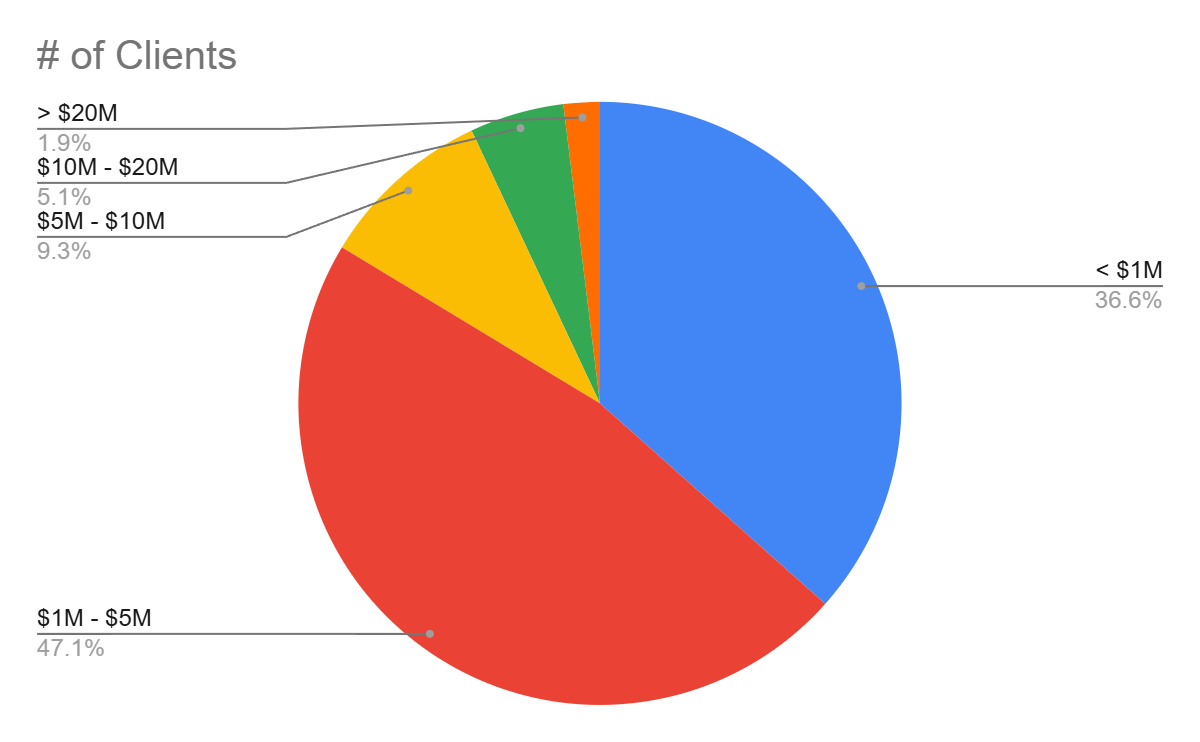
It is evident that there is a heavy concentration of clients with enterprise value between $1M - $5M. This is the group that needs to either grow or go, but don’t want to be hasty in dismissing because they can fill the next tiers eventually (the < $1M in value is a complete pricing conversation).
So then, take that $1M - $5M group and segment it by CAGR and valuation total. This will show which businesses are nearing the next tier and which ones are growing the fastest. Its the ones that aren’t growing that have to go. Plot these two elements on a graph to help you pinpoint the top 20% of your clients who represent the best opportunities for additional services/fees.
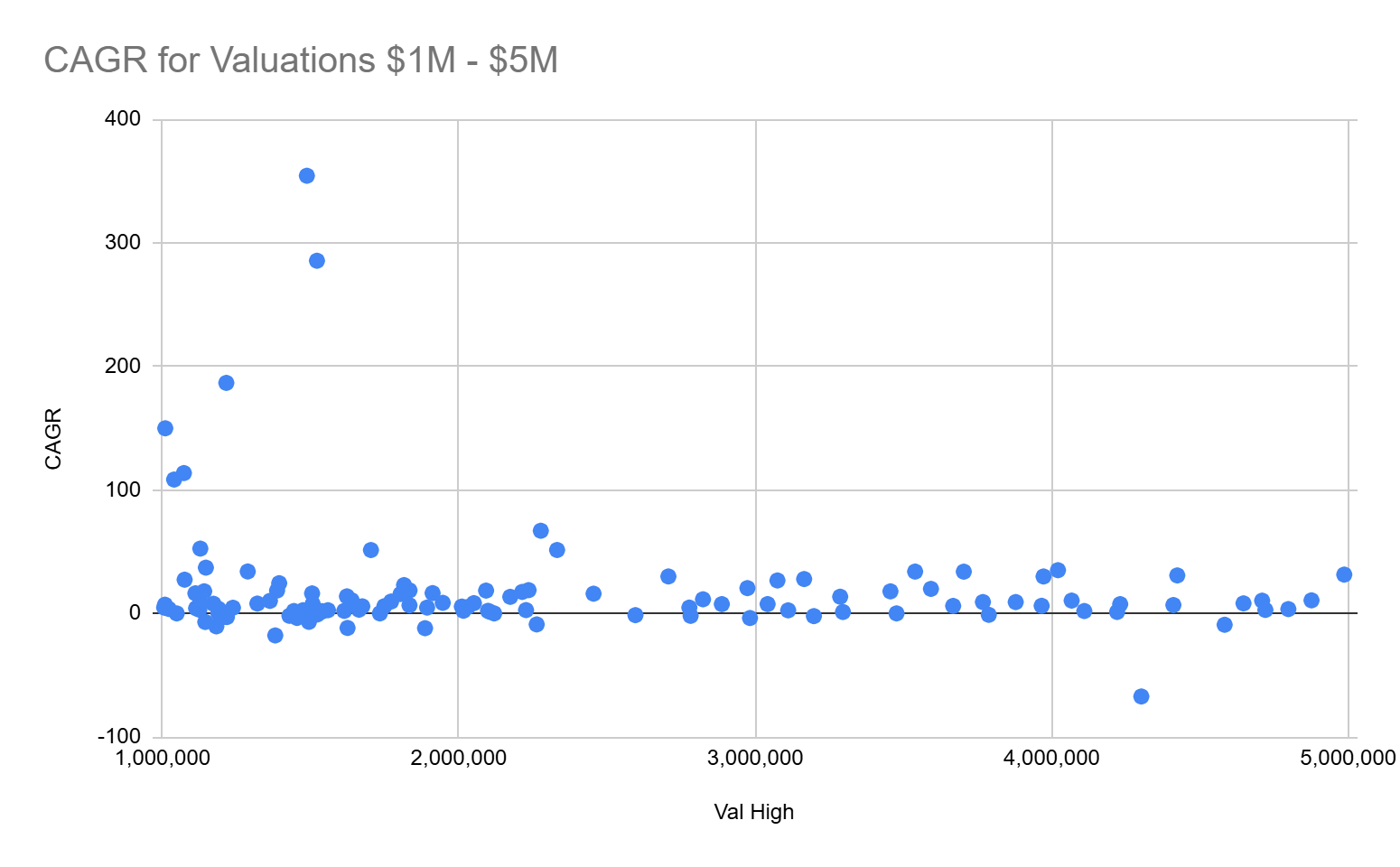
Relationship management has a fixed cost component, so focusing on clients who already engage with multiple services—or who can be encouraged to do so—yields higher profitability without dramatically increasing administrative costs.
Turning Insights into Action\
Once you’ve identified your high-growth clients, it’s time to develop a tailored strategy to maximize their potential. Start by plotting your clients on a two-dimensional graph:
For these clients, create customized account plans that outline:
1. **Cross-Selling Opportunities**: Identify gaps in their current service portfolio and propose additional solutions tailored to their needs.
2. **Strategic Engagements**: Schedule regular check-ins and strategic reviews to discuss growth goals and how your services align with their objectives.
3. **Upsell Potential**: Highlight premium packages or advisory services that could provide even greater value to the client while increasing your revenue.
Growing Your Practice from the Inside Out\
By focusing on high-potential clients within your existing book, you can unlock significant growth with less effort than chasing new business. This approach allows you to retain control over your client base, deepen relationships, and create a stable foundation for long-term success.
With the right analysis and strategic account planning, you might find that your next “A” client is already in your portfolio—just waiting to be nurtured.
*Author: Dave Bunce*
# Unveiling the Hidden Treasure: Discovering Non-Operating Assets
> Discovering a business's non-operating assets is a critical step in understanding its true financial strength and potential.
Identifying and understanding a company’s non-operating assets can be the key to unlocking hidden potential and ensuring a solid financial footing. Non-operating assets, which encompass everything from real estate properties to luxury vehicles, hold immense value for businesses, especially when planning an exit strategy. interVal helps you discover which clients have the highest levels of non-operating assets so you can quickly identify how your clients can benefit from an updated tax structure and strategic extraction of these assets, particularly if an exit is on the horizon.
Non-operating assets refer to assets that do not directly contribute to a company’s core business operations. Instead, they are surplus assets or investments that generate income or hold value over time. Common examples include real estate, investments, luxury vehicles, and more. Identifying and understanding these assets can be crucial to a business’s financial health and overall success.
**The Importance of Discovering Non-Operating Assets**
Accurate Financial Picture: Knowing the full extent of non-operating assets provides a more accurate and comprehensive view of a company’s financial standing. This information can be critical for decision-making, attracting investors, and securing loans or credit lines.
Maximizing Tax Efficiency: An updated tax structure that takes into account non-operating assets can lead to significant tax savings. Certain non-operating assets may be eligible for favourable tax treatment or depreciation deductions, reducing the overall tax burden for the business.
Strategic Resource Allocation: Understanding non-operating assets allows businesses to allocate resources more efficiently. By leveraging these assets, companies can diversify revenue streams and pursue growth opportunities in different sectors.
Strengthening the Balance Sheet: Non-operating assets can bolster a company’s balance sheet, improving its financial ratios and creditworthiness. This, in turn, can enhance the business’s reputation and attract potential partners or buyers.
**Extracting Non-Operating Assets for Future Success**
As an exit strategy approaches, businesses can benefit from strategically extracting certain non-operating assets:
Real Estate: Selling or leasing unused or underutilized real estate holdings can inject capital into the business while reducing the burden of maintaining such properties to free up funds for core operations or expansion. Real estate that is owned by a holding company is typically more tax-efficient, and is better protected in the event that an operating company experiences financial difficulties.
Luxury Vehicles and High-Value Assets: If these assets are not essential for daily business operations, their sale can provide a significant cash injection. Furthermore, downsizing the fleet or opting for more cost-effective options can reduce ongoing expenses, while better preparing a company for a potential sale or exit.
Investments: Reevaluating and potentially divesting non-core investments can lead to a more streamlined and focused investment portfolio. This approach can strengthen the business’s financial position and demonstrate better use of capital to potential investors while potentially achieving tax savings.
Discovering a business’s non-operating assets is a critical step in understanding its true financial strength and potential. By recognizing the value of these assets and optimizing their utilization, businesses can benefit from an updated tax structure, enhanced financial efficiency, and increased liquidity. When planning for an exit strategy, the strategic extraction of non-operating assets can significantly improve the company’s position, making it more attractive to potential buyers or investors. Overall, identifying and leveraging non-operating assets can pave the way for long-term success and financial stability in the ever-evolving business landscape.
# Unveiling the True Meaning of Insights
> Unveiling the true meaning of insights and how interVal addresses the challenges faced by business owners and advisors.
In his thought-provoking article, “[Insight, the Overused and Misunderstood Buzzword](https://www.linkedin.com/pulse/insight-overused-misunderstood-buzzword-paddy-rangappa/),” Paddy Rangappa discusses the diminishing value of buzzwords, with a particular focus on the term “insight.” Rangappa highlights that while data overload was once an obstacle to decision-making, today’s surplus of data has led to a new problem. Businesses are replacing data and information with the buzzword “insights,” without truly grasping its essence. Rangappa emphasizes that insights go beyond mere facts or findings and require a deeper understanding of the underlying truths discovered through data analysis.
We will delve into the concept of insights and explore how interVal aims to address the challenges faced by business owners and their advisors.
**The Need for Insights:**
interVal’s mission centres on improving financial outcomes for business owners by offering tools to monitor their business health efficiently, allowing them to focus on running their businesses. Simultaneously, interVal recognizes that analyzing business health data can provide valuable guidance to advisors, enabling them to enhance and safeguard their SMB clients’ financial success.
**Unveiling Meaningful Patterns:**
Drawing from anonymized data collected from 1,000 SMBs across various industries, several patterns emerge. However, it is crucial to differentiate between raw data and actual insights. The following examples showcase data that has been processed to reveal potential signals of significance:
1. \*\*Debt Serviceability:\
\*\*Through debt to equity ratios and serviceability calculations, interVal discovered that nearly 81% of business owners could service a bank loan of $10,000 or more. These 810 businesses collectively could safely service loans exceeding $750,000,000, with an average loan amount of over $925,000. While this data suggests an opportunity for providing debt instruments to businesses, further exploration is needed to confirm the significance of these findings.
2. \*\*Excess Cash and Non-operating Assets:\
\*\*Among the 1,000 randomly selected businesses, interVal found that 46% possessed over $200,000 in non-operating assets, primarily excess cash. The average non-operating asset size among this group was $988,000. These findings support the notion that SMBs often concentrate on day-to-day operations and may not leverage opportunities that exist beyond their immediate focus.
3. \*\*Monitoring Business Health:\
\*\*Businesses that actively monitor their underlying health experience faster growth rates and build stronger enterprises compared to those that neglect this aspect. interVal’s analysis reveals average year-over-year enterprise valuation growth rates of 29% for businesses monitored annually, surpassing typical SMB growth rates of 8-12%. This underscores the importance of measuring and managing key metrics to drive positive outcomes.
**Seeking Insights:**
To glean deeper insights or underlying truths from the collected data, let’s explore three known facts:
1. SMBs are accumulating excess cash without utilizing it effectively for tax mitigation or wealth generation.
2. Many SMBs qualify for additional loans but are either unaware, uninterested, or not considering the option.
3. SMBs that monitor their business health consistently achieve superior growth and build stronger businesses.
Hypothesizing from these facts, we may deduce that SMB owners are too consumed with day-to-day operations or lack the expertise to address these opportunities. However, if this hypothesis holds true, why aren’t knowledgeable entities such as banks, credit unions, and accountants proactively providing the necessary advice and products? The answer lies in two key challenges: limited time and lack of visibility.
The true insight lies not in the existence of data or the misapplication of the term “insights” but in recognizing the significance of this data. It unveils a pressing issue—the finite nature of time and limited capacity. This problem affects everyone involved. SMBs are unable to achieve optimal financial outcomes, while their advisors remain constrained by time and resources, because of attrition within the industry.
**Looking Beyond Buzzwords:**
As the evolution progressed from the need for “data” to the demand for “insights,” it is essential to consider what lies ahead. True insights are not mere replacements for the word “data” but rather conclusions drawn from interpreting and synthesizing relevant data points. It is our responsibility to leverage these insights, combining them with other pertinent information, to drive the industry forward.
# Using Automation to Get the Most out of Annual Client Reviews
> By making the most out of ACRs, you ensure long-term relationships with your SMB clients — resulting in sustainable mutual growth.
Annual Client Reviews (ACR) provide an opportunity to showcase the expertise and value of your financial services — while focusing on mutual financial growth. [Jackson and Greenwald’s study](https://www.jackson.com/pdf/ccr/cmv25696.pdf) on Annual Reviews found that **93%** of investors believe that these reviews are very to extremely important.
In this blog, we’ll explore strategies to ensure you make the most out of ACRs by incorporating automation into your processes.
## Leverage Automation for Prep Work
[Section titled “Leverage Automation for Prep Work”](#leverage-automation-for-prep-work)
Before engaging your clients in ACRs, ensure that your prep work is customized for each client. This involves not only analyzing their financial portfolio but also staying updated on market trends, economic conditions, and relevant regulatory changes within the SMB’s industry. Having a detailed understanding of your client’s financial goals and risk tolerance enables you to tailor advice and recommendations accurately.
The challenge, however, is to easily access and analyze this deep understanding for individual SMB clients. Automation is the best solution in this case. For example, by having your clients sync their SMB’s financial data with interVal, you gain instant access to actionable insights and opportunities. These industry-benchmarked opportunities are [tailored](/insights/tailored-financial-advice/) to their business needs, and help you advise them to optimize their business finances.
This ensures that discussions during the review are not only informed but also proactive in addressing potential challenges or opportunities. It also enhances the client’s perception of your commitment to their financial success.
## Visualized Financial Insights for Discussion
[Section titled “Visualized Financial Insights for Discussion”](#visualized-financial-insights-for-discussion)
Utilizing visual data analytics can help you present a comprehensive overview of your SMB client’s financial performance, investment potential, and loan capacity. [Visualized data](https://blog.csgsolutions.com/15-statistics-prove-power-data-visualization) is simple to understand, especially when navigating through financial trends. Equipped with accurate and digestible information, your clients feel empowered to make informed decisions that can help them grow their businesses.
This not only adds a layer of transparency to the ACR process but also empowers clients to actively participate in shaping their financial future.
## Empower SMBs to Grow
[Section titled “Empower SMBs to Grow”](#empower-smbs-to-grow)
Empowering clients with automation makes the Annual Client Review effective and positively impacts your long-term relationship. By having access to [visualized benchmarked ratios](/insights/getting-the-most-out-of-key-metrics/), and valuation insights, business owners feel confident in making revenue-generating decisions, and your team can discuss opportunities linked to investments and loans to create growth strategies for SMB clients.
ACRs can be viewed as an educational experience for business owners. Financial insights and opportunities can be complex, but with the help of financial advisors armed with automation, the task can be efficient. Informed clients are more likely to be engaged in the growth of their business, and are more likely to refer others to proactive financial advisors.
[Book a demo](/overview/get-started/) with us and learn how you can use automation to empower your SMB clients and grow together with them.
# Turning Business Valuation into a Growth Strategy
> Learn how wealth management firms can use business valuation insights to better serve SMB owners. Discover strategies to turn valuation into a growth opportunity.
In my years as a marketing executive I’ve seen how the right tools can transform the way businesses connect with their clients. At interVal, we’re helping wealth management firms do just that by using business valuation insights to better serve SMB owners. This isn’t just about data—it’s about creating deeper connections, offering unique value, and positioning your firm as a proactive partner. This is the first in a series exploring how to tactically incorporate interVal’s tools to make business valuation a unique selling point and a marketing advantage. Let’s dive in.
**Implement Valuation-Based Touchpoints in Client Communications**Proactively reach out to your clients to review interVal’s valuation insights. These touchpoints can serve as ongoing engagement points that show your firm is consistently monitoring their financial interests.
**Create an Educational Campaign on Business Valuation for SMB Owners**Develop a content series—blogs, emails, or webinars—on the importance of knowing business value, and why it matters in financial planning. Emphasize how this insight can impact insurance needs, succession planning, and overall wealth management. This educates and positions your firm as a trusted partner, building credibility and engagement with prospective clients.
**Offer Personalized Valuation Reports as a Lead Magnet**Use interVal’s valuation data to create tailored, simplified valuation reports for prospective clients. This can be a powerful lead-generation tool on your website or through your social channels. When business owners see your ability to provide this personalized service, it establishes your firm as knowledgeable and proactive.
Using interVal for business valuation insights positions your firm as a proactive, engaged partner for SMB owners. Each valuation update and communication reinforces your brand as a client-focused, data-driven advisor—a firm that business owners can rely on to guide them at every stage.
*Author: Karen Chalmers*
# Valuation Is Your Unfair Advantage—If You Use It
> Unlock your competitive edge. Real-time valuation drives strategy, reveals opportunity, and makes you indispensable to business owner clients.
Every advisor *says* they’re different. Few actually are.
You want to stand out? Start by showing business owners something no one else is showing them: not just what their business is worth today—but how that number shifts, grows, and responds to their decisions in real time.
That’s not a pitch. It’s a paradigm shift.
Valuation used to be a one-and-done event. You got one for sale. Maybe for litigation. Maybe for a loan. It was reactive, expensive, and slow. And it told a story that was already over.
Not anymore.
Automated valuation is always on. It doesn’t wait for a liquidity event—it drives toward it. It gives advisors and their clients a living, breathing view of the business’s true performance and trajectory.
This isn’t just a report. It’s a catalyst.
### **Lead With Valuation. Drive the Planning.**
[Section titled “Lead With Valuation. Drive the Planning.”](#lead-with-valuation-drive-the-planning)
When you lead with valuation, you flip the script. You’re no longer an advisor who shows up after decisions have been made. You become the one who informs the strategy *before* they’re made.
That’s a seat at the table that’s earned—not granted.
And once you’re there, everything changes.
Business owners don’t just want to *see* value. They want to *build* it. They want to see how a hire, a new contract, or an expansion plan shifts their net worth. Valuation gives you the language to translate day-to-day decisions into long-term impact.
That’s the unfair advantage.
### **Valuation Is a Lens. Use It Relentlessly.**
[Section titled “Valuation Is a Lens. Use It Relentlessly.”](#valuation-is-a-lens-use-it-relentlessly)
This isn’t about a number. It’s about what that number reveals.
Valuation shines a spotlight on what’s working—and what’s not.
It uncovers blind spots in insurance coverage.\
It exposes weak links in succession plans.\
It raises red flags in tax strategy, retirement planning, and partnership dynamics.
And it does all of it without guesswork. Just clean, defensible, real-time data.
That data becomes your anchor. It turns every meeting into a high-stakes, high-value conversation—because now, you’re tracking something that matters. Not market noise. Not generic KPIs. But the owner’s legacy. Their identity. Their exit.
### **Show Up More. Say More. Drive More.**
[Section titled “Show Up More. Say More. Drive More.”](#show-up-more-say-more-drive-more)
Valuation earns you a reason to reach out. Not once a year. Not “when something changes.” But regularly—with purpose.
Meetings shift from check-ins to strategy sessions.
Because now you’ve got progress to show. Gaps to close. Opportunities to unlock.
Every number gives you a new angle:
* Is it time to revisit the buy-sell agreement?
* Are we protecting against overexposure in a potential exit?
* Is the business ready to support the retirement timeline?
You’re not waiting for life to happen. You’re shaping what comes next.
### **Advisors Who Use Valuation Don’t Just Win Business—They Keep It**
[Section titled “Advisors Who Use Valuation Don’t Just Win Business—They Keep It”](#advisors-who-use-valuation-dont-just-win-businessthey-keep-it)
Business owners talk to a lot of advisors. But they remember the one who helps them *move*.
If you can connect their business’s trajectory to their personal goals—consistently, clearly, and with authority—you stop being one of many. You become indispensable.
You’re not there to react. You’re there to drive.
Valuation is your access point. Your differentiator. Your momentum builder.
So stop talking about value. Start proving it.
Make valuation your standard. Not your exception.
# Valuation: More Than an Exit Strategy
> Discover why business valuation is more than an exit strategy—it's a powerful tool for ongoing business health, smarter decisions, and long-term growth.
A Barometer of Business Health
When business owners think about valuation, their minds often jump to one major milestone: selling their company. While understanding a business’s value is crucial during an exit, limiting valuation to this moment overlooks its true potential as an ongoing tool for business health. As advisors, we have a unique opportunity to help clients see valuation as a metric that empowers them to make smarter decisions, seize growth opportunities, and navigate challenges with confidence.
Here’s why every business owner should know their number and how you, as an advisor, can guide them toward success by shifting the focus from exit planning to everyday strategy.
Valuation as a Business Health Check\
A business’s valuation tells a powerful story. It’s not just a number; it’s a reflection of the company’s financial health, operational efficiency, and market position. Regularly revisiting this number provides business owners with critical insights into areas of strength and opportunities for improvement.
Advisors who position valuation as a recurring conversation, rather than a one-time event, help clients make proactive, data-driven decisions that support long-term growth.
Breaking the Misconceptions Around Valuation\
Many business owners view valuation as something they only need when selling their business. This mindset can be limiting—and even dangerous. Without regular updates, owners risk being blindsided by financial realities they didn’t see coming.
The truth is, valuation is much more than a selling tool. It’s a barometer for understanding where the business stands today and where it’s headed tomorrow. By changing the narrative, we can help business owners:
* **Reframe Their Perspective:** Valuation isn’t just about preparing for an exit—it’s about knowing the true value of what they’ve built and ensuring they’re making the most of it.
* **Feel Empowered, Not Overwhelmed:** For many owners, the numbers can feel intimidating. As advisors, we have the chance to demystify the process and show how understanding valuation can unlock opportunities.
* **Plan for the Future:** Whether it’s scaling their business, transferring ownership to the next generation, or simply optimizing operations, knowing their number puts owners in the driver’s seat.
**The Advisor’s Role in Shifting the Conversation**\
As an advisor, you play a pivotal role in helping business owners embrace valuation as a recurring metric. Here’s how you can support your clients:
* **Introduce Valuation as a Health Metric:** Frame valuation as part of their regular financial check-ups, just like reviewing cash flow or profitability. Explain that it’s not just about exits but about planning for growth, resilience, and long-term success.
* **Leverage Technology:** Tools like interVal make it easier than ever to provide ongoing valuation insights. These platforms streamline the process, giving you and your clients a clear, actionable picture of their business value.
* **Tie Valuation to Their Goals:** Whether it’s expanding operations, attracting investors, or transitioning leadership, show how valuation insights can directly support their objectives.\
Be a Trusted Partner: By consistently incorporating valuation into your advisory services, you position yourself as a forward-thinking partner invested in your client’s success.
**The Real Impact of Knowing the Number**\
For many business owners, their company is more than a job—it’s their legacy. It represents years of hard work, sacrifice, and dedication. Helping them understand their number isn’t just about finances; it’s about empowering them to protect and grow what they’ve built.
By viewing valuation as an ongoing conversation, you’re giving your clients the tools they need to:
* **Make Informed Decisions:** From expanding operations to cutting costs, valuation provides a clear lens for evaluating options.
* **Seize Opportunities:** Whether it’s attracting investors or exploring acquisitions, a strong understanding of business value opens doors.
* **Navigate Challenges:** When unexpected events arise, having a clear grasp of valuation ensures owners can respond effectively.
Valuation isn’t just for exits—it’s a critical part of every business owner’s toolkit. As advisors, we have the opportunity to shift the narrative and show our clients that knowing their number is about more than preparing for the end; it’s about building a stronger future.
Are you ready to help your clients unlock their potential? Reach out today and let’s talk about how valuation insights can drive smarter growth, better planning, and lasting success.
# Key Metrics: Visualize Performance Evaluation
> Unlock the power of automation to elevate forecasting accuracy, turn data into actionable strategies, and advise your clients successfully.
As an advisor, you understand that insights derived from the historical performance of a business are paramount for informed decision-making. You’re also aware that manually analyzing this historical data and converting it into actionable steps is a time-consuming activity. interVal helps you dive deep into the financial intricacies of your clients’ company over a 5-year period with just a few clicks.
This ability to assess trends and invaluable insights therein helps you identify patterns, anticipate opportunities, and pinpoint areas of growth. You’re not just viewing numbers — you’re unlocking automated [Key Metric](/insights/getting-the-most-out-of-key-metrics/) trends that empower you to make decisions grounded in a thorough understanding of the past
## Elevating Performance through Automated Benchmarked Ratios
[Section titled “Elevating Performance through Automated Benchmarked Ratios”](#elevating-performance-through-automated-benchmarked-ratios)
interVal’s ratio benchmarking feature visualizes your SMB client’s financial performance over a period of 5 years. This quick snapshot gives you the ability to explore business functions and any opportunities that lie within. Through this evolution of benchmarked ratios, you also get a glimpse into the company’s financial health. This not only enhances the accuracy of your advisory services but also enables more strategic and informed planning.
## Actionable Insights: Transforming Data into Opportunities
[Section titled “Actionable Insights: Transforming Data into Opportunities”](#actionable-insights-transforming-data-into-opportunities)
Actionable insights derived from your SMB client’s data through automation increases your capacity — you can spend time with more clients, and more time with each of those clients. interVal essentially transforms their data into insights. As an advisor in an accounting firm or financial institution, you can leverage these insights to guide your clients toward opportunities that lie within reach in their respective industries.
## Transparency in Performance Evaluation
[Section titled “Transparency in Performance Evaluation”](#transparency-in-performance-evaluation)
interVal helps you make efficient use of your SMB client’s financial data by visualizing benchmarked ratio trends. This can also help you visualize your advice to your clients if need be. By combining your advice with visual trends, greater transparency is added to your advisory service. It becomes quicker and easier for you and your business owners to explore opportunities and discuss actionable strategies.
## A Transformative Future for Advisors
[Section titled “A Transformative Future for Advisors”](#a-transformative-future-for-advisors)
In a world driven by insights, the role of advisors in accounting firms and financial institutions is transforming. Automation has become more than a tool today — it’s a necessity that creates capacity and capitalizes on growth opportunities. From visualizing historical insights to providing actionable strategies, interVal helps you streamline your deliverables and saves time. The best way to find out how interVal can help your firm is by [booking a demo](/overview/get-started/) with us.
# Visualizing Advisory Matters to Small Business Clients
> Discover how accounting firms, banks, and wealth management firms can enhance their advisory services to SMB clients through visualization. Explore how adopting advanced tech tools can create a win-win scenario for advisors and clients, driving informed decision-making and foster long-term partnerships.
In the dynamic landscape of business, small enterprises often face numerous challenges in making informed decisions. Accounting firms, banks, and wealth management firms play a pivotal role in guiding these businesses toward financial stability and growth. One effective approach that these institutions can adopt is visualizing advisory services. This technique not only enhances the clarity of complex financial data but also significantly improves client understanding and decision-making. Here’s why visualizing advisory matters to your small business clients and how it benefits accounting firms, banks, and wealth management firms.
Simplifying Complex Information\
Visualizations, such as graphs, charts, and infographics, transform complex data into easily understandable formats. Presenting data visually can demystify reports, making it easier for clients to grasp their current financial standing and future projections. This simplification builds trust and ensures clients can make informed decisions without feeling overwhelmed by technical jargon.
Improving Client Engagement\
Visual content is inherently more engaging than text-heavy reports. Accounting firms, banks, and wealth management firms that utilize visual advisory tools can capture and retain their clients’ attention more effectively. Engaged clients are more likely to participate actively in financial planning sessions, ask pertinent questions, and seek further advice. This heightened engagement fosters stronger client relationships and increases the likelihood of long-term partnerships.
Facilitating Better Communication\
Communication is key in any advisory relationship. Visualizations bridge the gap between financial experts and small business owners by providing a common language that both parties can understand. Effective communication through visuals ensures that clients fully comprehend the advice being offered.
Building Trust and Transparency\
Trust is the cornerstone of any advisory relationship. Visual advisory tools promote transparency by presenting data in a straightforward and accessible manner. Small business clients can see for themselves the rationale behind specific recommendations. For accounting firms, banks, and wealth management firms, this transparency enhances credibility and reinforces the clients’ trust in their expertise.
Encouraging Proactive Financial Management\
Visualizing financial data can motivate small business clients to take a more proactive approach to their financial management. When clients can see the impact of their decisions and track their progress visually, they are more likely to stay engaged and committed to their financial goals. Accounting firms can use visual tools to set benchmarks and track performance, encouraging clients to take timely actions. Similarly, banks and wealth management firms can use visualizations to highlight the benefits of certain financial strategies, prompting clients to act proactively.
Streamlining Advisory Processes\
For advisory firms, visual tools can streamline the advisory process by making it easier to prepare and present reports. Instead of compiling lengthy documents, advisors can create visual summaries that convey the same information more efficiently. This not only saves time but also ensures that the advisory sessions are more focused and productive.
Adapting to Technological Trends\
The financial industry is rapidly evolving, with technology playing a significant role in shaping advisory services. Visual advisory tools, powered by advanced software and data analytics, represent the future of financial advisory. By adopting these tools, accounting firms, banks, and wealth management firms can stay ahead of the curve and offer cutting-edge services to their clients. Small business clients, in turn, benefit from the enhanced capabilities and insights that modern technology provides.
Visualizing advisory services is not just a trend; it’s a necessity for accounting firms, banks, and wealth management firms aiming to deliver exceptional value to their small business clients. By adopting tools like [interVal](/insights/what-is-interval/) that help simplify complex information, enhance decision-making, and build trust, you can create a win-win scenario for both advisors and clients. Embracing these tools will undoubtedly lead to more informed, empowered, and successful small businesses, thereby contributing to a robust and thriving economy.
# Wealth Management’s Turning Point: What 2025 Showed Us and What 2026 Will Demand
> Wealth advisors gained clarity in 2025. In 2026, turning visibility into business value becomes essential for deeper planning, stronger advice & client growth.
As 2025 wraps, one thing is clear: this was the year wealth management changed.\
Business owners did not just want investment guidance. They wanted advisors who understood their business, the asset that defines their net worth and shapes their future.
The firms that grew fastest in 2025 were the ones that stepped into that role: advisors with visibility, data, and the confidence to guide clients long before major decisions hit.
#### What 2025 Made Impossible to Ignore
[Section titled “What 2025 Made Impossible to Ignore”](#what-2025-made-impossible-to-ignore)
##### **1. Visibility became the difference-maker**
[Section titled “1. Visibility became the difference-maker”](#1-visibility-became-the-difference-maker)
Advisors who finally gained a clear view into a client’s business performance, valuation, and risk ran better meetings, had stronger conversations, and won more trust.
Firms still guessing or waiting for incomplete financials felt the cost of that gap.
##### **2. Business-owner planning became mainstream**
[Section titled “2. Business-owner planning became mainstream”](#2-business-owner-planning-became-mainstream)
Clients no longer saw personal wealth and business wealth as separate tracks.\
They wanted one plan, one advisor, and one strategy that understood both.
Firms that added valuation, growth analysis, and exit readiness became the natural choice for owners seeking clarity.
##### **3. Outcomes beat opinions**
[Section titled “3. Outcomes beat opinions”](#3-outcomes-beat-opinions)
Owners wanted advisors who could show proof, not possibilities.\
Real valuation movement. Real risk signals. Real planning triggers.\
Data-backed conversation replaced assumption-driven advice.
##### **4. Technology shifted from optional to operational**
[Section titled “4. Technology shifted from optional to operational”](#4-technology-shifted-from-optional-to-operational)
Advisors used automation to free their time.\
They used AI to surface the signals they had previously missed.\
They spent less time preparing and more time advising.
This became the new standard.
#### What 2026 Will Demand
[Section titled “What 2026 Will Demand”](#what-2026-will-demand)
December is not just a marker of what is ending. It is a preview of what’s to come. The firms that expect to lead in 2026 will need to operate differently than they did even one year ago.
##### **1. Advisors must lead earlier**
[Section titled “1. Advisors must lead earlier”](#1-advisors-must-lead-earlier)
Waiting for owners to raise issues will not work.\
Top advisors will spot planning triggers three to five years out and initiate conversations proactively.
##### **2. Business valuation will become a core planning metric**
[Section titled “2. Business valuation will become a core planning metric”](#2-business-valuation-will-become-a-core-planning-metric)
Not an add-on. Not a bonus insight.\
A standard part of every planning conversation.\
You cannot discuss retirement, liquidity, or timing without knowing what the business is worth.
##### **3. Planning and performance must stay connected year-round**
[Section titled “3. Planning and performance must stay connected year-round”](#3-planning-and-performance-must-stay-connected-year-round)
Owners no longer live in annual cycles.\
Markets move daily. Their business does too.\
Advisors who support them continuously, with fresh signals and ongoing visibility, will secure the relationship.
##### **4. Technology will separate firms that scale from those that stall**
[Section titled “4. Technology will separate firms that scale from those that stall”](#4-technology-will-separate-firms-that-scale-from-those-that-stall)
Manual prep and spreadsheet-heavy processes cannot support the advisory demand coming in 2026.\
Automation is not just efficiency. It is capacity. It is speed. It is the foundation for deeper service at scale.
#### Looking Back to Look Forward
[Section titled “Looking Back to Look Forward”](#looking-back-to-look-forward)
2025 was the year wealth management finally aligned with the reality of business owners.\
Personal wealth and business health are not separate conversations.\
They form one financial story that requires one advisor who understands both.
As we enter 2026, visibility is no longer an advantage. It is the cost of entry.
Advisors who embrace it will guide better decisions, build stronger relationships, and grow alongside the owners they serve.
Those who do not will continue reacting to moments they should have seen coming.
# What Business Owners Wish Their Advisors Actually Asked
> Unlock deeper client relationships by focusing on what business owners truly value—their business. Learn how to ask the right questions and deliver meaningful advice.
Imagine sitting across from a business owner and asking, “What’s your portfolio allocation strategy?” Watch their eyes glaze over. Now try, “What’s your biggest challenge in the business right now?” and see the spark return.
**Here’s the truth:** Business owners don’t define their success by stock tickers or benchmark indices. They define it by the health, growth, and future of their business. Their business isn’t just an asset—it’s their identity, their purpose, their legacy. And yet, many wealth advisors still lead with financial jargon that doesn’t reflect that reality.
So, what do business owners *actually* wish their advisors asked?
* “What’s keeping you up at night in your business?”
* “What do you want your business to do for your family, your lifestyle, your legacy?”
* “Have you thought about what your business is worth and how that fits into your personal goals?”
These questions aren’t just better conversation starters—they’re game-changers. They shift the dynamic from advisor-client to strategic partnership. Because when you ask questions that center the business, you acknowledge its importance and value in the owner’s life. That’s where real trust begins.
**Why this matters more than ever**
Today’s business owners are juggling growth plans, operational risks, succession timelines, and retirement dreams—all at once. And most don’t have a clear picture of how it all fits together. They might not even know what their business is truly worth or how that valuation should inform their planning.
This is where proactive, business-savvy advisors shine.
Advisors who confidently guide value-driven conversations open the door to an entire ecosystem of opportunity:
* Insurance planning tied to the business lifecycle
* Risk mitigation strategies aligned with ownership goals
* Succession and exit planning grounded in real valuation data
* Liquidity strategies that bridge business and personal wealth
* Tax-aware investing tailored to ownership events
In short, when you understand the owner’s world, you can serve them better—both personally and professionally. You create space for deeper needs, broader discussions, and smarter long-term strategies.
**Stop leading with portfolios. Start leading with purpose.**
If you’re serious about building relationships with business-owner clients, it’s time to meet them where they are. Understand their world. Speak their language. Focus on the one thing that matters most to them—their business.
And here’s the good news: you don’t have to do it alone.
**interVal makes it easy.**
With interVal, you can access automated, real-time business valuation insights that help you start smarter conversations with your clients. In minutes, you’ll gain visibility into the health, value, and potential of their business—so you can ask the right questions, uncover new planning opportunities, and deliver advice that truly connects.
\*\*Ready to be more than an advisor? Ready to become indispensable?\
\*\*[Let’s talk](/company/contact-and-demo/), and see how we help you unlock deeper value—for your clients and your practice.
# What Clients Want
> Most clients won’t say what they really need—great advisors learn to hear it anyway. Here’s how to become indispensable by listening between the lines.
In *What Women Want*, Mel Gibson’s character suddenly gains the ability to hear what women are really thinking. In other words not what they say, but what’s unsaid, the thoughts behind the words. The emotions behind the decisions.
At first, it overwhelms him. But over time, he learns:
It’s not about offering more. It’s about understanding better.
And that’s the core lesson for accountants, bankers, and wealth advisors today. 80% of clients leave their advisor do so not because of price or performance, but because of a perceived lack of communication or relationship.
Your business owner clients may not always articulate exactly what they need. They’ll ask you to ‘do my taxes’ but what they really want is, Advice. Context. Confidence. They want to be heard, guided, and supported by someone who doesn’t just respond to their requests, but anticipates their needs.
Today’s most valuable advisors aren’t the ones doing more, they’re the ones hearing more. They meet business owners where they are and guide them to where they want to go.
I can speak to this first hand as a former public accountant turned business owner.
1. ###### **What Clients** ***Say*** **They Want**
[Section titled “What Clients Say They Want”](#what-clients-say-they-want)
On the surface, the requests are tactical and specific:
* “I need help reducing taxes.”
* “Can you help me get financing for new equipment?”
These are legitimate asks, but they’re usually symptoms of something deeper.
Clients often approach their accountant or banker with a short-term need, but underneath it is a more strategic or emotional driver: uncertainty about the future, tension with partners, fear of making the wrong move, or anxiety about growth.
2. ###### **What Clients** ***Really*** **Want**
[Section titled “What Clients Really Want”](#what-clients-really-want)
What clients *really* want is harder to articulate because it lives below the surface.
They want:
* **Clarity** on how their business is really doing.
* **Confidence** that they’re making smart, well-timed moves.
* **Visibility** into the future, not just a snapshot of the past.
* **A thinking partner** who helps them feel less alone in high-stakes decisions.
According to a 2023 survey by [Intuit](https://accountants.intuit.com/taxprocenter/advisory-services/how-to-choose-the-advisory-services-you-should-offer-to-clients/), 86% of small business owners said they want their accountant to be a strategic advisor, not just a compliance provider. Yet only 26% feel they’re getting that today.
The gap isn’t about skill, but rather it’s about *approach*.
3. ###### **What Modern Advisors Do Differently**
[Section titled “What Modern Advisors Do Differently”](#what-modern-advisors-do-differently)
Modern advisors don’t wait for the client to ask. They translate financial data into actionable direction. And they meet business owners in the middle, between personal emotion and business logic.
These advisors:\
✅ Talk about margins and revenue trends before the client asks.\
✅ Surface insights not just from financials, but from patterns.\
✅ Ask questions that go beyond numbers: “What’s your succession plan and timeline?”\
✅ Use tools like [**inter-Val**](/pages/home/) to bring recurring visibility into business performance — helping owners *see* what’s happening in time to do something about it.
That’s the power of platforms like interVal: they make it easy for advisors to move from reactive to proactive, turning raw financials into meaningful conversations. A systemized way to deliver what clients actually value. interVal acts like a GPS for business performance: it tells you *where you are*, *where you’re heading*, and *how to course-correct*.
4. ###### **How to Put This Into Practice**
[Section titled “How to Put This Into Practice”](#how-to-put-this-into-practice)
Whether you’re an accountant, banker, or advisor, here’s how to better hear what your clients *really* want:
1. **Create recurring touch points** — not just tax season or when they reach out.
2. **Standardize your insights delivery** — use tools like interVal to turn data into consistent, client-friendly updates.
3. **Ask better questions** — “What’s keeping you up at night?” will unlock more than “Do you want to discuss your financials?”
4. **Step into their shoes** — consider how the financials feel, not just what they say.
5. **Be a translator, not just a technician** — clients don’t want the P\&L; they want to know what the P\&L means.
In the movie, Mel Gibson’s character learns that listening is what builds trust, connection, and influence.
The same is true in advisory. It’s not just about hearing your clients, it’s about understanding what they *mean*, even when they don’t say it out loud.
And if you can deliver that? You won’t just be their accountant, banker or wealth advisor.
You’ll be their most trusted advisor.
*Author: Dave Bunce, CPA, CA*
# What Gets Measured Gets Managed
> Measurement allows for the opportunity to manage based on the information or data provided back to you. Continuous management - assuming you’re measuring the right things - results in a higher likelihood of goal achievement.
One word can make all the difference. One word can change the tone of a sentence or even drastically change the intent of the message. We’ve all heard the saying “what gets measured gets done,” but historically the quote is attributed to Lord Kelvin and it is much more helpful, poignant, and accurate. Abbreviated, Kelvin said “what gets measured gets *managed.”* Why does this matter so much?
Well, first off, just because you measure something doesn’t mean it automatically ends up where you want it to. Measurement allows for the opportunity to *manage* based on the information or data provided back to you. Continuous management - assuming you’re measuring the right things - results in a higher likelihood of goal achievement. Why? Because as Ruth Henderson states in her Forbes [article](https://www.forbes.com/sites/ellevate/2015/06/08/what-gets-measured-gets-done-or-does-it/?sh=1d08209113c8), “measuring something gives you the information you need in order to make sure you actually achieve what you set out to do.”
Business owners and entrepreneurs are the ideal persona to use this continuous interaction between measurement and management that Kelvin spoke about. [Research shows](https://www.hbs.edu/faculty/Pages/item.aspx?num=36319) “the ‘desire to win’ … is heightened when rivalry and time pressure coincide”. When pressure and a rivalry are present - within yourself or with others - you want to win and beat your goals. Absent measurement, you cannot determine whether you have won and, therefore, you have less motivation to win.
Building a business is hard and there is only so much time. Relying on feedback and creating built-in measurement so that you can manage accordingly allows a business owner to spend the time doing what they do best, while receiving a real-time report card along the way. That is why we have given you, the business owner, the power to set your valuation goals to measure and manage your most important asset: the business itself.
The “done” is simply the result. The measurement and management is the process that gets you there.
# What Happens When a $3M Client Walks Into Your Office, and You’re Not Ready
> What happens when a $3M business owner walks in—and you’re not ready? Learn how to lead with valuation and win the clients others miss.
A $3 million business owner just walked into your office. You’ve got five minutes—maybe less—to prove you’re worth their time.
Lead with market talk, and you’ve already lost.
Because here’s the truth: their biggest asset isn’t an ETF. It’s their business. And if you’re not ready to talk about it—the value, the growth potential, the succession roadmap—someone else is.
### **You Don’t Get a Second Shot**
[Section titled “You Don’t Get a Second Shot”](#you-dont-get-a-second-shot)
Business owners don’t need a crash course in portfolio theory. They need real answers to questions that actually matter to them:
* *What’s my business worth today?*
* *What could it be worth in five years?*
* *How does this tie into my retirement, estate plan, and tax strategy?*
If your answer is “we’ll figure that out later,” you’re done.
### **This Is Where Most Advisors Fail**
[Section titled “This Is Where Most Advisors Fail”](#this-is-where-most-advisors-fail)
Too many advisors default to traditional wealth frameworks. They start talking about IRAs, asset allocation, and tax-loss harvesting—while the biggest driver of their client’s wealth sits completely ignored.
It’s not just tone-deaf. It’s a missed opportunity.
And the worst part? That owner won’t say anything. They’ll smile, nod, and never come back.
### **Business Owners Are Operating on a Different Frequency**
[Section titled “Business Owners Are Operating on a Different Frequency”](#business-owners-are-operating-on-a-different-frequency)
They’re scanning for relevance. For someone who *gets* what they’ve built—and what’s at stake.
They don’t want a generalist. They want a specialist who understands how business equity drives personal wealth. Someone who speaks their language. Someone who brings insight on day one.
That’s not just valuable. That’s unforgettable.
### **What Being Ready Actually Looks Like**
[Section titled “What Being Ready Actually Looks Like”](#what-being-ready-actually-looks-like)
It’s not a nicer office. It’s not a tighter pitch.
It’s coming to the table with tools, insights, and a framework built for business owners:
* You ask what their business is worth—and you have a plan to find out.
* You link business valuation to personal goals, family legacy, and future liquidity.
* You show how that number changes with every decision they make—from growth to exit.
* You don’t just talk about wealth. You talk about how they *create* it.
### \*\*This Is the New Standard
[Section titled “\*\*This Is the New Standard”](#this-is-the-new-standard)
\*\*
interVal puts business valuation and owner readiness at the center of your client conversations. Automatically. Continuously. No guesswork. No spreadsheets. No waiting until “someday.”
With interVal, you show up prepared—every time a business owner walks through your door.
### **Here’s the Bottom Line**
[Section titled “Here’s the Bottom Line”](#heres-the-bottom-line)
Business owners want guidance that reflects the full picture.
They’re looking for someone who can connect the dots between what their business is *worth today* and what it could unlock tomorrow.
Miss the mark, and that $3M client walks out and into the office of someone who does it better.
Hit the mark, and you become their inner circle—the advisor who actually gets them. The one they trust when the stakes get high and the numbers get real.
**Advisors who are ready win. Those who aren’t? They get left behind.**
# What is interVal?
> interVal is a platform designed for advisors, to automate processes, create capacity, and unlock growth for their SMBs.
Accounting and financial advisors always face these two common dilemmas — there’s too much data and yet, not enough insights. And, if you spend too much time uncovering insights, there’s not enough time to spend with clients. From its inception, interVal’s vision has been to help advisors spend more time with their SMBs rather than their financial statements.
interVal bridges the gap between data and advisory. To put it in one oversimplified sentence, interVal automatically ingests your clients’ financial statements and provides actionable insights. But, we need to dig deeper to fully comprehend how empowering it can be.
## What Does interVal Do For You?
[Section titled “What Does interVal Do For You?”](#what-does-interval-do-for-you)
interVal primarily does three things for you:
* [Automates Discovery](/insights/the-art-of-automated-discovery/)
* Creates Capacity
* Unlocks Growth
For any Client Advisory Service (CAS) practitioners, ‘creating time’ drives growth. That’s precisely what you get with interVal. Automation helps you automate discovery so that you can spend more time advising, thereby creating more opportunities for more SMBs.
## How Does interVal Do it?
[Section titled “How Does interVal Do it?”](#how-does-interval-do-it)
interVal syncs with your SMB client’s financial statements via QuickBooks, Xero, or Sage and analyzes available financial information to visualize benchmarked ratios, [key metrics](/insights/getting-the-most-out-of-key-metrics/), and [valuation](/insights/business-valuation-more-than-just-a-multiplier/). These five-year-period visual trends combined with suggested actionable insights arm you with instantly available opportunities for your clients. That’s it — simple and effective.
## Can it Do More?
[Section titled “Can it Do More?”](#can-it-do-more)
interval is an advisory ecosystem for its partners, from a quick snapshot of a company’s valuation to benchmarked ratios and automated discovery. Backed by AI and machine learning, interVal has become an integral part of client advisory, automation is no longer a luxury — it’s a must-have.
## The Future of interVal
[Section titled “The Future of interVal”](#the-future-of-interval)
If you’ve made it this far into the blog, we’ll share a secret with you. Remember how we mentioned at the start that ‘vision has been to help advisors spend more time with their SMBs rather than their financial statements — well that’s just part of it. interVal’s true vision is to help SMBs grow.
CAS practices are all about helping clients grow. That in return positively affects the growth of all stakeholders. interVal’s ultimate aim is to create a continuous loop where it caters to the pain points of SMBs and advisors and helps them make the best decisions available to them using available data.
By equipping your advisory services branch with a powerful tool, interVal will help you guide your SMB client’s to growth quicker than ever before.
# What Separates Good Advisors from Great Ones? One Word: Relevance.
> Discover what sets great advisors apart: relevance. Learn how focusing on business owners and valuation insight leads to deeper relationships and real growth.
Every advisor wants to grow. But the leap from good to great isn’t about adding more services or chasing the next product. It comes down to one thing: *relevance*—especially when your client is a business owner.
**Good advisors** help clients manage money.\
**Great advisors** go further. They connect the dots between business goals, personal wealth, and long-term vision—delivering value that actually resonates with how their clients live, work, and think.
And for business owners? That level of relevance is everything.
### **Business Owners Think Differently. Great Advisors Know That.**
[Section titled “Business Owners Think Differently. Great Advisors Know That.”](#business-owners-think-differently-great-advisors-know-that)
Business owners live in a world that most financial plans only glance at. They don’t separate “business” from “personal”—because in their reality, the two are fully intertwined. Their wealth is locked up in the business. Their future depends on how it performs and how it transitions. Their risks and opportunities are shaped by operational decisions, market trends, and succession plans—not just portfolio returns.
They are underserved by traditional wealth planning models. But for the advisors ready to meet them where they are, that gap is a massive opportunity.
### **The Shift: From “Managing Wealth” to “Understanding the Business”**
[Section titled “The Shift: From “Managing Wealth” to “Understanding the Business””](#the-shift-from-managing-wealth-to-understanding-the-business)
Advisors who stand out in this space are doing a few things differently:
* They ask smarter questions about the business—its health, its goals, its future.
* They use real valuation data to power smarter insurance, tax, and estate planning.
* They make the business an active part of every planning conversation—not an afterthought.
They don’t just offer ideas—they bring tools and insights that create clarity. They shift the conversation from vague ambition to measurable strategy.
That’s what earns trust. That’s what builds stickier relationships. That’s what drives referrals.
### **The Business Is the Plan**
[Section titled “The Business Is the Plan”](#the-business-is-the-plan)
At interVal, we see this every day: when advisors start treating the business as the centerpiece of the plan, everything changes.
Suddenly, the client feels seen.\
The advisor becomes indispensable.\
And wealth strategies become grounded in the realities of the client’s world.
That’s the power of financial data and automation working together. When an advisor has a live view into business performance, valuation trends, and strategic opportunities—they show up with insight, not just advice.
They go from managing money…\
to guiding legacy.\
From solving for retirement…\
to shaping the future of a company, a family, and a community.
### \*\*Let’s Make Great the New Standard
[Section titled “\*\*Let’s Make Great the New Standard”](#lets-make-great-the-new-standard)
\*\*
The truth is, most advisors want to deliver more value. They want deeper relationships. They want growth that’s aligned with their purpose.
The path forward isn’t complicated. It’s just often overlooked.
Start with the business.\
Support the owner.\
Be the advisor who *gets it*.
At interVal, we give advisors the technology and data to do just that—every day, at scale, and with impact.
Because being good is fine. But being great? That’s where the real value lives.
# What Will Differentiate Wealth Advisors in 2026?
> op advisors in 2026 leverage insights into business value and performance to have smarter, proactive planning conversations with clients.
2026 is here and wealth advisors are facing a familiar tension:
Clients are more informed, planning conversations are more complex, and expectations continue to rise, yet time remains the most constrained resource.
What’s becoming increasingly clear is this:
The advisors who will stand out in 2026 will be those who bring clear, relevant visibility into the parts of a business owner’s financial life that matter most.
### Business Owners Are Still Underserved in Planning Conversations
[Section titled “Business Owners Are Still Underserved in Planning Conversations”](#business-owners-are-still-underserved-in-planning-conversations)
For many wealth advisors, business-owner clients represent both the greatest opportunity and the greatest challenge.
Their businesses are often:
* Their largest asset
* Their primary source of income
* Central to tax, estate, and succession planning
Yet historically, business value has lived outside the core planning conversation, treated as static, estimated infrequently, or addressed only during a liquidity event.
Now in 2026, that gap is harder to justify.
### Visibility Is Replacing Assumptions
[Section titled “Visibility Is Replacing Assumptions”](#visibility-is-replacing-assumptions)
We’re seeing a shift away from assumptions and high-level estimates toward ongoing visibility into business performance and value drivers.
Why? Because better visibility leads to:
* More confident planning conversations
* Earlier identification of risks and opportunities
* Stronger collaboration with accountants and other professionals
* Better outcomes for clients, long before an exit is on the table
When advisors can clearly see how a business is performing, how value is evolving, and what’s influencing it, planning becomes more proactive and more strategic.
### Efficiency Still Matters, But Not at the Expense of Insight
[Section titled “Efficiency Still Matters, But Not at the Expense of Insight”](#efficiency-still-matters-but-not-at-the-expense-of-insight)
No advisor is looking to add friction to their workflow.
The challenge for 2026 is finding ways to:
* Reduce prep time
* Eliminate manual data gathering
* Avoid one-off analysis that becomes outdated quickly
The most effective advisors are leveraging technology that does the heavy lifting in the background, allowing them to focus on interpretation, advice, and client impact, not spreadsheets.
### Where interVal Fits In
[Section titled “Where interVal Fits In”](#where-interval-fits-in)
At interVal, we see our role as enabling this shift, not replacing the advisor, but strengthening the conversations they’re already having by acting as a **visibility engine** for business-owner planning.
By allowing advisors to:
* See the leading indicators behind a business owner’s value, cash flow, and overall trajectory
* Identify who is approaching a planning moment years in advance
* Initiate critical conversations earlier than competing advisors, and keep those clients firmly in their book
* Walk into meetings with clarity, intelligence, and the level of expertise clients expect
Advisors are able to seamlessly integrate business insights into planning discussions, making those conversations more tangible, more relevant, and ultimately more actionable for clients.
###
Looking Ahead for 2026
As wealth management continues to evolve, differentiation will come from how well advisors connect the dots across a client’s full financial picture.
Those who can confidently bring business value into planning conversations, efficiently, clearly, and consistently, will be better positioned to deepen relationships, defend their value, and deliver stronger client outcomes.
# Who’s the Most Trusted Advisor to a Business Owner?
> Discover how to become the most trusted advisor for business owners by asking better questions, improving communication, and offering holistic guidance.
It’s not always who you think. And it’s probably not you… yet.
**Let’s start with a dirty little secret:**\
The “most trusted advisor” to a business owner isn’t necessarily the one with the fanciest title or the longest list of credentials. It’s the one who picks up the phone, doesn’t bill in six-minute increments, understands the big picture, and doesn’t flinch.
In other words, *it’s the person who shows up and connects the dots.*
And if that’s not you… it could be.
### **The Usual Suspects**
[Section titled “The Usual Suspects”](#the-usual-suspects)
Ask a business owner who they trust most, and you’ll hear the classics:
* **Their accountant** – “They’ve seen everything. They know the books.”
* **Their attorney** – “They keep me out of trouble.”
* **Their banker** – “They get me money when I need it.”
* **Their wealth manager** – “They say I can retire if I sell for $8 million.”
* **Someone internal** – “My CFO is a rock. My spouse keeps me sane.”
All valid. All critical. But here’s the punchline: *none of these people are truly quarterbacking the whole game.* Most are playing one position, exceptionally well, while the business owner is stuck calling the plays.
### **The Problem with Silos**
[Section titled “The Problem with Silos”](#the-problem-with-silos)
This is where it gets messy.
* The CPA is optimizing for taxes.
* The attorney is protecting against risk
* The banker is focused on collateral.
* The wealth manager is eyeing the liquidity event.
* The CFO is just trying to make payroll.
Who’s stitching it all together? Who’s asking, “Hey, does any of this actually align with what you want out of life?”
Usually, no one.
That’s not trust. That’s *legacy* *knowledge in a vacuum.*
### **So… Who** ***Should*** **Be the Most Trusted Advisor?**
[Section titled “So… Who Should Be the Most Trusted Advisor?”](#so-who-should-be-the-most-trusted-advisor)
Simple: the one who brings clarity, connection, courage, and knows how to ask the right questions.
Let’s break that down:
* **Clarity** → They help the business owner *understand what’s really going on* across business, personal, financial, and emotional domains.
* **Connection** → They pull in the right players at the right time and eliminate the “Wait, who’s doing what now?” moments.
* **Courage** → They say what others won’t. They challenge decisions. They hold up the mirror.
* **Curiosity**→ They don’t just give answers. They ask better questions.
**“What’s the endgame here?”****“How does this affect your family?”****“If you got hit by a bus tomorrow, who’s ready to step in?”\*\*\*\*“Is this deal about freedom or ego?”**
Most advisors wait for questions and deliver answers. The *best* advisors ask the questions no one else is thinking about.
That’s the difference between being helpful and being indispensable.
### **Why Would You** ***Want*** **to Be This Person?**
[Section titled “Why Would You Want to Be This Person?”](#why-would-you-want-to-be-this-person)
Because it changes everything.
When business owners truly trust you, they *ask your opinion before acting*. They pull you into the room before the deal is signed, the will is written, the CFO is hired, and the company is sold.
You’re no longer a line item. You’re a lifeline.
That’s how you drive more revenue, more referrals, and deeper relationships. That’s how you go from *“my advisor”* to *“my person.”*
### **The Urgency: Why** ***Now*** **Is the Time**
[Section titled “The Urgency: Why Now Is the Time”](#the-urgency-why-now-is-the-time)
Let’s be blunt: market volatility is shaking up the status quo, and business owners are rethinking their inner circle.
A 2023 survey found that **75% of wealth clients considered leaving their advisor**, and **54% actually did\*\*\*\*1**. That’s not a trickle. That’s an exodus.
And during downturns, the cracks widen. Clients who received infrequent communication **had only a 22% confidence level in their financial plans during potential recessions**. In contrast, those contacted frequently exhibited a 71% confidence level.**1**
**Why are clients leaving?**
* **Communication breakdowns are the #1 reason clients leave.** According to Nitrogen Wealth, the top client complaints include advisors not returning phone calls, being slow to respond to emails, and failing to reach out proactively. All communication failures at their core.**2**
* **25%** cite a lack of personal connection.**3**
* Others simply felt their advisor “didn’t show up when I needed them most.”**4**
But wealth isn’t the only profession at risk.
In **accounting**, client retention rates can range as low as **60–70% for smaller firms**, while attrition rates can be as high as **25% for mid-size and large firms**.**5**
In **banking**, **average annual customer attrition is 15%**, and churn within the first 90–180 days can be **up to 200% higher** than that.**6** Customers leave for reasons like **high fees, uncompetitive rates**, and, no surprise, lack of engagement.**7**
In other words, **when things get hard, the invisible advisor gets replaced, whether you manage portfolios, books, or lending relationships.**
And yet, here’s the kicker: **strong relationships are more durable than markets**. During the chaos of 2020, **retention hit an all-time high of 94.6%,** *but only for advisors who showed up, communicated clearly, and led with conviction*.**8**
### \*\*
So the message is clear\*\*
***If you’re not stepping up, you’re stepping out.*\*\*\*\**But if you do step up? You become irreplaceable.***
### **The Opportunity (That Most Advisors Miss)**
[Section titled “The Opportunity (That Most Advisors Miss)”](#the-opportunity-that-most-advisors-miss)
You don’t need to be an expert in everything. But if you want the seat at the table, you need to *earn it*:
* Stop thinking like a vendor. Start thinking like a guide.
* Ask better questions. Don’t just wait for tasks.
* Know your lane and know who else should be on the bus.
* Think bigger than your billable hour or AUM fees.
Business owners crave someone who sees the full picture and helps them sleep at night. Not someone who just files the paperwork and peaces out.
\*\*Bottom line:\*\*There’s an empty chair next to the business owner; the seat of the most trusted advisor.
Want it?\
Pull it up.
*Author: Matt Beecher*
Links\
1\
2\
3\
4\
5\
6\
7\
*8[https://www.fa-mag.com/news/financial-advisors-enjoyed-record-high-client-retention-rates-in—20-62256.html?utm\_source=chatgpt.com](https://www.fa-mag.com/news/financial-advisors-enjoyed-record-high-client-retention-rates-in--20-62256.html?utm_source=chatgpt.com)*
# Why Accounting Needs to Evolve
> Accounting must evolve beyond compliance. Discover how interVal helps firms save time, leverage tech, and bridge expertise gaps to become trusted advisors.
“We Need to Do Something, But We Don’t Know What” is how a leader at a large, national accounting firm recently answered our question of “what made you reach out to us at interVal?” They were not the only ones who had this sentiment. A week earlier we had another practice leader at a national firm say, with regards to business valuation, “I imagine a future where financial statements can be read by AI and a valuation can be determined from that” and our response was “that future is now.”
In 2025 we have had numerous examples of these types of conversations. In today’s rapidly evolving financial landscape, accounting firms face a pivotal moment. The traditional reliance on compliance work such as financial statements, tax filings, and audits, is no longer sufficient to meet the growing demands of clients. Business owners now seek proactive advice, real-time insights, and strategic guidance. [Coupled with a talent shortage in the accounting profession](https://www.cpajournal.com/2023/12/01/the-accounting-profession-is-in-crisis/?utm_source=chatgpt.com), firms recognize the urgent need to adapt. However, many find themselves at a crossroads, acknowledging the necessity for change but uncertain about the path forward. This uncertainty is driving a growing interest in innovative solutions like [**inter-val.ai**](/pages/home/), designed to transform accountants into advisors and address critical challenges in three key areas: **time, tools, and expertise**.
### **Time: The Irreplaceable Resource**
[Section titled “Time: The Irreplaceable Resource”](#time-the-irreplaceable-resource)
Time is a finite resource, and for many accounting firms, it’s stretched thin. Balancing compliance deadlines, client meetings, and internal operations leaves little room for advisory work. Even with [the evolution of firms towards advisory services,](https://www.cpa.com/blog/2024/12/23/new-cas-benchmark-survey-results-are-and-they-can-help-take-your-practice-next) the lack of time poses a significant barrier.
Technology serves as a human multiplier in this context. Platforms like inter-val.ai automate data collection and analysis, surfacing valuable insights that enable accountants to scale advisory services without extending their work hours. By shifting from reactive compliance to proactive advisory, firms can provide clients with the insights they need before they even ask, embodying the principle that your clients’ future depends on your advice today.
### **Tools: Building a Future-Proof Tech Stack**
[Section titled “Tools: Building a Future-Proof Tech Stack”](#tools-building-a-future-proof-tech-stack)
Many firms operate with outdated or disconnected systems, relying on spreadsheets and legacy software that create inefficiencies and missed opportunities. Investing in the right tools is essential for firms aiming to look smarter and work faster, enabling them to provide advisory services at scale.
Inter-val.ai is designed to integrate seamlessly into existing workflows, delivering data-driven insights that strengthen client relationships without adding complexity. Firms that embrace future-proof technology position themselves to stay ahead, while those that don’t risk being left behind. As the saying goes, differentiate with data; win with relationships.
### **Expertise: Bridging the Knowledge Gap**
[Section titled “Expertise: Bridging the Knowledge Gap”](#expertise-bridging-the-knowledge-gap)
Even with time and tools in place, some firms hesitate to offer advisory services due to a perceived lack of expertise. Identifying insights is one thing; delivering strategic advice with confidence is another.
Technology can act as a partner in bridging this gap. Inter-val.ai doesn’t just generate reports; it helps firms interpret data and deliver actionable recommendations. As firms navigate the great wealth transfer, the need for trust-based, human-first relationships becomes more critical than ever. Clients seek advisors they can’t live without, and technology can empower firms to meet.
*Author: Dave Bunce*
# Why most advisors miss the liquidity event that defines their book.
> What signals predict a business owner's liquidity event? Discover the 4 indicators that give advisors a head start before the deal closes.
By the time a business owner tells you they’re selling, often the deal is already structured. The lawyer is hired. The accountant has been briefed. The tax strategy is locked. And you — the advisor who has known this client for a decade or more — are now optimizing around someone else’s decisions.
This is the reactive trap. And it’s quietly eating the wealth advisory industry from the inside.
> The gap isn’t talent. It’s visibility.
The firms pulling away from their peers right now aren’t smarter, better resourced, or more technical. They’re earlier. They engage business-owner clients years before a liquidity event — long before the owner has talked to a banker, a lawyer, or anyone else. That single shift in timing changes everything downstream: the depth of the relationship, the structure of the transaction, and whether the wealth stays at the firm after the deal closes.
#### Why business owners go silent before a transaction
[Section titled “Why business owners go silent before a transaction”](#why-business-owners-go-silent-before-a-transaction)
Here’s the part of advisor-client behavior that surprises almost no one who has actually been through a transaction, and surprises almost everyone who hasn’t:
##### Business owners go quiet for a reason.
[Section titled “Business owners go quiet for a reason.”](#business-owners-go-quiet-for-a-reason)
A liquidity event is the single most consequential financial decision most owners will ever make. It involves family dynamics, identity, legacy, taxes, employees, and sums of money that change everything. The instinct, almost universally, is to think it through privately for months — sometimes years — before bringing in outside perspective.
And when they finally do bring people in, they don’t start with their long-standing advisor. They start with whoever the deal lawyer or transaction broker recommends. By that point, the strategy is set. The advisor gets the call after the structure is in place — invited to optimize a plan they didn’t help shape.
This isn’t a failure of the relationship, but it is a failure of timing. The advisor wasn’t excluded because the client didn’t trust them. They were excluded because they didn’t start the conversation years before.
> The advisor wasn’t excluded because the client didn’t trust them. They were excluded because they didn’t start the conversation years before.
####
The four signals advisors miss
The good news: business owners don’t go silent without warning. There are signals — usually four of them — that predict a transaction long before the owner brings it up. Most firms aren’t watching for any of them in a systematic way.
##### Signal 1: Valuation drift
[Section titled “Signal 1: Valuation drift”](#signal-1-valuation-drift)
When a business’s enterprise value starts moving independent of its revenue — climbing because of multiple expansion in its sector, or compressing because of margin pressure — the owner notices first. They notice because someone close to them mentions a comparable sale, or because their own banker drops a number into casual conversation.
The owner who suddenly decides they know what their business is “worth” (regardless of accuracy) is an owner whose mental clock has started. Advisors who don’t track accurate valuation movement on a client-by-client basis miss the earliest possible signal.
##### Signal 2: Owner age and tenure
[Section titled “Signal 2: Owner age and tenure”](#signal-2-owner-age-and-tenure)
The probability of a transaction inside three years climbs sharply after age 58 and rises steeply through the early sixties. This is one of the best-documented patterns in private business — and one of the least-used inside advisory firms.
##### Signal 3: Industry Benchmarking
[Section titled “Signal 3: Industry Benchmarking”](#signal-3-industry-benchmarking)
When comparable businesses in a client’s sector sell the conversation starts at the client’s own dinner table. Spouses ask. Industry peers call. The question “could we do that?” goes from theoretical to specific.
Firms that benchmark clients key metrics against their industry know which clients just had this conversation at home. The ones that don’t, find out too late.
##### Signal 4: Personal liquidity needs (the one most miss)
[Section titled “Signal 4: Personal liquidity needs (the one most miss)”](#signal-4-personal-liquidity-needs-the-one-most-miss)
This is the signal almost everyone overlooks: personal cashflow predicts business decisions.
Tuition for a third child entering university. A vacation home purchase. Aging parents needing care. None of these are business events on their face — but every one of them is the spark that turns a long-running thought (“I should sell eventually”) into an active plan (“I should sell in the next two years”).
Advisors that have visibility **and** the relationship see the full financial picture of an owner — not just the business, not just the personal. They catch this signal in the early stages, when there’s still time to shape the strategy.
#### What changes when you can see the signal early
[Section titled “What changes when you can see the signal early”](#what-changes-when-you-can-see-the-signal-early)
Three things shift when a firm can see a transaction coming years in advance instead of finding out at the closing dinner:
##### 1. The conversation starts earlier.
[Section titled “1. The conversation starts earlier.”](#1-the-conversation-starts-earlier)
Years before the owner has talked to a banker or a lawyer, the advisor is in the room — asking the questions the owner hasn’t yet asked themselves. “What would you want this business to look like five years from now?” “What does enough actually mean for you and your family?” These conversations don’t sell anything. They earn the right to be in the room when the real decisions get made.
##### 2. The advice shifts from optimization to strategy.
[Section titled “2. The advice shifts from optimization to strategy.”](#2-the-advice-shifts-from-optimization-to-strategy)
The reactive advisor is handed a structured deal and asked to minimize its tax impact. The proactive advisor helps shape the deal itself — the timing, the structure, the order of operations, the tax-advantaged moves that have to land properly. One of these is a service. The other is the relationship.
##### 3. The retention math flips.
[Section titled “3. The retention math flips.”](#3-the-retention-math-flips)
Clients who have been shaped through a transaction by their existing advisor don’t leave. The relationship pre-dates the event. The trust isn’t transactional. The firm is the natural home for the post-transaction wealth because it earned that position over the years leading up to it — not because it submitted the lowest bid on the day the deal closed.
None of this is theoretical. It is what visibility makes possible. Without visibility, none of it is available.
#### Why this gap is widening, not closing
[Section titled “Why this gap is widening, not closing”](#why-this-gap-is-widening-not-closing)
It would be one thing if reactive advising were a slow-moving problem. It isn’t. Three forces are converging that make the next five years materially different from the last twenty:
First, the demographic wave is real and measurable. Roughly 15 million business owners are over 55 across North America. Most have no written succession plan. The transition wave isn’t an abstraction — it’s a forecastable timeline measured in years, not decades.
Second, owners are getting more sophisticated. They Google. They compare. They benchmark advisors. They expect the people they pay to bring ideas, not just answer questions. The advisor who shows up only when called is, increasingly, the advisor who gets replaced.
Third — and this is the underappreciated force — AI is collapsing the cost of general insight across the entire industry. But, the advisors who own the relationship and are using AI-integrated tools to provide useful information their clients couldn’t easily get? That moat will protect you in real time.
> The advisors who own the relationship and are using AI-integrated tools to provide useful information their clients couldn’t easily get? That moat will protect you in real time.
Put those forces together and the picture is clear. The firms that figure out how to move from reactive service to proactive engagement in the next 24 months will define the next decade of this industry. The ones that don’t will be optimizing around someone else’s decisions — for the clients they still have.
#### The choice in front of every firm
[Section titled “The choice in front of every firm”](#the-choice-in-front-of-every-firm)
This isn’t a technology question. It’s a positioning question.
The question isn’t “should our firm be more proactive?” Every partner at every firm already agrees with that in principle. The question is whether the firm has the visibility — into its own book — to make proactive engagement possible at scale.
Can you, today, name the ten clients in your book most likely to have a liquidity event in the next 36 months?
Not guess. Name them. Backed by data.
If the answer is yes, you are already operating from a position most firms don’t have access to. If the answer is no — or if it’s “yes, the senior partner who has covered them for 20 years probably knows” — that’s the gap. And that gap, multiplied across your top business-owner clients, is the firm’s transition exposure.
> Reactive advising is a business model with an expiration date. Which side of that line is your firm on?
interVal exists to close that gap. We surface the signals that enable you to be prepared for liquidity events across an entire book of business — so firms can engage years earlier than they otherwise would. Not as a workflow tool. Not as a reporting tool. As a visibility engine: the difference between finding out at the closing dinner and being in the room when the decisions actually get made.
# Why the Future of Finance Hinges on Being More Human
> In a world of automation, the future of finance belongs to professionals who lead with empathy, ask better questions, and build real human connections.
*What we should be teaching the next generation of professionals in accounting, wealth management, and commercial banking*
For the past few decades, much of the training and career development in financial services has focused on improving efficiency, meeting regulatory compliance, and mastering technical knowledge. And for good reason: the complexity of financial regulations, client expectations, and reporting requirements has grown exponentially.
But as we now stand at the edge of another major transformation, this one driven by artificial intelligence (AI), automation, and ever-smarter software, a new skillset is urgently needed. Not *more* technical capability, but *more humanity*.
### **The Automation Wave Has Already Hit**
[Section titled “The Automation Wave Has Already Hit”](#the-automation-wave-has-already-hit)
AI is already reshaping financial services. In accounting, platforms like Xero and QuickBooks are automating reconciliations and report generation. In wealth management, robo-advisors can design portfolio allocations and rebalance automatically. Commercial lenders use machine learning to underwrite loans and predict defaults with staggering accuracy.
According to a [McKinsey](https://www.mckinsey.com/~/media/McKinsey/Industries/Public%20and%20Social%20Sector/Our%20Insights/What%20the%20future%20of%20work%20will%20mean%20for%20jobs%20skills%20and%20wages/MGI-Jobs-Lost-Jobs-Gained-Executive-summary-December-6-2017.pdf) report, as much as **40% of time spent on accounting tasks** can be automated with existing technologies. The [World Economic Forum](https://www.weforum.org/publications/the-future-of-jobs-report-2023/) predicts that **44% of workers’ core skills will change by 2027**. The core skills needed will be the need for empathy, communication, and leadership.
If our industry continues to train young professionals solely to follow processes and tick compliance boxes, we are preparing them to be easily replaced. **You can’t out-compute a computer.**
### **Relationships Are the Differentiator**
[Section titled “Relationships Are the Differentiator”](#relationships-are-the-differentiator)
What machines *can’t* do (at least not well) is build trust, ask empathetic questions, and guide people through emotionally complex decisions. This is where future professionals must focus their development.
Whether advising a family business, helping a client retire, or guiding a commercial borrower through growth, the role of today’s financial professionals should be more like that of a **translator**—taking data and analysis and turning it into advice that aligns with someone’s personal or business goals. And more importantly, ensuring the client understands and acts on that advice with confidence.
The best professionals won’t just explain what happened last quarter, they’ll connect the numbers to the human story behind them. They’ll ask: *What does this mean for your plans? Are you comfortable with the risk? What’s changing in your life or business?*
### **Soft Skills Are Now Core Skills**
[Section titled “Soft Skills Are Now Core Skills”](#soft-skills-are-now-core-skills)
So, what exactly should we be teaching?
1. **Inquiry and Communication**Active listening. Open-ended questions. The ability to lead discovery conversations. These are now critical to uncovering a client’s true objectives, not just their financial needs, but their motivations and fears.
2. **Emotional Intelligence**Clients make decisions emotionally first and rationally second. Understanding this and knowing how to guide someone through change, uncertainty, or loss is invaluable.
3. **Contextualization**Data is only as useful as the context it’s framed in. Professionals must be taught how to interpret results in a way that’s specific, tangible, and meaningful to each client.
4. **Adaptability**With compliance demands still growing, professionals need to balance precision with agility, knowing when to follow the rules and when to challenge legacy thinking.
5. **Digital Fluency + Human Touch**Yes, professionals still need to understand the tools. But more importantly, they must understand how to use them in service of better relationships, not in place of them.
### \*\*Reclaiming the Profession from Red Tape
[Section titled “\*\*Reclaiming the Profession from Red Tape”](#reclaiming-the-profession-from-red-tape)
\*\*
In many ways, compliance and regulation have made professionals less human. Chained to checklists, many spend more time preparing for audits than they do engaging with clients. But if we keep heading down this path, we’ll find ourselves in a losing race trying to keep pace with machines that will always be faster, cheaper, and more consistent.
It’s time to redefine what makes a great financial professional. Not just someone who gets the numbers right, but someone who makes those numbers matter.
Because in the age of AI, the most irreplaceable skill isn’t technical, it’s human connection.
*Author: Dave Bunce, CPA, CA*
# Your Only Real Growth Engine
> Business owners are your only real growth engine. Stop flying blind. Learn how a Visibility Engine helps you capture wealth years before a liquidity event.
Wealth in motion does not come from a salary. It comes from business owners.
They control the assets. They drive the liquidity. They determine the future of your firm’s AUM.
Yet, for most of the wealth management industry, the business itself remains a black box. Advisors are experts at managing wealth after it is harvested, but they are blind to the machine that generates it.
You cannot engage early if you cannot see the signals that matter.
### The Parallel Problem
[Section titled “The Parallel Problem”](#the-parallel-problem)
The structural gap is obvious. Today, business planning and financial planning run in parallel tracks that rarely cross.
* **Financial data** sits in your CRM, organized but isolated.
* **Business data** sits with the owner, fragmented and constantly changing.
Because these worlds don’t meet, you get pieces of the story, never the full picture. You might know a retirement date, but you don’t see the liquidity momentum or risk exposure building inside the company.
This visibility gap forces you to be reactive. You discover a transition when it is already over.
### Visibility, Not Workflow
[Section titled “Visibility, Not Workflow”](#visibility-not-workflow)
The industry’s default response is to buy more “workflow tools.” We convince ourselves that if we process data faster, we will grow.
But this is not a workflow issue. It is a **visibility issue**.
Optimizing your back office does not help you see a succession trigger three years before it happens. To win, you do not need to be more efficient. You need to be present.
interVal is not a workflow tool. It is a **Visibility Engine**. We unify business and financial planning to surface value inflection points before the client asks.
### Early Advisors Win
[Section titled “Early Advisors Win”](#early-advisors-win)
When firms shift from “managing assets” to “monitoring businesses,” the metrics change immediately.
[IG Wealth Management](https://www.inter-val.ai/wp-ig-customer-story) is the proof. By using a visibility engine to uncover business opportunities, they saw:
* **6x better AUA Net Flows**
* **3x better insurance sales**
They stopped guessing. They led with confidence instead of reacting to client news. They stopped waiting for the liquidity event and started shaping the strategy.
### The Choice
[Section titled “The Choice”](#the-choice)
The market is splitting into two camps: Winners who see signals, and Losers who wait for the event.
If you cannot see the business, you cannot win the owner. The engagement window opens years before the transaction occurs.
Ask yourself the one question that matters: Can I afford to keep showing up late?.
# Get Started
> Get in touch with us and learn how interVal can help your firm automate processes, uncover hidden opportunities, and scale.
##### Solutions
[Section titled “Solutions”](#solutions)
* [Wealth](/solutions/wealth-management-firms/)
* [Banks](/solutions/banks/)
* [Accounting](/solutions/accounting-firms/)
##### Company
[Section titled “Company”](#company)
* [Our Story](/company/company/#ourStory)
* [Culture](/company/company/#ourCulture)
* [Careers](/company/company/#ourCareers)
* [Media](/company/media/)
##### Resources
[Section titled “Resources”](#resources)
* [Insights](/insights/insights/)
* [Terms of Service](/policies/end-user-terms-of-service/)
* [Privacy](/policies/end-user-terms-of-service/#privacy-policy)
* [Security](/policies/security/)
##### Sign up for our newsletter
[Section titled “Sign up for our newsletter”](#sign-up-for-our-newsletter)
[](/pages/home/)
© 2026 Inter-val Inc.
# interVal | The Visibility Engine
> Grow revenue and uncover valuable opportunities with interVal. Automate analysis of financial data, streamline operations and drive optimal growth.
####
AI Data Extraction
Deciphering business data seamlessly. Upload year-end documents and watch interVal extract key insights instantly.
####
[Section titled “”](#-1)
Insights That Matter
The talking points you need to give great advice. Valuation trends, business health metrics, and protection gaps at a glance.
####
[Section titled “”](#-2)
Client Ready Deliverables
Generate reports to deliver immediate and tangible value. Turn complex data into clear, compelling presentations.
# Back End Developer
> Join our dynamic and remote team as a Back End Developer in Canada. Enjoy competitive compensation, performance-based bonuses, and tailored training. Apply now!
**interVal** is the first **interactive business valuation software**, analyzing financial data in **seconds** to deliver **real value** in **real time**. We’re changing the way financial institutions, wealth advisors and accounting firms engage with their business owner clients. Our software provides them with valuable, actionable opportunities and creates efficiency, so they can help more businesses.
Our **people** are what makes us great! We strongly believe in being **energy givers**, and making others around us better. We get really excited by a challenge and our mission, and that energy is part of what makes us so awesome!
We are looking for a **Backend Developer**, someone who is a builder who will jump at the chance to use creative and innovative thinking to help build an exceptional product.
**Why People Choose to Work at interVal:**
* **Remote Work Friendly:** We fully embrace remote work, enabling talent from anywhere to join our team.
* **Competitive Compensation:** Enjoy a competitive salary package.
* **Performance-Based Bonuses:** Earn bonuses tied to your exceptional performance.
* **Tailored Training and Development:** Benefit from personalized training and growth opportunities.
* **Incentives:** Access various incentives to recognize and reward your valuable contributions.
* **Exceptional Benefits:** We offer a comprehensive benefits package, including professional development support and health/dental coverage.
* **Open-Door Policy:** Join a team that values open communication and collaboration through an open-door policy.
* **Commitment to Quality:** Be part of a team that takes immense pride in delivering high-quality projects.
* **Dynamic Role:** Seek a role that fosters innovation and critical thinking within a dynamic environment.
If this resonates with you, please continue reading to discover if you are a match for this permanent, full time, remote position.
**The Role:**
We’re seeking an inquisitive and collaborative **Backend Developer** who embodies self-motivation and a fervor for collaborating within Agile teams. Your strong development experience includes building and integrating with API’s, and you enjoy working with large data sets and databases. As a key player in our team, you should serve as a proponent of **best practices** and maintain an unwavering dedication to personal growth and team development. Your peers would describe you as someone who elevates the people around you.
**Core Requirements:**
* Experience working with **Java** and **Spring Boot.**
* Strong experience with **Git**, **Spring JPA**, **Swagger** and **Flyway** with relational databases (**Postgresql**).
* Experience implementing containerized **REST API’s** in \*\*AWS.\*\*
* Strong experience with the following AWS technologies:
* ECS
* RDS Aurora
* Lambda
* Cognito
**Nice to haves:**
* Understanding of financial reports like Balance Sheets and Income Statements.
* Experience working in Startups.
* Experience with Python and/or Go.
* Machine Learning or LLM exposure.
**Your Day-to-Day:**
* Work on a cross-functional, feature-driven development team; collaborate with developers, designers, and devops to implement features.
* Participate in technical design discussions.
* Develop code that maintains internal standards for scalability, documentation and industry best practices.
* Collaborate with Product Owners within the development team to plan features and estimate their complexity in a fast paced, ever-evolving environment.
* Uphold standards for quality by performing code reviews, fixing bugs, creating automated tests, and monitoring performance.
* Follow emerging technologies and learn new skills.
**Interested?**
Apply immediately - we will be interviewing soon (No cover letter required).
# Vanessa Salvador
Watch how accounting firms like Tino Gaetani & Carusi are using interVal to create conversations with their small business clients, and help them plan ahead. You’ll hear from Vanessa Salvador, CPA, CA a partner at Tino Gaetani & Carusi on her use of the platform and how she re-engages with clients by talking about valuation.
# End User Terms Of Service
> Inter-val Inc (“INTERVAL,” “we,” or “us”) provides exclusive business valuation service tools electronically
## TERMS OF SERVICE
[Section titled “TERMS OF SERVICE”](#terms-of-service)
Inter-val Inc (“INTERVAL,” “we,” or “us”) provides exclusive business valuation service tools electronically, including but not limited to the services and functionalities accessed through the Site, [www.inter-val.ai](http://www.inter-val.ai), (the “Services”). The Site and the Services are made available to you under the following Terms and Conditions.
PLEASE READ THE TERMS CAREFULLY. BY USING THE SERVICES, YOU ACKNOWLEDGE AND REPRESENT THAT (A) YOU HAVE READ THESE TERMS, (B) YOU UNDERSTAND THEM, (C) YOU AGREE TO BE BOUND BY THEM, AND (D) YOU ARE AT LEAST 18 YEARS OLD. IF YOU DO NOT AGREE TO ANY OF THE TERMS BELOW, WE ARE UNWILLING TO GRANT YOU ACCESS TO THE SITE OR THE SERVICES.
The rights granted to you by these Terms will remain in force only for so long as these Terms remain in effect. You may not resell or sublicense access to the Services to any third-party. You may use the Site solely for the purposes of participating in the Services, as identified below. You further agree not to combine or integrate the Service with hardware, software or other technology or materials not provided by us. You may not, directly or indirectly, modify or create any derivative product based on the Site or the Service. You may not, directly or indirectly, decompile, disassemble, reverse engineer or otherwise attempt to obtain or perceive the source code from which any component of the Site or the Services is compiled or interpreted, and nothing in these Terms should be interpreted as granting you any right to obtain or use source code. You agree not to use the Services or the Site to: (a) violate any local, provincial, national or international law; (b) stalk, harass or harm another individual; (c) collect or store personal data about other users; (d) impersonate any person or entity, or otherwise misrepresent your affiliation with a person or entity; or (e) interfere with or disrupt the Services or servers or networks connected to the Services, or disobey any requirements, procedures, policies or regulations of networks connected to the Services. Without our written consent, you may not (i) use any high volume, automated, or electronic means to access the Services (including, without limitation, robots, spiders or scripts); or (ii) frame the Site, place pop-up windows over its pages, or otherwise affect the display of its pages. You promise that any information that you voluntarily provide to us will be true, accurate, complete and current.
### Valuation Tools
[Section titled “Valuation Tools”](#valuation-tools)
By registering for the Services, you agree to abide by the rules applicable that may be posted from time to time in connection therein. As part of the Services, you agree to submit all information requested by us for purposes of tracking, verifying and fulfilling our obligations. You shall be responsible for the accuracy of all information submitted by you and agree to obtain all rights and approvals necessary to submit such information to us. Pursuant to maintaining your confidentiality and to our Privacy Policy, attached as Schedule A and available at [www.inter-val.ai](http://www.inter-val.ai), we shall have full rights to use any transactional information that you provide to us and you hereby assign to us all right, title, and interest in and to such information.
We may use such information to determine, in our sole discretion, whether you have fulfilled the requirements necessary to obtain any benefit through the Services. We may collect data from you including but not limited to: financial statements, supporting documentation, questionnaire responses, and other provided documentation for the purposes of delivering services to you. We retain the right to collect, access, and analyze information provided by users to provide and enhance the services we deliver over time.
We collect transactional data for the purposes of understanding platform usage and behaviour by users, enhancing our products, and adding state to the application such as remembering previously taken actions. Transactional data includes any information collected by INTERVAL or partners involving interactions with the platform, including but not limited to commonly tracked analytics data such as: IP, location, time, computing system used, etc. to support understanding our users’ usage.
### Use of Third-Party Offerings
[Section titled “Use of Third-Party Offerings”](#use-of-third-party-offerings)
You may be able to access educational based websites, content or services provided by third-parties through links that are made available on the Site which may enhance the value derived through using our service. We refer to all such websites, content, services and products as “Third-Party Offerings.” For example, we may permit third parties to advertise their products and services on the Site, and those advertisements may contain links to the website(s) of the advertisers. Unless we otherwise inform you on the Site, your use of such Third-Party Offerings is not ordinarily required in order to access and/or use the Services. If you elect to use such Third-Party Offerings, you understand that your use of them will be subject to any terms and conditions required by the applicable third-party. You understand that we are not the provider of, and are not responsible for, any such Third-Party Offerings and that these Terms do not themselves grant you any rights to access, use or purchase any Third-Party Offerings.
### Ownership
[Section titled “Ownership”](#ownership)
As between you and us, we and/or our clients, as applicable, retain all right, title and interest in and to the Site, the Services, and all related intellectual property rights. Unless you first obtain the copyright owner’s prior written consent, you may not copy, distribute, publicly perform, publicly display, digitally perform (in the case of sound recordings), or create derivative works from any copyrighted work made available or accessible via the Site or the Services.
Your feedback is welcome and encouraged. You agree, however, that (a) by submitting unsolicited ideas to us, you automatically forfeit your right to any intellectual property rights in those ideas; and (b) unsolicited ideas submitted to us or any of our employees or representatives automatically become our property.
### Disclaimer, Limitations, and Exclusions of Liability
[Section titled “Disclaimer, Limitations, and Exclusions of Liability”](#disclaimer-limitations-and-exclusions-of-liability)
#### No Warranties
[Section titled “No Warranties”](#no-warranties)
THE SERVICE, THE SITE AND ALL INFORMATION, CONTENT, MATERIALS AND SERVICES RELATED TO THE FOREGOING ARE PROVIDED “AS IS.” TO THE FULLEST EXTENT PERMISSIBLE UNDER APPLICABLE LAW, WE AND OUR AFFILIATES DISCLAIM ALL WARRANTIES, EXPRESS OR IMPLIED, INCLUDING, BUT NOT LIMITED TO, ANY WARRANTIES OF MERCHANTABILITY, FITNESS FOR A PARTICULAR PURPOSE, TITLE, NON-INFRINGEMENT, NON-INTERFERENCE, SYSTEM INTEGRATION, AND ACCURACY OF DATA. APPLICABLE LAW MAY NOT ALLOW THE EXCLUSION OF CERTAIN IMPLIED WARRANTIES, SO THE ABOVE EXCLUSION MAY NOT APPLY TO YOU. WE AND OUR AFFILIATES DO NOT WARRANT THAT YOUR USE OF THE SERVICE WILL BE UNINTERRUPTED, ERROR-FREE OR VIRUS FREE. THE SUBMISSION OF ANY PERSONAL CONTENT AND THE DOWNLOAD OR UPLOAD OF ANY MATERIAL THROUGH OUR SERVICE AND/OR SITE IS DONE AT YOUR OWN DISCRETION AND RISK. YOU WILL BE SOLELY RESPONSIBLE FOR ANY DAMAGE TO YOUR COMPUTER SYSTEM OR LOSS OF DATA THAT MAY RESULT FROM THE DOWNLOAD OR UPLOAD OF ANY SUCH MATERIAL OR FROM RELIANCE UPON THE SERVICES, AND YOU ARE ADVISED TO MAINTAIN OFFLINE BACKUP COPIES OF ALL INFORMATION SUBMITTED BY YOU. WE ARE NOT THE PROVIDER OF, AND MAKE NO WARRANTIES WITH RESPECT TO, ANY THIRD-PARTY OFFERINGS. WE DO NOT GUARANTEE THE SECURITY OF ANY INFORMATION TRANSMITTED TO OR FROM THE SITE; AND YOU AGREE TO ASSUME THE SECURITY RISK FOR ANY INFORMATION YOU PROVIDE USING THE SERVICE.
NO REPRESENTATION OR WARRANTY IS MADE THAT THE SERVICES PROVIDE COMPREHENSIVE OR ACCURATE INFORMATION. WE RESERVE THE RIGHT TO FILTER, MODIFY OR REMOVE CONTENT, MEDIA, INFORMATION, OR ANY OTHER MATERIAL FROM THE SERVICES AND FROM THE OUTPUT OF THE SERVICES. YOU UNDERSTAND THAT WE HAVE DEVELOPED OUR TECHNOLOGIES TO FIND INFORMATION THAT WE BELIEVE WILL BE MOST RELEVANT AND INTERESTING TO YOU.
#### Limitation of Liability
[Section titled “Limitation of Liability”](#limitation-of-liability)
USE OF OUR SERVICE AND/OR THE SITE IS AT YOUR OWN RISK. IN NO EVENT WILL WE OR OUR AFFILIATES OR ANY THIRD PARTY, BE LIABLE FOR ANY INDIRECT, INCIDENTAL, CONSEQUENTIAL OR SPECIAL DAMAGES IN CONNECTION WITH THESE TERMS, WHETHER OR NOT SUCH DAMAGES WERE FORESEEABLE AND EVEN IF WE WERE ADVISED THAT SUCH DAMAGES WERE LIKELY OR POSSIBLE. IN NO EVENT WILL OUR AGGREGATE LIABILITY TO YOU FOR ANY AND ALL CLAIMS ARISING IN CONNECTION WITH THESE TERMS EXCEED TEN DOLLARS (CAD $10.00). YOU ACKNOWLEDGE THAT THIS LIMITATION OF LIABILITY IS AN ESSENTIAL TERM BETWEEN YOU AND US RELATING TO THE PROVISION OF THE SITE, AND THE SERVICE, AND WE WOULD NOT PROVIDE THE SITE OR SERVICE TO YOU WITHOUT THIS LIMITATION.
#### Indemnification
[Section titled “Indemnification”](#indemnification)
YOU AGREE TO INDEMNIFY, HOLD HARMLESS AND, AT OUR OPTION, DEFEND OUR COMPANY (INCLUDING OUR AFFILIATES, OFFICERS, DIRECTORS, EMPLOYEES, AGENTS, LICENSORS, SUPPLIERS AND ANY THIRD-PARTY PROVIDERS) FROM AND AGAINST ALL DAMAGES, LIABILITIES, AND EXPENSES, INCLUDING REASONABLE ATTORNEYS’ FEES, RESULTING FROM ANY VIOLATION OF THESE TERMS.
### Term and Termination
[Section titled “Term and Termination”](#term-and-termination)
These Terms will become effective and binding when you use the Site or Service, when you voluntarily provide any information about yourself to us, or when you indicate your agreement by following any instructions we place on the Site (such as buttons labeled “I Agree”). You do not need to inform us if you wish to stop using the Site or Service. We reserve the right to terminate these Terms and your access to the Site and the Service at any time without notice. Your rights under these Terms will automatically and immediately terminate if you fail to comply with your promises and obligations stated in these Terms. The provisions intended to survive the termination of these Terms will do so.
### Miscellaneous
[Section titled “Miscellaneous”](#miscellaneous)
#### Privacy
[Section titled “Privacy”](#privacy)
In the course of accessing and/or using the Site and/or the Services, we may obtain information about you or you may be required to provide certain personal and confidential information to us. All uses of your personal information will be treated in accordance with our Privacy Policy, which forms an integral part of these Terms. If you use the Services and/or the Site, you are accepting the terms and conditions of our Privacy Policy, as may be amended from time to time. If you do not agree to have your information used in any of the ways described in the Privacy Policy, you must discontinue use of the Site and the Services.
#### Copyrights
[Section titled “Copyrights”](#copyrights)
If you believe your copyright has been violated by works or Third-Party Offerings accessible on the Site or through the Service, please contact us by email at
#### Modification to Terms
[Section titled “Modification to Terms”](#modification-to-terms)
INTERVAL may change these Terms from time to time. Any such changes will become effective when posted on the Site. If you object to any such changes, your sole recourse will be to cease using the Site and the Services. Continued use of the Site and/or the Services following posting of any such changes will indicate your acknowledgement of such changes and your agreement to be bound by the revised Terms, inclusive of such changes. In addition, certain features of the Services may be subject to additional terms of use. By using such features, or any part thereof, you agree to be bound by the additional terms of use applicable to such features. In the event that any of the additional terms of use governing such are a conflict with these Terms, the additional terms will govern.
#### Modification to Services
[Section titled “Modification to Services”](#modification-to-services)
We reserve the right to modify the Site and/or Services at any time without notice. If you object to any changes to the Site or Services, your sole recourse will be to cease using them. Continued use of the Site or Services following posting of any such changes will indicate your acknowledgement of such changes and satisfaction with the Services as so modified. We also reserve the right to discontinue the Site and/or Services at any time without notice. We will not be liable to you or any third party should we exercise our right to modify or discontinue the Site or the Services.
#### General Terms
[Section titled “General Terms”](#general-terms)
You agree to comply with all laws, rules and regulations that apply to your use of the Site and/or the Services. Any delay or failure by us to exercise or enforce any right or provision of these terms will not constitute a waiver of such right or provision. If any provision of these terms is found by a court of competent jurisdiction to be invalid, you agree that the court should endeavor to give effect to the intentions reflected in the invalid provision, to the fullest extent permitted by law, and the other provisions of these Terms shall remain in full force and effect. You agree that any claim or cause of action related to the Site, the Services and/or these Terms must be filed within one (1) year after such claim or cause of action arose or be forever barred. These Terms constitute the entire agreement between you and us with regard to the matters described above.
#### Governing Law
[Section titled “Governing Law”](#governing-law)
All INTERVAL Sites and Services are controlled, operated and administered by INTERVAL from its offices within Canada. INTERVAL makes no representation or warranty that an INTERVAL Site or any of the Services are appropriate or available for use at any locations outside Canada.
If you access an INTERVAL Site from outside Canada, you are responsible for compliance with all applicable laws. You may not export any of the content accessible through an INTERVAL Site in violation of applicable export laws and/or regulations. These Terms and Conditions will be interpreted, construed and governed by the laws in force in the Province of Ontario, Canada, without reference to its conflict of laws principles. By accessing the Site and/or using the Services, you agree to submit to the jurisdiction of the courts of the Province of Ontario and to waive any objections based upon venue. The United Nations Convention on Contracts for the International Sale of Goods does not apply to these Terms and Conditions.
#### More Information
[Section titled “More Information”](#more-information)
We have included INTERVAL Privacy Policy as Schedule A. Schedule A Section 7 Sharing of Personal Information defines how we share Personal Information and provides further clarification on the type of account you have with INTERVAL.
For more information about these Terms and Conditions, or to request permission to reproduce or distribute material on this site, please contact us at or by mail at 1148 Aintree Road, London, ON N6H 5P9.
Any rights not expressly granted herein are reserved.
## Schedule A
[Section titled “Schedule A”](#schedule-a)
### PRIVACY POLICY
[Section titled “PRIVACY POLICY”](#privacy-policy)
#### 1. Who We Are
[Section titled “1. Who We Are”](#1-who-we-are)
We are INTERVAL as well as our family of affiliated companies (collectively referred to herein as “INTERVAL,” “we,” “us,” or “our”).
#### 2. Purpose of This Privacy Policy
[Section titled “2. Purpose of This Privacy Policy”](#2-purpose-of-this-privacy-policy)
We provide online business valuations, including but not limited to the services accessed through the Site (the “Services”). This Privacy Policy explains how we handle your Personal Information, including how we collect it, use it, and share it with others, in the course of fulfilling our obligations to you. Having reviewed this Privacy Policy, or having been given the opportunity to do so, and by continuing to use this site (the “Site”), you consent to the terms and conditions of this Privacy Policy and to the Terms and Conditions governing use of the Site. If you have questions, comments or concerns about our Privacy Policy or the Terms and Conditions, please contact us at .
#### 3. If You Elect Not to Provide Personal Information
[Section titled “3. If You Elect Not to Provide Personal Information”](#3-if-you-elect-not-to-provide-personal-information)
You may choose not to provide us with your Personal Information. However, if you choose not to provide your Personal Information, you will not be able to create an account on this Site, and you will be unable to access and receive the Services.
#### 4. What Is Personal Information?
[Section titled “4. What Is Personal Information?”](#4-what-is-personal-information)
Personal Information is any information about an identifiable individual and may include: your name, address, telephone number, email address, credit card information, postal code, town or city, and gender; click through activity, product preferences or instructions; information about your computer and about your visits to and use of this website, such as your IP address, geographical location, browser type, operating system, referral source, length of visit and number of page views; information that you provide to us for the purpose of registering with us (including your name, email address, telephone number, postal address, and business details); information relating to any transactions carried out between you and us, and, any other information that you choose to send to us. In general, financial information relating to a business (and not an individual’s personal financial information), would not be considered Personal Information, but we treat such information in the same manner as Personal Information, as further outlined in this policy.
#### 5. Why We Collect Personal Information
[Section titled “5. Why We Collect Personal Information”](#5-why-we-collect-personal-information)
We collect Personal Information in order to facilitate the Services that are offered through the Site including: providing the financial analyses and valuations, completing your registration, establishing and verifying your identity, activating and maintaining your account, providing you technical support, offering updates, communicating with you about products and services, and fulfillment and processing of transactions.
We may also put Personal Information to other uses, which may include communicating information and offers to you (if we have your consent); responding to your questions, inquiries, comments and instructions; to better understand, analyze, and respond to your needs and preferences; for our business management purposes; processing payments and/or the Services ordered; and to subsequently develop, enhance, and/or provide products and services to meet those needs and preferences.
We also keep track of your Service preferences and instructions and analyze that information. In addition to providing the Services to you, we may use Personal Information to contact you regarding your use of the service.
#### 6. How We Collect Personal Information
[Section titled “6. How We Collect Personal Information”](#6-how-we-collect-personal-information)
##### (a) When you register for an account or interact with our Services.
[Section titled “(a) When you register for an account or interact with our Services.”](#a-when-you-register-for-an-account-or-interact-with-our-services)
We collect Personal Information when you access the Site or seek to access the Services, including when you register with us. We use this Personal Information to create your account, enable your activity within our Services, manage your account, process transactions, provide you invoices, and to provide the Services generally, including to develop, enhance, and improve our Services and your experience. We also use this data for internal purposes related to certain research, analytics, innovation, testing, monitoring, customer communication, risk management, and administrative purposes.
##### (b) When you communicate with us or sign up for promotional materials:
[Section titled “(b) When you communicate with us or sign up for promotional materials:”](#b-when-you-communicate-with-us-or-sign-up-for-promotional-materials)
We collect Personal Information when you communicate with us or sign up to receive promotional materials or information via email, push notifications, or text messages - including email address, mobile number, etc.
If you consent to such messages, we may use your Personal Information and other information to communicate with you to provide you with promotional messages and personalized advertising; to notify you of other products; to notify you of promotions; to notify you of Services we think may be of interest to you; and, for other marketing purposes.
Please note that regardless of your email settings, we may send you notifications pertaining to the performance of our Services, such as revision of our Terms and Conditions or this Privacy Policy or other formal communications relating to the processing of the Services.
We may use your Personal Information to respond to your requests for technical support, online services, information regarding your order of the Services, or to any other communication you initiate. This includes accessing your account to address technical support requests. We may also use your Personal Information to address your requests, enquiries, and complaints.
##### (c) When you engage with our online communities or advertising.
[Section titled “(c) When you engage with our online communities or advertising.”](#c-when-you-engage-with-our-online-communities-or-advertising)
We may collect your Personal Information when you engage with our online communities. This includes when you click on advertisements, interact with our social media pages, submit content, leave reviews, or otherwise enter information into comment fields, blogs, message boards, events, and other community forums sponsored by or affiliated with INTERVAL.
##### (d) When we leverage and/or collect cookies, device IDs, Location, data from the environment, and other tracking technologies.
[Section titled “(d) When we leverage and/or collect cookies, device IDs, Location, data from the environment, and other tracking technologies.”](#d-when-we-leverage-andor-collect-cookies-device-ids-location-data-from-the-environment-and-other-tracking-technologies)
We may collect certain Personal Information using cookies and other technologies such as web beacons, device IDs, and IP addresses. We specifically use browser cookies for different purposes, including cookies that are strictly necessary for functionality and cookies that are used for personalization, performance/analytics, and advertising. Our Cookie and Device Identifiers section contains more information and options to control or opt-out of certain data collection or uses.
#### 7. Sharing of Personal Information
[Section titled “7. Sharing of Personal Information”](#7-sharing-of-personal-information)
Your Personal Information has been collected by us in connection with registration for, or access to our Services, and for the other uses described in the Why We Collect Personal Information section above. By providing your Personal Information to us, you are consenting to our sharing that information as described in this Privacy Policy, including without limitation sharing your Personal Information as required in order to provide the Services.
Your Personal Information may be passed on to a third party in the event of a transfer of ownership or assets, or a bankruptcy, of INTERVAL or any of its affiliates or distributors. INTERVAL or any of its affiliates or distributors may also disclose your Personal Information to one or more of their respective subsidiary and parent companies and businesses, and other affiliated legal entities and businesses who are under common corporate control. However, all of the parent, subsidiary and affiliated legal entities and businesses of INTERVAL that receive your Personal Information will comply with the terms of this Privacy Policy with respect to their use and disclosure of such Personal Information. INTERVAL itself assumes no responsibility or liability for the privacy practices of our third parties in their handling of your Personal Information they collect from you online or offline.
How we further share your Personal Information varies depending on the type of account that you have with us. The types of account are:
(a) Direct Customer – you are a Direct Customer if you have connected with us directly and signed up for your own account. In this case, we will not share your Personal Information with any third party, without your consent. With your consent, we may share anonymized financial and accounting data for the purpose of procuring potential products to support the business.
(b) Partner Customer – you are a Partner Customer, if you have been connected to us through one of our partners, or if you have opted to connect to one or more of our partners. In this case, your Personal Information will be shared with these partners. With your consent, we may also share anonymized financial and accounting data for the purpose of procuring potential products to support the business.
If you are not sure which type of account you have, please contact us at .
We will not otherwise share your Personal Information, except: to third parties performing functions on our behalf (such as analyzing data, providing marketing assistance, providing search results and links, processing credit card and other payments, hosting, providing, maintaining or operating our services, processing transactions, and providing customer service); where we are required by law to disclose Personal Information; in connection with any legal proceedings or prospective legal proceedings; in order to establish, exercise or defend our legal rights (including providing information to others for the purposes of fraud prevention, identity verification, and reducing credit risk); and, to the purchaser (or prospective purchaser) of any business or asset which we are (or are contemplating) selling, we will require any person or entity to whom we provide your Personal Information to agree to comply with our then-current Privacy Policy. We will take reasonable commercial efforts to ensure that they comply with our Privacy Policy, however we will have no liability to you if any such person or entity fails to do so.
#### 8. International Data Transfers
[Section titled “8. International Data Transfers”](#8-international-data-transfers)
Where permitted by applicable law, INTERVAL may allow access to Personal Information collected in connection with the Services to entities in countries where data protection standards may differ from those in the country where you reside. By accessing the Site and utilizing the Services, you understand and consent to our allowing access to your Personal Information globally. In certain circumstances, courts, law enforcement agencies, regulatory agencies or security authorities in those other countries will be entitled to access your Personal Information.
#### 9. Consent
[Section titled “9. Consent”](#9-consent)
We try to ensure that you understand how we use your Personal Information. One of the ways this is done is by obtaining your consent. Consent may be either express or implied. Express consent is given when we specifically ask you if it is acceptable to you that we gather certain information and you explicitly agree that it is. Implied consent occurs when you provide information that may be Personal Information without objection. As we obtain only the information necessary to assist you with the transaction you require, we operate under the understanding that you have agreed to provide us with this Personal Information voluntarily and with knowledge of this Policy whenever you do so.
#### 10. Cookies and Device Identifiers
[Section titled “10. Cookies and Device Identifiers”](#10-cookies-and-device-identifiers)
This Site uses “cookies” and device identifiers to help personalize your online experience with us. A cookie is a small text file that is stored on your computer to help us make your visit to our site more “user-friendly”. Cookies provide us with information about your use of the Site that can help us improve the Site and your experience with it. Any Personal Information collected about you through cookies will be treated in accordance with this Privacy Policy. If you have set your browser to warn you before accepting cookies, you should receive a warning message with each cookie. You may refuse cookies by turning them off in your browser, however you should be aware that our site, like most other popular sites may not work well with “cookies disabled.” A device identifier is a unique label that can be used to identify a mobile device. Device identifiers may be used to track, analyze and improve the performance of the Site and the Services.
#### 11. Site Usage Information
[Section titled “11. Site Usage Information”](#11-site-usage-information)
Like most websites, this Site gathers traffic patterns, site usage information and other aggregated data in order to evaluate our visitors’ preferences and the effectiveness of our Site. This aggregate usage data does not identify you individually. We may share anonymous, aggregated statistics about visitors to our Site with others outside our company, or we may allow third-parties to collect aggregate data through our Site.
#### 12. Access
[Section titled “12. Access”](#12-access)
We will advise you on request about what Personal Information about you that we have collected. If you provide a written or email request for this information, we will act upon this request within 30 days and may charge a reasonable cost (e.g. photocopying and mail charges) to the individual making the request. You may be required to provide sufficient proof of your identity at this time to ensure the safety and security of the Personal Information we hold and that it is provided to individuals in accordance with this Policy. We reserve the right to decline to provide access to Personal Information where the information requested: would disclose Personal Information of another individual or of a deceased individual; is subject to legal privilege; is personal health information that was not provided to us directly by the individual requesting access; is not readily retrievable and the burden or cost of providing would be disproportionate to the nature or value of the information; does not exist, is not held, or cannot be found by us; could reasonably result in serious emotional harm to the individual or another individual, or serious bodily harm to another individual; or, may harm or interfere with law enforcement activities and other investigative or regulatory functions of a body authorized by statute to perform such functions. We will not respond to repetitious or vexatious requests for access.
#### 13. Updating or Correcting Your Information
[Section titled “13. Updating or Correcting Your Information”](#13-updating-or-correcting-your-information)
You may in most cases correct or update your Personal Information by accessing your account directly, or by instructing us to do so on your behalf.
You represent and warrant that all Personal Information you provide us is true and correct and relates to you and not to any other person or business.
#### 14. Security and Retention
[Section titled “14. Security and Retention”](#14-security-and-retention)
We operate secure data networks protected by industry-standard password protected systems, and maintain physical, encryption, electronic and procedural safeguards to guard the integrity and privacy of these systems and of your Personal Information. Although we cannot guarantee that there will never be a security problem, we and our agents that have access to your information carefully guard against the loss, misuse or alteration of the information we collect on our Site.
We will retain your Personal Information for as long as your account is active or as needed to provide Services to you. We will retain and use your Personal Information as necessary to comply with our legal obligations, resolve disputes, and enforce our agreements.
#### 15. Our Policy Regarding Children
[Section titled “15. Our Policy Regarding Children”](#15-our-policy-regarding-children)
The Site is not intended for use by children under the age of 18, and we do not knowingly collect Personal Information from children under the age of 18.
If a parent or legal guardian becomes aware that their child has provided us with Personal Information without the parent or legal guardian’s consent, please contact us at or by writing to us at 1148 Aintree Road, London, ON N6H 5P9. Attention: Chief Financial Officer.
#### 16. Marketing Communications
[Section titled “16. Marketing Communications”](#16-marketing-communications)
Where we are legally required to do so, we ask you for your prior consent before providing you with promotional materials or information (referred to as “Commercial Electronic Messages, or “CEM”s). You may revoke your consent to the receipt of CEMs at any time. This will not affect the processing of your Personal Information in relation to any Services ordered by you.
#### 17. Changes to this Privacy Policy
[Section titled “17. Changes to this Privacy Policy”](#17-changes-to-this-privacy-policy)
In order to enhance our Services, it might be necessary to change this Privacy Policy from time to time. We therefore reserve the right to modify this Privacy Policy in accordance with the applicable data protection laws. Please visit our Website from time to time for information on updates to this Privacy Policy.
#### 18. Governing Law
[Section titled “18. Governing Law”](#18-governing-law)
Our online privacy practices are governed by the laws of Canada and the province of Ontario, which may differ from privacy laws in your province, state or home country. By submitting your Personal Information to this Site, you consent to the transfer of your Personal Information to our Affiliates in Canada or the United States and our use and disclosure in accordance with the laws of Canada and the province of Ontario and with this Privacy Policy.
#### 19. For More Information or Assistance
[Section titled “19. For More Information or Assistance”](#19-for-more-information-or-assistance)
If you have any questions regarding this Privacy Policy or the privacy practices of INTERVAL or its affiliates, or if you require assistance to withdraw your consent to our processing of your Personal Information or wish to request that your Personal Information be deleted, please contact us by sending an email to or writing to us at 1148 Aintree Road, London, ON, N6H 5P9. Attention: Chief Financial Officer.
\[This Privacy Policy is effective as of May 23, 2024]
# Privacy Policy
> Personal information includes any factual or subjective information, recorded or not, about an identifiable individual.
###### Collection of Personal Information
[Section titled “Collection of Personal Information”](#collection-of-personal-information)
Personal information includes any factual or subjective information, recorded or not, about an identifiable individual. In our industry, this may include information such as name, age, income, or personal intentions (for example, to acquire another business, or to sell their business). We only collect this information when it is provided to us by the client (i.e. we do not solicit information from other parties) and collect it only for the purposes of conducting business activities.
The information stored in our database is reviewed yearly, and clients are given an option to update anything that has changed. We strive for our records to be as accurate, complete, and up-to-date as possible. Any interim changes may be provided to us by a client at any time.
###### Consent
[Section titled “Consent”](#consent)
Consent to collect or use personal information can be provided orally, in writing, or electronically. Consent may also be implied when the client voluntarily provides their personal information for the purpose of our business activities. However, the disclosure of any personal information to third parties will only be done with direct consent from the client.
###### Limiting Use, Disclosure, and Retention
[Section titled “Limiting Use, Disclosure, and Retention”](#limiting-use-disclosure-and-retention)
The information collected by us is only used to fulfill the delivery of our service. Under no circumstances will the information collected be made available to any third parties, unless directly approved by the client.
We will retain personal information only as long as necessary to fulfill the identified purposes or a legal or business purpose. A client may request the removal of their information from our database at any time, and the file will be removed within 10 working days.
###### Safeguarding
[Section titled “Safeguarding”](#safeguarding)
interVal™ is the sole owner of the information collected on our website. Any data collected is kept in a secure database and is protected from outside access.
###### Individual Access to Information
[Section titled “Individual Access to Information”](#individual-access-to-information)
An individual may ask at any time whether we have any personal information about them. We will respond to any requests within 7 days. Individuals will also be given access to their information and will be told how it has been used. Exceptions to the Access Principle will be upheld as necessary as defined in *PIPEDA*.
###### Requests for Information
[Section titled “Requests for Information”](#requests-for-information)
Requests for information, questions, or complaints about our Privacy Policy may be sent to our Privacy Officer, at or by phone at 519-601-0888. Our Privacy Policy is made available to clients in person, by telephone, or in writing by request. The most recent version of our policy will be posted on our company website.
# Security
> interVal platform security, SOC 2 compliance, and data protection.
Last Updated: December 21, 2023
This Security Statement applies to the platforms and services offered by inter-Val Inc. (“interVal”). The protection and security of our customer data is critical to operating our business, and inherently built into our platforms from the ground up. To provide transparency into our security processes with our partners and customers, a detailed summary of our security posture is provided below.
## Access Control
[Section titled “Access Control”](#access-control)
#### AWS Access
[Section titled “AWS Access”](#aws-access)
All of interVal’s platforms are hosted in AWS. Direct access to interVal servers hosted in AWS is protected by multi-factor authentication and whitelisted VPN access to servers and databases. Access to AWS is restricted by role-based access control, based on least privilege access permissions.
#### Access Control Reviews
[Section titled “Access Control Reviews”](#access-control-reviews)
Access permissions are reviewed at least quarterly by Information Systems owners and the Security Working Group, with access revoked immediately upon employee termination.
#### Password Policies
[Section titled “Password Policies”](#password-policies)
Password policies are implemented for strong password complexity, rotation and re-use. All password fields hide user input.
## Application Security
[Section titled “Application Security”](#application-security)
#### AWS Infrastructure
[Section titled “AWS Infrastructure”](#aws-infrastructure)
* interVal platforms are logically isolated at the network level in AWS into an AWS Virtual Private Cloud (VPC) where AWS resources are launched in a virtual network defined by interVal. interVal has complete control over its virtual networking environment, including the selection of your own IP address range, creation of subnets, and configuration of route tables and network gateways.
* AWS has identified critical system components required to maintain the availability of the system and recover service in the event of an outage. Critical system components are backed up across multiple, isolated locations known as Availability Zones (AZ). Each Availability Zone runs on its own physically distinct, independent infrastructure, and is engineered to be highly reliable. Availability Zones are connected to each other with fast, private fiber-optic networking, enabling you to easily architect applications that automatically fail-over between Availability Zones without interruption.
* AWS Elastic Load Balancers are used to automatically distribute incoming application traffic across AWS ECS-managed containers, deployed on multiple Amazon EC2 instances in the cloud. This allows us to achieve greater levels of fault tolerance in the interVal platforms, seamlessly providing the required amount of load balancing capacity needed to distribute application traffic.
* Firewalls, routers, switches and internet backbone connections are all maintained with redundancy and high availability on a 24/7/52 basis by AWS.
* AWS manages redundant power to all infrastructure routers and switches, as well as the data centers themselves; redundant fiber connections to Internet backbone connectivity providers; and advanced route optimization technology to provide efficient routing among the multiple backbone carriers connected to the data centers.
#### Network Security
[Section titled “Network Security”](#network-security)
* interVal utilizes AWS firewall-equivalent Security Groups and Route Tables to restrict traffic to servers and subnets based on source, destination, port and protocol.
* Databases are encrypted and deployed in private subnet tiers protected by AWS firewall-equivalent Security Groups.
* Access to platform servers, when required, is only available over encrypted, authenticated + MFA VPN access.
#### Server & Database Security
[Section titled “Server & Database Security”](#server--database-security)
* interVal uses AWS auto-scaling groups to automatically scale on-demand, replace failed instances, and seamlessly roll out new deployments.
* Hardware failures are replaced expeditiously using AWS native capabilities to spin up new servers or volumes in AWS on demand.
* Databases deployed on AWS RDS Managed Services help to reduce operational overhead and risk by automating common activities such as change requests, monitoring, patch management, security, and backup/restoration services, and provide full lifecycle services to provision, run, and support the infrastructure.
#### Monitoring & Logging
[Section titled “Monitoring & Logging”](#monitoring--logging)
* interVal platforms are constantly monitored with New Relic for application & infrastructure monitoring; AWS CloudWatch for centralized log aggregation (with logs encrypted using AES-256 during transport and at rest); AWS CloudWatch for alarms; AWS GuardDuty for intelligent threat detection & monitoring; host-based intrusion detection systems and file integrity monitoring; AWS Shield for threat remediation; AWS CloudWatch for auditing; and various other systems for real-time monitoring, alerting, forensics, and security.
## Asset Management
[Section titled “Asset Management”](#asset-management)
#### Asset Inventory
[Section titled “Asset Inventory”](#asset-inventory)
* A central IT management system is used to track and maintain corporate IT assets and laptops.
#### Licenses
[Section titled “Licenses”](#licenses)
* Paid vendor licenses go through a formal assessment and review process. Open source licenses must comply with internal policies for acceptable and non-restrictive licensing.
## Business Continuity & Disaster Recovery
[Section titled “Business Continuity & Disaster Recovery”](#business-continuity--disaster-recovery)
#### Annual Testing
[Section titled “Annual Testing”](#annual-testing)
* Business Continuity and Disaster Recovery tests are performed and reviewed annually by the cross-departmental Security Working Group.
#### Business Continuity
[Section titled “Business Continuity”](#business-continuity)
* interVal platforms and corporate services are all cloud-based, and can be fully implemented in both an office and remote setting.
#### Disaster Recovery
[Section titled “Disaster Recovery”](#disaster-recovery)
* interVal platforms are deployed across multiple Availability Zones (data centers). A failure in one Availability Zone will natively and automatically redirect traffic to the other.
* In the event of catastrophic failures, terraform automation would be used to redeploy environments; continuous integration and deployment processes (CI/CD) is utilized to redeploy the services and databases, and data would be recovered from encrypted backups hosted in AWS.
#### Storage & Backups
[Section titled “Storage & Backups”](#storage--backups)
* Database backups are performed at least daily, and stored for a minimum of seven days. All backups are encrypted during storage and transfer.
* Hard disks are stored on AWS SSD EBS volumes that are replicated across multiple servers in an Availability Zone to prevent loss of data.
* Data storage in AWS S3 buckets are replicated across multiple Availability Zones, providing 99.999999999% durability over a given year. AWS S3 is designed to sustain concurrent device failures by quickly detecting and repairing any lost redundancy, and also regularly verifies data integrity using checksums.
## Data Security
[Section titled “Data Security”](#data-security)
#### Data Encryption
[Section titled “Data Encryption”](#data-encryption)
* Customer data is encrypted in transit using HTTPS/TLS and encrypted at rest.
* Customer databases are located in data tiers in private subnets, and encrypted at rest.
* All database backups are encrypted in transit and at rest. Backups remain in AWS, and remain the country associated with the platform.
* Passwords are transmitted over TLS encrypted channels.
#### Data Classification
[Section titled “Data Classification”](#data-classification)
* interVal maintains a data classification system for public, internal, confidential, personally identifiable information (PII) and sensitive PII data.
#### Hardware & Media Disposal
[Section titled “Hardware & Media Disposal”](#hardware--media-disposal)
* interVal office equipment and AWS data centers policies and procedures implement the proper erasure and disposal of data on laptops, hard disks and other hardware & media, including techniques such as overwriting, degaussing and 2-pass wipes.
#### Key Management
[Section titled “Key Management”](#key-management)
* Encrypted keys are managed via AWS Key Management Service (KMS), with separate keys for development and production environments. As this is a managed AWS service, no human users have access to any of the keys.
## Information Systems (IS) Policies
[Section titled “Information Systems (IS) Policies”](#information-systems-is-policies)
#### Clean Desk & Removable Media Policies
[Section titled “Clean Desk & Removable Media Policies”](#clean-desk--removable-media-policies)
* Information System policies include a clean desk policy applied to all employee laptops via a central IT management system, and a ban on all removal media.
#### Risk Assessments
[Section titled “Risk Assessments”](#risk-assessments)
* interVal performs internal and major 3rd party vendor risk assessments at least annually.
#### Security Working Group
[Section titled “Security Working Group”](#security-working-group)
* interVal has a formal Security Working Group composed of management and technical leadership representatives from Engineering, Finance, Marketing, Compliance and HR. This group meets at least quarterly to review overall security posture; major events, trends and escalations; procedure and policy review; and various procedure testing, including disaster recovery, business continuity and breach response.
## HR & Organizational Security
[Section titled “HR & Organizational Security”](#hr--organizational-security)
#### Background Checks & Confidentiality
[Section titled “Background Checks & Confidentiality”](#background-checks-confidentiality)
* All employees undergo background checks covering 7+ years as part of the hiring process, including criminal and employment checks. The specific scope of any background checks shall always be subject to the applicable local laws and regulations.
* All employees are subject to confidentiality agreements as part of their employment agreement.
#### Employee Discipline
[Section titled “Employee Discipline”](#employee-discipline)
* Employees that violate interVal policies will be subject to disciplinary reviews and actions.
#### Employee Onboarding & Offboarding
[Section titled “Employee Onboarding & Offboarding”](#employee-onboarding--offboarding)
* Employee onboarding and offboarding procedures utilize automated notifications, reminders and auditing by our HR management system.
* These processes include access control enablement and revocation, and equipment removal and data destruction.
#### Security & Privacy Training
[Section titled “Security & Privacy Training”](#security--privacy-training)
* All employees participate in security & privacy training as part of their onboarding process, as well as annually. This process is managed by Compliance & Operations teams, and with audit records maintained of all training completed.
## Physical Security
[Section titled “Physical Security”](#physical-security)
#### AWS Data Centers: Physical Access
[Section titled “AWS Data Centers: Physical Access”](#aws-data-centers-physical-access)
* interVal Canada platforms are fully hosted in AWS data centers in the US and Canada.
* AWS security personnel are on duty 24/7/52.
* Physical access to AWS data centers is controlled at building ingress points by professional security staff utilizing surveillance, detection systems, and other electronic means. Authorized staff utilize multi-factor authentication mechanisms to access data centers. Entrances to server rooms are secured with devices that sound alarms to initiate an incident response if the door is forced or held open.
#### AWS Data Centers: Alarms, CCTV, Inspection
[Section titled “AWS Data Centers: Alarms, CCTV, Inspection”](#aws-data-centers-alarms-cctv-inspection)
* Electronic intrusion detection systems are installed within the data layer to monitor, detect, and automatically alert appropriate personnel of security incidents. Ingress and egress points to server rooms are secured with devices that require each individual to provide multi-factor authentication before granting entry or exit. These devices will sound alarms if the door is forced open without authentication or held open. Door alarming devices are also configured to detect instances where an individual exits or enters a data layer without providing multi-factor authentication. Alarms are immediately dispatched to 24/7 AWS Security Operations Centers for immediate logging, analysis, and response.
* Electronic intrusion detection systems are installed within the data layer to monitor, detect and automatically alert the 24/7 AWS Security Operations Centers and teams.
* Closed-circuit video surveillance (CCTV) at all entrance points on the interior and exterior of the building housing the data center facilities.
* AWS data centers security alarms are tested monthly, consistent with requirements for ISO 27001 and SOC.
#### AWS Data Centers: Access Cards, Badges, Visitors
[Section titled “AWS Data Centers: Access Cards, Badges, Visitors”](#aws-data-centers-access-cards-badges-visitors)
* All AWS personnel and visitors are required to display their identity badges at all times when onsite at AWS facilities.
* Two-factor authentication is used to gain access to server rooms and sensitive areas of the data center.
* Only authorized AWS personnel have access to data center facilities.
* Visitor access control applies to all areas of the data centers, including business justification to access, least privilege, time-bound access, badges worn at all times, authorized staff escorts, and access limited only to justified areas.
## AWS Data Center Infrastructure & Redundancy
[Section titled “AWS Data Center Infrastructure & Redundancy”](#aws-data-center-infrastructure--redundancy)
#### Climate and Temperature
[Section titled “Climate and Temperature”](#climate-and-temperature)
* AWS data centers use mechanisms to control climate and maintain an appropriate operating temperature for servers and other hardware to prevent overheating and reduce the possibility of service outages.
* Personnel and systems monitor and control temperature and humidity at appropriate levels.
#### Fire Detection and Suppression
[Section titled “Fire Detection and Suppression”](#fire-detection-and-suppression)
* AWS data centers are equipped with automatic fire detection and suppression equipment.
* Fire detection systems utilize smoke detection sensors within networking, mechanical, and infrastructure spaces.
#### Leakage Detection
[Section titled “Leakage Detection”](#leakage-detection)
* In order to detect the presence of water leaks, AWS equips data centers with functionality to detect the presence of water.
* If water is detected, mechanisms are in place to remove water in order to prevent any additional water damage.
#### Power
[Section titled “Power”](#power)
* AWS data center electrical power systems are designed to be fully redundant and maintainable without impact to operations, 24 hours a day.
* AWS ensures data centers are equipped with back-up power supply to ensure power is available to maintain operations in the event of an electrical failure for critical and essential loads in the facility.
## Software Development Process
[Section titled “Software Development Process”](#software-development-process)
#### Agile SDLC Process
[Section titled “Agile SDLC Process”](#agile-sdlc-process)
* interVal Product-Engineering teams operate in an Agile environment with continuous delivery capabilities. Tasks go through our standard SDLC process, including sprint planning, task documentation, development, code reviews, QA, build server testing, multiple deployment environments, automated production deployment and rollback capabilities.
* These processes include version control, coding standards and security best practices.
#### Environments
[Section titled “Environments”](#environments)
* interVal has fully separated AWS accounts for each platform’s production and development environments. Customer data in production is fully isolated at a network, logical, and access control level from local and development environments.
#### Segregation of Duties
[Section titled “Segregation of Duties”](#segregation-of-duties)
* interVal has segregation of duties across the various departments and stages of the software development cycle. This includes onboarding processes triggered by HR, laptop and corporate IT access by IT administrators, engineering access by Engineering management, software testing by QA, platform support by Support teams, and shared security responsibility by Engineering, IT and the Security Working Group.
## Threat Management
[Section titled “Threat Management”](#threat-management)
#### Patching and Anti-malware
[Section titled “Patching and Anti-malware”](#patching-and-anti-malware)
* interVal has patch management processes and anti-malware systems in place to proactively manage security updates.
#### Vulnerability & Penetration Testing
[Section titled “Vulnerability & Penetration Testing”](#vulnerability--penetration-testing)
* Monthly vulnerability testing and annual independent, manual penetration testing are performed to check for OWASP Top 10 security risks, amongst other security considerations. Critical and high-level fixes are remediated on a priority basis.
## Breach & Incident Response
[Section titled “Breach & Incident Response”](#breach--incident-response)
#### DDoS & Attack Prevention
[Section titled “DDoS & Attack Prevention”](#ddos--attack-prevention)
* DDoS prevention is managed by interVal and AWS. interVal has premier enterprise support with AWS for immediate escalation and support of critical issues, including DDoS attacks. interVal will also work with 3rd party cyber breach response teams in the event of a major incident.
* interVal platforms use a combination of threat management and monitoring including AWS WAF, Guard Duty, CloudWatch alarms, AWS CloudWatch centralized logging, Datadog application & infrastructure monitoring, and other tools to help monitor and prevent attacks.
#### Breach Notification
[Section titled “Breach Notification”](#breach-notification)
* In the event of a major or reportable breach, affected customers will be notified within 72 hours, or earlier as required by law. Customers may be notified directly by Support or Customer Success teams.
* Incident response procedures involve clear identification of roles and responsibilities. The incident is first assessed and classified by impact to the system and whether a breach has occurred, followed by escalation procedures and regular reporting intervals to affected customers. In the event of a major or reportable breach, interVal may appoint a 3rd party independent auditor to assess the scope and impact of a breach, assist in remediation, and write a full report of its findings.
#### Support
[Section titled “Support”](#support)
* interVal has live and automated 24/7 monitoring of its platform. Dedicated Customer Success teams regular North American EST hours via email access, Intercom for live chat, and support ticketing. After-hour platform priority issues can be triggered via Slack alerts and after hours designated emergency contacts.
#### Your Responsibilities
[Section titled “Your Responsibilities”](#your-responsibilities)
* Keeping your data secure is a shared responsibility that also involves you maintaining appropriate security on your accounts. This includes ensuring sufficiently complex credentials & password rotation policies.
* Do not share your accounts or credentials with others, and provide accurate self-identification information for account validation or potential data requests in the future.
## Compliance
[Section titled “Compliance”](#compliance)
#### AWS Data Centers
[Section titled “AWS Data Centers”](#aws-data-centers)
* interVal Canada platform is fully hosted in AWS data centers in US and Canada regions to provide high availability.
* AWS maintains annual certifications and 3rd party audit reports including PCI DSS Level 1, ISO 27001, FISMA Moderate, FedRAMP, HIPAA, and SOC 1 & SOC 2.
#### SOC-2 Audits
[Section titled “SOC-2 Audits”](#soc-2-audits)
* System and Organization Controls (SOC) Reports are independent, 3rd party examination reports that demonstrate how Inter-val Inc achieves key compliance controls and objectives.
* Inter-val Inc completed its first SOC-2 Type 2 Audit in August 2023, and performs an annual audit every year thereafter
#### Disclaimer
[Section titled “Disclaimer”](#disclaimer)
The information contained herein is for general information purposes only. While we endeavour to keep the information up to date and correct, we make no representations or warranties of any kind, express or implied, about the completeness, accuracy, reliability, suitability or availability with respect to the information, products, services, processes, activities or related materials referred to herein for any purpose. Any reliance you place on such information is therefore strictly at your own risk. In no event will interVal be liable for any loss or damage including without limitation, indirect or consequential loss or damage, or any loss or damage whatsoever arising, including from loss of data or profits arising out of, or in connection with, reliance upon this information.
***
**Other versions:** [`/policies/security`](https://www.inter-val.ai/policies/security), [`/policies/security-fr`](https://www.inter-val.ai/policies/security-fr)
# Terms Of Service
> This website is operated by interVal™. Throughout the site, the terms “we”, “us” and “our” refer to interVal™.
### **Overview**
[Section titled “Overview”](#overview)
This website is operated by interVal™. Throughout the site, the terms “we”, “us” and “our” refer to interVal™. interVal™ offers this website, including all information, tools and services available from this site to you, the user, conditioned upon your acceptance of all terms, conditions, policies and notices stated here.
By visiting our site and/ or purchasing from us, you engage in our “Service” and agree to be bound by the following terms and conditions (“Terms of Service”, “Terms”), including those additional terms and conditions and policies referenced herein and/or available by hyperlink. These Terms of Service apply to all users of the site, including without limitation users who are browsers, vendors, customers, merchants, and/ or contributors of content.
Please read these Terms of Service carefully before accessing or using our website. By accessing or using any part of the site, you agree to be bound by these Terms of Service. If you do not agree to all the terms and conditions of this agreement, then you may not access the website or use any services. If these Terms of Service are considered an offer, acceptance is expressly limited to these Terms of Service.
Any new features or tools which are added to the current store shall also be subject to the Terms of Service. You can review the most current version of the Terms of Service at any time on this page. We reserve the right to update, change or replace any part of these Terms of Service by posting updates and/or changes to our website. It is your responsibility to check this page periodically for changes. Your continued use of or access to the website following the posting of any changes constitutes acceptance of those changes.
### **Section 1 – Purchase Terms**
[Section titled “Section 1 – Purchase Terms”](#section-1--purchase-terms)
By agreeing to these Terms of Service, you represent that you are at least the age of majority in your state or province of residence, or that you are the age of majority in your state or province of residence and you have given us your consent to allow any of your minor dependents to use this site.
You may not use our services for any illegal or unauthorized purpose nor may you, in the use of the Service, violate any laws in your jurisdiction (including but not limited to copyright laws).
You must not transmit any worms or viruses or any code of a destructive nature.
A breach or violation of any of the Terms will result in an immediate termination of your Services.
### **Section 2 – General Conditions**
[Section titled “Section 2 – General Conditions”](#section-2--general-conditions)
We reserve the right to refuse service to anyone for any reason at any time.
You understand that your content (not including credit card information), may be transferred unencrypted and involve (a) transmissions over various networks; and (b) changes to conform and adapt to technical requirements of connecting networks or devices. Credit card information is always encrypted during transfer over networks.
You agree not to reproduce, duplicate, copy, sell, resell or exploit any portion of the Service, use of the Service, or access to the Service or any contact on the website through which the service is provided, without express written permission by us.
The headings used in this agreement are included for convenience only and will not limit or otherwise affect these Terms.
### **Section 3 – Accuracy, Completeness and Timeliness of Information**
[Section titled “Section 3 – Accuracy, Completeness and Timeliness of Information”](#section-3--accuracy-completeness-and-timeliness-of-information)
We are not responsible if information made available on this site is not accurate, complete or current. The material on this site is provided for general information only and should not be relied upon or used as the sole basis for making decisions without consulting primary, more accurate, more complete or more timely sources of information. Any reliance on the material on this site is at your own risk.
This site may contain certain historical information. Historical information, necessarily, is not current and is provided for your reference only. We reserve the right to modify the contents of this site at any time, but we have no obligation to update any information on our site. You agree that it is your responsibility to monitor changes to our site.
### **Section 4 – Modifications to the Service and Prices**
[Section titled “Section 4 – Modifications to the Service and Prices”](#section-4--modifications-to-the-service-and-prices)
Prices for our services are subject to change without notice.
We reserve the right at any time to modify or discontinue the Service (or any part or content thereof) without notice at any time.
We shall not be liable to you or to any third-party for any modification, price change, suspension or discontinuance of the Service.
### **Section 5 – Third Party Links**
[Section titled “Section 5 – Third Party Links”](#section-5--third-party-links)
Certain content and services available via our Service may include materials from third parties.
Third-party links on this site may direct you to third-party websites that are not affiliated with us. We are not responsible for examining or evaluating the content or accuracy and we do not warrant and will not have any liability or responsibility for any third-party materials or websites, or for any other materials, products, or services of third-parties.
We are not liable for any harm or damages related to the purchase or use of goods, services, resources, content, or any other transactions made in connection with any third-party websites. Please review carefully the third-party’s policies and practices and make sure you understand them before you engage in any transaction. Complaints, claims, concerns, or questions regarding third-party products should be directed to the third-party.
### **Section 6 – Personal Information**
[Section titled “Section 6 – Personal Information”](#section-6--personal-information)
Your submission of personal information through the store is governed by our Privacy Policy. To view our Privacy Policy, [click here.](/policies/privacy-policy/)
### **Section 7 – Errors, Inaccuracies, and Omissions**
[Section titled “Section 7 – Errors, Inaccuracies, and Omissions”](#section-7--errors-inaccuracies-and-omissions)
Occasionally there may be information on our site or in the Service that contains typographical errors, inaccuracies or omissions that may relate to service descriptions, pricing, or promotions. We reserve the right to correct any errors, inaccuracies or omissions, and to change or update information or cancel orders if any information in the Service or on any related website is inaccurate at any time without prior notice.
We undertake no obligation to update, amend or clarify information in the Service or on any related website, including without limitation, pricing information, except as required by law. No specified update or refresh date applied in the Service or on any related website, should be taken to indicate that all information in the Service or on any related website has been modified or updated.
### **Section 8 – Prohibited Uses**
[Section titled “Section 8 – Prohibited Uses”](#section-8--prohibited-uses)
In addition to other prohibitions as set forth in the Terms of Service, you are prohibited from using the site or its content: (a) for any unlawful purpose; (b) to solicit others to perform or participate in any unlawful acts; (c) to violate any international, federal, provincial or state regulations, rules, laws, or local ordinances; (d) to infringe upon or violate our intellectual property rights or the intellectual property rights of others; (e) to harass, abuse, insult, harm, defame, slander, disparage, intimidate, or discriminate based on gender, sexual orientation, religion, ethnicity, race, age, national origin, or disability; (f) to submit false or misleading information; (g) to upload or transmit viruses or any other type of malicious code that will or may be used in any way that will affect the functionality or operation of the Service or of any related website, other websites, or the Internet; (h) to collect or track the personal information of others; (i) to spam, phish, pharm, pretext, spider, crawl, or scrape; (j) for any obscene or immoral purpose; or (k) to interfere with or circumvent the security features of the Service or any related website, other websites, or the Internet. We reserve the right to terminate your use of the Service or any related website for violating any of the prohibited uses.
### **Section 9 – Disclaimer of Warranties; Limitation of Liability**
[Section titled “Section 9 – Disclaimer of Warranties; Limitation of Liability”](#section-9--disclaimer-of-warranties-limitation-of-liability)
We do not guarantee, represent or warrant that your use of our service will be uninterrupted, timely, secure or error-free.
We do not warrant that the results that may be obtained from the use of the service will be accurate or reliable.
You agree that from time to time we may remove the service for indefinite periods of time or cancel the service at any time, without notice to you.
In no case shall interVal™, our directors, officers, employees, affiliates, agents, contractors, interns, suppliers, service providers or licensors be liable for any injury, loss, claim, or any direct, indirect, incidental, punitive, special, or consequential damages of any kind, including, without limitation lost profits, lost revenue, lost savings, loss of data, replacement costs, or any similar damages, whether based in contract, tort (including negligence), strict liability or otherwise, arising from your use of any of the service or for any other claim related in any way to your use of the service including, but not limited to, any errors or omissions in any content, or any loss or damage of any kind incurred as a result of the use of the service or any content posted, transmitted, or otherwise made available via the service, even if advised of their possibility. Because some states or jurisdictions do not allow the exclusion or the limitation of liability for consequential or incidental damages, in such states or jurisdictions, our liability shall be limited to the maximum extent permitted by law.
### **Section 10 – Indemnification**
[Section titled “Section 10 – Indemnification”](#section-10--indemnification)
You agree to indemnify, defend and hold harmless interVal™ and our parent, subsidiaries, affiliates, partners, officers, directors, agents, contractors, licensors, service providers, subcontractors, suppliers, interns and employees, harmless from any claim or demand, including reasonable attorneys’ fees, made by any third-party due to or arising out of your breach of these Terms of Service or the documents they incorporate by reference, or your violation of any law or the rights of a third-party.
### **Section 11 – Severability**
[Section titled “Section 11 – Severability”](#section-11--severability)
In the event that any provision of these Terms of Service is determined to be unlawful, void or unenforceable, such provision shall nonetheless be enforceable to the fullest extent permitted by applicable law, and the unenforceable portion shall be deemed to be severed from these Terms of Service, such determination shall not affect the validity and enforceability of any other remaining provisions.
### **Section 12 – Termination**
[Section titled “Section 12 – Termination”](#section-12--termination)
The obligations and liabilities of the parties incurred prior to the termination date shall survive the termination of this agreement for all purposes.
These Terms of Service are effective unless and until terminated by either you or us. You may terminate these Terms of Service at any time by notifying us that you no longer wish to use our Services, or when you cease using our site.
If in our sole judgment you fail, or we suspect that you have failed, to comply with any term or provision of these Terms of Service, we also may terminate this agreement at any time without notice and you will remain liable for all amounts due up to and including the date of termination; and/or accordingly may deny you access to our Services (or any part thereof).
### **Section 13 – Entire Agreement**
[Section titled “Section 13 – Entire Agreement”](#section-13--entire-agreement)
The failure of us to exercise or enforce any right or provision of these Terms of Service shall not constitute a waiver of such right or provision.
These Terms of Service and any policies or operating rules posted by us on this site or in respect to The Service constitutes the entire agreement and understanding between you and us and govern your use of the Service, superseding any prior or contemporaneous agreements, communications and proposals, whether oral or written, between you and us (including, but not limited to, any prior versions of the Terms of Service).
Any ambiguities in the interpretation of these Terms of Service shall not be construed against the drafting party.
### **Section 14 – Governing Law**
[Section titled “Section 14 – Governing Law”](#section-14--governing-law)
These Terms of Service and any separate agreements whereby we provide you Services shall be governed by and construed in accordance with the laws of Ontario Canada.
### **Section 15 – Changes to Terms of Service**
[Section titled “Section 15 – Changes to Terms of Service”](#section-15--changes-to-terms-of-service)
You can review the most current version of the Terms of Service at any time at this page.
We reserve the right, at our sole discretion, to update, change or replace any part of these Terms of Service by posting updates and changes to our website. It is your responsibility to check our website periodically for changes. Your continued use of or access to our website or the Service following the posting of any changes to these Terms of Service constitutes acceptance of those changes.
### **Section 16 – Contact Information**
[Section titled “Section 16 – Contact Information”](#section-16--contact-information)
Questions about the Terms of Service should be sent to us at .
# interVal for Accounting Firms
> Clear, data-driven visibility for accounting teams. interVal turns business data into early signals that strengthen advisory, planning, and client readiness.
## See the Signals for More Advisory & More Growth.
[Section titled “See the Signals for More Advisory & More Growth.”](#see-the-signals-for-more-advisory--more-growth)
Most firms believe their constraint is talent. The real constraint is client readiness. When business owners show up with unclear books, and no performance visibility, your team ends up reacting instead of advising.
interVal gives your firm the clarity to change that. You get early valuation and performance signals, you know who’s ready for strategic conversations, and your firm grows through advisory, not cleanup.
**Learn how other Accounting Firms are leveraging interVal.**
# interVal for Banking
> Unlock growth for your bank with interVal's Visibility Engine, revealing business-owner signals to initiate critical conversations and seize opportunities ahead of competitors.
### Healthier Businesses. Stickier Relationships.
[Section titled “Healthier Businesses. Stickier Relationships.”](#healthier-businesses-stickier-relationships)
Owners make better decisions when they understand their value. They expand sooner, borrow with confidence, and consolidate relationships.
interVal helps your clients grow, and growing businesses stay loyal.
Healthy businesses drive:
* More lending
* More deposits
* More treasury and specialty products
* More wealth referrals
* Higher lifetime value
Everyone wins when you’re early and when you help them grow.
# interVal Personal Tax
> See the full picture inside every client tax return. interVal surfaces income trends, planning opportunities, and AI-generated summaries — so advisors walk into every meeting prepared.
Upload historical T1s, CRA Assessments, and NOAs and the platform immediately extracts, labels, and structures every relevant figure — transforming scattered documents into an organized, multi-year asset without manual effort.
From there, income sources, deductions, and credits are formatted into a strategic framework built for advisor-client conversations, so you can move beyond standard tax summaries and tell the story behind the numbers.
The platform then synthesizes data points across multiple schedules to surface advanced wealth planning opportunities — including strategic income splitting, optimal capital gains positioning, and missed opportunities from prior years — while tracking shifts in income composition and marginal tax rate trajectories over time.
**The result:** advisors shift from historical reviewers to forward-looking navigators, anticipating future tax liabilities before they occur.
\*\*See What’s Inside Your Clients’ Returns.\
\*\*
# interVal for Wealth Management Firms
> Unlock growth for your wealth management firm with interVal's Visibility Engine, revealing business-owner signals to initiate critical conversations and seize opportunities ahead of competitors.
Organic growth in wealth management is collapsing. The reality is, business owners are your firm’s growth engine. But most advisors miss the early moments where relationships are won, because they can’t see what’s happening inside the business.
**The Problem?**
Financial planning and business planning run in parallel. That’s why advisors show up too late.
Owners make strategic decisions silently. Expansion, contraction, hiring, borrowing, selling, and advisors often hear about it after the fact.
If you’re not surfacing business value signals, you’re missing opportunities.
**interVal changes that.**
# Customer Testimonials
> Quotes and stories from advisors, accountants, bankers, and business owners using interVal.
What advisors, accountants, bankers, and business owners say about interVal. Each testimonial links to its original page.
## Brad Scott
[Section titled “Brad Scott”](#brad-scott)

“The interVal platform was an eye opener for me. I had been in business for 31 years when I started using the platform, I had no idea what my business was worth at the time and no real way to find out, seems odd I know. When I signed up for the platform, I was amazed at how easy it was to get an evaluation quickly by just providing my financials. I discovered I had some definite improvements to be made and created some goals to increase my Saleability Score. The platform provided me with all the tools to make decisions with measured results that kept me on track yearly. Reaching my goals using interVal as a benchmark along the way, we have successfully changed our business into a really saleable business with the numbers to back it up, and oh I should mention the banks love it too. If you’re looking to understand where your business is today, start on the journey to improve your Saleability Score and increase your business knowledge, then interVal is your answer. Having a great score is very satisfying whether you’re selling or not.”

[Read on inter-val.ai](https://www.inter-val.ai/quote-testimonials/brad-scott)
***
## Bradley Byard
[Section titled “Bradley Byard”](#bradley-byard)

“Using interVal with my members has opened up many conversations about their long-term goals and gives us a tool to track their progress over time. By understanding the business on a deeper level, I can have more meaningful conversations with members at annual review meetings. interVal is an easy way for us to provide existing and prospective members with a tangible way to understand their overall business health.”

Bradley Byard
Business Banking Advisor
[Read on inter-val.ai](https://www.inter-val.ai/quote-testimonials/bradley-byard)
***
## Cole Messervey
[Section titled “Cole Messervey”](#cole-messervey)

“Connecting interVal to Quickbooks made everything quick and simple. It was certainly worth our time!”

Cole Messervey
Owner

“Connecting interVal to Quickbooks made everything quick and simple. It was certainly worth our time!”

Cole Messervey
Owner
[Read on inter-val.ai](https://www.inter-val.ai/quote-testimonials/cole-messervey)
***
## Darryl Hovanak
[Section titled “Darryl Hovanak”](#darryl-hovanak)
“I found the experience with interVal arriving at Servus, so timely, particularly with two business members who had mentioned that succession planning or sale of business was becoming an item for which laying out a framework was becoming a priority. In preliminary discussions, I had asked what they felt the business would value at now, and if I could offer a platform that could confirm their thoughts, and would also give guidance on how they can maintain that value and even improve it with real time review and recommendations…wouldn’t that be a great start? In both cases, it was an enthusiastic YES! Since they have both signed up, I have been able to confirm that the interVal valuation was within a few hundred thousand dollars for both members, quite impressive for companies valued at millions of dollars. For my part, the ratio information that comes along with the reporting has been nice to include in my discussions, metrics, and review of the account. Adding another touch point with these members to show we are paying attention and always at the ready to provide feedback and recommendations based on these real time updates.”

Darryl Hovanak
Senior Relationship Manager Team Lead
[Read on inter-val.ai](https://www.inter-val.ai/quote-testimonials/darryl-hovanak)
***
## Davie Lee
[Section titled “Davie Lee”](#davie-lee)
In an interview with Trevor Greenway, CEO at interVal, Davie shares the story about his family restaurant, and why he believes that business owners deserve access to business valuation and health metrics throughout their ownership journey.
[Read on inter-val.ai](https://www.inter-val.ai/quote-testimonials/davie-lee)
***
## Eric Toivonen
[Section titled “Eric Toivonen”](#eric-toivonen)

“InterVal is a tool to helps us see the real value of our business. It certainly helps us focus on initiatives that will have the best potential of increasing our EBITDA. It was quick and the staff were a great help in making the process painless.”

Eric Toivonen
President

“InterVal is a tool to helps us see the real value of our business. It certainly helps us focus on initiatives that will have the best potential of increasing our EBITDA. It was quick and the staff were a great help in making the process painless.”

Eric Toivonen
President
[Read on inter-val.ai](https://www.inter-val.ai/quote-testimonials/eric-toivonen)
***
## George Saganis
[Section titled “George Saganis”](#george-saganis)

“interVal came along at the perfect time for our company. We were cash strapped and leveraged going though restructure in shareholders. All we had to do was submit audited financial statements and the rest was taken care of, too easy! We didn’t have the resources to get a proper valuation done with our financial position, but we still needed to know what our business was worth. The ease and accuracy that interVal provided made a difficult situation less stressful. The fact that interVal also takes goodwill into account was key for us being in business for 42 years. This has given us the opportunity to potentially expand our ownership group and boost revenue significantly. For anyone looking to get an accurate valuation of their company I would highly recommend interVal.”

George Saganis
Managing Partner
[Read on inter-val.ai](https://www.inter-val.ai/quote-testimonials/george-saganis)
***
## Jason Montgomery
[Section titled “Jason Montgomery”](#jason-montgomery)

“As a small business owner I believe that interVal is going to be a crucial tool for use in planning for my business in the future. It has helped me understand where there is value in my existing business and what areas I would need to improve in order to effectively increase the value of my business. This insight is critical to my continued business operations, future success as well as further out on the horizon, when we look at things like succession planning and the next generation. Thank you for developing this tool, we look forward to being a user for years to come.”

Jason Montgomery
President
[Read on inter-val.ai](https://www.inter-val.ai/quote-testimonials/jason-montgomery)
***
## Jason Pereira
[Section titled “Jason Pereira”](#jason-pereira)

“For many business owners, the most valuable asset they own is their company. Financial Planners have always had to rely on the owners’ estimates of the value of their business when planning for the future, often leading to unrealistic assumptions and disappointing outcomes. With interVal, we finally have a tool for giving clients a realistic understanding of the value of their business, and the KPIs that will help them maximize their enterprise value to develop more realistic plans for their future.”

Jason Pereira
Senior Partner & Financial Planner
[Read on inter-val.ai](https://www.inter-val.ai/quote-testimonials/jason-pereira)
***
## Jeff Mulligan
[Section titled “Jeff Mulligan”](#jeff-mulligan)

“As business owners, we hear terms like; operate lean, ROI, EBITDA, Debt Service, Debt/Equity, Succession/Exit Strategies, BPR, and find ourselves constantly wondering how the business is really progressing? Now interVal has given us an invaluable tool to trim the fat and & punch above our weight as small-medium size businesses. Cost effective, administratively friendly, and furnishing management with actionable insights and feedback really motivates our team, while creating laser focus on initiatives that will drive corporate value.”

Jeff Mulligan
Chief Operating Officer
[Read on inter-val.ai](https://www.inter-val.ai/quote-testimonials/jeff-mulligan)
***
## Jen Perry
[Section titled “Jen Perry”](#jen-perry)

“As an early-stage but rapidly growing start-up, there are so many things to focus on day-to-day. For a new entrepreneur, it can be challenging to know whether the decisions being made are the right ones. Using the interVal platform to reflect on The Dime’s performance and understanding the breakdown of my key valuation ratios allows me to set clear and measurable targets for growth. interVal’s constant analysis of The Dime’s performance provides an awareness of how the business is doing beyond just revenue and expenses. interVal’s platform helps give me the confidence to know that I’m on the right track and am building a strong, sustainable, and valuable business. Feedback from the platform also highlights when and where adjustments are needed. I am excited to continue to utilize the interVal platform as we continue our growth journey at The Dime on Wortley.”

[Read on inter-val.ai](https://www.inter-val.ai/quote-testimonials/jen-perry)
***
## Jeremy Jablonski
[Section titled “Jeremy Jablonski”](#jeremy-jablonski)

“Upon being made aware of interVal by my banker, I was excited to have a valuation completed to use as a benchmark metric for my business. The procedure was quick and easy, the whole process was completed within a couple of days and required only about 10 minutes of my time to provide the required data. The valuation report was fair and provided just the right amount of detail to understand how the numbers were derived. In my opinion, this data is invaluable for any business owner regardless of their intent to sell or not – having this tool leads to a deeper understanding of whether your strategic decision making is having a positive effect or otherwise, which is critical. I am looking forward to getting an updated report after our upcoming year end. Thanks interVal for providing a great service!”

Jeremy Jablonski
President
[Read on inter-val.ai](https://www.inter-val.ai/quote-testimonials/jeremy-jablonski)
***
## John Kiser
[Section titled “John Kiser”](#john-kiser)

“As a Relationship Manager and Coach, it’s my job to help our Libro business Owners succeed. When our Owners can use tools like interVal to help understand the impact of their daily decisions on their business, Libro’s role in their business journey becomes more impactful.”

John Kiser
Regional Manager, Business Banking
[Read on inter-val.ai](https://www.inter-val.ai/quote-testimonials/john-kiser)
***
## Jonathan Krohn
[Section titled “Jonathan Krohn”](#jonathan-krohn)
.png?width=431\&height=431\&name=649b5b52238cceade0dd9772_TurnerMoore%20Testimonial%20Logo%20\(1\).png)
“interVal is a value-added tool we use with our clients. It provides key knowledge of the value of the client’s business as they grow and ultimately look toward succession planning. The first question from many of our clients used to be “how much tax do I owe?” However, after using interVal for several years, many of our clients first question has become “what is my business worth this year?””

Jonathan Krohn
Senior Accountant
[Read on inter-val.ai](https://www.inter-val.ai/quote-testimonials/jonathan-krohn)
***
## Kaley McLeod
[Section titled “Kaley McLeod”](#kaley-mcleod)

“Our members were quickly able to start using and gaining value from interVal. Members have indicated that the platform is user-friendly and easy to navigate, with no involvement needed from their advisor during onboarding. This has allowed advisors to focus on outputs with members.”

Kaley McLeod
Manager, Business Banking Centre

“Our members were quickly able to start using and gaining value from interVal. Members have indicated that the platform is user-friendly and easy to navigate, with no involvement needed from their advisor during onboarding. This has allowed advisors to focus on outputs with members.”

Kaley McLeod
Manager, Business Banking Centre
[Read on inter-val.ai](https://www.inter-val.ai/quote-testimonials/kaley-mcleod)
***
## Kim Oscar
[Section titled “Kim Oscar”](#kim-oscar)

“As a new business owner in a challenging industry and opening during the pandemic we were happy to just be operating. Going into our second year we needed to regroup and take a hard look at what we were doing correctly and what we could do better. The numbers and information that InterVal provided gave us a realistic picture of where we were at, what factors were hurting our business and what areas we should work on. We now have the confidence to make some big changes and tackle some problems that we had put on the backburner just because we didn’t understand the bigger picture. I would highly recommend this program. The support was phenomenal and it led to a fantastic learning and growing experience.”

[Read on inter-val.ai](https://www.inter-val.ai/quote-testimonials/kim-oscar)
***
## Leanne Wiseman
[Section titled “Leanne Wiseman”](#leanne-wiseman)

“Being able to offer interVal as a solution to our business owners, gives them insight on their business that they wouldn’t easily have access to. They not only have a better understanding on how their business is performing, they also can understand where there are opportunities for them to grow. As a Libro coach, having this information allows us to give better advice and help businesses with their goals and business planning on a consistent basis.”

Leanne Wiseman
Small Business Manager
[Read on inter-val.ai](https://www.inter-val.ai/quote-testimonials/leanne-wiseman)
***
## Martin Scaia
[Section titled “Martin Scaia”](#martin-scaia)

“I own a boutique building company on Vancouver Island. Even though we have been in business for 20 years, we are continually going through refinement and reformulation of our workflows and business structure. InterVal was introduced to me by our Credit Union and this programme has been an invaluable resource to not only give us a current baseline but also to help inform our future potential. This software is user friendly and the support is superior. I highly recommend this platform to anyone that wants key insight into their business performance and future potential.”

[Read on inter-val.ai](https://www.inter-val.ai/quote-testimonials/marti-n-scaia)
***
## Mike Hammond
[Section titled “Mike Hammond”](#mike-hammond)
-p-500.png?width=500\&height=416\&name=63b82c9427a269e04d4fd5ca_Untitled%20\(501%20%C3%97%20417%20px\)-p-500.png)
“As an early-stage but rapidly growing start-up, there are so many things to focus on day-to-day. For a new entrepreneur, it can be challenging to know whether the decisions being made are the right ones. Using the interVal platform to reflect on The Dime’s performance and understanding the breakdown of my key valuation ratios allows me to set clear and measurable targets for growth. interVal’s constant analysis of The Dime’s performance provides an awareness of how the business is doing beyond just revenue and expenses. interVal’s platform helps give me the confidence to know that I’m on the right track and am building a strong, sustainable, and valuable business. Feedback from the platform also highlights when and where adjustments are needed. I am excited to continue to utilize the interVal platform as we continue our growth journey at The Dime on Wortley.”

[Read on inter-val.ai](https://www.inter-val.ai/quote-testimonials/mike-hammond)
***
## Murray Voth
[Section titled “Murray Voth”](#murray-voth)

“I have been looking for a tool for my coaching practice that will help my clients not only focus on the bottom line in their income statements, but the value of their business on the balance sheet. That is the true bottom line, what could they sell this business for and bring the wealth that they have built up, across to their personal holdings. interVal makes my job easier, and me much more effective!”

Murray Voth
President
[Read on inter-val.ai](https://www.inter-val.ai/quote-testimonials/murray-voth)
***
## Rick Santos
[Section titled “Rick Santos”](#rick-santos)
“It’s clear to us our business owners want to tap insights from a tool like interVal. It truly helped us contextualize advice in a way we hadn’t been able to previously.”
.png?height=250\&name=64cbea000134aed74b636228_Rick%20Santos%20\(1\).png)
Rick Santos
Managing Partner

“It’s clear to us our business owners want to tap insights from a tool like interVal. It truly helped us contextualize advice in a way we hadn’t been able to previously.”
.png?height=250\&name=64cbea000134aed74b636228_Rick%20Santos%20\(1\).png)
Rick Santos
Managing Partner
[Read on inter-val.ai](https://www.inter-val.ai/quote-testimonials/rick-santos)
***
## Sarah Carradine
[Section titled “Sarah Carradine”](#sarah-carradine)

“After introducing my owners to the interVal platform, we’ve really been able to create a stronger, more meaningful relationship as this tool has helped us all understand the current state and discuss their future goals and how Libro can be a part of that growth. I’ve been able to better articulate their struggles and successes to help work towards achieving their end goals. We have all found the platform to be extremely user friendly and easy to understand as well. Would highly recommend!”

Sarah Carradine
Commercial Account Manager
[Read on inter-val.ai](https://www.inter-val.ai/quote-testimonials/sarah-carradine)
***
## Shailen Vadera
[Section titled “Shailen Vadera”](#shailen-vadera)

“Opening a business just over a year before the outbreak of COVID-19, I was unaware of how much effect this would have on my business from a valuation perspective. Throughout the various lockdowns, I was very much focused on the survival of my business, managing expenses and driving revenue wherever possible. I didn’t have time to wonder how much my business was worth because I, like many others, was in survival mode. Now, after having a year of rebound from COVID-19 behind me, I take great comfort in having a baseline of what my business is worth by leveraging the interVal platform. While the lockdowns certainly impacted my overall performance, I am now aware of the areas that I can focus on to ensure that the value of my business will continue to grow post-pandemic.”

Shailen Vadera
Franchise Owner
[Read on inter-val.ai](https://www.inter-val.ai/quote-testimonials/shailen-vadera)
***
## Shannon Kamins
[Section titled “Shannon Kamins”](#shannon-kamins)

“I overestimated the amount of time it would take to upload the files into interVal’s platform to determine what my company was valued at. To my surprise, it only took a few minutes, and the valuation was a great way of understanding where we sit as a business without the emotion. It also serves as a useful tool to determine if the day-to-day decisions are improving value over time.”

Shannon Kamins
Owner & Master Fermenter
[Read on inter-val.ai](https://www.inter-val.ai/quote-testimonials/shannon-kamins)
***
## Susan Goebel
[Section titled “Susan Goebel”](#susan-goebel)
Watch how consulting firms like Scaling Management Consulting Group, Inc. are using interVal to create conversations with their small and medium business clients, to help them plan ahead. You’ll hear from CEO Susan Goebel on her use of the platform and how she engages with clients by talking about valuation.
[Read on inter-val.ai](https://www.inter-val.ai/quote-testimonials/susan-goebel)
***
## Testimonials - AF Partners
[Section titled “Testimonials - AF Partners”](#testimonials---af-partners)
.png?width=431\&height=431\&name=649b5b52238cceade0dd9772_TurnerMoore%20Testimonial%20Logo%20\(1\).png)
Turner Moore LLP
“interVal is a value-added tool we use with our clients. It provides key knowledge of the value of the client’s business as they grow and ultimately look toward succession planning. The first question from many of our clients used to be “how much tax do I owe?” However, after using interVal for several years, many of our clients first question has become “what is my business worth this year?””

Jonathan Krohn
Senior Accountant

Tino-Gaetani & Carusi
Watch how accounting firms like Tino Gaetani & Carusi are using interVal to create conversations with their small business clients, and help them plan ahead. You’ll hear from Vanessa Salvador, CPA, CA a partner at Tino Gaetani & Carusi on her use of the platform and how she re-engages with clients by talking about valuation.

.png?width=431\&height=431\&name=649b5b52238cceade0dd9772_TurnerMoore%20Testimonial%20Logo%20\(1\).png)
Turner Moore LLP
“Using interVal’s automated discovery has been a game changer for me and my clients. Having access to automated actionable insights surfaced through the platform has allowed me to proactively advise my clients efficiently. They may need to invest excess working capital or have a better understanding of their serviceable debt, but they are trusting me as their advisor to do so, and interVal saves me time to help them.”
.png?width=250\&height=250\&name=64cbec71f76653bf4cde8b92_Yann%20Brisebois%20\(1\).png)

Davis Martindale
“It’s clear to us our business owners want to tap insights from a tool like interVal. It truly helped us contextualize advice in a way we hadn’t been able to previously.”
.png?width=250\&height=250\&name=64cbea000134aed74b636228_Rick%20Santos%20\(1\).png)
Rick Santos
Managing Partner
[Read on inter-val.ai](https://www.inter-val.ai/quotes/testimonials-afpartners)
***
## Testimonials - Bo
[Section titled “Testimonials - Bo”](#testimonials---bo)

Trident Property Management SWO
“I am thrilled to share my positive experience with this remarkable business valuation program. From the moment I started using this software, I was amazed by its intuitive interface and user-friendly design. It made the entire valuation process seamless and efficient. The program’s comprehensive features and robust functionality allowed me to perform an accurate valuation of my business with ease.”


BJ’s Country Market
“If you’re looking to understand where your business is today, start on the journey to improve your Saleability Score and increase your business knowledge, then interVal is your answer. Having a great score is very satisfying whether you’re selling or not.”


The Dime on Wortley
“interVal’s platform helps give me the confidence to know that I’m on the right track and am building a strong, sustainable, and valuable business. Feedback from the platform also highlights when and where adjustments are needed. I am excited to continue to utilize the interVal platform as we continue our growth journey at The Dime on Wortley.”


Green Island Builders
“I own a boutique building company on Vancouver Island. Even though we have been in business for 20 years, we are continually going through refinement and reformulation of our workflows and business structure. InterVal was introduced to me by our Credit Union and this programme has been an invaluable resource to not only give us a current baseline but also to help inform our future potential. This software is user friendly and the support is superior. I highly recommend this platform to anyone that wants key insight into their business performance and future potential.”


Sierra Cafe
“As a new business owner in a challenging industry and opening during the pandemic we were happy to just be operating. Going into our second year we needed to regroup and take a hard look at what we were doing correctly and what we could do better. The numbers and information that InterVal provided gave us a realistic picture of where we were at, what factors were hurting our business and what areas we should work on. We now have the confidence to make some big changes and tackle some problems that we had put on the backburner just because we didn’t understand the bigger picture. I would highly recommend this program. The support was phenomenal and it led to a fantastic learning and growing experience.”


The Coverall Shop
“Upon being made aware of interVal by my banker, I was excited to have a valuation completed to use as a benchmark metric for my business. The procedure was quick and easy, the whole process was completed within a couple of days and required only about 10 minutes of my time to provide the required data. The valuation report was fair and provided just the right amount of detail to understand how the numbers were derived. In my opinion, this data is invaluable for any business owner regardless of their intent to sell or not – having this tool leads to a deeper understanding of whether your strategic decision making is having a positive effect or otherwise, which is critical. I am looking forward to getting an updated report after our upcoming year end. Thanks interVal for providing a great service!”

Jeremy Jablonski
President

National RV Siding Ltd.
“Connecting interVal to Quickbooks made everything quick and simple. It was certainly worth our time!”


Booch Organic Kombucha
“I overestimated the amount of time it would take to upload the files into interVal’s platform to determine what my company was valued at. To my surprise, it only took a few minutes, and the valuation was a great way of understanding where we sit as a business without the emotion. It also serves as a useful tool to determine if the day-to-day decisions are improving value over time.”

Shannon Kamins
Owner & Master Fermenter

Tucker Industries Inc.
“As a small business owner I believe that interVal is going to be a crucial tool for use in planning for my business in the future. It has helped me understand where there is value in my existing business and what areas I would need to improve in order to effectively increase the value of my business. This insight is critical to my continued business operations, future success as well as further out on the horizon, when we look at things like succession planning and the next generation. Thank you for developing this tool, we look forward to being a user for years to come.”

Jason Montgomery
President

ASTEC Safety Inc.
“As business owners, we hear terms like; operate lean, ROI, EBITDA, Debt Service, Debt/Equity, Succession/Exit Strategies, BPR, and find ourselves constantly wondering how the business is really progressing? Now interVal has given us an invaluable tool to trim the fat and & punch above our weight as small-medium size businesses. Cost effective, administratively friendly, and furnishing management with actionable insights and feedback really motivates our team, while creating laser focus on initiatives that will drive corporate value.”

Jeff Mulligan
Chief Operating Officer

Crock A Doodle (Waterloo)
“Having a year of rebound from COVID-19 behind me, I take great comfort in having a baseline of what my business is worth by leveraging the interVal platform. While the lockdowns certainly impacted my overall performance, I am now aware of the areas that I can focus on to ensure that the value of my business will continue to grow post-pandemic.”

Shailen Vadera
Franchise Owner
-p-500.png?width=500\&height=416\&name=63b82c9427a269e04d4fd5ca_Untitled%20\(501%20%C3%97%20417%20px\)-p-500.png)
Braxx Railings
“As a business owner, it’s essential to have a clear understanding of my company’s current financial performance and business value in order to make informed decisions and ensure long-term success. Now that we have been introduced to interVal, I have access to a comprehensive view of my business’s valuation, and benchmarked financial ratios. These outputs have been essential for knowing my value today and for identifying areas of strength and weakness within my business.”


Leto’s Steakhouse & Bar
“interVal came along at the perfect time for our company. We were cash strapped and leveraged going though restructure in shareholders. All we had to do was submit audited financial statements and the rest was taken care of, too easy! We didn’t have the resources to get a proper valuation done with our financial position, but we still needed to know what our business was worth. The ease and accuracy that interVal provided made a difficult situation less stressful. The fact that interVal also takes goodwill into account was key for us being in business for 42 years. This has given us the opportunity to potentially expand our ownership group and boost revenue significantly. For anyone looking to get an accurate valuation of their company I would highly recommend interVal.”

George Saganis
Managing Partner

North Pole Trim & Supplies Ltd.
“InterVal is a tool that helps us see the real value of our business. It certainly helps us focus on initiatives that will have the best potential of increasing our EBITDA. It was quick and the staff were a great help in making the process painless.”


BitBakery Software
“Understanding the value of a small business is hard. Understanding the value of a software services business is harder. InterVal solves these problems. They made assessing my company’s value as simple as importing my accounting data, completing some easy to answer questions and then provided me with valuation range as well as a detailed explanation as to the valuation rationale. The InterVal reports are informative as well as helping our team to understand our value and how to add to it going forward.”

Wes Worsfold
Chief Executive Officer
[Read on inter-val.ai](https://www.inter-val.ai/quotes/testimonials-bo)
***
## Testimonials - interval
[Section titled “Testimonials - interval”](#testimonials---interval)
interVal
In an interview with Trevor Greenway, CEO at interVal, Davie shares the story about his family restaurant, and why he believes that business owners deserve access to business valuation and health metrics throughout their ownership journey.

Davie Lee
Head of Product Innovation
[Read on inter-val.ai](https://www.inter-val.ai/quotes/testimonials-interval)
***
## Testimonials - Partners
[Section titled “Testimonials - Partners”](#testimonials---partners)

Libro Credit Union
“Being able to offer interVal as a solution to our business owners, gives them insight on their business that they wouldn’t easily have access to. They not only have a better understanding on how their business is performing, they also can understand where there are opportunities for them to grow. As a Libro coach, having this information allows us to give better advice and help businesses with their goals and business planning on a consistent basis.”

Leanne Wiseman
Small Business Manager

Libro Credit Union
“As a Relationship Manager and Coach, it’s my job to help our Libro business Owners succeed. When our Owners can use tools like interVal to help understand the impact of their daily decisions on their business, Libro’s role in their business journey becomes more impactful.”

John Kiser
Regional Manager, Business Banking

Servus Credit Union
“I found the experience with interVal arriving at Servus, so timely, particularly with two business members who had mentioned that succession planning or sale of business was becoming an item for which laying out a framework was becoming a priority. In preliminary discussions, I had asked what they felt the business would value at now, and if I could offer a platform that could confirm their thoughts, and would also give guidance on how they can maintain that value and even improve it with real time review and recommendations…wouldn’t that be a great start? In both cases, it was an enthusiastic YES! Since they have both signed up, I have been able to confirm that the interVal valuation was within a few hundred thousand dollars for both members, quite impressive for companies valued at millions of dollars. For my part, the ratio information that comes along with the reporting has been nice to include in my discussions, metrics, and review of the account. Adding another touch point with these members to show we are paying attention and always at the ready to provide feedback and recommendations based on these real time updates.”

Darryl Hovanak
Senior Relationship Manager Team Lead

Valley First, a division of First West Credit Union
“Using interVal with my members has opened up many conversations about their long-term goals and gives us a tool to track their progress over time. By understanding the business on a deeper level, I can have more meaningful conversations with members at annual review meetings. interVal is an easy way for us to provide existing and prospective members with a tangible way to understand their overall business health.”

Bradley Byard
Business Banking Advisor

Synergy Credit Union
“Our members were quickly able to start using and gaining value from interVal. Members have indicated that the platform is user-friendly and easy to navigate, with no involvement needed from their advisor during onboarding. This has allowed advisors to focus on outputs with members.”

Kaley McLeod
Manager, Business Banking Centre

Libro Credit Union
“After introducing my owners to the interVal platform, we’ve really been able to create a stronger, more meaningful relationship as this tool has helped us all understand the current state and discuss their future goals and how Libro can be a part of that growth. I’ve been able to better articulate their struggles and successes to help work towards achieving their end goals. We have all found the platform to be extremely user friendly and easy to understand as well. Would highly recommend!”

Sarah Carradine
Commercial Account Manager
[Read on inter-val.ai](https://www.inter-val.ai/quotes/testimonials-fipartners)
***
## testimonials- CF partners
[Section titled “testimonials- CF partners”](#testimonials--cf-partners)

RPM Training
“I have been looking for a tool for my coaching practice that will help my clients not only focus on the bottom line in their income statements, but the value of their business on the balance sheet. That is the true bottom line, what could they sell this business for and bring the wealth that they have built up, across to their personal holdings. interVal makes my job easier, and me much more effective!”


Woodgate Financial Inc.
“For many business owners, the most valuable asset they own is their company. Financial Planners have always had to rely on the owners’ estimates of the value of their business when planning for the future, often leading to unrealistic assumptions and disappointing outcomes. With interVal, we finally have a tool for giving clients a realistic understanding of the value of their business, and the KPIs that will help them maximize their enterprise value to develop more realistic plans for their future.”

Jason Pereira
Senior Partner & Financial Planner
.png?width=164\&height=164\&name=Scaling%20Management%20\(1\).png)
Scaling Management Consulting Group, Inc.
Watch how consulting firms like Scaling Management Consulting Group, Inc. are using interVal to create conversations with their small and medium business clients, to help them plan ahead. You’ll hear from CEO Susan Goebel on her use of the platform and how she engages with clients by talking about valuation.

[Read on inter-val.ai](https://www.inter-val.ai/quotes/testimonials-cf-partners)
***
## Twee Brown
[Section titled “Twee Brown”](#twee-brown)

“I am thrilled to share my positive experience with this remarkable business valuation program. From the moment I started using this software, I was amazed by its intuitive interface and user-friendly design. It made the entire valuation process seamless and efficient. The program’s comprehensive features and robust functionality allowed me to perform an accurate valuation of my business with ease. One aspect that truly impressed me was the software’s ability to gather and analyze relevant data. It provided me with a comprehensive overview of key financial metrics, market trends, and industry benchmarks. Furthermore, the program generated professional, visually appealing reports that effectively communicated the valuation results to me. Another standout feature of this valuation tool was its exceptional customer support. The dedicated support team was responsive, knowledgeable, and always ready to assist with any inquiries or technical issues. Their commitment to ensuring a smooth user experience was truly commendable. I wholeheartedly recommend this business valuation software program. Its intuitive interface, comprehensive features, accurate modeling, and outstanding customer support make it an indispensable tool for anyone who wants their business evaluated.”

[Read on inter-val.ai](https://www.inter-val.ai/quote-testimonials/twee-brown)
***
## Vanessa Salvador
[Section titled “Vanessa Salvador”](#vanessa-salvador)
Watch how accounting firms like Tino Gaetani & Carusi are using interVal to create conversations with their small business clients, and help them plan ahead. You’ll hear from Vanessa Salvador, CPA, CA a partner at Tino Gaetani & Carusi on her use of the platform and how she re-engages with clients by talking about valuation.
[Read on inter-val.ai](https://www.inter-val.ai/quote-testimonials/vanessa-salvador)
***
## Wes Worsfold
[Section titled “Wes Worsfold”](#wes-worsfold)

“Understanding the value of a small business is hard. Understanding the value of a software services business is harder. InterVal solves these problems. They made assessing my company’s value as simple as importing my accounting data, completing some easy to answer questions and then provided me with valuation range as well as a detailed explanation as to the valuation rationale. The InterVal reports are informative as well as helping our team to understand our value and how to add to it going forward.”

Wes Worsfold
Chief Executive Officer
[Read on inter-val.ai](https://www.inter-val.ai/quote-testimonials/wes-worsfold)
***
## Yann Brisebois
[Section titled “Yann Brisebois”](#yann-brisebois)
.png?width=431\&height=431\&name=649b5b52238cceade0dd9772_TurnerMoore%20Testimonial%20Logo%20\(1\).png)
“Using interVal’s automated discovery has been a game changer for me and my clients. Having access to automated actionable insights surfaced through the platform has allowed me to proactively advise my clients efficiently. They may need to invest excess working capital or have a better understanding of their serviceable debt, but they are trusting me as their advisor to do so, and interVal saves me time to help them.”
.png?height=250\&name=64cbec71f76653bf4cde8b92_Yann%20Brisebois%20\(1\).png)
Yann Brisebois
Partner
[Read on inter-val.ai](https://www.inter-val.ai/quote-testimonials/yann-brisebois)